Denise Sullivan

Author, Arts & Cultural Reporter and Worker

“We’re Not Going Back”

Now that it’s September and the clouds here in San Francisco have cleared, I have some news to share: A new publication – the slim volume pictured above is on a new press – and it was made not only in memory of a movement hero, but in support of voting rights for all.

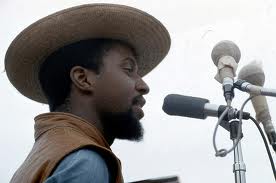
The story of Len Chandler is one of a path taken by chance. Among the  countless singers, students and teachers from coast to coast who sat in, stood up and rode freedom’s highway for the voting rights of their fellow Americans in the Jim Crow South, Chandler had an extraordinary knack for topical songwriting and an unwavering dedication to racial justice. From his home in Akron, to the heart of the Greenwich Village folk scene, Chandler was introduced in short order to humorist Hugh Romney  aka Wavy Gravy, poets Bob Kaufman and Langston Hughes, and folksingers Dave Van Ronk and Bob Dylan. Swiftly recruited by Pete Seeger to join the singing organizers with the Student Nonviolent Coordinating Committee, he was sent to Arkansas to register voters.

“You have to take the lead from somewhere and there were only a few performers around who wrote songs, and of them, my favorite was Len Chandler,” said Dylan. Compiled from rare interviews with Chandler by the author, Denise Sullivan’s concise tribute, Shadow Dream Chaser of Rainbows, pays homage to an unsung folk hero and provides instruction and inspiration for artists and activists pushing for change in perilous times.

This project has been long in the making: It started nearly 20 years ago when I embarked on the research for Keep on Pushing. It was resurrected when I was invited by the Bob Dylan Center to contribute an essay to a proposed catalog, and it was completed with the creation of a small press, Lyon Editions. Your purchase of Len Chandler: Shadow Dream Chaser of Rainbows will not only support its makers, it will contribute toward supporting voting rights and poll watching organizers, specifically in Georgia.

Rest assured Chandler is missed this election season, but let’s vote in his memory and in the memory of Medgar Evers, Viola Liuzzo, James Chaney, Andrew Goodman, Michael Schwerner, Martin Luther King, Jr. and others who lost their lives in the name of civil rights. A vote for Kamala Harris will see to it that the John R. Lewis Voting Rights Advancement Act is passed, ending voter suppression in all its forms, once and for all.

Thank you to our friends at Bird and Beckett Books and Records for the proper launch on August 28 as we commemorated 61 years since the March on Washington for Jobs and Freedom, and one year to the day of the passing of Chandler. Full book talk and discussion here. Purchase books here. Thank you.

Filed under: anti-capitalist, anti-racist, anti-war, Arts and Culture, Black Power,, Bob Dylan, Book news, Books, Civil Rights, Dr. Martin Luther King Jr., Folk, Georgia, Harry Belafonte, income disparity, Keep On Pushing, racism, , , ,

Rest In Power, Len Chandler: Shadow Dream Chaser of Rainbows Died on August 28, 2023

images

As anyone with their eyes on the prize knows, the 60th anniversary of the historic March on Washington for Jobs and Freedom was on August 28, 2023.  Among those assembled to help Dr. King push forward his dream of racial harmony and economic justice was Len Chandler (often overlooked in the history of civil rights work), one of the voices in a trio that day which included Bob Dylan and Joan Baez (Chandler appears at about 17 minutes into the following clip, though the whole 25 minutes is worth your time). Unfortunately, I come here today with a heavy heart to belatedly report that Chandler died at home in Los Angeles, on August 28, 60 years to the day of the march.

It was a blessing to have interviewed Len on several occasions for the purpose of documenting his story. I was invited to the home he shared with his wife Olga James, to break bread with him, and to participate in several community functions and political gatherings where he was still singing for freedom in the 21st Century. My deepest condolences to all who loved him. I did not know him well, but his work has continued to move and motivate me, long after first making contact with him more than a decade ago.

It was hoped that Chandler and I would be visiting the Bob Dylan Center in Tulsa this year, to deliver a panel on singing, songwriting, racial justice and voting rights, to coincide with the publication of my essay commissioned by the Center on Chandler. But none of that was to be. Timing, as it’s said, is everything. And racism is still very much alive, very much afoot in America, 2023.

The following is a repost from my previous posts on Chandler

Chandler would march with Dr. King and travel throughout the South in the name of voter registration, informing rural Southerners of their polling rights, often at great risk to his own life. His poems were recognized by Langston Hughes, he wrote the folk standard “Green, Green Rocky Road” with poet Bob Kaufman, and recorded two albums for Columbia Records, but little is known about him or his life.  I sought out Chandler when I wrote Keep on Pushing, my text that tracks the origins and evolution of freedom music, and its roots in African American resistance and liberation movement.

Originally from Akron, Ohio, and studying on scholarship at Columbia in the ’50s, Chandler made his way to Greenwich Village folk music by accident: Lured to the sounds of Washington Square Park by the downtown youths he was mentoring, he easily fell into the scene with his natural ear for songwriting and his familiarity with the songs of Lead Belly, Big Bill Broonzy, and Woody Guthrie.  Following a performance at the popular Village coffeehouse, the Gaslight Cafe,  Chandler landed a contract to go to Detroit, writing and performing topical songs for local television. A few months later, when he returned to New York, the folk thing was in full swing:  Bob Dylan was the latest arrival to town and the pair started to trade ideas and songs.

“I hadn’t yet begun writing streams of songs like I would, but Len was, and everything around us looked absurd—there was a certain consciousness of madness at work,” wrote Dylan in his book Chronicles.  Chandler remembers it like this in Keep on Pushing:  “The first song I ever heard of Dylan’s was ‘Hey ho, Lead Belly, I just want to sing your name,’ stuff like that.”  Dylan used Chandler’s melody for his song, “The Death of Emmett Till.” “Len didn’t seem to mind,” Dylan wrote.

Chandler went on to record two albums for Columbia:  To Be a Man and The Loving People. He continued to work as a topical songwriter, a peace and civil rights advocate, and as a songwriting teacher; his tour of Pacific Rim bases with Donald Sutherland, Jane Fonda, Holly Near and Paul Mooney was documented in the Francine Parker film, FTA, a must-see for anyone interested in US history and anti-war efforts within military ranks. Catch a glimpse of Chandler at the end of this trailer for the film:

It was an extreme privilege (and I have since found out a rare opportunity) to meet one of the true unsung heroes of singing activism (as well as his wife Olga James, a pioneering performer in her own right), and have him tell his story to me. Though largely retired from performing, he remains well- informed on human rights, politics, and the arts and will step up and step out for civil rights. You can read a portion of our talks in Keep on Pushing, and someday I will post the complete unedited transcripts, though for now, enjoy the voice of Chandler from back in the day, when singing was a huge part of moving the movement forward.

Filed under: anti-capitalist, anti-racist, anti-war, Arts and Culture, Black Power,, California, Civil Rights, Folk, racism, ,

Rest in Power: Sinéad O’Connor

When I heard the news that Sinéad O’Connor died last week, the news was not terribly surprising – people suffer, they take ill, they die. And yet, the depth of my feeling for the world’s loss of such a prophetic, powerful and perfect singer was startling. Though I’m well-familiar with her work and saw her perform live more than once (she was after all a part of the fabric of the ’80s and ’90s popular culture), I think what struck me hardest was how much of her good work for humankind and her general love of the world’s people had gone unnoticed. Here was a God-loving and spiritually devoted singer who had never turned away from her mission to help others, and yet, others had turned away from her time and again.

And then I remembered her turn as the Virgin Mary in Neil Jordan’s film, The Butcher Boy: There was something about her performance that stayed with me, all these years later. I guess what I mean to say is there is no doubt in my mind that someday, future generations will see Sinéad as the visionary, the prophet, the truthsayer and comforter she was; maybe she’ll even be venerated accordingly.

My full remembrance of O’Connor can be read at the link to Tourworthy.

Filed under: anti-capitalist, anti-racist, anti-war, Arts and Culture, Bob Marley, film, Hip Hop, Immigration Reform, income disparity, Nina Simone, Protest Songs, racism, ,

Four Little Girls and Two Songs

On September 15, 1963, four Birmingham, Alabama girls, Addie Mae Collins, Denise McNair, Carole Robertson and Cynthia Wesley, lost their lives during the bombing of the Sixteenth Street Baptist Church.  In 2011, a marker was finally dedicated in their names at the site of the vicious, racially motivated, murderous attack.

Just three months after the murder of Medgar Evers in Jackson, Mississippi, and two weeks after the March on Washington and Dr. King’s momentum-building “I Have a Dream” speech in 1963, the Alabama tragedy became the pivotal event in the Civil Rights Movement. Singer Nina Simone wrote “Mississippi Goddam” in immediate response to hearing the news: “I shut myself up in a room and that song happened,” she said of the song that begins, “Alabama’s got me so upset.” From that moment forward, Simone was committed to writing and performing material that would jolt people awake or into action.  It remains her most enduring work.

Joan Baez had of course walked alongside Dr. King at the marches in the South all along; her tribute was a recording of “Birmingham Sunday” by her brother-in-law, the writer Richard Fariña.  Each girl was remembered by name in the verses, set to the tune of a beautiful folk melody. Fifty-plus years on, both songs remain painful reminders of the brutalities waged by so-called humanity, here and yonder, year in and year out, against women, girls and Black lives.

Filed under: anti-capitalist, anti-war, Arts and Culture, Origin of Song, Protest Songs, racism, , , , , , , , , ,

Writers making change in the pandemic age

This week, and what a week it was, I’m pleased to introduce you to several writers living and working in San Francisco, all of them striving

Poet and activist Thea Matthews in the Mission District on Wednesday, June 3, 2020. (Kevin N. Hume/S.F. Examiner)

toward a more just and equitable society in their own unique ways.  First, poet and activist Thea Matthews is a San Francisco born and raised writer, celebrating the publication of her first poetry collection for a local press. She’s also deeply involved and on the frontlines of the Movement 4 Black Lives. Read more about where she’s been and where she’s going in this week’s San Francisco Examiner column, SFLives.

Also publishing today, a story I was reporting on and off for about five months on the Writers Grotto, a community of authors who found they needed to recreate their organization so that it would be more inviting to writers of color. You can read the full story in today’s San Francisco Chronicle Datebook  (and one day, I promise to a write story about the process of reporting it).

I love my work, seeking out the stories on the lives of the people and places that show San Francisco at its best. What a privilege it is to be trusted to tell these stories and deliver them to you, especially in these times. As ever, I thank you for taking the time to read and I bid the best to you and your families as the pandemic runs its course. May the moral arc of the universe continue its bend toward justice.

Filed under: anti-capitalist, anti-war, Arts and Culture, Black Power,, Books, Poetry, racism, San Francisco News, ,

Two California Women in Conversation

Getting to meet inspiring, creative and intelligent people is probably my favorite part of the job as an independent journalist, editor and curator (aside from doing the writing, of course…). Over the past couple of years, I’ve had the pleasure of working with two extraordinary women, Kim Shuck, a poet/educator/beadworker and Lynell George, a journalist/essayist/photographer. Somewhere along the way and between individual conversations with both of them, I had the idea to get the pair together to talk about the things we seem to talk about most: The changing cityscapes of Los Angeles and San Francisco. Being born Californian and staying here has given Lynell and Kim a deep understanding of the place. I hope you’ll explore their insights and their work, and I invite you to read the conversation, published this month in Boom California, by the University of California Press.

(photo of Kim Shuck by Doug Salin; photo of Lynell George by Al Quattrocchi)

Filed under: Arts and Culture, Book news, Books, California, gentrification, Poetry, racism, San Francisco News, Women's issues, , , , ,

Take Down The Statues

DnEWEbcXoAYf3Kl

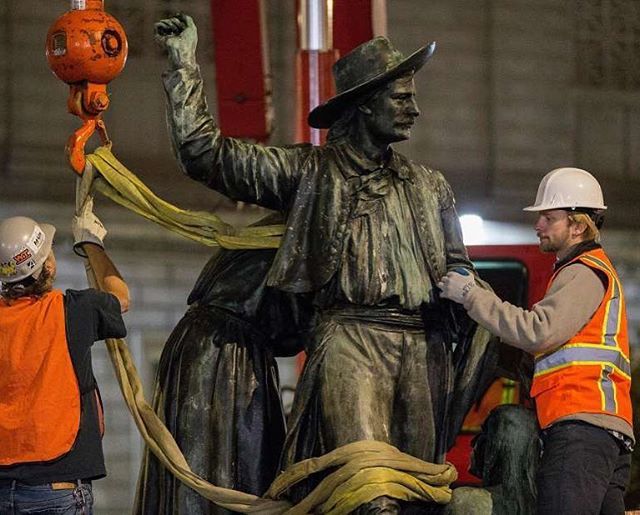
All around the country, bronze statues are coming down, thanks to a movement started in the South in 2015 following the church shooting in Charleston. A city, a whole region, holding on to a vision of the past that was not very honorable in the first place is no way to acknowledge true history or let the generations of people who were harmed by that history heal; instead these megaton renderings glorify injustice and beget more violence. A nation in the middle of a prolonged racial crisis can no longer continue to inflict harm on its citizens and yet, these statues are a daily reminder of how twisted, inaccurate, and dated our history has become.  It’s time for a change.

The movement to unpack and teach a more accurate version of our state’s history has finally reached the far west, where we of course are supposed to understand and know better (yet by and large, I’m sad to report, there are those who still don’t get it).  Here in San Francisco last week, Native American activists and their allies achieved a victory that was 30 years in the making:  The rendering of a piece called Early Days depicting a Spanish conquistador and a Franciscan missionary lording over a Plains Indian (who by the way, was not from this region), was finally removed at the break of dawn following a contentious hearing process. I talked about statuary and other civic concerns with San Francisco’s poet laureate, Kim Shuck, a member of the Cherokee nation as well as a Polish American and a native to San Francisco.  She’s an educator with a masters in fine art and knows well the precedents for public art display; as a Native American, a person of conscience, and a mother, she was personally aggrieved by the sight of the statue as she moved in and out of the public library, her primary place of work as our city’s poet laureate.  And we talked more in-depth about the battle to topple the statue and about her San Francisco life.  I hope you’ll read on and link to this week’s edition of my San Francisco Examiner column, S.F. Lives: READ NOW

Filed under: Arts and Culture, California, Poetry, racism, Tales of the Gentrification City, , , , , , , , ,

The Last Holiday: On Stevie Wonder, Gil Scott-Heron and the MLK Observance They Turned From Dream to Reality

150119092427-restricted-02-mlk-0119-super-169

It was a long road to the third Monday in January when all 50 states observe the birth of Martin Luther King, Jr. and the day named in his honor.  Largely owed for making the dream of a King holiday a reality is Stevie Wonder, who back in 1980, wrote the pointed song, “Happy Birthday,” then launched a 41-city U.S. tour (and invited Gil Scott- Heron along) to promote the idea which was first mooted by Rep. John Conyers in 1968. The musical efforts were ultimately the key in collecting the millions of citizen signatures that had a direct impact on Congress passing the law signed by President Ronald Reagan in 1983, declaring a day for MLK. Observed for the first time in 1986, some states were late to the party, however, by the turn of the 21st Century, all were united in some form of remembrance of the civil rights giant. “Happy Birthday,” which served as the Wonder-campaign theme (and is now the “official” King holiday tune) is  the last track on Hotter Than July. The album also features “Master Blaster,” Wonder’s tribute to Bob Marley (he’d been scheduled for the tour until he fell too ill to participate). Stepping into the breach was Scott-Heron whose 2011, posthumously published memoir The Last Holiday, details his own journey with music and activism, and helps retrace the long and winding road Wonder took to bring home the last US federal holiday, with the help of a song.


The Hotter Than July tour brought Gil and Stevie to Oakland, where they played in the name of King, along with Rodney Franklin and Carlos Santana. In a weird turn of events, the concert on December 8, 1980, coincided with the shocking night John Lennon was killed. The musicians and crew learned of the tragedy from a backstage television; the job fell to Wonder,  with Scott-Heron and the other musicians at his side, to deliver the news to the arena of assembled music fans. “For the next five minutes he spoke spontaneously about his friendship with John Lennon:  how they’d met, when and where, what they had enjoyed together, and what kind of man he’d felt Lennon was,” wrote Scott-Heron.  “That last one was key, because it drew a line between what had happened in New York that day and what had happened on that motel balcony in Memphis, Tennessee, a dozen years before.  And it drew a circle around the kind of men who stood up for both peace and change.”  This year marks the 50th remembrance of Dr. King’s assassination on April 4. Scott-Heron devotes the final pages of The Last Holiday  to a remembrance of how the murder of Lennon fueled the final drive to push for a federal observance of an official MLK Day.

The politics of right and wrong make everything complicated

To a generation who’s never had a leader assassinated

But suddenly it feels like ’68 and as far back as it seems

One man says “Imagine” and the other says “I have a dream”

Filed under: anti-war, Arts and Culture, Black Power,, Civil Rights, Dr. Martin Luther King Jr., Georgia, income disparity, racism, , , , ,

Mumia Abu-Jamal & Matters Of Black Life

I have composed my thoughts about the new book, Have Black Lives Ever Mattered? by political prisoner, Mumia Abu-Jamal. Read the piece by clicking through to Down With Tyranny!
Abu-Jamal’s collection of essays, published by City Lights Books, covers the extrajudicial killings of Black Americans since the late ’90s to the present. The writings are an attempt to examine how the country arrived at its new stage of intolerance and what can be done from here. As told from the perspective of a writer who has spent the last 30 plus years behind bars, and most of those years on Death Row, the analysis proves to have been prescient in its wisdom and precise in its depiction of the US problem with white supremacy and law enforcement’s impunity when it comes to taking Black lives. I hope you’ll let me know what you think.


Filed under: anti-war, Books, income disparity, police, racism, , , , ,

Bob Dylan: Nobel Laureate

620-06-bob-dylan-cover-dylan-portrait-imgcache-rev1421082330863-web

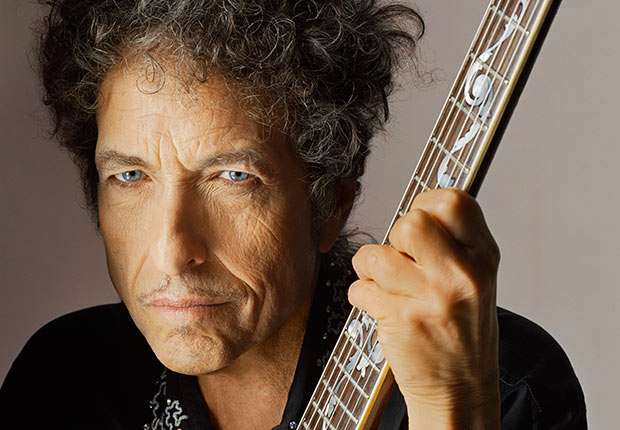
The Thursday morning announcement that Bob Dylan has won the 2016 Nobel Prize in Literature, seems to have struck a raw nerve among (mostly) male novelists and some crabby millennials on social media who were intent on disputing the 75-year-old American songwriter’s worthiness of the honor. We pay no attention to them other than to say, they are entirely wrong: Dylan is a writer the likes of which we will never again see in our lifetimes. That we lived in his time and were able to see him perform his written work just happens to have been our good luck and privilege, an idea suggested by the writer Paul Williams and one I believe should be kept close at hand when the inevitable bashing and clashing continues.

The Nobel committee called Dylan’s work “poetry for the ear,” celebrating him for “having created new poetic expressions within the great American song tradition;” authors Joyce Carole Oates and Mary Karr weighed in with a series of favorable tweets as did the great Salman Rushdie who offered comparisons to Orpheus and Faiz.

Meanwhile author Gary Shteyngart (Absurdistan) used his twisted sarcasm to tweet, “books are kinda gross.” Irvine Welch (Trainspotting) was a little more coarse, and Hari Kunzru (My Revolutions) wins for angriest. That Dylan is a songwriter, and an innately American one, touring during his country’s likeliest darkest hours yet was not enough to stop the novelists’ outbursts: All three were born outside of the USA and are well read here, though none among them have written anything that can remotely compare to the beauty of “Mr. Tambourine Man” and “Visions of Johanna” nor anything as compelling as “Masters of War,” “Ballad of a Thin Man,” “It’s Alright Ma (I’m Only Bleeding)” or “Subterranean Homesick Blues.” Their lyricism has not been likened to that of Keats, Blake, and Shakespeare, like Dylan’s work has been. Of course this is barely scratching the surface of a long list of Dylan-writings, including songs, poems, memoirs and screenplays, and possible reasons for other writers’ grievances. One is tempted to simply list the titles and produce evidence of the full bodied depth and freshness to the work that stretches out following the ’60s and into the ’70s, ’80s and beyond, whether it be the collaborative Desire or high watermarks Infidels and Oh Mercy, or late work like “Not Dark Yet” from Time Out of Mind and “Mississippi” and “Sugar Baby” from the 21st Century magnum opus, Love and Theft, released on September 11, 2001.

Read the entire article at Down With Tyranny!

Filed under: anti-war, Arts and Culture, Bob Dylan, Poetry, Protest Songs, racism,

Archives

Recent Posts

Browse by subject or theme