Denise Sullivan

Author, Arts & Cultural Reporter and Worker

Black History Month: Rosa Parks Meets The Neville Brothers

February 4 is the birthday of Rosa Parks, the rebellious civil rights activist remembered most for refusing to move to the back of the bus: The Montgomery Bus Boycott, in the name of the desegregating public transit, was organized immediately following her arrest on December 1, 1955.

Born Rosa Louise McCauley in Tuskegee, Alabama in 1913, Parks was a student of non-violent protest and an active member of her local chapter of the NAACP in Montgomery. Her refusal to move on the bus that day was not part of any kind of group action or occupation—she held her seat on her own steam–though she knew her rights,  the protocol for civil disobedience, and the possibility of taking an arrest.  In the immediate aftermath of sitting down for racial equality and desegregation, far from receiving any heroine’s awards, Parks paid a price for asserting her right to ride. She could no longer find work in the Montgomery area; she and her husband Raymond moved north, eventually settling in Detroit where she worked the better part of her life as a secretary for US Representative John Conyers.

Parks would one day receive the highest honors in the land– from the NAACP’s Spingarn Medal, to the Presidential Medal of Freedom (awarded to her by President Bill Clinton), and the Congressional Gold Medal. A new political biography of Parks details a life dedicated to seeking justice, from the Scottsboro Boys case to the anti-apartheid movement.

Parks remained particular and protective of her legacy:  She slapped legal actions on filmmakers and recording artists who wished to use her name and likeness, though “Sister Rosa,” a tribute to her by New Orleanians the Neville Brothers, was cleared to appear on their 1989 album, Yellow Moon.  Produced by Daniel Lanois, and accompanied by The Dirty Dozen Brass Band and Brian Eno for the sessions, Yellow Moon is an exceptional record. The band transforms two Bob Dylan songs (“With God On Our Side,” “The Ballad of Hollis Brown”), the Carter Family classic “Will the Circle be Unbroken,” Sam Cooke’s civil rights anthem, “A Change is Gonna Come,” and Link Wray’s “Fire and Brimstone” (title self-explanatory, taken from the guitarist’s obscure and brilliant 1971 album). Standing alongside the Neville Brothers’ bayou-fired originals, “Sister Rosa” is their attempt at rap.

For more information on Rosa Parks, visit the Rosa and Raymond Parks Institute.  For more information on the Neville Brothers, visit their website.

Filed under: cross cultural musical experimentation, Dr. Martin Luther King Jr., Freedom Now, Hip Hop, video, , ,

The Last Holiday: Remembering Dr. MLK, Jr.


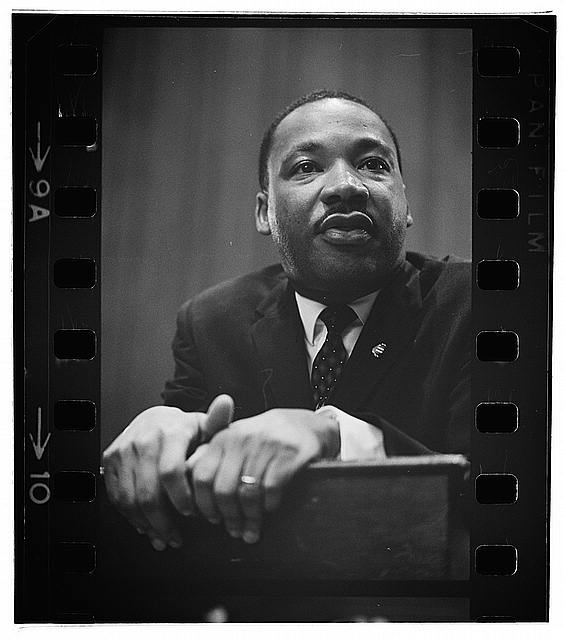
mlkIt was a long road to the third Monday in January when all 50 states observe the birth of Martin Luther King, Jr. and the day named in his honor.  Largely owed for making the dream of a King holiday a reality is Stevie Wonder, who back in 1980, wrote the pointed song, “Happy Birthday,” then launched a 41-city U.S. tour (and invited Gil Scott- Heron along) to promote the idea which was first mooted by Rep. John Conyers in 1968. The musical efforts were ultimately the key in collecting the millions of citizen signatures that had a direct impact on Congress passing the law signed by President Ronald Reagan in 1983, declaring a day for MLK. Observed for the first time in 1986, some states were late to the party, however, by the turn of the 21st Century, all were united in some form of remembrance of the civil rights giant. “Happy Birthday,” which served as the Wonder-campaign theme (and is now the “official” King holiday tune) is  the last track on Hotter Than July. The album also features “Master Blaster,” Wonder’s tribute to Bob Marley (he’d been scheduled for the tour until he fell too ill to participate). Stepping into the breach was Scott-Heron whose 2011, posthumous memoir The Last Holiday, details his own journey with music and activism, and helps retracethe long and winding road Wonder took to bring home the last US federal holiday, with the help of a song.

https://www.youtube.com/watch?v=8lL31NCLeDs
The Hotter Than July tour brought Gil and Stevie to Oakland, where they played in the name of King, as did Rodney Franklin and Carlos Santana. In a weird turn of events, the concert coincided with the shocking night John Lennon was killed. The musicians and crew learned of the tragedy from a backstage television; the job fell to Wonder,  with Scott-Heron and the other musicians at his side, to deliver the news to the arena of assembled music fans. “For the next five minutes he spoke spontaneously about his friendship with John Lennon:  how they’d met, when and where, what they had enjoyed together, and what kind of man he’d felt Lennon was,” wrote Scott-Heron.  “That last one was key, because it drew a line between what had happened in New York that day and what had happened on that motel balcony in Memphis, Tennessee, a dozen years before.  And it drew a circle around the kind of men who stood up for both peace and change.”  Scott-Heron devotes the final pages of The Last Holiday  to a remembrance of how the murder of Lennon fueled the final drive to push for a federal observance of an official MLK Day.

The politics of right and wrong make everything complicated

To a generation who’s never had a leader assassinated

But suddenly it feels like ’68 and as far back as it seems

One man says “Imagine” and the other says “I have a dream”

Filed under: anti-war, Arts and Culture, Books, Civil Rights, Concerts, Dr. Martin Luther King Jr., video, , , ,

The Staple Singers: The Long March on Freedom’s Highway

StapleSinger_cover-450x450In April of 1965, just weeks after the historic marches for voting rights across Alabama, the Staple Singers convened at a South Side Chicago church for a service dedicated to the marchers. The resulting live album, Freedom Highway, has since become a recorded classic, merging soul-solid messages and spirit-rising music. Long out of print, it was reissued in an expanded edition this week to coincide with the 50th anniversary of the Selma marches, though its gospel-sung dreams of justice for all are yet to be won.  Read my full review at Blurt online.

Filed under: Civil Rights, Concerts, Dr. Martin Luther King Jr., Freedom Now, Gospel, Reviews, Roots of Rock'n'Soul, , , , ,

MLK: The Last Holiday

01269r-1“In the end we will remember not the words of our enemies but the silence of our friends.” –Martin Luther King, Jr.

This weekend I joined hands with Down With Tyranny! to present a series of guest blogs. Following a bit of background on the creation of the King holiday by a musician, I write a little about the music in the extraordinary film, Selma, and direct listeners to the old songs that still sing out strong during the current justice movement afoot in the US.

Yesterday’s post concerns the State of San Francisco following last week’s mayoral address.  Tuesday will feature an everyday story of gentrification and how it is impacting the lives of two working people here in town.

Wishing you peace and enjoyment of this day of service.

Filed under: anti-war, Arts and Culture, Civil Rights, Dr. Martin Luther King Jr., Freedom Now, , , ,

We’re On The Freedom Side

There’s a new version of the labor standard, “Which Side Are You On?” going around: Sung at the Black Lives Matter and Blackout Coalition actions, it’s also been used as the intro and outro marching song at some of the Black Brunch protests.

Malcolm X was a freedom fighter
And he taught us how to fight
We go’n’ fight all day and night
Until we get it right
Which side are you on, my people? Which side are you on?

https://www.youtube.com/watch?v=xTVUKexfro0

In the early ’30s when the United Mine Workers of America began to organize around Eastern Kentucky (in an effort to end practices like payment in scrip and pay docking toward rent in substandard housing) it was Florence Reece, a Kentucky miner’s daughter and wife who wrote the original lyrics to “Which Side Are You On?”.  It remains a labor movement standard.

They say in Harlan County
There are no neutrals there
You’ll either be a union man
Or a thug for J.H. Blair

Blair was the sheriff who rousted Reece’s family during the strike among Harlan County mine workers, just one of the struggles which contributed toward the region earning its nickname “Bloody Harlan County.”   In the ‘70s, workers struck again and Reece reprised the song for striking miners (preserved in this clip from Barbara Kopple’s Academy Award-winning documentary, Harlan County U.S.A.).

https://www.youtube.com/watch?v=WYr09q9dHSo

The song’s melody is said to be based on a hymn, “Lay the Lily Low.” Some researchers believe it is the same song that forms the basis for the traditional “Jack-a-Roe,” (also known as “Jack Munro”), its best-known version performed by the Grateful Dead. But I think that somewhere in the Kentucky mountains, singers have been intoning this strange melody for hundreds of years, its deep minor tones more reminiscent of the mystic drone of a Gregorian chant than anything known to folk or gospel. Whatever its melody’s true origins, “Which Side Are You On?” was first repurposed during the Civil Rights Movement by topical singer-songwriter Len Chandler (you can hear his recorded version on the album, WNEW’S Story of Selma).

Come all you Northern liberals,
Take a Klansman out to lunch
But when you dine instead of whine
You should serve nonviolent punch
Which side are you on? Which side are you on?

Chandler told me his story, of how he came to be a topical singer in Greenwich Village, then moved on to marching with Dr. King from, Selma to Montgomery (he appears in archival footage in the new film, Selma). “I’d write a song like that and then I’d be singing it in a mass meeting that night. People would be playing and singing for forty five minutes, until you were just worn out,” he said. Fifty years later, he remains in pursuit of social justice through action and song (Chandler’s full story appears in Keep on Pushing). I learned from listening to Chandler’s songs and to his songtalk, and by studying the work of freedom singers like Odetta, Bernice Johnson and voting rights activist Fannie Lou Hamer, that group singing among activists gives people who may start the night as strangers a chance to bond. Communing over songs, we become more bound to purpose. Singing together is energizing, nourishing, and feeds the spirit; it provides strength to move forward, together as one. But group singing for justice serves a further purpose beyond what some mock as a moment to join hands and sing “Kumbaya”:  In the fight for non-violence, singing has the ability to disarm.

Hamer practiced the power of song when she sang alongside Chandler and other SNCC volunteers at the mass meetings and marches, through her representation of the Mississippi Freedom Democratic Party at the 1964 Democratic Convention and on to the passage of the Voting Rights Act of 1965. Women at the forefront of workers organizing, who’ve pushed for voting and employment rights, and led the fights to end war, poverty, and racism across the planet all know well the power of song: Whether Hamer, Reece, or Ani DiFranco (who updated the song in 2012 then titled her collection of socially conscious songs, ¿Which Side Are You On?) or the Black Lives Matter and Blackout Coalition organizers, women are allied in a long and storied legacy of traditional and gospel song.  With songs we have contributed to toppling apartheid in South Africa, had voting rights granted in the US, fought warlords in Liberia and begun to make corrections to the broken justice system in the USA. With songs that have traveled the road from blues to hip hop, we will continue toward freedom for all people. It’s good to hear the timeless soundtrack to justice making a comeback. Now, which side are you on?

Filed under: anti-war, Civil Rights, Coal Mining Songs, Dr. Martin Luther King Jr., Origin of Song, , , , , ,

The King of Love

“Somewhere I read of the freedom of assembly. Somewhere I read of the freedom of speech. Somewhere I read of the freedom of the press. Somewhere I read that the greatness of America is the right to protest for right,” said Dr. King in his final speech, delivered on April 3 to striking sanitation workers in Memphis, Tennessee. The following day, April 4, the civil rights leader, winner of the Nobel Peace Prize, and beloved hero to millions around the world, was shot to death on the balcony of the Lorraine Motel. Forty-eight years later, the work of non-violent protest in the name of desegregation, voting rights, racial harmony, jobs, freedom, opportunity, and an end to wars, is carried on by an international community of civil rights advocates and human rights and anti-war activists. Among the musical tributes in response to the tragedy were Dion’s popular “Abraham, Martin and John,” Otis Spann’s less-known “Blues for Martin Luther King, ” and Nina Simone’s enduring and emotional “Why (The King of Love is Dead),” first performed in his memory on April 7, 1968, the national day of mourning following the assassination. For further reflection on Dr. King’s message of love, please start with the The King Center archives, dedicated to the non-violent eradication of poverty, racism and violence.

Filed under: Dr. Martin Luther King Jr., Keep On Pushing, Nina Simone, “I’ve Been to the Mountaintop”, “Why (The King of Love is Dead)”, April 4 1968, Memphis TN, Striking Sanitation Workers

Filed under: Dr. Martin Luther King Jr., Freedom Now, income disparity, Keep On Pushing, Never Forget, Nina Simone, Protest Songs, , , , ,

History: Rosa Parks Born Today

February 4 is the birthday of Rosa Parks, the civil rights activist remembered for refusing to move to the back of the bus: The Montgomery Bus Boycott, in the name of the desegregating public transit, was organized immediately following her arrest on December 1, 1955.

Born Rosa Louise McCauley in Tuskegee, Alabama in 1913, Parks was a student of non-violent protest, an active member of her local chapter of the NAACP in Montgomery and a great admirer of both Dr. King and Malcolm X; her refusal to move on the bus that day was not part of any kind of group action or occupation—she held her seat on her own steam. And yet far from receiving any heroine’s awards, Parks paid the price for asserting her right to ride: In the immediate aftermath of the desegregation effort, she could no longer find work in Montgomery.  She and her husband Raymond moved north, eventually settling in Detroit where she worked the better part of her life as a secretary for US Representative John Conyers.

Parks would one day receive the highest honors in the land– from the NAACP’s Spingarn Medal (Harry Belafonte was honored in 2013), to the Presidential Medal of Freedom (awarded to her by President Bill Clinton) and the Congressional Gold Medal.  And if you dared to mess with the Mother of the Modern Day Civil Rights Movement and her legacy in a movie or a song, look out:  Parks was known for slapping down artists with legal actions and launching her own boycotts against them. But there was one song that met Ms. Parks’ high standards: “Sister Rosa,” a tribute to her by New Orleanians the Neville Brothers, appeared on their 1989 album, Yellow Moon.  Produced by Daniel Lanois, and accompanied by The Dirty Dozen Brass Band and Brian Eno for the sessions, Yellow Moon is an exceptional record, even by the Nevilles’ own high standard: Produced by Daniel Lanois, the band transforms two Bob Dylan songs (“With God On Our Side,” “The Ballad of Hollis Brown”), the Carter Family classic “Will the Circle be Unbroken,” Sam Cooke’s civil rights anthem, “A Change is Gonna Come,” and Link Wray’s “Fire and Brimstone” (title self-explanatory, taken from the guitarist’s obscure and brilliant 1971 album). Standing alongside the Neville Brothers’ bayou-fired originals, “Sister Rosa” is their attempt at rap.

Parks passed in 2005, though matters of her personal estate have not been resolved and her detailed personal archive has not yet found a permanent home.  She would’ve been 101 this year.  For more information on Rosa Parks, visit the Rosa and Raymond Parks Institute.

Filed under: Civil Rights, cross cultural musical experimentation, Dr. Martin Luther King Jr., Freedom Now, Hip Hop, Malcolm X, Never Forget, Uncategorized, video, , , ,

RIP Pete Seeger (1919-2014)

The folksinger, activist, songcatcher, banjo-picker, environmentalist, family man and non-violent resistor Pete Seeger was inspiration and forbear to any man or woman who uses their songs for economic and social justice—and doesn’t ever stop. Persecuted for his beliefs by federal law enforcement, the House Un-American Activities Committee and the public, he pressed on to become the greatest singing activist of our time.  “These days my purpose is in trying to get people to realize that there may be no human race by the end of the century unless we find ways to talk to people we deeply disagree with,” Seeger told his biographer Alec Wilkinson, author of The Protest Singer. “Whether we cooperate from love or tolerance, it doesn’t much matter, but we must treat each other nonviolently.” Seeger will be an irreplaceable force on the protest scene, not only for his songs and actions, but for his pure belief in the promise that we shall overcome someday.

Filed under: anti-war, Arts and Culture, Bob Dylan, Buffy Sainte-Marie, Civil Rights, Dr. Martin Luther King Jr., Environmental Justice, Folk, Freedom Now, Immigration Reform, Latino culture, Never Forget, Obituary, Occupy Wall Street, Protest Songs, Songs for the Occupation,

In The Name of MLK

mlkIn one of those weird, under-reported facts, the origin of the third Monday in January when all 50 states are set to observe the birth of Dr. Martin Luther King, Jr. (January 15, 1929) is not widely acknowledged, but it is in fact a musician we may largely thank for the creation of a federal holiday in the name of MLK.  Back in 1980, Stevie Wonder wrote his pointed song “Happy Birthday,” then launched a 41-city U.S. tour (and invited Gil Scott- Heron along) to promote an idea first mooted by Rep. John Conyers in 1968. The city to city tour was ultimately the key in collecting the millions of citizen signatures which had a direct impact on Congress passing the law signed by President Ronald Reagan in 1983, declaring the day for MLK. Of course it took some more years, more activist effort, more songs, and more applied pressure for the idea to catch on and the day to become a reality.

“Happy Birthday,” which served as the Wonder-campaign theme (and is now the “official” King holiday tune) is the last track on Wonder’s Hotter Than July album which also features “Master Blaster,” his tribute to Bob Marley.  The reggae giant was also scheduled for the tour until he fell too ill to participate. Stepping into the breach was Scott-Heron whose 2011, post-humously published memoir, The Last Holiday, details his own journey with music and activism; he retraces the long and winding road Wonder took to bring home a US federal holiday with the help of a song.  In a a strictly horrific twist of fate, the tour brought Gil and Stevie to Oakland, California, where they were playing in the name of King (as did Rodney Franklin and Carlos Santana) on the night John Lennon was assassinated.  The story of the evening is better read in Scott-Heron’s book, though here’s a clip of Wonder delivering the news to the assembled crowd, back in the time before we carried our own tracking devices.

Observed for the first time in 1986, some states were late to the party, however, by the turn of the 21st Century, all were united in some form of remembrance. On Monday January 20, cities all across the country will attempt to honor Dr. King’s dream the best they can, given our nation’s state of economic and moral poverty.  In King’s birthplace of Atlanta, Georgia,  the King Center, has a full weekend schedule of events culminating on Monday (the King Center’s events are dedicated to discussing and teaching non-violence). In San Francisco on January 20, there is an all-day celebration of King’s life, its theme Now is the Time, at Yerba Buena Center for the Arts from 11 a.m. — 5 p.m. Among the events scheduled are author readings sponsored by Marcus Books, America’s oldest black-owned bookstore engaged in a final push to preserve culture and community in the City’s historic Fillmore District. San Francisco is generally struggling with displacement of its African American population, as well as other issues related to the City’s techsploitation of housing and services. City of Santa Monica hosts Southern California’s largest King Day event; this year’s theme is Unity in the Community. I am permanently dumfounded by the American shame that is Skid Row LA:  Just spitting distance from the unfathomable displays of wealth that define Beverly Hills, Hollywood and the Westside, human life and dignity are compromised there everyday.

Much like Dr. King’s vision, justice and equality in our democracy remain very much a dream. But wherever we go, whatever we do that day, let us not only continue to dream of love and peace, but to take an action toward eradicating poverty, eliminating racial injustice, and loving our fellows, in the name of MLK.

Filed under: anti-war, Arts and Culture, Bob Marley, Concerts, Dr. Martin Luther King Jr., Georgia, income disparity, Origin of Song, , , , , , ,

Anybody Here?

http://www.youtube.com/watch?v=rGKnrBP8ARY

“Abraham, Martin and John” was written by Dick Holler and first released by Dion (DiMucci) in 1968. Neither Holler nor DiMucci were known for being particularly political in their music, but the assassination of Robert Kennedy inspired the question, delivered in a song.

Smokey Robinson and Marvin Gaye also recorded “Abraham, Martin and John.” Here’s a clip of Robinson singing it at the White House, followed by Gaye’s version, featuring full text of the lyrics.

Countless artists have performed or recorded variations on the song and it has more than once reached the charts; comedian Moms Mabley took it to number two. For those seeking further illumination on the relationship between the Kennedy brothers and Black America, read this.

Though the assassinations are no mystery, and 50 years later the grief lingers on,  liberty and justice await, and hope is still awake in the song.

http://www.youtube.com/watch?v=mobZZRcrCHA

Filed under: Arts and Culture, Dr. Martin Luther King Jr., video, , , , , , ,

Archives

Recent Posts

Browse by subject or theme