The folksinger, activist, songcatcher, banjo-picker, environmentalist, family man and non-violent resistor Pete Seeger was inspiration and forbear to any man or woman who uses their songs for economic and social justice—and doesn’t ever stop. Persecuted for his beliefs by federal law enforcement, the House Un-American Activities Committee and the public, he pressed on to become the greatest singing activist of our time. “These days my purpose is in trying to get people to realize that there may be no human race by the end of the century unless we find ways to talk to people we deeply disagree with,” Seeger told his biographer Alec Wilkinson, author of The Protest Singer. “Whether we cooperate from love or tolerance, it doesn’t much matter, but we must treat each other nonviolently.” Seeger will be an irreplaceable force on the protest scene, not only for his songs and actions, but for his pure belief in the promise that we shall overcome someday.
The story of Chicago’s 15-year-old Emmett Till (born today in 1941), murdered while on summer vacation in Money, Mississippi, was among the events in the mid-‘50s that mobilized the Civil Rights Movement; the tragedy was chronicled by Bob Dylan in one of his earliest songs. This clip contains a bit of background as well as the audio of the song which tells the story.
Following the recent events in Florida, where George Zimmerman was acquitted of the murder of Trayvon Martin, the names Emmett Till, as well as slain NAACP field secretary Medgar Evers have been invoked by civil rights leaders. It is unthinkable, though entirely possible, that a generation of young folk are unfamiliar with these names, icons of the civil rights movement that marched on, throughout the South and toward Washington in the Summer of ’63. But there remains similarities in the cases: Like the families of Till and Evers, in the face of extreme tragedy, Martin’s mother, Sybrina Fulton, and his father Tracy, are working with the civil rights communities for justice. And like Till and Evers, the death of Trayvon Martin has moved artists to tell his story, in an effort to increase knowledge and inspire action. Here are but two, “Trayvon” by Jasiri X, and “Justice (If You’re 17)” by Wyclef Jean.
In this 50th anniversary year of Freedom Summer and the March on Washington, while we at once celebrate a victory for same sex couples across the country, we must mourn the return to states rights and the constricting of voting and women’s rights down South, as well as the injustice of the trial in Florida and ridiculous Stand Your Ground laws. Young men of color remain especially at risk of racial profiling, targeted and incarcerated in vastly disproportionate numbers. As the California prison hunger strike (protesting torturous conditions of solitary confinement) now in its third week continues, while overseas US drones hunt and kill innocent people mercilessly, “the conversation on race” is having its moment in the media spotlight. We must insist it continue and on Freedom Now, as the generations of our parents and grandparents did. Deep in my heart, I do believe, there is a song waiting to be written and sung at this year’s March on Washington.
If you can’t speak out against this kind of thing, a crime that’s so unjust
Your eyes are filled with dead men’s dirt, your mind is filled with dust…
…But if all us folks that thinks alike, if we gave all we could give
We could make this great land of ours a greater place to live.
When 80,000 barrels of oil spilled into the waters of the Santa Barbara Channel in January of 1969, the crude-splattered water, beaches, and birds along the California coast in its aftermath became the symbols of modern eco-disaster. While the ensuing public outcry helped hasten the formalization of the environmental movement as we now know it, for musician Van Dyke Parks, the spill and “the revelation of ecology,” as he calls it, was a very personal, life-altering occasion. “It changed my M.O. and changed my very reason for being,” he says. The Union Oil rig rupture in Santa Barbara made Parks go calypso.
“When I saw the Esso Trinidad Steel band, I saw myself in a Trojan Horse,” he says. “We were going to expose the oil industry. That’s what my agenda was. I felt it was absolutely essential.” From 1970 to 1975, Parks waged awareness of environmental and race matters through the music and culture of the West Indies, though in the end, “You don’t know whether to laugh or cry. That’s what makes Van Gogh go,” he says, “That’s what great art does.” Though Parks is referring directly to Esso Trinidad’s happy/sad steel drum sounds, he could just as easily be talking about his own experience during his Calypso Years.
My interview with Van Dyke Parksoriginally appeared in the pages of Crawdaddy! in 2009. Four years later, the story of one man’s adventures in art and activism The Day Van Dyke Parks Went Calypso, remains the most most-read and most searched piece here at denisesullivan.com. Parks had a goal and an idea ahead of its time: To forge environmental healing through music made by instruments made of cast-off oil drums. Read the full story here or at the link above. And happy Earth Day.
February 4 is the birthday of Rosa Parks, the civil rights activist remembered for refusing to move to the back of the bus: The Montgomery Bus Boycott, in the name of the desegregating public transit, was organized immediately following her arrest on December 1, 1955.
Born Rosa Louise McCauley in Tuskegee, Alabama in 1913, Parks was a student of non-violent protest and an active member of her local chapter of the NAACP in Montgomery, but her refusal to move on the bus that day was not part of any kind of group action or occupation—she held her seat on her own steam. And yet far from receiving any heroine’s awards, Parks paid the price for asserting her right to ride: In the immediate aftermath of the desegregation effort, she could no longer find work in Montgomery. She and her husband Raymond moved north, eventually settling in Detroit where she worked the better part of her life as a secretary for US Representative John Conyers.
Parks would one day receive the highest honors in the land– from the NAACP’s Spingarn Medal (Harry Belafonte will be honored this year), to the Presidential Medal of Freedom (awarded to her by President Bill Clinton) and the Congressional Gold Medal. But if you dared to mess with the Mother of the Modern Day Civil Rights Movement and her legacy in a movie or a song, look out: Parks was liable to slap you with a legal action or a boycott. “Sister Rosa,” a tribute to her by New Orleanians, the Neville Brothers, appears to have passed the test (though atypically for the Nevilles, it’s a rap track, taken from their 1989 album, Yellow Moon).
Parks passed in 2005, though matters of her personal estate have not been resolved and her detailed personal archive has not yet found a permanent home. She would’ve been 100 this year. For more information on Rosa Parks, visit the Rosa and Raymond Parks Institute.
Following an incantatory opening by Jorge Molina, Shaman of the Mission, remarks by poetic elder, Roberto Vargas, and a performance by Dr. José Cueller (also known as musician Dr. Loco), Murguía took the stage on Sunday at the San Francisco Public Library’s Koret Auditorium.
“I learned to read in workingman cafes,” he said, as he offered his appointment to the community—those who read before him, the poets of the here and now, and the voices of the future. He read his poems “16th and Valencia,” “Lorca’s Dream,” and “The Poet Recalls His First Reading,” among other vivid, humorous, and moving bits and pieces.
Born in the US but living in Mexico until age six, Spanish is his native tongue, though childhood trauma left him speechless for a spell. He claims his first English words were “Pepsi, please,” ironic given his concerns as a poet and activist. As a young man and new arrival from the southland, Murguía was embraced by North Beach poets Lawrence Ferlinghetti, Jack Hirschman, Allen Ginsberg, Gregory Corso and Bob Kaufman; his compañeros were the writers (like Ishmael Reed, Janice Mirikitani and Jessica Hagedorn) of Asian, Black, Latino and Pacific Islander heritage who were part of the Bay Area’s cultural empowerment movements of the ‘60s and early ‘70s.
In addition to his home among the Beats in North Beach and the poets of progress and resistance, Murguía fell into La Mission: The district became his cultural home, the place where he made lifelong friends, got politicized and became a fixture in the neighborhood. He was among the founders of the Mission Cultural Center, preserving and promoting Latino arts, and those of the area’s indigenous people. However, Murguía is not just a Latino poet—he embraces his post as poet laureate as an opportunity to serve all of the city’s people.
“From this day forward, we will no longer speak of parallel histories but of a literary history and true history of San Francisco, punto final,” he said. He would like to see San Francisco officially adopt the slogan, The City of Poets, and he suggests that we would all benefit from poetry workshops (but especially those in governance would benefit from studying the relationship between words and the truth, so to speak). Reminding listeners that poetry is a form best read aloud, he encouraged the reading not only of our own work, but of poems written by others. I once heard him read with tremendous impact from Ishmael Reed’s Flight to Canada. Here’s the clip:
It was a long road to the third Monday in January when all 50 states will observe the birth of Martin Luther King, Jr. and the day named in his honor in their own unique ways. Largely owed for making the dream of a King holiday a reality is Stevie Wonder, who back in 1980, wrote the pointed song “Happy Birthday,” then launched a 41-city U.S. tour (and invited Gil Scott- Heron along) to promote the idea which was first mooted by Rep. John Conyers in 1968. The musical efforts were ultimately the key in collecting the millions of citizen signatures that had a direct impact on Congress passing the law signed by President Ronald Reagan in 1983, declaring a day for MLK. Observed for the first time in 1986, some states were late to the party, however, by the turn of the 21st Century, all were united in some form of remembrance of the civil rights giant. “Happy Birthday”, which served as the Wonder-campaign theme (and is now the “official” King holiday tune) is the last track on Hotter Than July. The album also features “Master Blaster”, Wonder’s tribute to Bob Marley who had been scheduled for the tour until he fell too ill to participate. Stepping into the breach was Scott-Heron whose 2011, post-humously published The Last Holiday, details his own journey with music and activism, while it retraces the long and winding road Wonder took to bring home a US federal holiday with the help of a song. The tour brought Gil and Stevie to Oakland, where they played in the name of King, as did Rodney Franklin and Carlos Santana, on the shocking night John Lennon was killed (though that is a story better read in Scott-Heron’s memoir).
In King’s birthplace of Atlanta, Georgia, the King Center, has a full schedule of events currently underway; the celebrations and various symposiums are of course dedicated to the King’s teachings in non-violence. In San Francisco on January 21, there will be an all-day celebration of King’s life at Yerba Buena Center for the Arts from 11 a.m. — 5 p.m. The City of Santa Monica also has a full weekend schedule of events beginning on Friday. The photo above was of course taken during the historic “I Have a Dream” speech, delivered on August 28, 1963 at the March on Washington now in its 50th anniversary year. Had he lived, Dr. King would’ve been 84 today—and still dreaming.
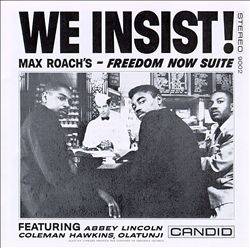
Two albums credited for fusing the politics of black liberation with the sound of freedom are Sonny Rollins’s Freedom Suite—the first experiment in 1958—and We Insist! Max Roach’s Freedom Now Suite— the fulfillment of the form. Born for the record in rural North Carolina on January 10 (by his family’s recollection it was the 8th) 1924, and raised in Bedford-Stuyvesant, Brooklyn, Roach was not only an innovative drummer who revolutionized jazz rhythms, he was actively engaged as a civil rights advocate and performed frequently for the cause. His Freedom Now Suite was initially conceived as a performance piece to coincide with the fast-approaching centennial of the Emancipation Proclamation in 1963: Fifty years later, as the historic document that freed all slaves celebrates its 150th anniversary, Roach’s piece with vocals by his then-wife Abbey Lincoln, (with Coleman Hawkins on sax, Olatunji on congas and lyrics by Oscar Brown Jr.) sounds as radical as the ’60s revolution in words and sound it helped to launch.
The cover art, in bold black and white, was groundbreaking graphic and image-wise in its depiction of three African American men at a lunch counter, a white waiter standing by, a reference of course to the sit-in on February 1, 1960 at a Greensboro, North Carolina Woolworth’s store that became a pivotal action in the non-violent fight for civil rights. But inside the cardboard sleeve, the vinyl grooves were an assault on the senses, capturing as they did the sound of exploitation, degradation, and ultimately, freedom. A sonically and politically strong statement, the Freedom Now Suite is a cornerstone recording in the history of contemporary black liberation music and remains a challenging, invigorating, and inspiring listen for anyone interested in such things. Making a link between the oppression of blacks throughout the world, Roach and other politically motivated American artists like Harry Belafonte and Nina Simone sought to parallel the civil rights movement in the US with the unfolding liberation of Kenya, Ghana, Congo, and Algeria. Dubbed the Year of Africa, 1960 held hope for the continent for independence from France, Britain, and Belgium and the promise that human rights, dignity, and economic health would be restored throughout the land. Fifty-three years later, the people here and there continue the fight for human rights, and the chance to be emancipated from the conditions of poverty, ill-health, environmental crisis, and violence that defines both our lands, while Freedom NowSuite still pounds out the sound of impending liberation.
The following clip depicts civil rights power couple Max Roach and Abbey Lincoln with their band performing the suite’s “Triptych (Prayer/Protest/Peace)” on Belgian television in 1964. Roach passed in 2007, though in his lifetime he he’d been a recipient of the USA’s MacArthur genius award, a commandeur in France’s Ordre des Artes et les Lettres, and a RIAA (Grammy) honoree. Read more on both Rollins, Roach, and their respective Freedom Suites in Keep on Pushing.
Everybody’s humming “Keep On Pushing” again, thanks to it being the soundtrack to a new ad, but there are a few details that even LeBron’s smart phone doesn’t know about the wonderful song that also stands in for the title of my book concerning political movement and music.
Among the young songwriters who knew the power of an anthem and made the Freedom Movement swing was Curtis Mayfield of Chicago. Just 17 and straight out of the Cabrini-Green housing projects when he hit it big with “Your Precious Love,” recorded by his vocal group the Impressions, Mayfield was a highly conscious, conscientious, and musicially gifted individual. By the early ‘60s he had already sustained the departure of his childhood gospel choir buddy, Jerry Butler, from the group and was leading Samual Goodens and Fred Cash on his own as he became a formidable writer of inspirational R&B hits.
The Impressions captured the ephermeral spirit of gospel’s lift and married it to Mayfield’s layered melodies with a message. In 1964 Mayfield came up with the black-powered “Keep on Pushing,” its sentiment and language borrowed from a gospel groove and easily adapted to the civil rights cause: “Hallelujah, hallelujah, keep on pushing.” “Keep on Pushing” was in perfect synch with Dr. King and the march forward; it has been characterized as one of the movement’s unofficial anthems. “Move up a little higher,” “I’ve got my strength,” “keep on pushing,” all phrases from the song, also borrowed from gospel’s language and its inspirational intent. These were elements that never strayed far from Mayfield’s consciousness, and combined with the melodious strains to which he set his words, he could disguise the tougher sentiments by weaving them into the complex harmonies, while never losing the threads. As time went on, Mayfield became more direct lyrically, but these early works were foundational to setting soul music in its new direction while they also passed in the mainstream.
The Impressions album Keep on Pushing was a Top 10 hit, making its impression on the masses as well as on two major 20th Century songwriters: Bob Marley had begun performing with his vocal group the Wailers in Kingston Jamaica, as if they were their country’s answer to the Impressions. “Amen” and “I Made a Mistake” from Keep on Pushing were an important part of their early repertoire. In 1965, Bob Dylan featured a picture of Keep on Pushing on the cover of his own album, Bringing It All Back Home. That same year, the Impressions hit again with “People Get Ready,” a song Mayfield was first inspired to get busy on following the March on Washington; it ultimately became the song for which he would be best known. “When humans from all walks of life can experience a piece of music and feel the same way—that’s soul,” he once said. Fifty years later, “People Get Ready” and “Keep on Pushing” are still turning heads and inspiring people to singalong, though sadly Mayfield is gone. Following a distinguished career as a groundbreaking solo recording artist and performer, Mayfield became paralyzed as a consequence of an in-concert accident (a lighting rig fell on him). He still wrote, but didn’t perform; he died the day after Christmas in 1999 of complications from diabetes.
You can read more on Curtis Mayfield and “Keep on Pushing” in Keep on Pushing. And next time you see that LeBron spot, I hope you enjoy the Curtis song just a little bit more.
Amoeblog: There’s a lot of “Keep On Pushing” titled songs. Which one were you thinking of when you titled your book?
Denise Sullivan: I was thinking of the original song by the Impressions, written by Curtis Mayfield and the way “keep on pushing,” and “move up a little higher” reoccur in his other songs, like “We’re a Winner” and “Move on Up.” Mayfield isn’t talking about the ladder of success and financial status. He’s talking about raising consciousness and about transcendence–about moving above and beyond circumstances. Combine those themes that are of deep interest to me with the genius of his composition and you get a title that I hope conveys the potential for extreme unity, between message, music and people.
There is a section in Keep on Pushing which addresses how the songs of black power made way for the songs of liberation of other oppressed groups: women, homosexuals, brown, yellow, and red folks, as well as the disabled. At our Keep on Pushingevents over the last 12 months, Cindy Lee Berryhill has been among the musicians accompanying me at readings, singing the songs of freedom and pitching in with anti-war and other anthems. Her song, “Make Way For the Handicapped,” is meant to empower those with missing parts—or anyone who feels unaligned and out of sorts, I suppose. Personally, I have a new appreciation for the song by Berryhill and her old bandmate Max W. Temporarily impaired due to injury, I am relying heavily on the three limbs that are still able, and the kindness of new friends and neighbors as I hobble down the street. New to a culturally diverse neighborhood, it’s a bit of a sociological experiment to observe how people are taking to me, the gimpy new gal. There are those who avert their eyes, while others will nod or say hello as they pass by, leaving me in the dust. And then there are those who’ve got California soul; they see beyond skin color and age and physical disability; they see a member of the human race who’s falling behind. “That looks like hard work on a hill. If you’re going a short distance I could give you a ride—I have a dog,” said the young man apologetically. He was wearing a wool cap, likely on his way to work—general contracting by the looks of his truck. “I’d take you up on it,” I told him, “But I need to learn how to use these things,” motioning with my crutch. And that was how it went, in a matter of about 30 seconds. But that simple gesture made by a stranger turned my day around. Later in the afternoon, a bank teller intercepted me as I walked toward the line, offered me a seat, and suggested I take one of the candies from a dish on his desk. “Sometimes a sweet makes the day a little nicer” he said. I couldn’t disagree and grabbed a lemon Dum Dum. So thank you, wool hat guy, and thank you bank teller. I am grateful to you for your kindnesses. Now here’s that song by Cindy Lee Berryhill (with Lenny Kaye on guitar) I was talking about:
Hats off to West Coast artists Tom Morello, Jello Biafra and Michelle Shocked for joining Lee Ranaldo and Co.at New York’s Foley Square Park last Sunday for the kick off of the one year anniversary week of Occupy. Shocked performed “99 Ways to Loathe Your Lender,” sung to the tune of Paul Simon’s “50 Ways to Leave Your Lover.” Though Shocked discourages filming of her shows, I hope she won’t mind that I found a barely viewed clip of her performing it (she follows Biafra’s spoken word piece). The protest standard, “Which Side Are You On,” was performed as a singalong (it’s as close as any song the movement has to an official anthem). Happy Anniversary Occupy, and thank you to the Occupiers and musicians who represent the 99 percent.

 inspiration and forbear to any man or woman who uses their songs for economic and social justice—and doesn’t ever stop. Persecuted for his beliefs by federal law enforcement, the House Un-American Activities Committee and the public, he pressed on to become the greatest singing activist of our time. “These days my purpose is in trying to get people to realize that there may be no human race by the end of the century unless we find ways to talk to people we deeply disagree with,” Seeger told his biographer Alec Wilkinson, author of The Protest Singer. “Whether we cooperate from love or tolerance, it doesn’t much matter, but we must treat each other nonviolently.” Seeger will be an irreplaceable force on the protest scene, not only for his songs and actions, but for his pure belief in the promise that we shall overcome someday.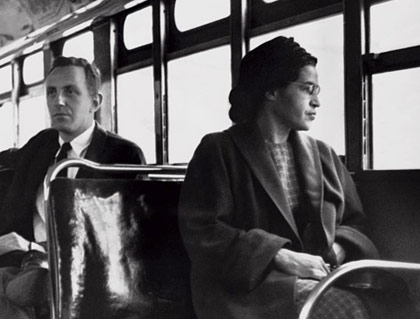




 Denise Sullivan