
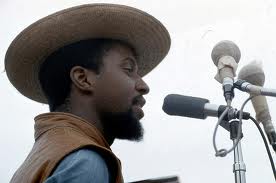
photo of Len Chadler at the 1964 Newport Folk Festival by John Rudoff.
August 28 marks the 49th anniversary of the the historic March on Washington for Jobs and Freedom. Among those assembled to help Dr. King push forward his dream of racial harmony and economic justice on that day was Len Chandler, one of the voices in a trio that included Bob Dylan and Joan Baez. Chandler would march with Dr. King and travel through out the South in the name of voter registration, informing rural Southerners of their polling rights, at risk to his own life. It was a now-vanished YouTube clip of Chandler’s inspirational performance of “Eyes on the Prize” that contributed to inspiring me to track him down and move forward with the writing of Keep on Pushing, my text that tracks the origins of freedom music, and its roots in African American struggle and triumph.
Originally from Akron, Ohio, and studying on scholarship at Columbia in the ’50s, Chandler made his way to Greenwich Village folk music a bit by accident. Lured to the sounds of Washington Square Park by the downtown youths he was mentoring, he easily fell into the scene based on his natural ear for songwriting and his familiarity with the songs of Lead Belly, Big Bill Broonzy, and Woody Guthrie. Following a performance at the popular Village coffeehouse, the Gaslight Cafe, Chandler landed a contract to go to Detroit, writing and performing topical songs for local television. A few months later when the gig was through, he returned to New York to find the folk thing in full swing: Bob Dylan was the latest arrival to town and the pair started to trade ideas and songs. “I hadn’t yet begun writing streams of songs like I would, but Len was, and everything around us looked absurd—there was a certain consciousness of madness at work,” wrote Dylan in his book Chronicles, remembering when. Chandler remembers it like this in Keep on Pushing: “The first song I ever heard of Dylan’s was ‘Hey ho, Lead Belly, I just want to sing your name,’ stuff like that.” Dylan used Chandler’s melody for his song, “The Death of Emmett Till.” “Len didn’t seem to mind,” Dylan wrote.
Chandler went on to record two albums for Columbia: To Be a Man and The Loving People. He continued to work as a topical songwriter, a peace and civil rights advocate, and as a songwriting teacher; his tour of Pacific Rim bases with Donald Sutherland, Jane Fonda, Holly Near and Paul Mooney was documented in the Francine Parker film, FTA, a must-see for anyone interested in US history and anti-war efforts within military ranks. Catch a glimpse of Chandler at the end of this trailer for the film:
Today, Chandler is largely retired from performing, but he remains well- informed on human rights, politics, and the arts. I must say it was a privilege to meet one of the true unsung heroes of singing activism (as well as his wife Olga James, a pioneering performer in her own right), and to tell his story in Keep on Pushing which is where you will find more straight talk from Chandler, as well as my own perspectives on his contribution to civil rights history. If there is any chance that Harry Belafonte intends to organize the musical presentation for next year’s 50th anniversary of the March on Washington, I hope he will consider issuing an invitation to Chandler for another chorus of “Eyes on the Prize” (hold on).
Filed under: Dr. Martin Luther King Jr., Folk, Freedom Now, 1963, 49th Anniversary, August 28, Freedom Now, Freedom Rides, Len Chandler, March on Washington for Jobs and Freedom


 Denise Sullivan