It feels like something changed this Fourth of July: On the morning of the fifth, I woke up to one radio report after another in which people, ordinary American citizens, were expressing their disbelief, distress and general fatigue at being sold a story about our country’s origins that doesn’t quite add up to the truth. This, it would seem, is a good thing: More and more people have woken up to the idea that all is not well with us, that their children have been and continue to be misled and are ill-prepared for the future. To prevent further erosion to our democracy, our planet, and life at large, it’s time for all of us to participate in some form of direct action. At least that’s my interpretation of things on the morning after a restless night of listening to cherry bombs bursting in air, for the sake of our freedoms.
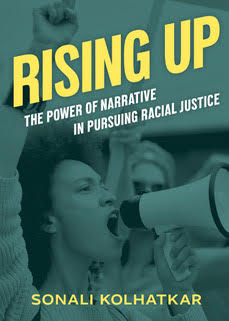
But despite sustained political efforts to constrict our liberties and suppress the truth of the United States’ origins (as in the current opposition to teaching critical race theory and the trend toward banning books and criminalizing the teaching of history) there are other ways to forge change to a tired old story. In Rising Up: The Power of Narrative in Pursuing Racial Justice, Sonali Kolhatkar has constructed a guide to the ways in which we can all participate in a sea change by becoming better consumers of the media and resisting the stories we are told. She offers tools for more critical thinking, productive discussion and ways to create empathy as opposed to enmity. As racial justice editor of Yes! magazine and host of Pacifica Radio’s Rising Up With Sonali, Kolhatkar is a solutions-oriented journalist, focused on progress rather than problems. I have long been a fan of her broadcasts and was delighted to talk to her more about the pursuit of racial justice.
My full interview with Kolhatkar appears in Bay City News/Local News Matters. For now, free speech and a free press remain among the cornerstones to democratic society. I hope you’ll take a moment to read the profile and support independent voices inside and outside the media.
Five songs into their set at Chicago’s New Nazareth Church, the Staple Singers get down to the real, and the reason, they called their gospel meeting on April 9, 1965.
“A few days ago freedom marchers marched on Selma to Montgomery, Alabama,” says Roebuck “Pops” Staples. “And from that march, words were revealed and a song was composed. And we wrote a song about the freedom marchers and we call it the ‘Freedom Highway.’ And we dedicate this number to all the freedom marchers, and it goes something like this.”
Tearing into their new song as if it was a longtime traditional favorite, the Staples evoke the energy and resistance of the historic freedom trail for voting rights, right there at their South Side parish. Though few could’ve predicted or believed that the messages of the Martin Luther King, Jr.-led movement would still be necessary or relevant 50 years on, this timeless performance at the height of the fight has been mercifully preserved, restored and reissued on Legacy’s new Freedom Highway Complete—Recorded Live at Chicago’s New Nazareth Church, April 9, 1965, for all the world to once again bear witness and hear the beauty in a song.
The whole world is wondering what’s wrong with the United States
Yes, we want peace if it can be found
Marching freedom’s highway,
I’m not gonna turn around…
Stay on freedom’s highway until the day is done
Following an introduction from Pops encouraging folks to sing, clap, and shout amen, the group (accompanied by Al Duncan on drums and Phil Upchurch on bass) eases in parishioners with the familiar invocation, “When The Saints Go Marching In.” But they waste no time getting to the darker stuff, slipping in the Hank Williams tale of “The Funeral,” concerning the closing of the casket on a little curly-headed boy. The secular movement standard, “We Shall Overcome” is delivered easily enough, serving as the crowd-participatory number it was built to be, though in the Staples’ hands, all is holy. Their originals like “Freedom Highway” and “Tell Heaven,” and the arrangements of spirituals like “He’s All Right” strive to tear the roof off the chapel and touch greener pastures, delivering the listener from all earthly distraction. For gospel singers like the Staples family, “Jesus Is All” (one of the set’s previously unreleased tracks) and “Help Me Jesus” are not just proud declarations of their savior’s name, they are a way of life, a deep faith that does not ask its adherents to acquiesce in God’s presence; it puts the holy spirit in charge, so that the faithful may take action on the streets and in all matters of the everyday, fearlessly and free.
Church was where the gospel group first practiced its faith as family singers—Roebuck, Pervis, Cleotha, Yvonne and Mavis—in the late forties and early fifties, developing an acoustic folk-gospel style with a bluesy feeling, distinguished by soul-solid lead vocals by Mavis and piercing, bending guitar by “Pops.” They recorded for a number of labels including Vee-Jay (famous for releasing blues acts and later, the Beatles) where they had some early success with “Uncloudy Day,” (a song Bob Dylan recently called the “most mysterious thing” he’d ever heard). In later years they joined the Stax label where during the apex of soul music, they enjoyed Top 40 success with funk-based, gospel-powered hits like “Respect Yourself” and “I’ll Take You There.” In between these distinct eras, the Staples were signed to Epic where their A&R man and producer Billy Sherrill (remembered mostly for his Nashville productions) assisted in the development of merging their sacred and soul sides. For the Freedom Highway session, he arranged the necessary equipment be brought to the church and recorded the service/rally. Mobile units were in their infancy at the time, but the project was not conceived as a “field” recording. Before release, the tracks were edited, telescoped, and worked to conform to studio and broadcast standards, purposefully leaving behind the churchy and ambient parts, though even with the tweaking, the set was a revelation. Becoming one of the era’s most beloved recordings, it was also long left out-of-print, only to become highly sought after (a 1991 Legacy reissue titled Freedom Highway is not the original recording, but rather a compilation).
Bolstered by the anticipation of the tracks becoming once again available digitally and on vinyl, the new and expanded edition produced by Steve Berkowitz and Nedra Olds-Neal stands to surpass the original’s already relic-like status. By daring to return the tapes to their original form and to recreate the evening from front to back, Freedom Highway becomes all at once a historical document, a spirit-lifting gospel session, and a fist-raising call for freedom now. Accompanied by rock and soul historian Robert Gordon’s liner notes which ascertain the place of race in music and in the country then and now, the Staples brand of “message music” is spelled out for non-believers and anyone else in need of a nudge.
Leaping into faith-based music in times of uncertainty is natural; gospel survives on rock solid melodies and timeless messages of liberation which by design were created to subvert slavery and oppression. And while the marchers in Ferguson, New York and Oakland in recent months may not have exactly had the notes of “Freedom Highway” on their minds when they shut down roadways, its words were already written on their souls. Built to travel the distance, and as necessary as in the hour they were recorded, these songs performed 50 years ago (and some scored a hundred years before) are available to accompany movement, anytime, anywhere, there is a fight for voting rights, civil rights and human need. These songs’ messages are as urgent now as they were then, as is faith in the idea that the march will ultimately be won, mile by mile, hand in hand.
“Let’s say amen again,” says Pops Staples on the restored set’s recovered audio tracks. “Let’s keep on marchin’…Keep on marchin’ up freedom highway.”
(This review appeared originally in Blurt online, upon the release of the 50th anniversary edition of Freedom Highway)



 Denise Sullivan