Denise Sullivan

Author, Arts & Cultural Reporter and Worker

Howie Klein: One of a kind

Howie Klein 1948-2025

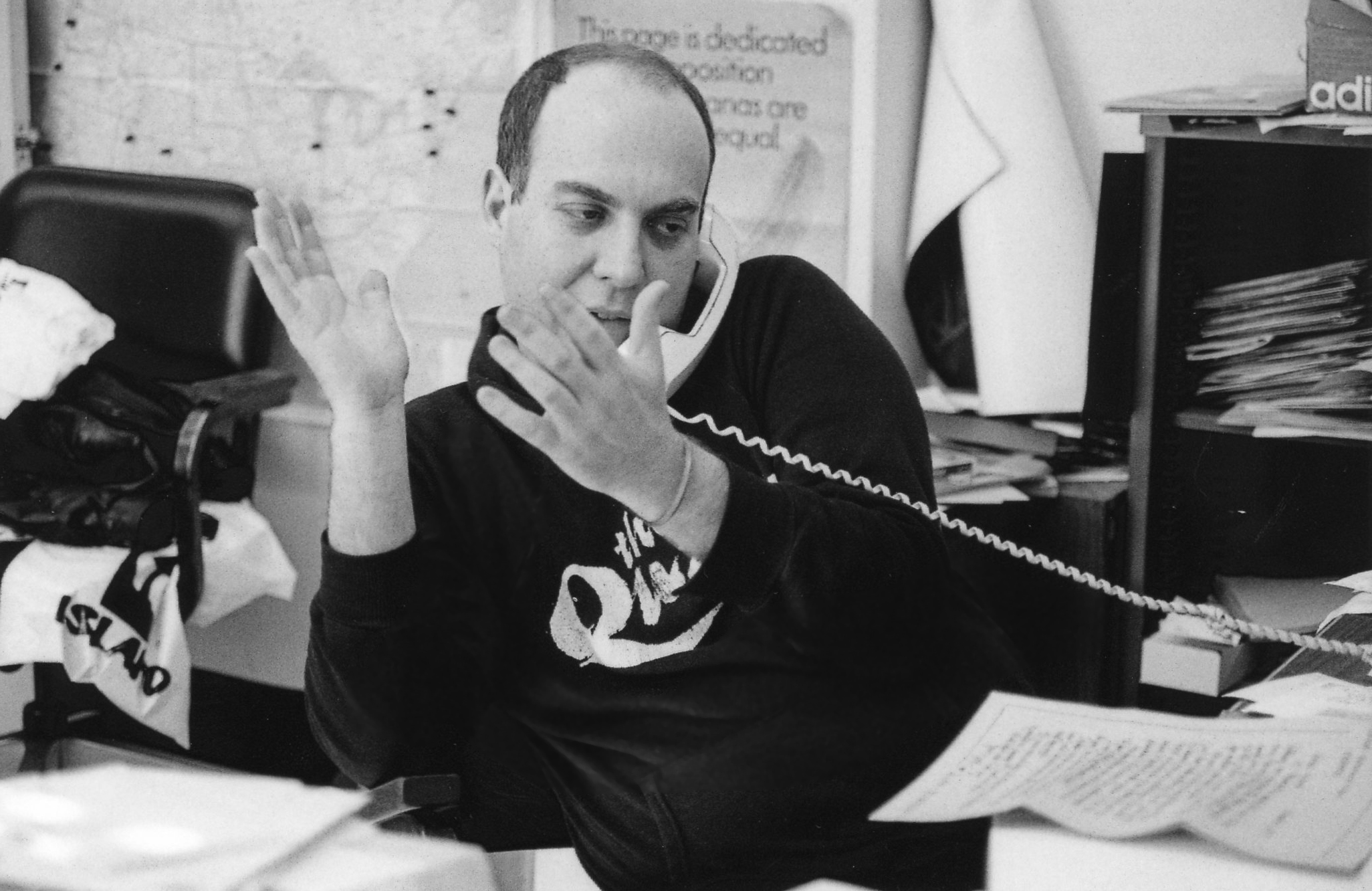
Writer, political activist, broadcaster, and record man Howie Klein’s life was large, unique and apparently complete as it came to a close on December 24. The work, his work–what some might call magic–was largely invisible, so much of it occurring out of the public eye, yet he leaves an indelible imprint on politics and culture, both on the underground and in the mainstream, as well on the individual lives he touched. Boiling down his life and legacy to a few paragraphs or simple words isn’t possible, especially today, Christmas, one day after he left our present reality for parts unknown. It’s particularly poignant that he should exit at this time of year when I think he secretly loved the holiday (his longtime annual Christmas shift as Howie Klaus on KUSF-FM was the giveaway).

Following an outstanding career in the record business in which he became known as an artist and First Amendment advocate, he spent the past 20 years fighting fascism as a commentator and as an ally for politically progressive candidates, while tending to several bouts of long term illness.

I met Howie about 45 years ago, when I was still a teenager, though before that, I heard his voice on the radio, broadcasting on KSAN-FM from the Sex Pistols final concert at Winterland. Lucky for us, he’s left behind a catalog of his life and times on the hippie trail, at Harvey Milk’s camera store, at Neil Young’s Broken Arrow Ranch and on the White House dancefloor, in writing and images, all to be compiled for publication as a memoir (more news on that in the new year). For now, I send love and condolences to all who knew and cared for him and leave you with his own words, on what it means to write and remember.

HOWIE KLEIN: So, as you probably know, I’m trying to write this memoir… but I don’t have the greatest memory in the world. Neither do most of my friends. Neither do most people in general it turns out. I explained how this has been impacting my work when I wrote about DEVO and Dolly Parton last month. How did “Mr B’s Ballroom” get written? My recollection was that I brought DEVO there and they wrote the song. My friend Michael Snyder, who I brought there, said DEVO wasn’t with us and that we told DEVO about the place and Mark Mothersbaugh wrote the song afterwards. I called Mark and he confirmed Michael’s version. I had such vivid “memories” of DEVO aghast at “Mr. B’s!”

I don’t remember exactly when I read Anne Rice’s Interview With A Vampire but I remember where I read it— San Francisco… and I remember discussing it with Harvey Milk, who was assassinated in 1978, so it was probably that year or the year before. No one had to tell me that the vampire myth was a metaphor for homosexuality long before Anne Rice came along and I was explaining that to Harvey while I was reading the book, which isn’t nearly as queer as the new TV series running on AMC now.

In that series (the 3rd episode), Daniel Molloy is interviewing Louis de Pointe du Lac in his Dubai penthouse and Louis seems to say that Lestat was the actual creator of “Wolverine Blues,” the jazz classic by Jelly Roll Morton, recorded in 1923. Daniel gets pissed off and accuses Louis of being an unreliable witness. As a defense, Louis explains the theory of the “odyssey of recollection” by reading from Daniel’s own memoir: “I am in my Buick, staring in the rearview mirror at my daughter in the car seat, an hour after I gave Derek, a guy I don’t know, the last 30 bucks I had. My editor reminds me, it’s seven years before car seats are mandatory. My ex-wife reminds me, I never owned a Buick. This is the odyssey of recollection.”

Sometimes there’s irrefutable— more or less— evidence, proof. That Iceland story I wrote was based on a daily diary I kept of our visit to the island early in 1969. When I asked Martha, now an internationally renowned neuroscientist, then my girl friend and traveling companion, what she thought of the page I posted about the trip, she had no recollection of Mario and Frances, the two American professors we met on the plane who asked us to chip in with them for a car and explore the country. We were with them for over a week, had plenty of adventures and dramas. Martha couldn’t even recall their existence.

I also sent [a] photo of Martha and Autumn Haze at our off-campus house in Rocky Point on Long Island (probably 1967 or ’68). Martha and Autumn didn’t like each other at all; they kind of tolerated each other. So this was a sweet and rare photo I found of them. I asked Martha what she recalls about the photo. She immediately remembered her blouse, she told me. She said she doesn’t recall I had a dog.

Memory does not work like a recording device. Elizabeth Loftus is a psychologist and memory expert, specializing in studying false memories. She explains her work in this TED Talk in Scotland, which has been viewed by over 5.8 million people on the Ted Talk site and another 2 million on YouTube. “Our memories,” she said, “are constructive. They’re reconstructive. Memory works a little bit more like a Wikipedia page: You can go in there and change it, but so can other people.” She discusses misinformation in this talk three years before Trump slithered into the White House.

She concluded her talk with the kind of statement that must be the bane of every memoir writer: “Most people cherish their memories, know that they represent their identity, who they are, where they came from. And I appreciate that. I feel that way too. But I know from my work how much fiction is already in there. If I’ve learned anything from these decades of working on these problems, it’s this: just because somebody tells you something and they say it with confidence, just because they say it with lots of detail, just because they express emotion when they say it, it doesn’t mean that it really happened. We can’t reliably distinguish true memories from false memories. We need independent corroboration.”

In 1802 William Wordsworth wrote “The Rainbow” (also known as ‘My Heart Leaps Up’) which was published in 1807. In high school we were asked to memorize the last three lines, which are also featured in the even more famous “Ode: Imitations of Immortality,” which Wordsworth started the day after he wrote “The Rainbow.”

My heart leaps up when I behold

A rainbow in the sky:

So was it when my life began;

So is it now I am a man;

So be it when I shall grow old,

Or let me die!

The Child is father of the Man;

I could wish my days to be

Bound each to each by natural piety.

©Howie Klein

Filed under: Obituary, Punk, rock 'n' roll, , , , , , , ,

Poly Styrene’s Time is Now

“When we all got into music, back in the day, we got into it to be anti-establishment,” said punk filmmaker and musician Don Letts. “Nowadays, bands start bands to become part of the establishment.”

Poly Styrene, late ’70s

In the ’70s and ’80s, Letts was an intimate friend and documentarian of the Clash. He was also acquainted with punk empress Poly Styrene, front woman of X-Ray Spex and a witness to her unfurling following a difficult evening spent in the company of Johnny Rotten.

Much has been left uncovered and to the imagination concerning Styrene’s reclusive post-punk life, but the new documentary, Poly Styrene: I Am A Cliché, co-directed by Paul Sng and Styrene’s daughter, Celeste Bell, corrects the record and tells the true tale of an accidental icon.

“People often ask me if she’s a good mum – it’s hard to know what to say,” says Bell in narration of the film, exploring the life, career and spiritual-questing of her mother. Decades later, Styrene is still considered one of punk rock’s mothers and its premiere feminist, anti-capitalist and Afrofuturist.

Expertly weaving archival film with ephemera, testimonials and additional voicing of Styrene’s diaries by actor Ruth Negga, Bell’s very personal story is centered on the art itself, along with a narrative that underscores the artist’s ability to create lasting work in the face of the odds and a world that was built in opposition to her. That the artist was her mother makes for a complex telling but those complicated feelings never get in the way of keeping the focus on Styrene’s values as an artist; her contemporaries like Letts, ska music’s Pauline Black and Rhoda Dakar, and latter-day punk spokespeople like Bikini Kill’s Kathleen Hanna and Sonic Youth’s Thurston Moore are all quick to corroborate her impact. Bell does away with the documentary convention of talking heads which effectively keeps her subject in the spotlight rather than creating a distraction by fixing a camera on so-called experts. A daughter’s understanding of her mother’s role as a pioneering biracial feminist environmentalist with a spiritual directive to deliver a message to the world is a testament to Bell’s own commitment to making a film about art as opposed to conforming to commercial ideas of what makes good entertainment. Read full article here:

Filed under: anti-capitalist, anti-war, Arts and Culture, Environmental Justice, film, Protest Songs, Punk, Women in Rock, , ,

Remembering Tony Kinman

Tony and Chip Kinman, photo by Marcus Leatherdale

There was an anti-authoritarian pulse that coursed through Tony Kinman’s work until the end: When Kinman lost his life to pancreatic cancer in May, rock ’n’ roll lost one of its greatest champions.

Working side by side for decades with his brother Chip Kinman, whether it was in their first wave political punk band The Dils, or producing his brother’s new rock ’n’ blues band, Ford Madox Ford, Kinman left his own unique imprint on rock ‘n’ roll: Working upstream and against trends, he carried a torch for all that was holy and good about the music, always questing for the possibility that it would manifest its original intention to upset and forever change things like it did in its formational 1950s. When that promise didn’t deliver, he dug deeper toward the source, searching for rock’s proverbial lost chord.

READ THE ENTIRE APPRECIATION AT TOURWORTHY.

Filed under: Protest Songs, Punk, , ,

Peace Punks, Hate Speech & Berkeley

Green Day at Gilman, photo by Murray Bowles

In 1988, the peace punks who congregated at 924 Gilman Street in Berkeley, California, had a choice to make: To meet encroaching skinheads with violence or to fight back with the tactics of non-violence. Choices were made, the inevitable schisms from within ensued, and life went on, as the new documentary, Turn It Around: The Story of East Bay Punk, tells. While the story and other tales of punk rock glory illustrate punk’s inherent contradictions and what happens when utopian ideals like egalitarianism and rule-by-committee are put to the test, the film is also in perfect synch with the hate speech controversy happening on the UC campus this fall.

“The film played in Charlottesville a few weeks back,” explained its director, Corbett Redford. “Someone from the audience commented, ‘This is how allies work. Allies stand up.’”

The punks of Gilman, far more of them straight, white, and male than queer, people of color, or women, did indeed stand up to the Nazi strain in their midst. And yet, the politics of waging peace and the how music fits into those politics is often more nuanced and complicated than taking up of pitchforks, tiki torches, or baseball bats.

READ THE WHOLE STORY AT DOWN WITH TYRANNY!

Filed under: Arts and Culture, film, Punk, , , , , ,

Latinas And The Roots of American Music

For my monthly column on music making a difference, I tried to capsulize the long history of Latinas contributing to popular music in America. From the earliest phonograph records made by San Antonio’s Lydia Mendoza, to LA’s Alice Bag (pictured here) who helped invent West Coast punk, and into the 21st Century with Fea, that’s nearly 100 years of recording history on their side. Read the entire article here and let me know what you think.

Filed under: Arts and Culture, California, column, cross cultural musical experimentation, Latina, Latino culture, Latinx culture, Mexican American/Latino Rock, Punk, Texas, , ,

Shonen Knife Keeps Going and Going

Formed in 1981 in Osaka, Japan, Shonen Knife, founded by sisters Naoko and Atsuko Yamano are still going strong. Cheered to hear of the pop-punk band’s recent US tour dates which they dubbed The Ramen Adventure Tour, I’m reprinting a portion of an interview with Naoko which appears in my book, Rip It Up: Rock ‘n’ Roll Rulebreakers.   20151214-181016-466913.jpg

Three Japanese women named after a brand of penknife seem the unlikely embodiment of punk rock, yet Shonen Knife may be among the genre’s last rebels.  The power trio makes a pop-punk noise comparable to the Ramones, and counts Sonic Youth, Redd Kross, and the former members of Nirvana among their fans.  But after six albums, fifty singles, and more than ten years together, in 1995, the band was headed stateside in search of a record deal, having cut all management and US label ties.

“We didn’t have enough control, so we quit,” explains guitarist, songwriter and group leader, Naoko Yamano, at home in Osaka.  She was due on the West Coast in a few days, where she intended to test the waters and play a couple of dates with a newly organized Shonen Knife.  “We have about twenty new songs, and we’ve demoed all of them. Our shows in America are going to be our showcase to play our songs and find a record company.” She reels off the new titles:  “‘ESP’ is about people who have extra power, ‘Explosion!’ is about anger, ‘Buddah’s Face’…how he looks at you as if you’ve gone too far this time.”

The band’s album prior to its split with Virgin Records,  Rock Animals, had a metal-lite sound and hellbent for leather meets Spinal Tap graphics that may’ve given the wrong impression to listeners.

“I love hard rock and punk,” says Naoko.  “Hard rock has the spirit of punk.  But I think our managers may have pushed things in the wrong direction…”

Shonen Knife are true fans of rock and quite simply aren’t afraid to let their enthusiasm shine. They’ve played ’60s pop, psychedelic rock, Asian pop, reggae, Motown, ’80s punk and more.  As natural musicians they’ve diversified and developed technically. Nevertheless, the Knife have been teased mercilessly, often by otherwise intelligent male critics, who note they “can’t play,” that they are “cute,” and have “funny accents:” The criticisms betray a wild misunderstanding of what it means to be “of the Knife.”

The members of Shonen Knife came of age at a time when forming a rock band was a serious transgression for girls in Japanese society; they’ve since toured the world, including a stint opening for Nirvana, and remain duty-bound to their mission.

“Shonen Knife is our life’s work,” Naoko says of a vow taken by the women long ago.  “It is equal to ourselves.  So we will do it as long as we live.”

Filed under: Arts and Culture, Punk, video, Women in Rock, , ,

New Replacements Bio Lays Rock to Rest

-1Faultily wired from the womb, like all true rockers from Little Richard to Johnny Thunders, the things that were wrong with the Replacements were precisely what was so right about them. Forming in the late ’70s, a time before rock became the domain of the pasty and privileged college set, problem child Bob Stinson slapped a bass on his baby brother Tommy in an effort to save him from a similar juvenile delinquent fate. A girl, and there were always girls around, introduced them to drummer Chris Mars. Eventually, Paul Westerberg, the child of an alcoholic with his own disobedience disorder, heard the din coming from the practice house, and the games would commence.

“It was the four of us.  It was an attitude that made those songs,” says Westerberg in the new and definitive biography of the band, Trouble Boys: The True Story of the Replacements, by Commercial Appeal critic, Bob Mehr. READ ENTIRE BOOK REVIEW AT BLURT:

Filed under: Books, new article, Punk, rock 'n' roll, , , , , , ,

Indigenous Musicial Sheroes: Buffy Sainte-Marie and Debora Iyall

Buffy Sainte-Marie is one of the central figures in Keep on Pushing: As unique musically as she is direct lyrically, Sainte-Marie was born on the Piapot Cree Indian reservation in Saskatchewan and adopted by a family in Maine. She says that as a child she was artistic innately, as well by necessity. Befriended by a Narragansett couple who lived near her family in Maine, it was from them she learned about cultural handcrafts and kindness. “They didn’t sit around and give me Indian lessons,” she said, “But on the other hand, they didn’t chase me away.”  As a young student, Sainte-Marie was drawn to philosophy and religion, while she simultaneously developed her musical side, as a folk performer. Her unique vibrato and innovative song style are what first drew me to finding out more about her story; what I found, moved me to the core, from the volume of hardship and turmoil she described, to her refusal to study war, which landed her among Nixon’s enemies.  “I don’t think many people, even today, understand how much blacklisting has gone on of artists in the record business,” she says.  In the face of the hassles, Sainte-Marie continued to innovate, as an electronic musician as well as a computer-based visual artist. Committed to teaching, to passing on what was given freely to her as well as what she fought to achieve, Sainte-Marie’s work still offers a pointed critique of war, greed, injustice and the anti-people policies that impact indigenous people all over this land.

Debora Iyall is one of the artists  directly descended from Sainte-Marie’s example of native creativity:  A singer, a songwriter, a poet, and a visual artist, Iyall’s story also unfolds throughout Keep on Pushing, beginning with her time as a teenager during the Indians of All Tribes’ Occupation of Alcatraz.  Her punk-rooted style bears little resemblance to Sainte-Marie’s folk roots (Iyall was most influenced by Patti Smith), but a close connection to arts education and her roots in the Cowlitz tribe made her a unique presence in San Francisco art-punk band, Romeo Void. Iyall had the guidance of elders—her mother and the Natives she met at pow-wows and on Alcatraz—who supported her creative discoveries. “I felt like I had these little nuggets of information or culture to hang on to,” she said.  Today, Iyall exudes confidence in her work as a performer and visual artist and is also a teacher and advocate, for artists of all colors and dimensions.

I was honored and humbled to have been allowed access to the lives of both Debora Iyall and Buffy Sainte-Marie—two women whose works have uplifted and inspired, not only their brothers and sisters native to the Americas, but their fellow artists and anyone who’s ever been broke or hungry, tired, or cast aside, and helped them to keep on keeping on: Their complete stories are told in Keep on Pushing.

Filed under: anti-war, Arts and Culture, Folk, Punk, Women's rights, , , , ,

On Bernie Sanders, Alice Bag, and the Enduring Politics of Punk Rock

Alice Bag 1

Frightwig and Alice Bag photo by Eric Goodfield

Among reasons to like Bernie Sanders, he supports the ERA and the Paycheck Fairness Act, he advocates for increasing minimum wage, has commited to expanding health and reproductive rights, and believes that childcare, preschool, and parental leave should be available to all Americans, not just a privileged few.  While I don’t know where punk rocker Alice Bag stands on Bernie Sanders, I recently heard her perform “Equality in the USA” with Frightwig in San Francisco at the Punk Renaissance, a week long festival organized by Punk Rock Sewing Circle, former punk rockers committed to social justice. Interestingly, Sanders has ties to punk rock, when as mayor of Burlington, he approved the Mayor’s Youth Office and punk gathering spot, 242 Main. Not only do I think there could be a valuable meeting of the minds here– as in a coalition of punk rockers for Sanders– but Bag’s powerful punk performance once again reminded me of my generation’s musical ability to change hearts and public opinion in fundamental ways. Read entire article at

Filed under: anti-war, Arts and Culture, California, Editorial, income disparity, Punk, ,

Goodbye Columbus: Hello Buffy Sainte-Marie and Debora Iyall

Buffy Sainte-Marie is one of the central figures in Keep on Pushing: As unique musically as she is direct lyrically, Sainte-Marie was born on the Piapot Cree Indian reservation in Saskatchewan and adopted by a family in Maine. She says that as a child she was artistic innately, as well by necessity. Befriended by a Narragansett couple who lived near her family in Maine, it was from them she learned about cultural handcrafts and kindness. “They didn’t sit around and give me Indian lessons,” she said, “But on the other hand, they didn’t chase me away.”  As a young student, Sainte-Marie was drawn to philosophy and religion, while she simultaneously developed her musical side, as a folk performer. Her unique vibrato and innovative song style are what first drew me to finding out more about her story; what I found, moved me to the core, from the volume of hardship and turmoil she described, to her refusal to study war, which landed her among Nixon’s enemies.  “I don’t think many people, even today, understand how much blacklisting has gone on of artists in the record business,” she says.  In the face of the hassles, Sainte-Marie continued to innovate, as an electronic musician as well as a computer-based visual artist. Committed to teaching, to passing on what was given freely to her as well as what she fought to achieve, Sainte-Marie’s work still offers a pointed critique of war, greed, injustice and the anti-people policies that impact indigenous people all over this land.

Debora Iyall is one of the artists  directly descended from Sainte-Marie’s example of native creativity:  A singer, a songwriter, a poet, and a visual artist, Iyall’s story also unfolds throughout Keep on Pushing, beginning with her time as a teenager during the Indians of All Tribes’ Occupation of Alcatraz.  Her punk-rooted style bears little resemblance to Sainte-Marie’s folk roots (Iyall was most influenced by Patti Smith), but a close connection to arts education and her roots in the Cowlitz tribe made her a unique presence in San Francisco art-punk band, Romeo Void. Iyall had the guidance of elders—her mother and the Natives she met at pow-wows and on Alcatraz—who supported her creative discoveries. “I felt like I had these little nuggets of information or culture to hang on to,” she said.  Today, Iyall exudes confidence in her work as a performer and visual artist and is also a teacher and advocate, for artists of all colors and dimensions.

I was honored and humbled to have been allowed access to the lives of both Debora Iyall and Buffy Sainte-Marie—two women whose works have uplifted and inspired, not only their brothers and sisters native to the Americas, but their fellow artists and anyone who’s ever been broke or hungry, tired, or cast aside, and helped them to keep on keeping on: Their complete stories are told in Keep on Pushing.

Filed under: anti-war, Arts and Culture, Buffy Sainte-Marie, Folk, Punk, Women's rights, , , , ,

Archives

Recent Posts

Browse by subject or theme