On this day in 1965, Malcolm X was assassinated, shot mulitiple times at the podium of the Audubon Ballroom where he was about to address the Organization of Afro-American Unity. Thousands flocked to Harlem over a three-day period to view his body before the burial.
Malcolm Little was born in Omaha, Nebraska in 1925 into a Baptist family; his father was a follower of Marcus Garvey and educated his son on all matters of black pride. While serving a prison sentence in the 1950s, he learned about the Nation of Islam and began a correspondence with Elijah Muhammed; by the time of his release he’d joined the organization and changed his name to Malcolm X. An immediately charismatic leader at Temples one, 10, 12, and seven, his musician following included Etta James, Johnny Otis and saxophonist Archie Shepp. In 1964, he left the NOI and made his way to Mecca. As a Sunni Muslim, El-Hajj Malik El-Shabazz came to believe that Islam was the way toward racial harmony.
Twenty years after his death, the legacy of Malcolm X had largely not been passed down to the next generation; certainly, his contribution to the black liberation cause had not been fully incorporated into history texts despite the perennial popularity of the considered classic, The Autobiography of Malcolm X, a collaboration with Alex Hayley. But leave it to music—in particular Public Enemy—to recognize and close the gap. The New York hip hop collective began to use Malcolm X’s teachings and speeches in concert with their videos and recordings (Boogie Down Productions and KRS-One and Spike Lee’s film, Malcolm X, also played a major role in the comeback; the efforts were not without controversy at the time).
Chuck D has said Public Enemy was partly founded on the idea of “connecting the dots” for those unfamiliar with the depth of black history; hard information is tightly packed into their raps that raise a fist in the name of consciousness. Of course this all happened back in the highwater era of Reagan and Bush, or what you might call the beginning of the middle of the end: As the nation enjoyed its boom-time and Michael Jackson paid a visit to the White House, the holiday for Dr. King was still left unrecognized by all 50 states, and the disconnect had only just begun. This year, smack dab in the middle of black history month, Nikki Minaj misappropriated the famous image of Malcolm X holding a gun, in defense of his family; Black media voiced its concern, the Shabazz family threatened legal action and Minaj rethought her plan. Hip hop is generally removed from its mission to educate and there is still no holiday in the name of Malcolm X. Instead, his civil and human rights works are officially recognized by films, speeches, books and songs. In addition to the Hayley book, Malcolm X: A Life of Reinvention by Manning Marable is the considered definitive biography. James Cone’s Martin & Malcolm & America: A Dream or A Nightmare is a comparison study of the pair’s liberation strategies. This musical tribute from musician, poet and educator, Archie Shepp, taken from his 1965 album, Fire Music, was recorded as an elegy soon after the assassination. A reading from Keep on Pushing follows.
(UPDATE, December 19: I have since seen the film in its entirety and the “Green Green Rocky Road” scene is the best part. Though Len Chandler and the histories of some of the other folksingers of color on the scene—Odetta, Richie Havens, Buffy Sainte-Marie—have been well-documented, the filmmakers chose to render invisible their counterparts or composites in their deeply cynical look at Greenwich Village folk).
Inside Llewyn Davis, the new Coen Brothers film concerning a fictional folksinger from the early ‘60s Greenwich Village scene (based loosely in post-modern style on some incidents from the life of actual folksinger Dave Van Ronk and other figures of the Village scene) opened in select theaters this weekend.
I have not yet seen the film, but gathered from the soundtrack the title character played by Oscar Isaac, performs “Green, Green Rocky Road,” which Van Ronk himself went as far as to call his “theme song.” With melodic and rhythm roots in the Georgia Sea Islands and before that, West Africa, readers of Keep on Pushing will remember the songwriting credit for “Green, Green Rocky Road” belongs to Len Chandler and Robert Kaufman (yes, as in Beat poet, Bob Kaufman).
I had the great and rare honor to interview songwriter and activist Chandler in 2007; large portions of our interview appeared throughout Keep on Pushingand on this site. Chandler spoke highly of Kaufman, Van Ronk, and of course Bob Dylan, who detailed their shared history and collaborations in his book, Chronicles. And yet, it is “Green, Green Rocky Road,” a song Chandler never recorded, that may be one of his most enduring achievements, despite the fact he was a singing hero of the Civil Rights Movement (his contributions to African American/US political and social history remain obscured and inexplicably, largely unsung).
Here’s a clip of Van Ronk performing the song, followed by a clip of Chandler performing his own “Keep on Keepin’ On,” from his rare Columbia album, To Be A Man.
(UPDATE, December 19: Morrison’s notebook reportedly sold for the unverified amount of $200,000 on December 18, 2013).
This week’s news that Jim Morrison’s “Paris” notebook will be auctioned later next month, 10 days after what would’ve been the singer and poet’s 70th birthday, hasn’t exactly set the night on fire. The headline, characterizing the discovery as his “druggy musings” makes it sound like more of the same, and yet, we’re talking about the recovery of a holy relic of rock’n’roll history here. Media and mythology strike again, though the story managed to uncover the seller of the notebook as Graham Nash. He and the Doors shared a manager who gifted Nash with the collection of notes and sketches, valued to be worth approximately $320,000. There was no mention of who shall benefit from the sale of the artifact which likely dates back to the singer’s life in the pre-Doors dawn, during his time spent at UCLA, his interests more focused on poetry and film than on songs. The inside flap of the book features a quote from a 1963 Paris Review interview with Norman Mailer (Morrison was an avowed fan) alongside an image of the artist Francis Bacon, artistic inspirers from the early ’60s.
As for Morrison, deceased since 1971, the ‘60s most idolized rock star was no doubt plagued by alcoholism and drug addiction, and yet, he was able to keep his artistic life somewhat sacrosanct; it is said when he left for Paris he took only his poems, filed in old notebooks, and his canisters of film with him. The notebook, with its so-called musings are presumably continuations of his creations, a winnowing and distillation of the things he’d been jotting down in notebooks he carried with him at all times, even since before he arrived to the California coast as a student from Florida. The writings in his own hand offer more than “a window into the mind of the deep-thinking singer, known for his drug abuse, in the run up to his death.” They are a closer look at his process as an artist, a chance to examine the singer’s life through a new pair of glasses, one that isn’t too concerned with ‘60s nostalgia, preserving mystique or cashing in on it. Whatever its true origins, I would hope that the notebook will be purchased with the intent to publicly display it.
It is time to retire the persistent media portrait of the artist as a semi-dimensional party dude with a quasi-mystic side. My forthcoming book, Shaman’s Blues, The Art and Influences Behind Jim Morrison and the Doors, to be published early next year, attempts to cancel some of the old notions, and replace them with the source of Jim’s ideas and what he was creating with his body of work. I went in search of the building blocks that make his songs and poems meaningful to each new generation, his messages, and even his meanderings, still relevant to listeners in the 21st Century.
To better appreciate Morrison’s “druggy musings” is to understand his complete devotion to Arthur Rimbaud’s systematic derangement of the senses, the principles behind Antonin Artaud’s Theater of Cruelty, Bertolt Brecht’s dramaturgy, and Julian Beck’s Living Theater, among other sources of his inspiration. One must have a general sense, if not knowledge, of what those historic, artistic precedents were about to fully appreciate the Doors’ work. I took on the project as an opportunity to investigate the people, places and other worlds alluded to in Morrison’s songs, to seek the poetry at the core of the stories, and the diligence that went into creating the Doors’ own dark music. And then I tried to unravel some of all that for the general reader without boring people to death by use of academic language, while striving to make Morrison more whole, less of an icon, and more of a human. Because behind the Hollywood and media representations of him, Morrison has largely been remembered well by family and friends. He was said to be thoughtful, loving, humorous, artistic, and pretty decent young cat, when he wasn’t under the influence (though there would also appear to reasons for his discontent, in addition to a predisposition to alcoholism). I make no apologies for the drunk and disorderly behavior; it is on the record and clearly a part of who he was, but it was not all of Jim Morrison. And that’s part of why I’m so interested in the news of the notebook going on the market: It is part of the ongoing rehabilitation of Morrison’s legacy, the process of demythologizing the mythic Lizard King.
I’m pleased to say I’m not a voice in the wilderness in my attempts to bring more light to the other side of Morrison’s work. His friend Frank Lisciandro, who has long worked to keep Jim’s poetry and filmmaking in the public consciousness, is compiling Jim Morrison: Friends Gathered Together, an oral history of the singer’s pre-Doors years. And filmmakers Jeff and Jess Finn continue work on Before the End: Jim Morrison Comes of Age, a documentary take on the tale we all (think we) know so well, as told by Jim’s closest intimates, guided by the filmmakers’ access and own intuitive sense of his Jimness.
When I hear Jim speak or sing, on the page and on audio and video, on his clear days he seems thoughtful, interesting and right-on to me too. This is the Morrison I wanted to capture in Shaman’s Blues, and I certainly hope it is received in that spirit, though a writer cannot predict how she will be read. Perhaps there is no better example than Jim Morrison’s own legacy, to illustrate the dichotomy of the saying about one man’s trash: Welcome to “The Soft Parade.”
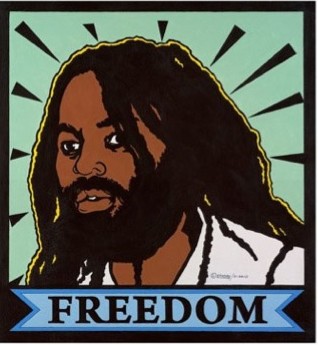
There is only one voice like Mumia Abu-Jamal’s, its tone perfect for professional broadcasting, its message carrying necessary information for our times. But Abu-Jamal, as most people know, is no longer primarily an announcer by trade. Better known as Mumia to the worldwide community of human rights activists who support his case, the former radio journalist has been serving time in prison for over 30 years now. He has spent much of that time writing and appealing his case.
In the documentary Long Distance Revolutionary, filmmaker Stephen Vittoria and co-producer/Prison Radio sound recordist Noelle Hanrahan, make a compelling case that Mumia’s situation as a prisoner for life is more than a miscarriage of justice: Rather than retell the circumstances that lead to the incarceration of the journalist/activist (whose views forced him to moonlight as a cabbie, just to survive), they shine a light on how he’s used misfortune as opportunity, to become a prophetic voice for the voiceless.
Angela Davis, Amy Goodman, Alice Walker, Cornel West, Tariq Ali, Ruby Dee and James Cone are among the scholars, theologians, journalists, actors, activists, writers, colleagues, and family members who testify in the film on the important role Mumia—the writer as political prisoner—plays on the world stage, reflecting the revolutionary’s role in contemporary American society. Through interviews, news reel footage, photographs and most of all, interviews and sound recordings of Abu-Jamal, Long Distance Revolutionary tells the story of an intuitive and self-described “nerd” of a child, Wesley Cook, who journeyed into the Black Panthers, then followed his call to report on his city as he saw it, much to the distaste of its notoriously racist law enforcement. Of course, that’s business as usual in the land of the free, while the mystery that unfolds onscreen in Long Distance Revolutionary is more to a specific point: Just how does a death row inmate as sharp as Abu-Jamal keep his mind in shape and his spirit alive while the state does its job squeezing the life out of him? Of particular note are the words of literary agent Frances Goldin who I’m unable to quote here, but who talks of how she was sufficiently moved by Mumia’s prose to take a chance on him in the book market. But the most convincing voice of all is Mumia’s own which can be read in his multiple books in print all over the world and heard on Prison Radio, still recorded by Noelle Hanrahan. At the film’s premiere in Mill Valley, California last October, Mumia delivered an address, especially recorded for the Bay Area. He remembered its “luscious sun,” and the Bay as a place where he, “a tall, skinny, dark sunflower,” could be among some of the “best, boldest, blackest, sweetest” brothers and sisters he claims to have known.
Curiously, the film’s only musical voice in the chorus is M-1 of Dead Prez. Used to be musicians sang out for injustice, the way that Bob Dylan once did for Rubin “Hurricane” Carter (who also appears in the film); in that case, the musical association indirectly lead to Carter’s exoneration. But the music community has largely remained silent on the subject of Abu-Jamal. So where are the other contemporary Musicians for Mumia? According to director Vittoria, the usual suspects were approached, but only Eddie Vedder responded to the urgency of the call. “Please know that I (and my co-producers) tried hard to get…and a number of other musicians into the mix—on numerous occasions and through numerous fronts—but not one of them would agree to interview (except M-1) and/or offer a musical piece or new selection,” Vittoria wrote in an email to me. Vedder’s song “Society” (previously associated with the feature film, Into the Wild, concerning environmentalist/adventurer, Christopher McCandless) serves as the film’s closing theme.“I was fortunate that Eddie allowed us to grace the film with his powerful song,” added Vittoria.
Abu-Jamal was taken off death row late last year; he remains sentenced for life without possibility of parole and lives among the general prison population at the Pennsylvania State Correctional Institution at Mahanoy. But the system has not vanquished his spirit or his message. Mumia is still on move: Long Distance Revolutionary has been on the festival circuit and in general release throughout the year. It opens August 23 at the Roxie Theatre in San Francisco and next month at Spokane’s Magic Lantern. Here’s the trailer:
Extraordinary musician and activist Richie Havens has passed today, Earth Day, following a heart attack. Havens was a performing songwriter, though by his own admission, specialized in performing the songs of other writers. Havens’ life and how he came to be an activist through song throughout his career was central to the narrative of my book, Keep on Pushing; starting as a Doo-wop singer in Bed-Stuy, his curiosity led him to the Greenwich Village clubs of the late ’50s where he was exposed to folk music and poetry, and was encouraged by Allen Ginsberg to perform. His journey through the heart of the counter culture was the source of much inspiration as I wrote, and I will forever be grateful for the gift of our conversation, along with the beautiful songs he left us. Havens will be missed by music lovers and friends of the earth throughout the world. I would like to send my condolences to his family, friends, and fans, and will take the rest of this precious day to honor his memory by doing something for the earth. Thank you, Richie Havens, for your soulful lifetime contributions to our planet, Earth.
Update: There will be a public memorial for Richie Havens on Monday, April 29, at City Winery in New York City.
Cambio’s album title, I, Too, Sing America caught my eye for being named after a Langston Hughes poem(his answer to Walt Whitman’s work, “I Hear America Singing”). Cambio’s music caught my ear, too, thanks to his talk with Ignacio Palmieri on KPOO last week. With allusions to illusions, references to referendums, and tracks built on layers upon sound bites, scratch noises, and clips of speeches, Cambio’s point of view is progressive to the max, and that powerful voice is at the center of the mix.
Californian by birth, Latino by descent, Cambio is from Watsonville while belonging to Quilombo Arte, the international collective of artists, writers and musicians spearheaded by Mexico’s Bocafloja, committed to breaking down barriers and to emancipation for all people.
As a Latino influenced by hip hop, a young man in love with basketball and a speaker of “broken Spanish,” Cambio described himself as “having issues within his own community.” It was through becoming educated and learning the stories of colonization that he began to seek and find his place in the world as an artist. Beginning to record and perform locally, it was by chance that Bocafloja heard Cambio’s recordings and reached out to him. Though he records in English, Cambio has since found an audience for his music in Mexico and throughout Latin America.
An earlier album, Or Does It Explode?, also has a title borrowed from a Hughes poem (“A Dream Deferred”); a newer project, Underground Railroad, of course refers to the network built from slavery to freedom. History, poetry, social movement and music are among the themes in Cambio’s work: One minute he’ll borrow from Malcolm X, Fred Hampton or Che Guevara, the next from Nina Simone or Bob Dylan. Here’s “Eyes Wander,” featuring Favi and DJ Ethos.
There is so much to like about Cambio, so much more to learn and know, but the music speaks volumes on its own. Listen for yourself on his Bandcamp page. You may also hear the archived broadcast (scroll down) of the show I heard. I encourage you to listen and support cambio: Positive hip hop is marginalized and Cambio’s is a voice that if given a proper hearing could resound all over this land. He, too, sings America.
The following clip features the voice of Langston Hughes reading from the poem that started it all.
April marks National Poetry Month and Jazz Appreciation Month. This month’s posts will attempt to shine a light on great moments and people in jazz and poetry history, as well as the places where the two forms meet.
In 1970, Gil Scott-Heron was barely 21 when his first novel, The Vulture, was published and his startling, spoken-word record, Small Talk at 125th and Lenox, caught his incisive cool on tape. “I consider myself neither poet, composer, or musician. These are merely tools used by sensitive men to carve out a piece of beauty or truth that they hope may lead to peace and salvation,” he wrote in the album’s liner notes. Accompanied only by conga drums and percussion, Small Talk at 125th and Lenox featured a reading of “The Revolution Will Not Be Televised”, Scott-Heron’s most enduring work and an early masterpiece, its flow combining elements of both poetry and jazz.
“The revolution will not be brought to you by Xerox
In four parts without commercial interruptions.”
Excoriating the media and marketing, the song’s structure burrowed its way into the collective consciousness of musicians—both mainstream and underground—and listeners alike; it is referenced throughout music, and rather un-ironically the title phrase has been repurposed to advertise consumer goods, from sneakers to television itself. The piece is also, of course, foundational to hip-hop, its words potent and direct, even if some of the allusions and references may be lost on those uneducated in ‘60s or ‘70s culture. It also sounds great, which explains why it’s a standard-bearer for all music, whether it be politicized rock’n’soul, funk or jazz. Pulsing throughout the piece is Scott-Heron’s projection, a foreshadowing of the realities of global connectivity and the pacifying effect on the brain produced by viewing from a small screen. Heron’s vision was a word to the wise:
“The revolution will not give your mouth sex appeal…
The revolution will not make you look five pounds
thinner, because the revolution will not be televised.”
Positing a necessary parsing of media-generated “reality” from truth and setting his poem to music on his 1971 album, Pieces of a Man, Scott-Heron was caught in the chasm between jazz and soul, poetry and rock, and few knew just what to do with the new poet and big bass voice on the scene, though time would reveal his impact: As the years rolled by, this poet of vision would weigh in on matters environmental and racial, as well as political and social. Though Scott-Heron’s voice was too often a cry in wilderness, it served as a clarion for future generations of conscious writers and thinkers.
Scott-Heron was raised in Tennessee by his grandmother, until he and his single mother, a librarian, eventually moved north to New York City. As a teenager, he excelled at writing and earned enrollment at Fieldston, a progressive Ivy League preparatory school. Upon graduation, he chose to attend Lincoln University in Philadelphia, quite simply because it was the alma mater of poet Langston Hughes. As a musician, Scott-Heron’s style was conjoined with the word styles of Hughes, as well as those of talkers like Malcolm X and Huey Newton. But it was “musicians more than writers” who inspired him, and he used the rhythms of folk, blues, soul, and jazz to fulfill the intensity of his emotion. “Richie Havens—what he does with the images and themes, Coltrane—the time defiant nature and thrust of his work. Otis Redding—the way he sings lyrics so that they come through as sounds. You can really appreciate how close a saxophone is to the human voice when you hear Otis singing. I sometimes write poetry, in a way, like Otis sings. The sounds form shapes. Like clouds banging into each other. That’s how I get loud sounds in my poetry,” said Scott-Heron to Jazz and Pop‘s Nat Hentoff.
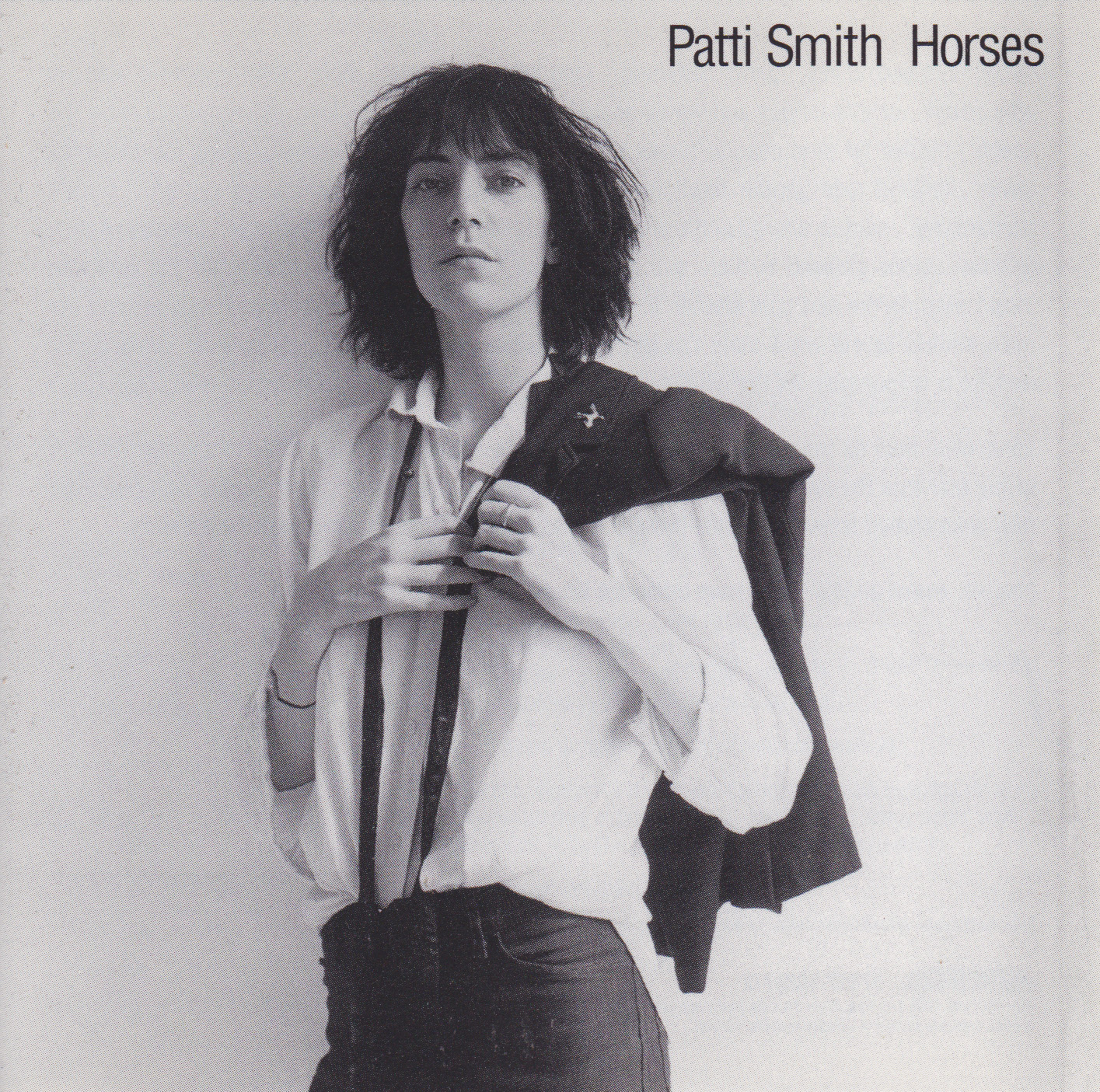
“He wrote me a note to say we would make art together, and we would make it with or without the rest of the world,” writes Patti Smith of Robert Mapplethorpe in Just Kids, her memoir of their lives and great love. Concerning their time as young artists discovering New York City and themselves in the late ‘60s and early ‘70s, not only would both of them make art together, they would eventually become nothing short of internationally recognized, particularly among artists, freethinkers, and members of their blank generation. But while Mapplethorpe’s life was cut short by AIDS in 1989, Smith lived on to keep the fire of rock’s poetic origins alight, Mapplethorpe’s influence on her inseparable from the origin of inspiration in her art and life. Without his prodding—his love—it’s quite possible that an entirely different Patti Smith than the one we know would have emerged. In Just Kids, Smith reveals Mapplethorpe’s commitment to art, his companionship, and his collaboration in the years leading up to her debut album Horses was invaluable to its creation: Not only did he capture the image of the poet/rock star-to-be on its cover, but it was he who first encouraged her to sing.
Produced (reportedly with some difficulty) by John Cale and performed by the Patti Smith Group (with songs written mostly by Smith and co-writers Tom Verlaine, Allen Lanier, and members of her group, specifically Lenny Kaye), Horses launched at least a hundred punk bands, if not a generation of kids with punk attitude, and it remains fully alive today. Infused with the spirit of Smith’s dead poet/rock ‘n’ roll heroes—particularly Arthur Rimbaud, the libertine poet whose spirit she’s kept moving through rock ‘n’ roll—the first word of the first song is “Jesus,” as Smith cleverly fuses her own invocation to Van Morrison, proclaiming rock ‘n’ roll “Gloria: In Excelsis Deo.” Whether intertwined with the Catholicism of Mapplethorpe’s youth or with Rimbaud’s travels to Ethiopia and his relationship to Rastafari, Smith made bold statements, particularly for a young woman who claimed to be shy by nature; she summoned the spirits of two men named James (Hendrix and Morrison) with three Bobs (Marley, Dylan, and Neuwirth) or four if you count Mapplethorpe, and her own strong desire to merge poetry with performing rock ‘n’ roll.
“I felt, watching Jim Morrison, that I could do that. I can’t say why I thought this… yet, I harbored that conceit,” she writes in Just Kids. Her connection with Hendrix was slightly more intimate: She was invited to the opening of his recording studio, Electric Lady. “I was excited to go. I put on my straw hat and walked downtown, but when I got there, I couldn’t bring myself to go in,” she writes. “By chance, Jimi Hendrix came up the stairs and found me sitting there like some hick wallflower and grinned.” He talked to Patti, revealing that he didn’t like parties either. “He spent a little time with me on the stairs and told me his vision of what he wanted to do with the studio. He dreamed of amassing musicians from all over the world in Woodstock and they would sit in a field in a circle and play and play… Eventually, they would record this abstract universal language of music in his new studio. ‘The language of peace. You dig?’ I did.” And then he was off, to catch a plane to England, from which he never returned. Smith read the news of his death about a month later while on a trip to Paris—on one of her rare respites from her gigs as a bookstore clerk/rough living artist/caretaker of Robert.
In New York, she happened to meet singer-songwriter and painter Bob Neuwirth in a coffee shop (she recognized him from the Dylan documentary, Don’t Look Back), and becomes just a little more inspired to try her hand at turning her poems into songs. “Next time I see you I want a song out of you,’ he said as we exited the bar,” she writes. But when she reports to Mapplethorpe of meeting Neuwirth, the photographer snaps back, “Maybe he’ll be the one to get you to sing, but always remember who wanted you to sing first.” Mapplethorpe doesn’t approve of Smith’s Marley-inspired pot smoking either, but the pair go on to spark up some sacred herb together, in the name of enhancing creativity.
Trying on her voice, reading her poetry aloud, Smith dove into performance mostly without Robert’s help, as he was moving deeper into the world of street hustling (this time it’s Patti who is disapproving). She reads for unappreciative fans of the New York Dolls and gets heckled by drunks before finding her sea legs and accompanists—first guitarist Lenny Kaye, and then Richard Sohl on piano. But when it’s time to record a single, it’s Robert who pays for the studio time at Electric Lady. For the recording, they choose “Hey Joe”, a song made famous by Hendrix. While Jimi closed his set at Woodstock with it, Smith and co. use it to usher in the era of the punk rock seven-inch. Recording at Jimi’s place, “I felt a real sense of duty,” she told the Observer in 2005. “I was very conscious that I was getting to do something that he didn’t.” Though Horses’ de facto title track “Land” was famously inspired by William Burroughs’ The Wild Boys, the lesser-acknowledged last third—“La Mer (de)”—makes reference to Jimi (“In the sheets there was a man”), as well as Rimbaud. “Elegie”, the final song on Horses, is also for Hendrix: It was recorded on September 18th, the anniversary of his death. “I think it’s sad, just too bad, that all our friends can’t be with us today,” she wrote, the words closely echoing those from Jimi’s “Well, it’s too bad that our friends can’t be with us today,” from “1983… (A Merman I Should Turn to Be)” from Electric Ladyland. As for fellow inspirer and rock star ghost Jim Morrison, “Break It Up” was based on a dream Smith had about him covered in plaster—like a statue.
The making of Smith’s own image as a rock star poet was yet another Mapplethorpe collaboration. “You should take your own photographs,” she once told him, and eventually he turned his attention away from jewelry, objects, and installations and towards photography. For the Horses cover Mapplethorpe knew exactly what he wanted, and so did Smith: “I flung the jacket over my shoulder, Frank Sinatra style; I was full of references,” she writes. Though still developing as a photographer, Mapplethorpe was clear that he would work only in shades of black and white. Illuminated only by natural light, he got the image of Patti in 12 shots.
“Patti, you got famous before me,” said Mapplethrope in 1978 as he and Smith walked the streets of Greenwich Village. “Because the Night”, the song Smith wrote with Bruce Springsteen, blared from a series of storefront radios, “fulfilling Robert’s dream that I would one day have a hit record,” Smith writes. The song rose to lucky 13 on the pop charts, but Smith was burning out on the biz before she’d barely gotten stared in it. Following the recording of the album Wave, produced by her friend Todd Rundgren and again cover photographed by Mapplethorpe, she retreated from New York and rock to live as a wife and mother in Detroit, where her husband, Fred “Sonic” Smith of the MC5, hailed. But the hiatus didn’t really take, and by 1986, she was ready to make a comeback. With the encouragement of her husband, she called her old friend Robert to see if he would shoot a portrait for the album, Dream of Life; Mapplethorpe, who had become a major art star in the interim, took the photo of Patti as a 40th birthday gift. But the reunion between artists was fated to be brief, and the sessions that took place yielded some of his final photos.
Mapplethorpe’s patron and partner Sam Wagstaff succumbed to AIDS during the making of the album (Smith and Smith recorded “Paths That Cross” in Wagstaff’s memory). She had sung “The Jackson Song” (for the Smiths’ son) in which Mapplethorpe is also referenced (“little blue star that offers light”) to Wagstaff as a lullaby in his final days. Recording for Dream of Life continued, and she wrote “Wild Leaves” for Robert on the occasion of his 41st birthday. Somewhere in this mix, Smith and Smith also penned an enduring protest anthem, “People Have the Power”—the kind of song people sing when they need to raise a little spirit to keep on keeping on. Dream of Life was finally released in June of 1988, 10 years after the success of “Because the Night.” Mapplethorpe died in March of 1989, and Smith wrote “Memorial Tribute” (“little emerald soul, little emerald eye”) for him (it appears on the 1993 No Alternative AIDS awareness compilation).
In 1994, Fred “Sonic” Smith died, followed by the death of Patti Smith’s brother Todd and her bandmate Richard Sohl. Soon to turn 50, she returned to Electric Lady for the recording of the 1996 album Gone Again, a tribute to her dead friends and loved ones. Kurt Cobain was mourned (“About a Boy”) and soon to be gone Jeff Buckley sang on “Beneath the Southern Cross”, a song that survives as part of the Patti Smith Group’s concert repertoire. Following an eight year gap after Dream of Life, Gone Again, recorded in Fred’s memory, proved to be Smith’s real comeback. Now without Fred or Robert, she was supported as ever by guitarist Lenny Kaye and by new friend Oliver Ray, a young poet and guitarist who joined her band and photographed her. Michael Stipe (who had been inspired to become an artist himself upon hearing Horses) was also on board as a road friend when Bob Dylan invited her to tour with him. Back on the swing shift as a musician, there was no time to write the book she promised Robert on the day before he died that she would one day write.
In 2010, 35 years after its debut, Horses was added to the National Recording Registry of the Library of Congress, archived for posterity alongside sonic artifacts by Little Richard, Willie Nelson, and Ethel Merman. That same year, Just Kids won the National Book Award. Moved to tears as she accepted the honor, Smith recalled what it was like to work as a bookstore clerk, dreaming of what it might feel like to author a book with the award-winning seal one day. “Thanks for letting me know,” she said by way of acceptance. For the reader, Just Kids is the kind of book that serves not only as a history of a bygone age or a how-to as an artist, but as inspirational literature. It is a reminder that we are all members of the human family and artists of the everyday. If we are lucky, we have friends, relatives, and inspirers, our own set of losses, and our own unique memories, as well as a collective conscience from which we draw. There are dreams to be accessed and visions to fulfill, all day, everyday, whether through words, music, pictures, or the creation of an artful life. As Allen Ginsberg told Patti upon the occasion of the death of Fred “Sonic” Smith: “Let go of the spirit of the departed and continue your life’s celebration.”
While Mapplethorpe depicted dark against light—and vice versa, his increasingly sexually explicit images landed him in much hot water. But there is something innocent in his early photograph of Smith that portends more about the new wave of rocker than words could have ever described at the time: Smith is an original and reverent, androgynous yet vulnerable, regular but inscrutable. Mapplethorpe’s true image of her on Horses ripples through the contemporary persona who conducted the interviews for Just Kids: Patti Smith in black and white has her humble and “bravada” sides; the disheveled waif converges with the mensch in designer clothes. Open but reserved, she is a wizened poet who’s still girlish, gangly, and awkward—and still very much in love with art and life.
Following an incantatory opening by Jorge Molina, Shaman of the Mission, remarks by poetic elder, Roberto Vargas, and a performance by Dr. José Cueller (also known as musician Dr. Loco), Murguía took the stage on Sunday at the San Francisco Public Library’s Koret Auditorium.
“I learned to read in workingman cafes,” he said, as he offered his appointment to the community—those who read before him, the poets of the here and now, and the voices of the future. He read his poems “16th and Valencia,” “Lorca’s Dream,” and “The Poet Recalls His First Reading,” among other vivid, humorous, and moving bits and pieces.
Born in the US but living in Mexico until age six, Spanish is his native tongue, though childhood trauma left him speechless for a spell. He claims his first English words were “Pepsi, please,” ironic given his concerns as a poet and activist. As a young man and new arrival from the southland, Murguía was embraced by North Beach poets Lawrence Ferlinghetti, Jack Hirschman, Allen Ginsberg, Gregory Corso and Bob Kaufman; his compañeros were the writers (like Ishmael Reed, Janice Mirikitani and Jessica Hagedorn) of Asian, Black, Latino and Pacific Islander heritage who were part of the Bay Area’s cultural empowerment movements of the ‘60s and early ‘70s.
In addition to his home among the Beats in North Beach and the poets of progress and resistance, Murguía fell into La Mission: The district became his cultural home, the place where he made lifelong friends, got politicized and became a fixture in the neighborhood. He was among the founders of the Mission Cultural Center, preserving and promoting Latino arts, and those of the area’s indigenous people. However, Murguía is not just a Latino poet—he embraces his post as poet laureate as an opportunity to serve all of the city’s people.
“From this day forward, we will no longer speak of parallel histories but of a literary history and true history of San Francisco, punto final,” he said. He would like to see San Francisco officially adopt the slogan, The City of Poets, and he suggests that we would all benefit from poetry workshops (but especially those in governance would benefit from studying the relationship between words and the truth, so to speak). Reminding listeners that poetry is a form best read aloud, he encouraged the reading not only of our own work, but of poems written by others. I once heard him read with tremendous impact from Ishmael Reed’s Flight to Canada. Here’s the clip:

 where he was about to address the Organization of Afro-American Unity. Thousands flocked to Harlem over a three-day period to view his body before the burial.




 Denise Sullivan