Denise Sullivan

Author, Arts & Cultural Reporter and Worker

Survive Baraka, Survive

“Never settle for the given.  What is it that hasn’t been mentioned? What is beyond that?” These are the words of activist, actor, poet, playwright, director, and music critic Amiri Baraka. “Art is supposed to unlock you, make the world more available to you,” like the way he felt when he heard Thelonious Monk for the first time, he said. Baraka was at the Hammer Museum in Los Angeles last weekend, in conversation with his daughter, Kelly Jones, curator of the wildly successful exhibit, Now Dig This! Art and Black Los Angeles 1960—1980, to discuss art and family, though the conversation inevitably turned to Baraka’s recurrent theme, surviving America. “Do you understand the world?…What do you think?… What is important to you?…What is it you want to say?…How do you say what the world is?…How do you tell us who lives on this planet?…How do you make something speak to the world?…” These are the questions he asks of himself and of other artists.

Born LeRoi Jones in 1934 in Newark, NJ, where he lives today, Baraka chronicled the birth of free jazz as a journalist; he wrote an Obie award-winning play, The Dutchman, and he is the author of Blues People, one of the first books to make connections between music and social history. Equally informed by the poetry of Langston Hughes, the politics of Malcolm X and the Black Mountain College poets, Allen Ginsberg and the Beat movement, in the mid-‘60s, Baraka founded the Black Arts Repertory Theater/School (BARTS) in Harlem which contributed to the development of a new, unapologetically black style of writing, its creation dovetailing with the Black Power movement’s cultural agenda. His album It’s Nation Time—African Visionary Music, for Motown’s Black Forum label, features his Black Nationalist poetry set to music.

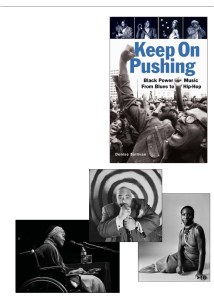
Stirring it up for 50 years, in 2002, Baraka was named Poet Laureate of New Jersey and of the Newark Public Schools amidst controversy over his poem, “Somebody Blew Up America” (who? who?  who?). That same year, The Roots accompanied him on “Something in the Way of Things (In Town),” on their album, Phrenology. More on Amiri Baraka, the Black Arts Movement, and his connections to music, from blues to hip hop in Keep on Pushing.

Filed under: Blues, Jazz, Keep On Pushing, , , , ,

Goodbye Old Year, Happy New You

Among arts enthusiasts, there is the year-end tradition of list-making, that compulsive, hierarchical compiling of bests and worsts that at its most sinister and cynical is rooted in the marriage of media and market forces and at its most benign is a form of entertainment for us media freaks and geeks. I happen to enjoy the tradition of critically reviewing the year in culture; it helps me remember its themes and threads and some of the good times as I determine what I shall carry forward versus what I’d rather forget. Listmaking or at least the act of reading and sharing of lists, is a form of community; and a little like resolutions, a list can hold you accountable for your taste, revealing however impeccable, poor, quirky, or mediocre it might be. Top Tens are also great conversation starters, and they can contribute toward creating a grassroots buzz for the otherwise unheralded.  Word of mouth is still my favorite way of receiving a recommendation, especially when so many other channels of information have been cut-off or rendered unreliable.  “I didn’t hear it, but a friend told me she liked it,” is often a good enough reason for me to try something new. Which brings me to my own list of a few of my favorite things from 2011.

Tassili by Tinawiren produced by Ian Brennan: Mali music spiked with the art rock of TV on the Radio, a taste of New Orleans from the Dirty Dozen Brass Band, and all the soul of Tinawiren’s distinct desert blues.

Detroit Ville Sauvage aka Detroit Wild City, directed by Florent Tillon, concerns the regenerating landscape and pioneering people of one of America’s greatest cities.

The Black Power Mixtape 1967-1975, directed by Goran Hugo Olsson, conjoins lost and found footage of the struggle in the ‘60s and early ‘70s with the voices of contemporary artists and activists (its narrative echoes the story told in Keep on Pushing, but that’s not the only reason I liked it).

La Havre by Aki Kurismaki.  A middle-aged French bohemian with problems of his own offers asylum to a young immigrant from Africa, separated from his family in the port city of La Havre.

Activist and educator, Dr. Cornel West and journalist Tavis Smiley for The Poverty Tour.

Nobel Peace Prize winner Leymah Gbowee for her activism.

Journalist Amy Goodman for her coverage of the Occupy movement

All the citizens who occupied our streets and parks, from coast to coast.

The Marriage Plot by Jeffrey Eugenides.  The story of trio of students forced to reevaluate everything they’ve learned up until graduation day will ring through for not only ’80s grads but the graduating classes of  2012 and 2013, too.

The Last Holiday by Gil Scott-Heron: A memoir as well as the story of how a hip hop original, alongside Stevie Wonder, contributed toward establishing the federal holiday honoring Dr. Martin Luther King, Jr. I can’t wait to read it.

Who and what contributed to some of your most treasured moments, events and artistic endeavors from the year that was?  And what are you looking forward to in the year that is?

Twenty-eleven was chock-a-block with personal milestones on my calendar—not least of which was the publication of Keep on Pushing--though I’d like to begin 2012 with a few words of thanks for the memories, inspiration and encouragement from this past super-year. First to my readers—whether we are strangers, relatives, colleagues, kindred spirits or friends for real, your support of the book has meant a great deal to me.  In the cases where we’ve dialogued, whether about the book’s themes, its soundtrack, the artists, and my reasons for writing about them, your inquiries and  feedback have been most gratifying. I am indebted to the thoughtful interviewers—broadcast and print journalists—who took the book to their hearts and invited me in for conversation.  In a new section of the blog headed Audio, I’ve recapped some of those recorded highlights (or I should say, the miracle that is internet radio and its archives has preserved them, in perpetuity).  Also, I owe yet another round of thanks to the publications that reviewed the book, as well as to the book sellers and librarians who invited me to participate in events at their stores and institutions, my editors and publisher Lawrence Hill Books and its distributor IPG, as well as the the musicians and poets who supported me at those appearances by performing for free. Chuck D’s tweet  about the book on New Year’s Eve ended the year on a sweet, high note.

We plan to Keep on Pushing throughout the election year with our revue. If you are a musician, a poet, an educator, activist, or a citizen who wants to get into it and get involved, please be in touch. Wishing us all peace, prosperity and good health in the new year (and whatever else it takes to move up a little higher, someway, somehow).

Filed under: Keep On Pushing, Occupy Wall Street, Reviews, , , , ,

Ce N’est Pas Bon by Mariam and Amadou

Anyone who’s read Keep on Pushing, this blog, my recent columns, or if you’ve read or heard any of the Keep on Pushing interviews, you know that in addition to collecting the origins of anti-oppression songs, traditional protest songs and contemporary topical songs of peace, justice and non-violent resistance, I’ve been in search of a new freedom anthem that concerns the survival of all the people–throughout the world. In a recent column (my Crawdaddy! column, Origin of Song has been appearing once a month on the Crawdaddy! blog at Paste Magazine), I suggested that “We Shall Overcome” the anthem that was, could serve as the anthem that is, and always shall be.  But I changed my mind:  “Ce N’est Pas Bon” by Mali’s Mariam and Amadou, is clear in its vision and intent, and you barely even have to know French to understand it. Hypocrisy, demagogy, and dictatorships are not good—nous n’en voulons pas.  “Du respect pour le peuple, de l’amour pour le peuple, de la paix pour le peuple.” ” Ce N’est Pas Bon” is from Mariam and Amadou’s 2009 Nonesuch album, Welcome to Mali (which I was happy to discover was released on vinyl): C’est magnifique.

Filed under: Keep On Pushing, Mali, Occupy Wall Street, , ,

On Two Giants: Belafonte and Davis

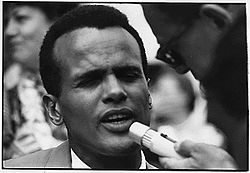
It should come as no surprise that both Harry Belafonte and Angela Davis figure prominently in the text of Keep on Pushing:  both are great American activists, with essential ties to the Civil Rights and Black Power Movements and the political and cultural events that shaped their times—then and now. This week I had the good fortune to hear both of them speak in person: Monday, Harry Belafonte addressed an audience in discussion with Tim Robbins, at a benefit for the Actor’s Gang, a community theater organization that also works with the prison population.  Then on Thursday evening, a talk between Angela Davis and Robin Levi was aimed at raising awareness about the prison industrial complex, specifically the California prison situation and the women in them.  Held at the UCLA/Hammer Museum, the event coincided with Now Dig This, a survey of LA African American-themed art, which is the runaway hit and must-see show of the city-wide Pacific Standard Time art exhibit.  As Davis explained, many of the visual artists on display were also “of the movement.”

Born and raised in Birmingham Alabama and educated at Brandeis University, while studying French and philosophy in Paris, Angela Davis learned of the bombing of the 16th Street Baptist Church that killed the four little girls with whom she’d been acquainted at home as a child.  Continuing her studies at home and abroad, she eventually returned to UCLA and Los Angeles in 1969, a time where the heat was turned up high on the Black Panthers, as well as anyone else interested in the politics of revolution; the UC Board of Regents made it difficult for her to teach peacefully.  When she was falsely accused of being an accomplice in the kidnapping and murder of Marin County Judge, Harold Haley, she served time in a California detention center.  A nationwide, grassroots campaign to liberate her contributed to her being set free after 18 months and her ultimate acquittal.  In 1972 the  Rolling Stones recorded “Sweet Black Angel” about her on their epic set, Exile on Main Street; John and Yoko/Plastic Ono Band cut “Angela” on their Some Time in New York City album  (the Stones sing “keep on pushing,” while John and Yoko tell her to “keep on moving”).

http://www.youtube.com/watch?v=GAMR0JPXDHo

In the decades since she made headlines and the FBI’s most-wanted list, Davis has continued to work as an activist, educator and author.  After teaching at one prestigious university after another, ironically, she returned to the UC system, to become a Distinguished Professor Emerita at UC Santa Cruz’s History of Consciousness Department.   She also founded the prison abolition organization, Critical Resistance, “dedicated to opposing the expansion of the prison industrial complex.”

Harry Belafonte was inspired by the works of singer-actor Paul Robeson, who became a mentor.  Early in his career as an actor turned singer, he reached out to foster a cross-cultural alliance with South African artists like Miriam Makeba and Hugh Masekela.  On the Greenwich Village music scene, Belafonte had familiarized himself with traditional American folk songs through his work in the theater.  In 1956, he released Calypso for which he turned to his Caribbean roots; it would sell in the millions.  Choosing his roles and repertoire with precision, Belafonte was uncompromising as an artist which earned him a commanding reputation; he explained that sometimes it was difficult for his peers to metabolize his energies, though he didn’t mean for it to be this way. As it was, he was the obvious choice for Dr. King who needed his assistance organizing the entertainment communities and their financial resources for the Freedom/Civil Rights movement.  Helping to organize the March on Washington, Belafonte became not only a confidante of Dr. King’s but he helped introduce African music to wider audiences.  His relationship to South Africa and the struggle against apartheid grew deeper; he became an intimate of Nelson Mandela.  From famine relief in Ethiopia to working with the incarcerated in the USA, Belafonte’s artistic gifts landed him on the frontlines of activism, which is where he’s lived for over 50 years.

The similarities between Belafonte’s and Davis’ stories are striking, a man and woman, two different generations, one a drop-out, the other highly educated. Yet both told stories of their mothers, young country girls who had to overcome resistance, obstacles and indignities to get themselves schooled, then went on to become fierce defenders of education. Today, both Belafonte and Davis are advocates for education, especially among prisoners—the people Davis calls “the other one percent”—who need to know their basic human rights.  Education has also been proven as a solution to recidivism, and contributes to the greater good of humankind, inside and outside prison walls. Both activists also share a vocal and visible enthusiasm for the Occupy Wall Street Movement; both had visited the New York encampment, while Davis has visited and spoken at various Occupy demonstrations.  She said that on November 2, the day the Port of Oakland was shut down, she joined somewhere between 10,000—to 15,000 people on the street, some of them from her own generation, all of them cheered by the protests led by the new generation of activists.  As for President Obama, and to anyone who may be disillusioned by his performance after three years on the job, Davis offered a reminder.

“Let us not forget that moment,” she said, referring to election night, 2008, as well as the collective amnesia that afflicts American consciousness.  “It was a triumphant moment,” she said.  Reiterating that protest and pressure is an American tradition she added, “We cannot allow one of these Republicans to get elected,” she said.  While Belafonte had  a few things to say about Herman Cain…

I probably don’t need to add that Mr. Belafonte, 84, and Ms. Davis, 67, were both extraordinarily gracious while greeting their public after their formal presentations.  They took time, meeting each gaze and responding to the individual requests of handshakes and photos with them. Their love for the people, has made them much beloved by the people. The warmth generated in the rooms they occupied in LA during the blustery last week of November/first week of December  will sustain some of us through the upcoming season—the one that passes for winter around here.

http://www.youtube.com/watch?v=ak_hQ9luKds

Filed under: Angela Davis, Calypso, Harry Belafonte, Keep On Pushing, Occupy Wall Street

Notes From the Keep on Pushing Express

Author reading this weekend

Interview with the author in Blurt

On-air at KUSF (In Exile)

Filed under: Keep On Pushing

President’s Dedication to Dr. King Rings with Message to Keep on Pushing

“…he kept on pushing, he kept on speaking, he kept on marching, until change finally came.”

“…when met with hardship, when confronting disappointment, Dr. King refused to accept what he called the “is-ness” of today; he kept pushing towards the “ought-ness” of tomorrow.

“We can’t be discouraged by what is…we’ve got to keep pushing for what ought to be…”

Filed under: Keep On Pushing, , , ,

Curtis Mayfield, Part Two

Amoeblog: There’s a lot of “Keep On Pushing” titled songs. Which one were you thinking of when you titled your book?

Denise Sullivan: I was thinking of the original song by the Impressions, written by Curtis Mayfield and the way “keep on pushing,” and “move up a little higher” reoccur in his other songs, like “We’re a Winner”and “Move on Up.” Mayfield isn’t talking about the ladder of success and financial status. He’s talking about raising consciousness and about transcendence–about moving above and beyond circumstances. Combine those themes that are of deep interest to me with the genius of his composition and you get a title that I hope conveys the potential for extreme unity, between message, music and people.

Filed under: Curtis Mayfield, Keep On Pushing, Soul, ,

Vibration is…Positive for Keep on Pushing

“A pleasing survey of soul music, from Lead Belly to Johnny Otis to Michael Franti to Louis Farrakhan . . . Sullivan offers a welcome exploration of how African-American popular music became America’s vernacular.”—Kirkus Reviews

Sullivan . . . combines impressive research and wide-ranging interviews in a multilayered narrative about the power of music within black liberation, civil rights, antiwar, and gender-related movements . . . This is for anyone interested in a thorough analysis of music as a commanding force in change as well as a continually evolving artistic presence.” —Library Journal

Filed under: Keep On Pushing, Reviews, , , ,

Keep on Pushing Reviewed in July Print Edition of Under the Radar

“Reaching as well into the areas of punk rock, reggae, and finally hip-hop, Keep On Pushing admirably points out numerous key developments and connections throughout a vital, revolutionary element of popular music.” —Under the Radar

Filed under: Keep On Pushing, Reviews, , ,

Kudos For Keep on Pushing in Pop Matters


“…Sullivan paints with condensed strokes, documenting in succinct sections how the music segued with powerful protest movements to smash disfranchisement and rouse sometimes fleeting victories, daring “to question the new freedoms and the quality of life ‘freedom’ brought in the face of liberty’s inconsistencies and … costs.”  -Pop Matters

Filed under: Keep On Pushing, Reviews, ,

Archives

Recent Posts

Browse by subject or theme