It was 50 years years ago that the four Birmingham, Alabama girls, Addie Mae Collins, Denise McNair, Carole Robertson and Cynthia Wesley, lost their lives during the bombing of the Sixteenth Street Baptist Church. In 2011, a marker was finally dedicated in their names at the site of the vicious, racially motivated attack.
Just three months after the murder of Medgar Evers in Jackson, Mississippi, and two weeks after the March on Washington and Dr. King’s momentum-building “I Have a Dream” speech in 1963, the Alabama tragedy became the pivotal event in the Civil Rights Movement. Singer Nina Simone wrote “Mississippi Goddam” in immediate response to hearing the news: “I shut myself up in a room and that song happened,” she said of the song that begins, “Alabama’s got me so upset.” From that moment forward, Simone was committed to writing and performing material that would jolt people awake or into action. It remains her most enduring work.
Joan Baez, had of course walked alongside Dr. King at the marches in the South all along; her tribute was a recording of “Birmingham Sunday” by her brother-in-law, the writer Richard Fariña. Each girl was remembered by name in the verses, set to the tune of a beautiful folk melody. Fifty years on, both songs remain painful reminders of the brutalities waged here and yonder, year in and year out, by so-called humanity.
As most readers know, today is the 50th anniversary of the the historic March on Washington for Jobs and Freedom. What you may not know, even as an astute observer of civil rights and music history and where they meet, is the name Len Chandler: He was among those assembled to help Dr. King push forward his dream of racial harmony and economic justice on that day, as well as on the marches in the Southern States. At the March on Washington, Chandler was one of the voices in a trio that included Bob Dylan and Joan Baez. He marched with Dr. King and traveled through the South in the name of voter registration, informing rural Southerners of their polling rights, at risk to his own life. It was a now-you-see-it-now-you- don’t YouTube clip of Chandler’s inspirational performance of “Eyes on the Prize” that contributed to inspiring me to track him down and move forward with the writing of Keep on Pushing, my text that unpacks the origins of freedom music, and its roots in African American struggle and triumph.
Originally from Akron, Ohio, and studying on scholarship at Columbia in the ’50s, Chandler made his way to Greenwich Village folk music a bit by accident. Lured to the sounds of Washington Square Park by the downtown youths he was mentoring, he easily fell into the scene based on his natural ear for songwriting and his familiarity with the songs of Lead Belly, Big Bill Broonzy, and Woody Guthrie. Following a performance at the popular Village coffeehouse, the Gaslight Cafe, Chandler landed a contract to go to Detroit, writing and performing topical songs for local television. A few months later when the gig was through, he returned to New York to find the folk thing in full swing: Bob Dylan was the latest arrival to town and the pair started to trade ideas and songs. “I hadn’t yet begun writing streams of songs like I would, but Len was, and everything around us looked absurd—there was a certain consciousness of madness at work,” wrote Dylan in his book Chronicles, remembering when. Chandler remembers it like this in Keep on Pushing: ”The first song I ever heard of Dylan’s was ‘Hey ho, Lead Belly, I just want to sing your name,’ stuff like that.” Dylan used Chandler’s melody for his song, “The Death of Emmett Till.” “Len didn’t seem to mind,” wrote Dylan.
Chandler went on to record two albums for Columbia: To Be a Man and The Loving People. He continued to work as a topical songwriter, a peace and civil rights advocate, and as a songwriting teacher; his tour of Pacific Rim bases with Donald Sutherland, Jane Fonda, Holly Near and Paul Mooney was documented in the Francine Parker film, FTA, a must-see for anyone interested in US history and anti-war efforts within military ranks.Catch a glimpse of Chandler at the end of this trailer for the film:
Today, Chandler is largely retired from performing, but he remains well- informed on human rights, politics, and the arts, and can write and perform songs that still pack a punch. I must say it was a privilege to meet one of the true unsung singing activists of my lifetime (as well as his wife Olga James, a pioneering performer in her own right), and have him tell his story in Keep on Pushing (which is where you will find more straight talk from Chandler, as well as my own perspectives on his contribution to civil rights history). I had hoped to see him on television today, in the crowd in Washington, or better yet, onstage with Peter and Paul, reviving a freedom song for our times. Perhaps I missed him, but Len Chandler belongs on the guest list of esteemed names assembled for any kind of 50th anniversary commemoration of the March, the Civil Rights Era, and anywhere Freedom Songs are still sung.
The story of Chicago’s 15-year-old Emmett Till (born today in 1941), murdered while on summer vacation in Money, Mississippi, was among the events in the mid-‘50s that mobilized the Civil Rights Movement; the tragedy was chronicled by Bob Dylan in one of his earliest songs. This clip contains a bit of background as well as the audio of the song which tells the story.
Following the recent events in Florida, where George Zimmerman was acquitted of the murder of Trayvon Martin, the names Emmett Till, as well as slain NAACP field secretary Medgar Evers have been invoked by civil rights leaders. It is unthinkable, though entirely possible, that a generation of young folk are unfamiliar with these names, icons of the civil rights movement that marched on, throughout the South and toward Washington in the Summer of ’63. But there remains similarities in the cases: Like the families of Till and Evers, in the face of extreme tragedy, Martin’s mother, Sybrina Fulton, and his father Tracy, are working with the civil rights communities for justice. And like Till and Evers, the death of Trayvon Martin has moved artists to tell his story, in an effort to increase knowledge and inspire action. Here are but two, “Trayvon” by Jasiri X, and “Justice (If You’re 17)” by Wyclef Jean.
In this 50th anniversary year of Freedom Summer and the March on Washington, while we at once celebrate a victory for same sex couples across the country, we must mourn the return to states rights and the constricting of voting and women’s rights down South, as well as the injustice of the trial in Florida and ridiculous Stand Your Ground laws. Young men of color remain especially at risk of racial profiling, targeted and incarcerated in vastly disproportionate numbers. As the California prison hunger strike (protesting torturous conditions of solitary confinement) now in its third week continues, while overseas US drones hunt and kill innocent people mercilessly, “the conversation on race” is having its moment in the media spotlight. We must insist it continue and on Freedom Now, as the generations of our parents and grandparents did. Deep in my heart, I do believe, there is a song waiting to be written and sung at this year’s March on Washington.
If you can’t speak out against this kind of thing, a crime that’s so unjust
Your eyes are filled with dead men’s dirt, your mind is filled with dust…
…But if all us folks that thinks alike, if we gave all we could give
We could make this great land of ours a greater place to live.
“Somewhere I read of the freedom of assembly. Somewhere I read of the freedom of speech. Somewhere I read of the freedom of the press. Somewhere I read that the greatness of America is the right to protest for right,” said Dr. King in his final speech, delivered on April 3 to striking sanitation workers in Memphis, Tennessee. The following day, April 4, the civil rights leader, winner of the Nobel Peace Prize, and beloved hero to millions around the world, was shot to death on the balcony of the Lorraine Motel. Forty-five years later, the work of non-violent protest in the name of desegregation, voting rights, racial harmony, jobs, freedom, opportunity, and an end to wars, is carried on by an international community of civil rights advocates and human rights and anti-war activists. Among the musical tributes in response to the tragedy were Dion’s popular “Abraham, Martin and John,” Otis Spann’s less-known “Blues for Martin Luther King, ” and Nina Simone’s enduring and emotional “Why (The King of Love is Dead),” first performed in his memory on April 7, 1968, the national day of mourning following the assassination. For further reflection on Dr. King’s message of love, please start with the The King Center archives, dedicated to the non-violent eradication of poverty, racism and violence.
Actor, singer and activist Harry Belafonte accepted the NAACP’s Spingarn Medal on Friday night in New York City for outstanding achievement by an African American in 2012. Reprising a powerful speech he delivered at the NAACP Image Awards on February 1 in Los Angeles, he urged Black America, especially its artists, to get involved in the ongoing fight for social and economic justice, particularly in the areas of gun and prison reform, and eradicating poverty.
Asking for leadership while calling out the names of his mentors, his inspirers, those he cited as his moral compass, “W.E.B. Du Bois, Martin Luther King Jr., Eleanor Roosevelt, Fannie Lou Hamer, Ella Baker, Bobby Kennedy, Ms. Constance Rice and perhaps for me, most of all, Paul Robeson,” he honored their names and others like them as “The men and women who spoke up to remedy the ills of the nation.”
He elaborated on the role the accomplished singer, actor, athlete, and activist Robeson played in inspiring his own work as an artist/activist.
“For me, Mr. Robeson, was the sparrow. He was an artist who made those of us in the arts understand the depth of that calling when he said, ‘Artists are the gatekeepers of truth. We are civilization’s radical voice.'”
Belafonte continued with his own inspiring message to America’s next freedom singers. “Never in the history of black America has there be such a harvest of truly gifted and powerfully celebrated artists. Yet, our nation hungers for their radical song. In the field of sports, our presence dominates. In the landscape of corporate power we have more of a presence of captains and leaders of industry than we have ever known. Yet, we suffer still from abject poverty and moral malnutrition.”
He suggested as a solution, that what’s missing in the struggle for justice today is radical thought. “America keeps that part of the discourse mute,” he claimed.
“I would make an appeal to the NAACP as the oldest institution in our quest for dignity and human rights that they stimulate more fully the concept and the need for radical thinking…Unless Black America raises its voice loud and clear…America will never become whole, and America will never become what it dreams to be, until we are truly free.”
Here is the speech in its entirety from today’s broadcast of Democracy Now.
Read more on Harry Belafonte, Paul Robeson and singing for justice in Keep on Pushing
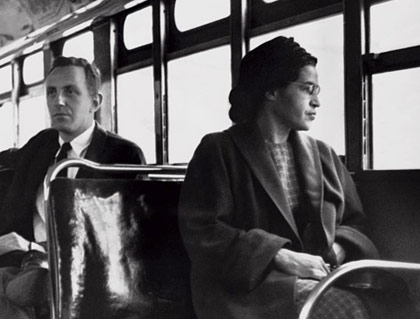
February 4 is the birthday of Rosa Parks, the civil rights activist remembered for refusing to move to the back of the bus: The Montgomery Bus Boycott, in the name of the desegregating public transit, was organized immediately following her arrest on December 1, 1955.
Born Rosa Louise McCauley in Tuskegee, Alabama in 1913, Parks was a student of non-violent protest and an active member of her local chapter of the NAACP in Montgomery, but her refusal to move on the bus that day was not part of any kind of group action or occupation—she held her seat on her own steam. And yet far from receiving any heroine’s awards, Parks paid the price for asserting her right to ride: In the immediate aftermath of the desegregation effort, she could no longer find work in Montgomery. She and her husband Raymond moved north, eventually settling in Detroit where she worked the better part of her life as a secretary for US Representative John Conyers.
Parks would one day receive the highest honors in the land– from the NAACP’s Spingarn Medal (Harry Belafonte will be honored this year), to the Presidential Medal of Freedom (awarded to her by President Bill Clinton) and the Congressional Gold Medal. But if you dared to mess with the Mother of the Modern Day Civil Rights Movement and her legacy in a movie or a song, look out: Parks was liable to slap you with a legal action or a boycott. “Sister Rosa,” a tribute to her by New Orleanians, the Neville Brothers, appears to have passed the test (though atypically for the Nevilles, it’s a rap track, taken from their 1989 album, Yellow Moon).
Parks passed in 2005, though matters of her personal estate have not been resolved and her detailed personal archive has not yet found a permanent home. She would’ve been 100 this year. For more information on Rosa Parks, visit the Rosa and Raymond Parks Institute.
It was a long road to the third Monday in January when all 50 states will observe the birth of Martin Luther King, Jr. and the day named in his honor in their own unique ways. Largely owed for making the dream of a King holiday a reality is Stevie Wonder, who back in 1980, wrote the pointed song “Happy Birthday,” then launched a 41-city U.S. tour (and invited Gil Scott- Heron along) to promote the idea which was first mooted by Rep. John Conyers in 1968. The musical efforts were ultimately the key in collecting the millions of citizen signatures that had a direct impact on Congress passing the law signed by President Ronald Reagan in 1983, declaring a day for MLK. Observed for the first time in 1986, some states were late to the party, however, by the turn of the 21st Century, all were united in some form of remembrance of the civil rights giant. “Happy Birthday”, which served as the Wonder-campaign theme (and is now the “official” King holiday tune) is the last track on Hotter Than July. The album also features “Master Blaster”, Wonder’s tribute to Bob Marley who had been scheduled for the tour until he fell too ill to participate. Stepping into the breach was Scott-Heron whose 2011, post-humously published The Last Holiday, details his own journey with music and activism, while it retraces the long and winding road Wonder took to bring home a US federal holiday with the help of a song. The tour brought Gil and Stevie to Oakland, where they played in the name of King, as did Rodney Franklin and Carlos Santana, on the shocking night John Lennon was killed (though that is a story better read in Scott-Heron’s memoir).
In King’s birthplace of Atlanta, Georgia, the King Center, has a full schedule of events currently underway; the celebrations and various symposiums are of course dedicated to the King’s teachings in non-violence. In San Francisco on January 21, there will be an all-day celebration of King’s life at Yerba Buena Center for the Arts from 11 a.m. — 5 p.m. The City of Santa Monica also has a full weekend schedule of events beginning on Friday. The photo above was of course taken during the historic “I Have a Dream” speech, delivered on August 28, 1963 at the March on Washington now in its 50th anniversary year. Had he lived, Dr. King would’ve been 84 today—and still dreaming.
Hats off to West Coast artists Tom Morello, Jello Biafra and Michelle Shocked for joining Lee Ranaldo and Co.at New York’s Foley Square Park last Sunday for the kick off of the one year anniversary week of Occupy. Shocked performed “99 Ways to Loathe Your Lender,” sung to the tune of Paul Simon’s “50 Ways to Leave Your Lover.” Though Shocked discourages filming of her shows, I hope she won’t mind that I found a barely viewed clip of her performing it (she follows Biafra’s spoken word piece). The protest standard, “Which Side Are You On,” was performed as a singalong (it’s as close as any song the movement has to an official anthem). Happy Anniversary Occupy, and thank you to the Occupiers and musicians who represent the 99 percent.
photo of Len Chadler at the 1964 Newport Folk Festival by John Rudoff.
August 28 marks the 49th anniversary of the the historic March on Washington for Jobs and Freedom. Among those assembled to help Dr. King push forward his dream of racial harmony and economic justice on that day was Len Chandler, one of the voices in a trio that included Bob Dylan and Joan Baez. Chandler would march with Dr. King and travel through out the South in the name of voter registration, informing rural Southerners of their polling rights, at risk to his own life. It was a now-vanished YouTube clip of Chandler’s inspirational performance of “Eyes on the Prize” that contributed to inspiring me to track him down and move forward with the writing of Keep on Pushing, my text that tracks the origins of freedom music, and its roots in African American struggle and triumph.
Originally from Akron, Ohio, and studying on scholarship at Columbia in the ’50s, Chandler made his way to Greenwich Village folk music a bit by accident. Lured to the sounds of Washington Square Park by the downtown youths he was mentoring, he easily fell into the scene based on his natural ear for songwriting and his familiarity with the songs of Lead Belly, Big Bill Broonzy, and Woody Guthrie. Following a performance at the popular Village coffeehouse, the Gaslight Cafe, Chandler landed a contract to go to Detroit, writing and performing topical songs for local television. A few months later when the gig was through, he returned to New York to find the folk thing in full swing: Bob Dylan was the latest arrival to town and the pair started to trade ideas and songs. “I hadn’t yet begun writing streams of songs like I would, but Len was, and everything around us looked absurd—there was a certain consciousness of madness at work,” wrote Dylan in his book Chronicles, remembering when. Chandler remembers it like this in Keep on Pushing: “The first song I ever heard of Dylan’s was ‘Hey ho, Lead Belly, I just want to sing your name,’ stuff like that.” Dylan used Chandler’s melody for his song, “The Death of Emmett Till.” “Len didn’t seem to mind,” Dylan wrote.
Chandler went on to record two albums for Columbia: To Be a Man and The Loving People. He continued to work as a topical songwriter, a peace and civil rights advocate, and as a songwriting teacher; his tour of Pacific Rim bases with Donald Sutherland, Jane Fonda, Holly Near and Paul Mooney was documented in the Francine Parker film, FTA, a must-see for anyone interested in US history and anti-war efforts within military ranks.Catch a glimpse of Chandler at the end of this trailer for the film:
Today, Chandler is largely retired from performing, but he remains well- informed on human rights, politics, and the arts. I must say it was a privilege to meet one of the true unsung heroes of singing activism (as well as his wife Olga James, a pioneering performer in her own right), and to tell his story in Keep on Pushing which is where you will find more straight talk from Chandler, as well as my own perspectives on his contribution to civil rights history. If there is any chance that Harry Belafonte intends to organize the musical presentation for next year’s 50th anniversary of the March on Washington, I hope he will consider issuing an invitation to Chandler for another chorus of “Eyes on the Prize” (hold on).
Sen. Robert F. Kennedy was preparing his bid for the presidency, looking as if he would surely be the one chosen to lead his country through the deep water. Like Dr. King, he had grown in favor of withdrawing troops from Vietnam. From his seat on Capitol Hill, he had become a fierce advocate of civil rights and economic justice and the social programs to accompany those ends, supported by a progressive belief within his faith. Following his victory in the California primary election, on June 5, 1968, he too was shot down, two months after the loss of Dr. King.
Has anybody here seen my old friend Bobby? Can you tell me where he’s gone?
So went the Dick Holler song, “Abraham, Martin and John,” it’s final verse devoted to “Bobby.” Written in response to the 1968 assassinations, it was first recorded by Dion DiMucci; Smokey Robinson, Marvin Gaye, and Harry Belafonte were also moved to record the song, as were others as time and the years wore on.
In this clip, Smokey Robinson sings and talks a bit about what the song has meant to him, during a 2010 performance at the White House.

 It was 50 years years ago that the four Birmingham, Alabama girls, Addie Mae Collins, Denise McNair, Carole Robertson and Cynthia Wesley, lost their lives during the bombing of the Sixteenth Street Baptist Church. In 2011, a marker was finally dedicated in their names at the site of the vicious, racially motivated attack.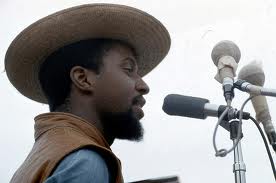




 Denise Sullivan