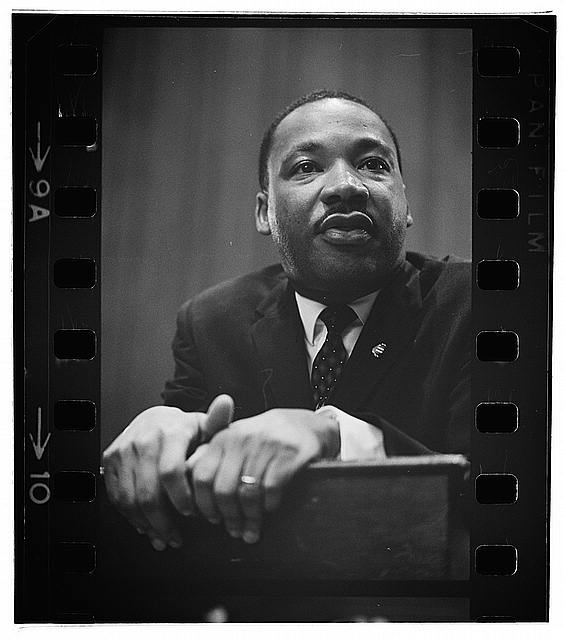
Martin Luther King Jr., Joan Baez and Harry Belafonte
Joan Baez was a junior at Palo Alto High School when she first heard Martin Luther King, Jr. speak at a conference for young Quakers. She would go on to sing for the non-violent movements for civil rights, social, economic and racial justice and against the war in Vietnam.
“King was giving voice to my passionate and ill-articulated beliefs,” wrote Baez in her memoir. Her “exhilarating sense of ‘going somewhere’ with my pacifism” in the aftermath of that speech would lead her to join King on marches in the Jim Crow south and at the historic March on Washington.
If you don’t already know about Baez’s history as a lifelong activist, you certainly would not get it from a viewing of the ahistorical Bob Dylan biopic, A Complete Unknown, released in US theaters this Christmas.
Loosely based on Dylan’s arrival in New York City in 1961, the film covers the songwriter’s introduction to the Greenwich Village scene, his meetings with Woody Guthrie and Pete Seeger, and his intimate relationships with Baez and the fictional Sylvie Russo, a stand-in for his real life steady, Suze Rotolo.
“During the height of the civil rights era Bob wrote, among other songs, ‘The Lonesome Death of Hattie Carroll,’ ‘The Death of Emmett Till,’ [‘Only A Pawn In Their Game’] and of course, ‘Blowing in the Wind,’ which became a kind of anthem,” Rotolo wrote in her own memoir of the Village in the ‘60s. In the film, “Blowing in the Wind” is framed in his repertoire to be more like an annoyance or an albatross.
There’s a scene recreating Dylan and Rotolo’s meeting at a 1961 folk-a-thon at the Riverside Church, the historic hub of progressive gathering in New York City. And there is a brief moment when the Russo character explains to a befuddled Dylan that she works at the Congress for Racial Equality (CORE), organizing the Freedom Rides from North to South — in fact one of Rotolo’s jobs in the era.
Facts are also, that in 1963, Dylan walked off the all-important nationally broadcast The Ed Sullivan Show when he was asked not to play his song, “Talkin’ John Birch Society Blues.” For those unacquainted, the John Birch Society is a radical far right group and the song is a satire.
That not much is made of the realities of the causes and concerns that moved both Baez and Rotolo to become immersed in movement work and the folk scene is perhaps understandable: A Complete Unknown is after all, a version of a story of Dylan becoming Dylan. But the gaps in the story of Dylan’s own connections to civil rights and the songs he wrote in their favor are woefully understated in the film, as are his friendships with the people in his circle (where, for example, were the nods to Ramblin’ Jack Elliott? Phil Ochs? Odetta? Lead Belly, at least, appears in an 8×10 photograph). There are also no poets, comedians or jazz musicians in the film’s version of the Village, though they are among those who also contributed to it being America’s bohemian center of its time.
Nor are there any three dimensional Black artists or musicians depicted in the film. The one scene in which a Black musician has a speaking role was made out of whole cloth and is particularly egregious: The fictional bluesman, Jesse Moffette (portrayed by Big Bill Morganfield whose father in real life was blues legend Muddy Waters) is played as a drunken mess when he appears with Dylan on Seeger’s public television show, Rainbow Quest. That Rainbow Quest really existed and featured musicians Rev. Gary Davis, Mississippi John Hurt and Sonny Terry and Brownie McGee is undeniable. The inclusion of any one of those artists would’ve made an interesting, albeit fictional meeting between Black and white, established and next generation musicians. But the creation of a fictionalized and stereotypical bluesman is not only in poor taste, it was a missed opportunity to introduce new listeners to the musicians who influenced Dylan and generations of future folk, blues and rock musicians.
One full episode of Rainbow Quest was devoted to Dylan’s friend and contemporary, Len Chandler, another figure on the Village scene who was eliminated from the story told in A Complete Unknown. It was Chandler who drove Dylan on the back of his motorbike to deliver his first album to Guthrie in the hospital.
“We took out our guitars and played Woody songs,” said Chandler.
Len Chandler and Bob Dylan at Newport Folk Festival, 1964, photo by Jim Marshall
Chandler and Dylan hung out, traded songs, learned their trade and celebrated their song publications in folk journals, Broadside and Sing Out! And while Chandler spent considerably more time in the South fighting for the rights of Black Americans (like Baez, it was his calling), it’s significant that Dylan appeared shoulder to shoulder with both of them at the March on Washington (though the film makes a bungle of computer generated imagery to recreate his appearance there).
Considering what could’ve been is a fool’s game but I’ll play it anyway: Dylan’s first recording session was as a harmonica player on another one of his heroes records: Harry Belafonte’s “Midnight Special.” The often told story of Dylan throwing his harps in the trashcan afterward would’ve made a great cinematic moment. The inclusion of a civil rights giant would’ve again been a nice prompt for a young viewer to dig deeper into Belafonte’s role in American civil rights, music and Dylan’s own history.
Oh but there’s more: Dylan famously had a crush of the wanting to marry her kind on Mavis Staples. Here again, was another missed opportunity to demonstrate how the singer’s dreams listening to and playing music with his inspirers became his reality. Instead, there is a Black woman of intrigue in the film who Dylan dumps in short order after her appearance. We have no idea who she is or is supposed to be standing in for, but a little like the nameless “mistress” played by Angela Bassett in Masked in Anonymous, she is there to let us know the main dude is an equal opportunity romancer.
The studio players on Dylan’s recordings, Paul Griffin, Sam Lay, Bruce Langhorne, as well as his producer Tom Wilson, could all have been elevated to characters with even one or two-line speaking roles, if only to let the audience know these cats were not just extras to add color to the cast: These were seasoned professionals hand-picked for the records that transitioned Dylan from solo folky to serious, original artist.
And then there is the short shrift given to Dr. King, whose “I Have A Dream” speech Dylan and Chandler listened to in real time, on the day it was delivered.
“That’s what I remember from the speech, being behind another monument with Dylan and silencing ourselves, and sitting in amazement as we heard that wonderful speech unfold,” Chandler remembered. But the take on historic Black preaching in A Complete Unknown, comes in the form of a man in a fedora and trench coast on a soap box. Listed in the credits as “civil rights speaker,” the character is but a token symbol for the movement that reached its very apex during the era depicted in the film. The scenes at the Newport Folk Festival would take me another viewing to de/reconstruct but they suffer from similar missed opportunities to display Black excellence and inspiration (Lightnin’ Hopkins, Willie Dixon, Fannie Lou Hamer, for God’s sake).
What could’ve been a simple and effective portrait of young Dylan and the ways folk musicians, women, and Black Americans intersected with the Civil Rights Movement and helped to shape the counterculture and ideals that came to define the ’60s, is in the end, just another piece of product, a part of the Dylan Industrial Complex: The books for days, the several documentaries, a museum and archive, a brand of liquor, a Christmas album, ornaments, and a line of bobbleheads…these are but a fraction of the branded, approved, licensed and unlicensed materials on offer in his name. Why should I have wished that a biopic be anything more than a distraction, an entertainment?
In the end, the contributions to the Civil Rights Movement made by women and Black Americans are the real hidden figures and unknowns obscured in the Hollywood retelling of Dylan’s own early ‘60s story. As impenetrable as the “real Dylan” may be or seem to be, I left the film not thinking about him, but wanting to ask the folks living and passed over, how does it feel?
Now that it’s September and the clouds here in San Francisco have cleared, I have some news to share: A new publication – the slim volume pictured above is on a new press – and it was made not only in memory of a movement hero, but in support of voting rights for all.
The story of Len Chandler is one of a path taken by chance. Among the countless singers, students and teachers from coast to coast who sat in, stood up and rode freedom’s highway for the voting rights of their fellow Americans in the Jim Crow South, Chandler had an extraordinary knack for topical songwriting and an unwavering dedication to racial justice. From his home in Akron, to the heart of the Greenwich Village folk scene, Chandler was introduced in short order to humorist Hugh Romney aka Wavy Gravy, poets Bob Kaufman and Langston Hughes, and folksingers Dave Van Ronk and Bob Dylan. Swiftly recruited by Pete Seeger to join the singing organizers with the Student Nonviolent Coordinating Committee, he was sent to Arkansas to register voters.
“You have to take the lead from somewhere and there were only a few performers around who wrote songs, and of them, my favorite was Len Chandler,” said Dylan. Compiled from rare interviews with Chandler by the author, Denise Sullivan’s concise tribute, Shadow Dream Chaser of Rainbows, pays homage to an unsung folk hero and provides instruction and inspiration for artists and activists pushing for change in perilous times.
This project has been long in the making: It started nearly 20 years ago when I embarked on the research for Keep on Pushing. It was resurrected when I was invited by the Bob Dylan Center to contribute an essay to a proposed catalog, and it was completed with the creation of a small press, Lyon Editions. Your purchase of Len Chandler: Shadow Dream Chaser of Rainbows will not only support its makers, it will contribute toward supporting voting rights and poll watching organizers, specifically in Georgia.
Rest assured Chandler is missed this election season, but let’s vote in his memory and in the memory of Medgar Evers, Viola Liuzzo, James Chaney, Andrew Goodman, Michael Schwerner, Martin Luther King, Jr. and others who lost their lives in the name of civil rights. A vote for Kamala Harris will see to it that the John R. Lewis Voting Rights Advancement Act is passed, ending voter suppression in all its forms, once and for all.
Thank you to our friends at Bird and Beckett Books and Records for the proper launch on August 28 as we commemorated 61 years since the March on Washington for Jobs and Freedom, and one year to the day of the passing of Chandler. Full book talk and discussion here. Purchase books here. Thank you.
Back when I wrote for the music press part time and worked at a small record label where it was also my job to answer the phone, I received a call from San Quentin. Immediately a recording played, stating the call was coming from a California correctional facility, though I was surprised to learn the call was for me. Though I did not know the person, he was seeking a member of the press to write about the sudden cessation of the prison’s writing program. He said it was imperative to get the word out so that some action could be taken to preserve the incarcerated population’s right to read. I listened to the plea, said I would do what little I could, and called a reporter, a friend of mine’s sister, who worked at the San Francisco Chronicle. I think the calls came a couple of more times, but there wasn’t much I could do. To my knowledge there was never a news story about conditions at the prison or its literacy programs. At the time, I didn’t realize there wasn’t any meaningful oversight of the state prison system and that “privileges” like food, exercise and activities were withheld at random, say, if a guard took a dislike to an incarcerated individual.
During the ’80s, the Reagan administration’s War on Drugs created the conditions that led to the over-incarceration we see today, particularly of Black and Latinx individuals. Scholars, like Michelle Alexander and Angela Davis among others, contend incarceration is a racist system of control that extends outside prison walls. There is plenty documented on the subject and I invite you to read more
Today there are over 2 million people living inside America’s prisons. According to the Sentencing Project, at the time I received the call from San Quentin, there were about 40,000 people in prison at the cost of approximately 6 billion dollars annually. Today the state spends over 60 billion on incarcerating its citizens. Two new books on the subject, mostly in the words of people who have done their time, suggest that prisons are a modern day form of slavery and that we abolish the prison nation.
When I received that phone call from San Quentin some years ago, I did not know that the prison population would increase by 500 percent over the next 40 years. Surely by now, most every American knows someone whose life or family has been impacted by the carceral system.
Writing and educational programs have been restored on and off in the California system, though mostly, they are off.
Over the years, I thought about that phone call, the lack of coverage of the prison system in the media, and lack of oversight behind prison walls. I became aware of the prison industrial complex — the relationship between businesses and institutions — as well as the basic human rights violations of incarcerated individuals, and corresponding mobilization efforts, inside and out, to raise awareness of the injustices and correct the abuses.
I am still learning about how we talk about the injustices of incarceration. Hearing stories from people who have lived the horror of America’s prisons seems to offer the most hope toward solutions. I recently viewed the documentary, The Strike, and learned more about the historic California State Prison hunger strike; I listen to Prison Radio, which broadcasts the voices of incarcerated, and look forward to the compact commentaries, often prophecies from Mumia Abu-Jamal. I read the San Francisco Bay View, one of the few publications that delivers firsthand coverage from incarcerated reporters; and I have spoken to San Franciscans who do what they can, using their time and talent to care for incarcerated loved ones and strangers.
Please take a moment today to consider the over 2 million Americans incarcerated. If interested, one action you can easily take is to support the Prison Literature Project: They send books to incarcerated individuals which is not as easy as it sounds — it’s a process and they are specialists. Thanks for reading today. Songs also contain information. Thanks for listening.
Earlier this year in San Francisco, there was a live, all-star tribute to 92-year-old folksinger, Ramblin’ Jack Elliott. Making his way around the world in the ‘50s, and a friend of Woody Guthrie’s during the pivotal modern era of American folk music, the contemporary celebration of Elliott was also a benefit for Sweet Relief, the 30-year-old organization founded by Victoria Williams to assist musicians in need. Oddly, the show was mostly void of political content save for a few remarks by musical director Joe Henry, 64, and Jackson Browne, 75, nodding to Guthrie and the roots of American folk and topical song.
Showing up in Elliott’s honor were Joan Baez and Bob Weir, both 83, and Steve Earle and Rickie Lee Jones aged 69. Of course there were younger performers on the bill, but my eyes and ears weren’t trained on them as much as they were on the older adults onstage and in the house: I gleefully whispered to my husband that unusually, I was among the youngest in the room.
Len Chandler was a protest singer, movement worker and unsung hero from the Civil Rights Era, a frontline campaigner in the fight for voting rights, racial and economic justice and against wars of aggression. He performed with Bob Dylan and Joan Baez at the March on Washington For Jobs and Freedom in 1963 where Dr. Martin Luther King, Jr. delivered his historic “I Have A Dream” speech. In 2021, I was commissioned to write a piece on Chandler and his relationship to Bob Dylan in front of the opening of the Bob Dylan Center in Tulsa, OK. The essay is emerging here for the first time before its publication as a commemorative limited edition booklet on the life of Chandler (with expanded content). A portion of the book’s earnings will be contributed to voting rights organizations. Order here: Len Chandler: Shadow Dream Chaser of Rainbows/In memory of a movement hero
“You have to take the lead from somewhere and there were only a few performers around who wrote songs, and of them, my favorite was Len Chandler,” wrote Bob Dylan in his book, Chronicles.
Among the singing foot soldiers in the civil rights movement, the students and teachers from coast to coast who sat in, stood up and rode on freedom’s highway, and of all the folksinging pamphleteers and poets who swarmed Greenwich Village in the late ‘50s and early ‘60s, only Len Chandler emerged from that fabled period an under-looked groundbreaker and a foundational freedom singer, a kind of cosmic twin to Bob Dylan.
“We talked all the time,” said Chandler. “I can’t remember what we talked about but half the time, it would be philosophical, our different approaches to things. We could talk for two days on whether it’s a straight line or circle,” he said, recalling that vortex, that wrinkle in time in Greenwich Village where the cultural happenings of the ‘60s were beginning to reveal themselves. “I’d argue today that it’s a circle. The circle is built into everything. It’s built into our DNA, it’s built into the way the cosmos is formed. Everything is circular.”
The Village swirled with poets, playwrights, and artists of all stripes, mixed with locals and others from afar, far-out people who sought a fluid place to become who they thought they were meant to be – the kind of place and kind of time where young Len Chandler (from Ohio) and young Bob Dylan (from Minnesota) could meet, become friends and learn how to frame, shape and deliver a song.
“He sang quasi-folk stuff with a commercial bent and was energetic, had that thing that people call charisma,” Dylan wrote. “Len performed like he was mowing down things. His personality overrode his repertoire. Len also wrote topical songs, front-page things.”
Ordering infoLen Chandler: Shadow Dream Chaser of Rainbows
Five songs into their set at Chicago’s New Nazareth Church, the Staple Singers get down to the real, and the reason, they called their gospel meeting on April 9, 1965.
“A few days ago freedom marchers marched on Selma to Montgomery, Alabama,” says Roebuck “Pops” Staples. “And from that march, words were revealed and a song was composed. And we wrote a song about the freedom marchers and we call it the ‘Freedom Highway.’ And we dedicate this number to all the freedom marchers, and it goes something like this.”
Tearing into their new song as if it was a longtime traditional favorite, the Staples evoke the energy and resistance of the historic freedom trail for voting rights, right there at their South Side parish. Though few could’ve predicted or believed that the messages of the Martin Luther King, Jr.-led movement would still be necessary or relevant 50 years on, this timeless performance at the height of the fight has been mercifully preserved, restored and reissued on Legacy’s new Freedom Highway Complete—Recorded Live at Chicago’s New Nazareth Church, April 9, 1965, for all the world to once again bear witness and hear the beauty in a song.
The whole world is wondering what’s wrong with the United States
Yes, we want peace if it can be found
Marching freedom’s highway,
I’m not gonna turn around…
Stay on freedom’s highway until the day is done
Following an introduction from Pops encouraging folks to sing, clap, and shout amen, the group (accompanied by Al Duncan on drums and Phil Upchurch on bass) eases in parishioners with the familiar invocation, “When The Saints Go Marching In.” But they waste no time getting to the darker stuff, slipping in the Hank Williams tale of “The Funeral,” concerning the closing of the casket on a little curly-headed boy. The secular movement standard, “We Shall Overcome” is delivered easily enough, serving as the crowd-participatory number it was built to be, though in the Staples’ hands, all is holy. Their originals like “Freedom Highway” and “Tell Heaven,” and the arrangements of spirituals like “He’s All Right” strive to tear the roof off the chapel and touch greener pastures, delivering the listener from all earthly distraction. For gospel singers like the Staples family, “Jesus Is All” (one of the set’s previously unreleased tracks) and “Help Me Jesus” are not just proud declarations of their savior’s name, they are a way of life, a deep faith that does not ask its adherents to acquiesce in God’s presence; it puts the holy spirit in charge, so that the faithful may take action on the streets and in all matters of the everyday, fearlessly and free.
Church was where the gospel group first practiced its faith as family singers—Roebuck, Pervis, Cleotha, Yvonne and Mavis—in the late forties and early fifties, developing an acoustic folk-gospel style with a bluesy feeling, distinguished by soul-solid lead vocals by Mavis and piercing, bending guitar by “Pops.” They recorded for a number of labels including Vee-Jay (famous for releasing blues acts and later, the Beatles) where they had some early success with “Uncloudy Day,” (a song Bob Dylan recently called the “most mysterious thing” he’d ever heard). In later years they joined the Stax label where during the apex of soul music, they enjoyed Top 40 success with funk-based, gospel-powered hits like “Respect Yourself” and “I’ll Take You There.” In between these distinct eras, the Staples were signed to Epic where their A&R man and producer Billy Sherrill (remembered mostly for his Nashville productions) assisted in the development of merging their sacred and soul sides. For the Freedom Highway session, he arranged the necessary equipment be brought to the church and recorded the service/rally. Mobile units were in their infancy at the time, but the project was not conceived as a “field” recording. Before release, the tracks were edited, telescoped, and worked to conform to studio and broadcast standards, purposefully leaving behind the churchy and ambient parts, though even with the tweaking, the set was a revelation. Becoming one of the era’s most beloved recordings, it was also long left out-of-print, only to become highly sought after (a 1991 Legacy reissue titled Freedom Highway is not the original recording, but rather a compilation).
Bolstered by the anticipation of the tracks becoming once again available digitally and on vinyl, the new and expanded edition produced by Steve Berkowitz and Nedra Olds-Neal stands to surpass the original’s already relic-like status. By daring to return the tapes to their original form and to recreate the evening from front to back, Freedom Highway becomes all at once a historical document, a spirit-lifting gospel session, and a fist-raising call for freedom now. Accompanied by rock and soul historian Robert Gordon’s liner notes which ascertain the place of race in music and in the country then and now, the Staples brand of “message music” is spelled out for non-believers and anyone else in need of a nudge.
Leaping into faith-based music in times of uncertainty is natural; gospel survives on rock solid melodies and timeless messages of liberation which by design were created to subvert slavery and oppression. And while the marchers in Ferguson, New York and Oakland in recent months may not have exactly had the notes of “Freedom Highway” on their minds when they shut down roadways, its words were already written on their souls. Built to travel the distance, and as necessary as in the hour they were recorded, these songs performed 50 years ago (and some scored a hundred years before) are available to accompany movement, anytime, anywhere, there is a fight for voting rights, civil rights and human need. These songs’ messages are as urgent now as they were then, as is faith in the idea that the march will ultimately be won, mile by mile, hand in hand.
“Let’s say amen again,” says Pops Staples on the restored set’s recovered audio tracks. “Let’s keep on marchin’…Keep on marchin’ up freedom highway.”
(This review appeared originally in Blurt online, upon the release of the 50th anniversary edition of Freedom Highway)
Today marks the 57th anniversary of the historic March on Washington for Jobs and Freedom. Among those assembled to help Dr. King push forward his dream of racial harmony and economic justice was Len Chandler (often overlooked in the history of civil rights work), one of the voices in a trio that day which included Bob Dylan and Joan Baez (he appears at about 17 minutes into the following clip, though the whole 25 minutes is worth your time).
Chandler would march with Dr. King and travel throughout the South in the name of voter registration, informing rural Southerners of their polling rights, often at great risk to his own life. His poems were recognized by Langston Hughes, he wrote the folk standard “Green, Green Rocky Road” with poet Bob Kaufman, and recorded two albums for Columbia Records, but little is known about him or his life. I sought out Chandler when I wrote Keep on Pushing, my text that tracks the origins and evolution of freedom music, and its roots in African American resistance and liberation movement: a fraction of what we discussed was included in the book. I remain curious why nearly 10 years after publication, few scholars have pursued the lead and why so little is known about him…
Originally from Akron, Ohio, and studying on scholarship at Columbia in the ’50s, Chandler made his way to Greenwich Village folk music by accident: Lured to the sounds of Washington Square Park by the downtown youths he was mentoring, he easily fell into the scene with his natural ear for songwriting and his familiarity with the songs of Lead Belly, Big Bill Broonzy, and Woody Guthrie. Following a performance at the popular Village coffeehouse, the Gaslight Cafe, Chandler landed a contract to go to Detroit, writing and performing topical songs for local television. A few months later, when he returned to New York, the folk thing was in full swing: Bob Dylan was the latest arrival to town and the pair started to trade ideas and songs.
“I hadn’t yet begun writing streams of songs like I would, but Len was, and everything around us looked absurd—there was a certain consciousness of madness at work,” wrote Dylan in his book Chronicles. Chandler remembers it like this in Keep on Pushing: “The first song I ever heard of Dylan’s was ‘Hey ho, Lead Belly, I just want to sing your name,’ stuff like that.” Dylan used Chandler’s melody for his song, “The Death of Emmett Till.” “Len didn’t seem to mind,” Dylan wrote (today, as it happens, is the anniversary of the murder of Emmett Till).
Chandler went on to record two albums for Columbia: To Be a Man and The Loving People. He continued to work as a topical songwriter, a peace and civil rights advocate, and as a songwriting teacher; his tour of Pacific Rim bases with Donald Sutherland, Jane Fonda, Holly Near and Paul Mooney was documented in the Francine Parker film, FTA, a must-see for anyone interested in US history and anti-war efforts within military ranks.Catch a glimpse of Chandler at the end of this trailer for the film:
It was an extreme privilege (and I have since found out a rare opportunity) to meet one of the true unsung heroes of singing activism (as well as his wife Olga James, a pioneering performer in her own right), and have him tell his story to me. Though largely retired from performing, he remains well- informed on human rights, politics, and the arts and will step up and step out for civil rights. You can read a portion of our talks in Keep on Pushing, and someday I will post the complete unedited transcripts, though for now, enjoy the voice of Chandler from back in the day, when singing was a huge part of moving the movement forward.
photo of Len Chandler at Newport Folk Festival, 1964, by John Rudoff
Today marks the 55th anniversary of the historic March on Washington for Jobs and Freedom. Among those assembled to help Dr. King push forward his dream of racial harmony and economic justice was Len Chandler (often overlooked in the history of civil rights work), one of the voices in a trio that day which included Bob Dylan and Joan Baez (he appears at about 17 minutes into the following clip, though the whole 25 minutes is worth your time).
Chandler would march with Dr. King and travel throughout the South in the name of voter registration, informing rural Southerners of their polling rights, often at great risk to his own life. His poems were recognized by Langston Hughes, he wrote the folk standard “Green, Green Rocky Road” with poet Bob Kaufman, and recorded two albums for Colombia Records, but little is known about him or his life. I sought him out when I wrote Keep on Pushing, my text that tracks the origins and evolution of freedom music, and its roots in African American resistance and liberation movement: a fraction of what we discussed was included in the book. I remain curious why seven years after publication, few scholars have pursued the lead and why so little is known about him…
Originally from Akron, Ohio, and studying on scholarship at Columbia in the ’50s, Chandler made his way to Greenwich Village folk music by accident: Lured to the sounds of Washington Square Park by the downtown youths he was mentoring, he easily fell into the scene based on his natural ear for songwriting and his familiarity with the songs of Lead Belly, Big Bill Broonzy, and Woody Guthrie. Following a performance at the popular Village coffeehouse, the Gaslight Cafe, Chandler landed a contract to go to Detroit, writing and performing topical songs for local television. A few months later, when he returned to New York, the folk thing was in full swing: Bob Dylan was the latest arrival to town and the pair started to trade ideas and songs.
“I hadn’t yet begun writing streams of songs like I would, but Len was, and everything around us looked absurd—there was a certain consciousness of madness at work,” wrote Dylan in his book Chronicles. Chandler remembers it like this in Keep on Pushing: “The first song I ever heard of Dylan’s was ‘Hey ho, Lead Belly, I just want to sing your name,’ stuff like that.” Dylan used Chandler’s melody for his song, “The Death of Emmett Till.” “Len didn’t seem to mind,” Dylan wrote (today, as it happens, is the anniversary of the murder of Emmett Till).
Chandler went on to record two albums for Columbia: To Be a Man and The Loving People. He continued to work as a topical songwriter, a peace and civil rights advocate, and as a songwriting teacher; his tour of Pacific Rim bases with Donald Sutherland, Jane Fonda, Holly Near and Paul Mooney was documented in the Francine Parker film, FTA, a must-see for anyone interested in US history and anti-war efforts within military ranks.Catch a glimpse of Chandler at the end of this trailer for the film:
It was an extreme privilege (and I have since found out a rare opportunity) to meet one of the true unsung heroes of singing activism (as well as his wife Olga James, a pioneering performer in her own right), and have him tell his story to me. Though largely retired from performing, he remains well- informed on human rights, politics, and the arts and will step up and step out for civil rights. You can read a portion of our talks in Keep on Pushing, and someday I will post the complete unedited transcripts, though for now, enjoy the voice of Chandler from back in the day, when singing was a huge part of moving the movement forward.
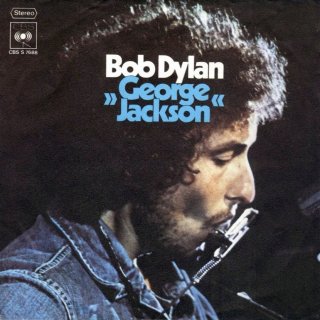
Bob Bob Dylan’s 1971 single, “George Jackson,” a remembrance for the radicalized convict and Black Panther who died in a San Quentin prison shoot-out on August 21, 1971, remains one of his most mysterious recordings. Not only does “George Jackson” mark the songwriter’s return to topical song form and to touring after a long hiatus, his subject remains as misunderstood to a general audience as does the singer and his songs.
Less than a month after the prison shooting in California, a historic event at Attica Correctional Facility wherein prisoners took control of the prison to protest its poor conditions resulted in more fatalities—an unmistakable call for prison reform. Perhaps it was that call to which Dylan was responding when in November, he cut and released “George Jackson,” a 45-rpm record that reached the Top 40 in January of 1972.
Opening with the blues trope, “I woke up this morning,” Dylan’s “George Jackson” is not a typical blues song, though it surely addresses the larger topic of racial and socio-economic oppression from which a certain style of blues was born. It also leaves a record of Jackson and his story.
“The power of George Jackson’s personal story remains painfully relevant to our nation today, with its persistent racism, its hellish prisons, its unjust judicial system, and the poles of wealth and poverty that are at the root of all that,” wrote historian Howard Zinn in an updated version of Jackson’s Soledad Brother. Wresting larger truths from the events of 1971, Dylan delivered his summation in these often quoted lines from “George Jackson”
Sometimes I think this whole world Is one big prison yard Some of us are prisoners The rest of us are guards
Dylan cut two versions of “George Jackson” for a double sided seven-inch: A “big band” version featuring Kenny Buttrey (drums), Ben Keith (steel guitar), and Leon Russell (bass), and a solo acoustic version. Among the various issues of the single—and there are many—is a picture sleeve with an image of Dylan performing at the Concert for Bangladesh (pictured above, it remains sought-after by record collectors). Here’s a version of Dylan’s song recorded by reggae band, Steel Pulse:
The details of the Jackson case are still debated today by scholars, historians, and those who remember the events. As the story goes, it was a 70-dollar robbery that landed Jackson in state prison, his sentence indeterminate. Guards took an instant dislike to Jackson on the inside and his sentences were extended following events occurring at Soledad State Prison in which three Black inmates and a white guard were killed. Using his time in solitary to educate himself, Jackson studied psychologist Franz Fanon (The Wretched of the Earth), Marx, and Mao, and came to understand the incarceration of poor Blacks for petty crime in a political context. A leader in moving prisoners to radicalize, Jackson joined the Black Panthers and became one of the group’s most celebrated members, despite J. Edgar Hoover’s declaration in 1969 that the Black Panthers were public enemy number one.
Published in 1971, Soledad Brother: The Prison Letters of George Jackson, was greeted with a positive reception by intellectuals and political progressives. That Jackson had been framed for conspiring to kill a guard in the Soledad incident was a widely held belief; his defenders were vocal and his case was a cause célèbre. But a few days before the Jackson trial was to begin, a riot broke out in San Quentin in which inmates and guards were again slain and Jackson was among those killed as he ran across the yard in an alleged escape attempt. In 2015, Hugo Pinell, the last incarcerated member of the San Quentin Six, was killed while serving his life sentence, much of it in solitary confinement.
The following is a live recording of Joan Baez singing “George Jackson.”
Advertisements
Occasionally, some of your visitors may see an advertisement here,
This is your Earth Day long read: The story of how musician, composer and arranger Van Dyke Parks came to produce the 16-man steel pan band, Esso Trinidad, following the Santa Barbara oil spill of 1969. I interviewed Parks in 2009 for Crawdaddy! and since that time, this story has become the most-read on this site, receiving the top number of views daily from around the world. Thanks for your continued readership and for your stewardship of the earth today (Parks suggests planting milkweed, to save the Monarch butterflies).
When 80,000 barrels of oil spilled into the waters of the Santa Barbara Channel in January of 1969, the crude-splattered water, beaches, and birds along the California coast in its aftermath became the symbols of modern eco-disaster. While the ensuing public outcry helped hasten the formalization of the environmental movement as we now know it, for musician Van Dyke Parks, the spill and “the revelation of ecology,” as he calls it, was a very personal, life-altering occasion. “It changed my M.O. and changed my very reason for being,” he says. The Union Oil rig rupture in Santa Barbara made Parks go calypso.
“When I saw the Esso Trinidad Steel band, I saw myself in a Trojan Horse,” he says. “We were going to expose the oil industry. That’s what my agenda was. I felt it was absolutely essential.” From 1970 to 1975, Parks waged awareness of environmental and race matters through the music and culture of the West Indies, though in the end, “You don’t know whether to laugh or cry. That’s what makes Van Gogh go,” he says, “That’s what great art does.” Though Parks is referring directly to Esso Trinidad’s happy/sad steel drum sounds, he could just as easily be talking about his own experience during what we’ll dub the Calypso Years.
Over a five-year period, Parks produced albums by the Esso Trinidad Steel band (1971) and Bob Dylan favorite, the Mighty Sparrow (Hot and Sweet, 1974); he also recorded his own calypso-inspired works, Discover America (1972) and Clang of the Yankee Reaper (1976). Born from his passion for popular song and launched at a time when grassroots protest was at an all-time high, Parks had every reason to believe calypso consciousness would prevail. But he hadn’t factored in the complications of taking on big oil, nor of touring the US with a 28-man steel drum corps from the Caribbean. He was unable to predict that the sessions with Mighty Sparrow would be fraught with rage, and that his efforts would earn him the enmity of Bob Marley, whose production requests he ignored in favor of calypso. And yet, you get the feeling he’d agree in one hot minute to do it all over again the exact same way if given a chance to revisit this section of his checkered recording history.
Parks is generally a well-mannered and affable Southern-born gent with a mildly mischievous streak. A one-time child prodigy on clarinet, he’s often mentioned in tandem with his Southern California work with Beach Boy Brian Wilson, who was reportedly too tripped-out to continue their Smile-era collaborations. A formidable freethinker and raconteur of psychedelic dimensions himself, you can hear the Parks imprint, curly-cuing through “Heroes and Villains” and “Sail On, Sailor”; songs that made a lasting impression on the Beach Boys sound. Rarely at a loss for bookings as a composer, arranger, musician, and producer (Parks would go on to work with artists from Harry Nilsson and Ringo Starr to Joanna Newsom and Rufus Wainwright), his song “High Coin” traded freely on the hippie covers market while he juggled sessions by psychedelic bands as well as singer-songwriters Randy Newman and Phil Ochs. It was following the critical success of his first solo work, Song Cycle, in 1968 and the oil spill in ’69, that Parks began in earnest his pursuit of the music of the West Indies—specifically calypso and steel drum (also known as steel pan). Initially played on instruments made from clankity household odds and ends, by the ’40s, steel drums were made from a surplus of oil barrels, washed ashore the islands of Trinidad and Tobago from the coast of Venezuela. “America pollutes its environment with oil: Little Trinidad makes beautiful music from the drums that you throwaway,” says pan player Godfrey Clarke in the Esso liner notes.
Serving as the accompaniment to Carnival (for which Trinidad is world-famous), calypso is also often accompanied by lyrically potent verses that alternately use breezy and nasty humor to signify its weighty concerns: Imperial oppression and the extreme poverty of the islands. Ideally, the counterculture audience could’ve dug this political/party music with its motives to create equality and earthly harmony. Surely younger folks could identify with the calypsonian struggle, more than say, Liberace’s audience in Las Vegas, which is where Parks found the Esso Trinidad Tripoli Steel band working in the late ’60s. “I saw them as enslaved in their relationship to Liberace; I thought it was a vulgarity. I wanted to save them from their trivialization.” What had begun as Parks’ desire to popularize calypso at that point became his crusade.
The Land of the Hummingbird
“I just love that performance of ‘Aquarium,’” Parks says of Esso’s album finale. “You see, it represents that eco-consciousness that the album should project. I’m just telling you why I did it: I devoted the album to Prince Bernhard, who was the head of the World Wildlife association. Everything was directed to making it a proper, political, green album.” Nearly 40 years later, the Bananastan label has issued newly-minted versions of the Parks-produced Esso and Sparrow’s Hot and Sweet. Not only are the calypsos strangely contemporary, I find I’m deeply moved by Esso’s environmentally-tuned music from the island officially nicknamed the Land of the Hummingbird. When Parks suggests we meet beside the Santa Monica Bay, I agree: There is no better place than under the sun for a talk about his rarely-discussed calypso intermezzo. “This has been a well-kept secret,” he begins with a whisper. “The promotion men were successful at that.”
Parks’ devotion to calypso puts him in the unique position of serving as the music’s chief 21st century stateside ambassador; as it is, his relationship to calypso predates his own childhood and runs in the family. According to Parks, his mother’s uncle was the founder of the University of Miami and a calypso devotee. “Of course, they were touched by calypso down there. He had been to Trinidad at the same time as FDR,” explains Parks. President Franklin Delano Roosevelt’s 1936 trip to Trinidad, documented in the song “FDR in Trinidad”, is among the first calypso standards. By the 1940s, “Rum and Coca-Cola”, as sung by the Andrews Sisters, had brought calypso music to the American masses. “Of course, everyone was aware of ‘Rum and Coca-Cola’, which was incidentally my mother’s favorite drink,” says Parks. Though, everyone was not necessarily aware that the jolly little song was also a critique of American military presence in Trinidad (nor would it be a truly great calypso without the double edge). But the Andrews Sisters’ vocal stylings would soon be outdone by authentic calypsonian Harry Belafonte’s ’50s success with the Jamaican folk song “Day-O (The Banana Boat Song)”, calypso’s most enduring hit. In the early ’60s, Parks recalls he and his brother were “left in the dirt” on a bill they shared with calypso’s Andrew “Pan” de la Bastide. But it is in the music’s details rather than its broad overview where Parks gleans inspiration: The origins of the intensity of the music, the unparalleled musicianship of the pan players, the wordplay of the singers and their emotional extremes—from treachery to triumph—are the elements of interest to Parks.
“I was serious about serious music from an early age. Hardwired to a lot of music of dead white guys—very serious discipline—I had three brothers who played. We had this musical oleo in the house, from Bill Haley and the Comets to Les Paul and Mary Ford, Fats Waller, George Shearing, Paul Whiteman, the usual popular American diet, from 78s on. To me, calypso music was everything that the Memphis blues was, everything that Schubert and his sort were of the 19th century Romantic songwriters. Melody: Fantastic, like studying a novel with many subplots, seeing all of them resolved by the conclusion of the work. Lyrics: The scansion, the absolute art of phrasing, it had absorbed everything proper from the British Empire, so you find this incredible intelligence of mind. These are the scions of African nobility, the protectors of the musical and oral tradition. That’s what I think of calypso—the greatest pop music.”
The music of the West Indies was begotten from a 19th century slave history. “Barbados, adjacent to Trinidad, is direct in line of the slave trade that unfortunately plagues us all,” says Parks. But while European settlers imposed customs and traditions on the islands’ people, the indigenous population and those whose origins were African engaged in their own forms of expression. It’s that combination of sound, from two hemispheres and at least three continents, that make up the basics of calypso. Working with the large ensemble steel band, “I took it as an incredible opportunity… from a standpoint of my very American identity,” says Parks. “This group presented such a great opportunity in testing my ethics.” Though were the ethical challenge not combined with the band’s esthetic of extreme musicianship, individually and as a collective, Parks probably wouldn’t have traveled the distance he did with Esso.
“It was really a profound experience to me, to hear the small fish that run by quickly in the ear during Saint-Saëns’ ‘Aquarium’ from The Carnival of the Animals. Those fast notes that shimmer through the piece, they are 32nd/10th notes, there are 10 in a figure, and these guys memorized this thing in a matter of two days and they did an incredible job.” The band was led, as it were, by Hugh Borde. “He was their captain, there was no leader,” explains Parks, though for those two days in the studio he passed his captain’s hat to Parks and pan man Kenrick Headley, who led the group through versions of songs like “Apeman” by the Kinks, “I Want You Back” by the Jackson Five, and Simon and Garfunkel’s “Cecilia.” The Rev. Fr. John Sewell, an Episcopalian missionary who served transcribing the ultimately jaw-dropping versions of the playful classical and orchestral pieces in Esso’s repertoire, also assisted the group. “They were the first to do it,” says Parks of Esso’s classical works on pan, “and it became a requirement for all steel bands to have a classical test piece. So they might do ‘Waltz of the Flowers’ by Tchaikovsky or ‘Unto Us a Child Is Born’ from Handel’s Messiah.” For the recording, they chose the aforementioned Saint-Saëns and the frantic “Sabre Dance.” The steel band also cut a Parks favorite, “Erasmus B. Black”, a wordplay tune penned by the Mighty Sparrow in which an innocently christened baby ends up with an unfortunate double entendre of a name. “I thought there was a great deal of theater and comedy in the group. I’ve never enjoyed myself so much, almost understanding what was going on!”
Keep Your Eye on the Mighty Sparrow
Steel band players gain entry into the prestigious ensembles through a highly competitive audition process. The spirit of musical competition and excellence is rooted in poverty, though it’s a celebratory event, staged each year at Carnival, the annual pre-Lenten festival that finds pan players and wordsmithing calypsonians performing for cash and crowns. The annual Carnival Road March is a calypso competition at its fiercest and reigning supreme eight times was the Mighty Sparrow—his wins rivaled only by contemporary calypso’s Super Blue and Sparrow’s friend and competitor, Lord Kitchener. While Sparrow had traveled to the US seeking help from Belafonte at the height of calypso’s popularity, Kitchener was making a name for himself in England. Upon their respective returns to the islands, Kitchener and Sparrow spent the rest of the decade and into the early ’70s duking out the Road March and Calypso Monarch crowns.
“I wanted very much to do Lord Kitchener,” admits Parks. “Lord Kitchener, to me, is the greatest of all the calypso singers, but Sparrow was absolutely rhapsodic.” In his liner notes to Biograph,Bob Dylan wrote of the Sparrow: “… as far as concept and intelligence and warring with words, Mighty Sparrow was and probably still is the king.” “I thought he would be more difficult to sell than Kitchener,” says Parks. “Sparrow would show up with a cape; Kitchener would’ve shown up in a fedora.” Perhaps Sparrow could sense Parks’ preference for Kitchener upon his arrival at Miami’s famed Criteria Studios. Or maybe it was a hurricane, just about to make its way to land, that turned the session into a perfect storm. “We got to Miami. Phil Ochs appears,” begins Parks, referring to his friend and fellow traditional music enthusiast, famous for folk-singing and a notorious unraveling that had already begun. “Phil is somewhat deranged. The rain starts to whip against the wall absolutely horizontally. We are near the eye of the hurricane. It’s a big one. The studio owner Mack Emerman wondered if we should airboat the whole thing to Barbados.” In a world without Pro Tools, the crew obtained remote power from their own generator and hunkered down as the hurricane passed. “What you hear, we did in two days. Sparrow would step up to the piano and go pht pht—pht pht. You notice that’s irregular,” explains Parks, pounding on the picnic table before us for emphasis. “It’s not pht, pht, pht, pht. You know, it’s said that irregular beat is something that started in Curaçao as the natives imitated the Dutch governor, Peter Stuyvesant… he had a lame leg and so he would pht pht—pht pht. That’s what I heard… it’s the rhythm that Sparrow played for two bars before the piece begins. And then the band came in. This didn’t take a producer. This didn’t take an efficiency expert. This was incredible.”
Rather than arriving at the studio with a finished set of lyrics, Sparrow came with phrases. “Sparrow knows exactly where he’s going… he knows how to get the cat out of the tree, get the cat down; he’s got the chorus solved. He’s very able. There is nothing false about his incredible musical skill. That he can ideate phraseology with such powers of deception is a very good quality of his work. It’s the very same power of deception that I see in Schubert, that also likes to take you out somewhere, then puts you somewhere subtly that is surprising and refreshing.” Of the songs he compiled for Hot and Sweet, Parks cites two standouts: “More Cock” (“I asked for it. I know, it’s my fault”) and “Maria.” “My favorite. As Ted Turner said… ‘it only looks easy.’ To me, it’s as good as anything I’ve heard out of Allen Toussaint. It’s tight.”
Co-produced with Andy Wickham, the session with Sparrow was not without incident. Parks describes British Wickham as “right wing” and in thrall to “Country and western and super-America, Buck Owens and Merle Haggard.” Parks says, “I remember he was ecstatic with ‘Okie from Muskogee,’” Haggard’s toast to redneckism. And yet, like Parks, Wickham loved calypso. “He came to realize how much the butt [of the jokes] the British were.” Wickham could also appreciate the melodies (“He loved Wagner, secretly,” says Parks) and the lyrics (“Very good turn of phrase,” he’d say). But it was sport that bound Wickham to the calypsonians. “He knew all the West Indian super heroes of cricket,” says Parks; however, that did not make him the boss of Mighty Sparrow.
Sparrow was not one to take studio direction. “Which is a big mistake. Every bullet counts on a record,” says Parks. “It was hard. It was a bumpy ride. It was occasionally filled with rage and great hostility. And blackberry brandy; I think the record was a four quarts of blackberry brandy record.” The necessary lubricant relieved some of the tension courtesy of the elephant in the room: The British Empire. “Well, the British were leading the decolonized African freeman, and I was right in the middle of all that. The Sparrow is filled with bravado and severe opinions that aren’t always convenient… There were moments that you hoped the guy in the cape wasn’t going to show up at dinnertime to protest his individuality to everyone.”
By the time Parks was finishing with Sparrow, calypso’s rhythmic energy was in the process of being subsumed by disco, while the war on poverty was being fought by reggae, the Caribbean’s other music. “Calypso was feeling very disco-ed, which is funny because they wanted to feel disco-ed, and yet, they were bothered by the fact that disco was calypso. It was a dead ringer,” Parks says, once again sounding out beats at the picnic table. “They were mad as hell about that. And then reggae hit the fan—in a big way—and I was delighted.” This is when Parks received his call from Bob Marley.
Clang of the Yankee Reaper
“‘Let’s face it, Mr. Parks, the white man is finished in the Caribbean,’” said Marley to Parks. “I thought that was a rather harsh thing to say. He was so pissed at me, because I didn’t have time to work for him because I was so trying to get 28 toothbrushes… I was just too busy and he took it as a slight.” Though, what may’ve been a missed opportunity with Marley, Parks made up for it by recording with his contemporary, Jimmy Cliff. “Jimmy Cliff was a big deal to me,” he says. Believing Cliff’s melodies often prevailed over Marley’s “rhythm machine,” Parks helped the singer secure his publishing and played keyboards on Cliff’s 1976 album, Follow My Mind. “I honestly think that the Jamaicans showed a greater power of adaptability against ‘guns, germs, and steel’ than calypso. Trinidad is more removed—it’s a different world…”
Following the Sparrow production gig and Parks’ own Clang of the Yankee Reaper (a good half of its material bearing the earmarks of calypso), by the end of the ’70s, Parks was back in the bosom of the California singer-songwriter scene, working with Lowell George, Nicolette Larson, and again with Harry Nilsson. So what then of calypso, his first Caribbean love?
“Calypsonians were an uncapturable lot, really, and I’ll tell you why… They never had any regard in an engagement in copyright. Maybe it’s an uncommon modesty of sorts.” Matters of contractual arrangement were a formality that, according to Parks, was of no interest to calypsonians. “It finally dawned on me there is an undeniably vulgar aspect to contract agreements because they’re built to check coercion and that’s a sad way to approach any mutual trust. These songs are for a moment’s discovery, born of such a highly extemporaneous, unanticipated purpose. A solution to a problem is what it’s all about.”
Artistically, he was satisfied by the calypso interlude. “Those two recordings were made at the apex of analog. Such a phenomenon of sound and so nuanced… small notes that all make up the way it feels in the bones,” he said.
Environmentally, the idea to link calypso or any music to the earth’s wellness was visionary on Parks’ behalf; the frontiers of such thought combined with activism are yet to be fully explored. Although at one time he’d hoped to deliver his message directly to consumers at the pump as a “premium gift” with fill-up (the idea was a sound sheet of the Esso Trinidad Steel Band singing “White Christmas” with Bing Crosby), his dream of harmony, enlightenment, and environmental healing through steel band music was too far-reaching. Idealistically, Park could not fulfill his full vision with Esso.
“I was in the crosshairs of the racial divide with these gentlemen who had no idea about such things,” explained Parks. “A guy shot at us—a farmer up on a hill with a shotgun—when the bus broke down on the road in the South. The culture collision was probably among the top five benchmark psychological events of my life, for so many reasons.” Esso’s US tour ground to a halt for good when their aforementioned bus crashed. Several men were hospitalized and one was laid up at the Parks household for four months. “I came up as quickly as I could with another record about calypso to keep the focus on the medium. I put a Greyhound bus and a Continental Trailways bus on the front cover, just to get these men out of bed.” The Parks album Discover America contains interpretations of “FDR in Trinidad”, “The Four Mills Brothers”, and “Bing Crosby”, among others from the calypso canon. Parks’ time with the steel band was drawing to a close, though not before one last act in which he finessed a potentially sticky situation with Standard Oil of New Jersey that ultimately okayed the Trinidad Steel Band to retain the use of Esso in its name, without an injunction.
He still stands by a statement he made of Esso, those years ago: “The greatest group I’ve ever had the privilege to produce.” Like his calypso brethren, Parks may’ve been bloodied, but his confidence in the art of calypso is unyielding. “All of the bravado of such poverty—poor people speaking plainly, representing the disenfranchised—is what calypso is all about,” he states. “It’s not only topical songs that are optimally crafted, both lyrically and melody—it’s that they do things: They move mountains. It’s a life force.”






 Bob
Bob  Bob Dylan’s 1971 single,


 Denise Sullivan