Denise Sullivan

Author, Arts & Cultural Reporter and Worker

Howie Klein: One of a kind

Howie Klein 1948-2025

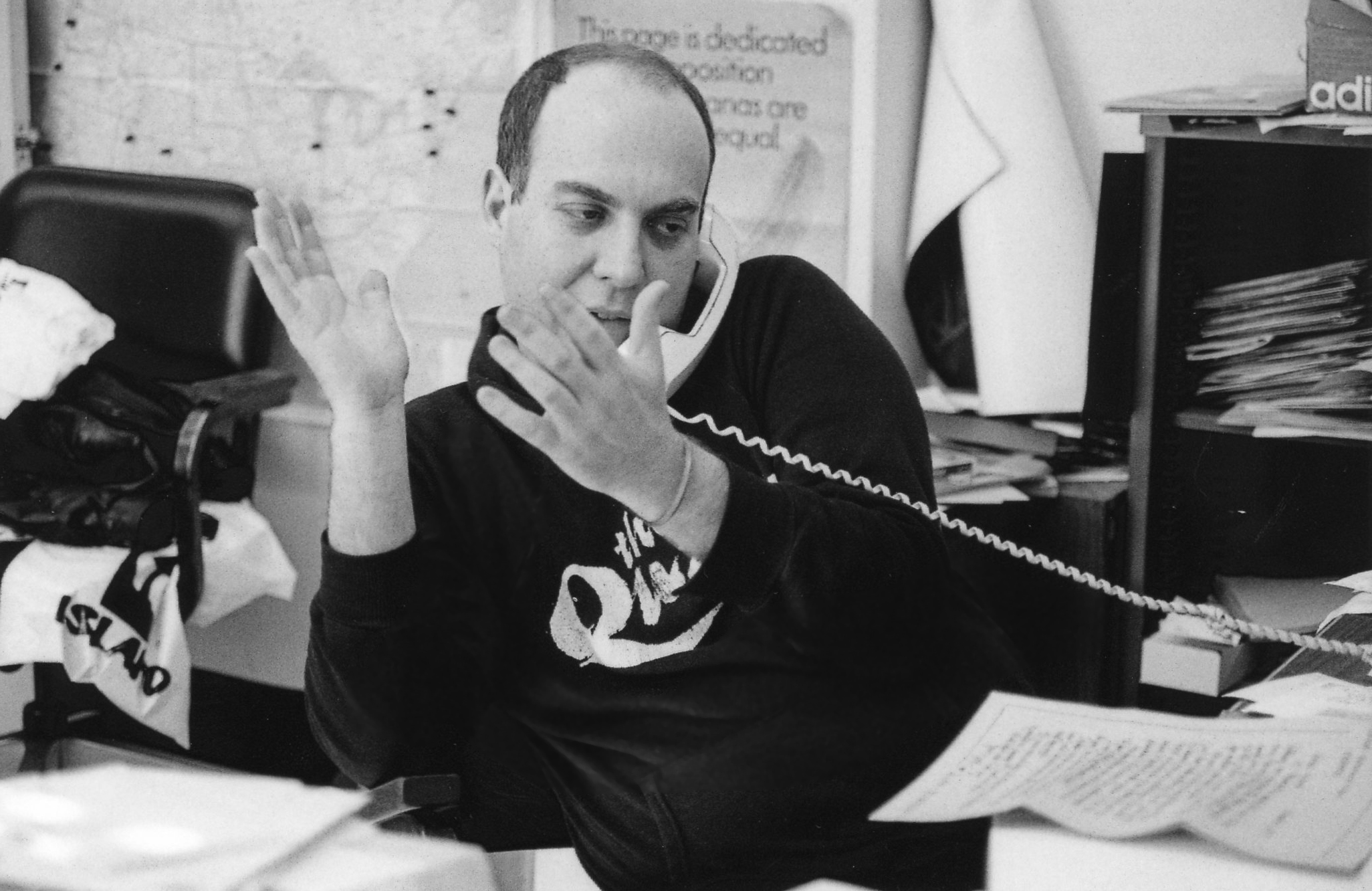
Writer, political activist, broadcaster, and record man Howie Klein’s life was large, unique and apparently complete as it came to a close on December 24. The work, his work–what some might call magic–was largely invisible, so much of it occurring out of the public eye, yet he leaves an indelible imprint on politics and culture, both on the underground and in the mainstream, as well on the individual lives he touched. Boiling down his life and legacy to a few paragraphs or simple words isn’t possible, especially today, Christmas, one day after he left our present reality for parts unknown. It’s particularly poignant that he should exit at this time of year when I think he secretly loved the holiday (his longtime annual Christmas shift as Howie Klaus on KUSF-FM was the giveaway).

Following an outstanding career in the record business in which he became known as an artist and First Amendment advocate, he spent the past 20 years fighting fascism as a commentator and as an ally for politically progressive candidates, while tending to several bouts of long term illness.

I met Howie about 45 years ago, when I was still a teenager, though before that, I heard his voice on the radio, broadcasting on KSAN-FM from the Sex Pistols final concert at Winterland. Lucky for us, he’s left behind a catalog of his life and times on the hippie trail, at Harvey Milk’s camera store, at Neil Young’s Broken Arrow Ranch and on the White House dancefloor, in writing and images, all to be compiled for publication as a memoir (more news on that in the new year). For now, I send love and condolences to all who knew and cared for him and leave you with his own words, on what it means to write and remember.

HOWIE KLEIN: So, as you probably know, I’m trying to write this memoir… but I don’t have the greatest memory in the world. Neither do most of my friends. Neither do most people in general it turns out. I explained how this has been impacting my work when I wrote about DEVO and Dolly Parton last month. How did “Mr B’s Ballroom” get written? My recollection was that I brought DEVO there and they wrote the song. My friend Michael Snyder, who I brought there, said DEVO wasn’t with us and that we told DEVO about the place and Mark Mothersbaugh wrote the song afterwards. I called Mark and he confirmed Michael’s version. I had such vivid “memories” of DEVO aghast at “Mr. B’s!”

I don’t remember exactly when I read Anne Rice’s Interview With A Vampire but I remember where I read it— San Francisco… and I remember discussing it with Harvey Milk, who was assassinated in 1978, so it was probably that year or the year before. No one had to tell me that the vampire myth was a metaphor for homosexuality long before Anne Rice came along and I was explaining that to Harvey while I was reading the book, which isn’t nearly as queer as the new TV series running on AMC now.

In that series (the 3rd episode), Daniel Molloy is interviewing Louis de Pointe du Lac in his Dubai penthouse and Louis seems to say that Lestat was the actual creator of “Wolverine Blues,” the jazz classic by Jelly Roll Morton, recorded in 1923. Daniel gets pissed off and accuses Louis of being an unreliable witness. As a defense, Louis explains the theory of the “odyssey of recollection” by reading from Daniel’s own memoir: “I am in my Buick, staring in the rearview mirror at my daughter in the car seat, an hour after I gave Derek, a guy I don’t know, the last 30 bucks I had. My editor reminds me, it’s seven years before car seats are mandatory. My ex-wife reminds me, I never owned a Buick. This is the odyssey of recollection.”

Sometimes there’s irrefutable— more or less— evidence, proof. That Iceland story I wrote was based on a daily diary I kept of our visit to the island early in 1969. When I asked Martha, now an internationally renowned neuroscientist, then my girl friend and traveling companion, what she thought of the page I posted about the trip, she had no recollection of Mario and Frances, the two American professors we met on the plane who asked us to chip in with them for a car and explore the country. We were with them for over a week, had plenty of adventures and dramas. Martha couldn’t even recall their existence.

I also sent [a] photo of Martha and Autumn Haze at our off-campus house in Rocky Point on Long Island (probably 1967 or ’68). Martha and Autumn didn’t like each other at all; they kind of tolerated each other. So this was a sweet and rare photo I found of them. I asked Martha what she recalls about the photo. She immediately remembered her blouse, she told me. She said she doesn’t recall I had a dog.

Memory does not work like a recording device. Elizabeth Loftus is a psychologist and memory expert, specializing in studying false memories. She explains her work in this TED Talk in Scotland, which has been viewed by over 5.8 million people on the Ted Talk site and another 2 million on YouTube. “Our memories,” she said, “are constructive. They’re reconstructive. Memory works a little bit more like a Wikipedia page: You can go in there and change it, but so can other people.” She discusses misinformation in this talk three years before Trump slithered into the White House.

She concluded her talk with the kind of statement that must be the bane of every memoir writer: “Most people cherish their memories, know that they represent their identity, who they are, where they came from. And I appreciate that. I feel that way too. But I know from my work how much fiction is already in there. If I’ve learned anything from these decades of working on these problems, it’s this: just because somebody tells you something and they say it with confidence, just because they say it with lots of detail, just because they express emotion when they say it, it doesn’t mean that it really happened. We can’t reliably distinguish true memories from false memories. We need independent corroboration.”

In 1802 William Wordsworth wrote “The Rainbow” (also known as ‘My Heart Leaps Up’) which was published in 1807. In high school we were asked to memorize the last three lines, which are also featured in the even more famous “Ode: Imitations of Immortality,” which Wordsworth started the day after he wrote “The Rainbow.”

My heart leaps up when I behold

A rainbow in the sky:

So was it when my life began;

So is it now I am a man;

So be it when I shall grow old,

Or let me die!

The Child is father of the Man;

I could wish my days to be

Bound each to each by natural piety.

©Howie Klein

Filed under: Obituary, Punk, rock 'n' roll, , , , , , , ,

Local Writers Make Good

It takes an extraordinary effort to write a book and see it through to completion. That might seem like an obvious and plain thing to say, but it’s true: Though many folks like to think they can do it or try to, fewer actually do. Perhaps that is why publication day and month is most always a big deal for writers: Congratulations cards, flowers and gifts are in order! Short of those things, I’ve got a couple of articles I wrote about two very different writers with two very different books celebrating mutual publication dates to share with you.

“Sexy Life, Hello!” is the first book for Michelle Kircherer. Her debut novella is also the premiere release of her independent publishing venture, Banana Pitch Press. Kicherer is an ambitious performer, writing coach and instructor and has a big vision for her multimedia venture, without any of the yuckiness associated with the big three publishing houses. She will be reading from her book and discussing it at Green Apple on the Park in San Francisco on March 6 and at Clio’s in Oakland on March 8. You can read more about Michelle in my profile of her for the San Francisco Chronicle.

“The Mansion” (Gnashing Teeth Publishing) is the tenth collection of poems by Dee Allen. A performance poet, Dee has been writing and performing his work in San Francisco, Oakland and beyond for over 20 years. I had the good fortune to first hear him read in 2012, or maybe it was 2013 — at any rate, that was several books ago for Dee. I try never to miss his publications and readings, but they are coming so fast and furious, I accidentally skipped 2024’s collection “Discovery.” It’s time to catch up and that’s exactly what we’ll be doing during a live-streamed conversation from Bird and Beckett Books and Records on Sunday March 9 at 10 a.m. A sneak preview of what’s likely to come up is in this profile for Bay City News, published today.

Congratulations to Michelle and Dee on their respective new publications. Though writing is its own reward, sometimes it helps to know there are those of us reading and appreciating the work, respecting what goes into the process and identifying with it. Thanks to this pair of authors for making our Bay Area literary community particularly unique, for making my job reporting on them easy, and for helping to keep the spirit of independent publishing alive in these unreal times.

Filed under: Arts and Culture, Book news, Books, California, San Francisco News, , , , , , , , , ,

Litquake at 25

updated from a previous post on Litquake at 20

This week San Francisco’s literary festival, Litquake, celebrates 25 years of supporting writers, publishers, bookstores and the literary arts here in the Bay Area.

Running October 10-26, Litquake is the big event of the year for the Bay Area’s literary community. The mostly free readings and panels during Litquake and Litcrawl have become starting places for some of our writers and remain a testing and resting ground for those with more experience in need of a little recharge. These days, I mostly write about books, but when the festival rolls around, it’s a chance to remind myself, I too am a writer of books.

The festival’s co-founders, Jack Boulware and Jane Ganahl are my kind of people: Journalists and authors by trade, they dared to dream beyond the newsroom and share their love of the writing life with their immediate community. As their cohort of writers grew to include novelists, memoirists, biographers, sexperts, technologists and performance poets, the festival grew and grew, blossoming into its current incarnation as year round foundation and a 10+ day fest, culminating with an evening LItcrawl. Boulware and Ganahl have since stepped down as directors and as of this year, the organization welcomes its new director, Norah Piehl. Litquake is also powered by a small staff and tons of volunteers.

Though the years, I’ve been lucky to participate in the annual festival as a reader. Litquake has always been a place to try out new ideas and styles and as a writer I’ve test run biography, memoir and poetry, to get a feel for how the work sits with an audience of listeners. Litquake month has also served as a time of the year to create new work, to reset and reclaim one’s writing life, and affirm, that we are still readers and writers, no matter where the day or our lives may take us.

In more recent years, I’ve volunteer-organized and curated readings at Litquake in support of independent bookstores, particularly during San Francisco’s gentrification crisis. In 2014 we celebrated 55 years of Marcus Books. In 2015 and 2016, we honored the Mission District booksellers Modern Times Bookstore Collective, Alley Cat, Dog Eared and Adobe Books with standing-room-only events at the Make Out Room as fundraisers for Litquake and the grassroots United Booksellers (UBSF has since disbanded, but not before publishing a series of chapbooks, The City Is Already Speaking in collaboration with poet laureate Kim Shuck and featuring contributions by Tongo Eisen-Martin, Alejandro Murguía and other Bay Area poets). This year, the festival honors bookstores citywide at its opening night fundraiser, the Bookseller’s Ball. We are lucky to have so many bookstores here in San Francisco (my go-to is Bird & Beckett Books and Records). Despite digitization, the pandemic, extreme rent and operating costs (like insurance), San Francisco’s independent bookstores are strong and thriving.

It was at Bird and Beckett in 2019, that we hosted a full house for a comeback discussion with author David Talbot on Between Heaven and Hell: The Story of My Stroke, which he survived in 2017 and lived to write about. Talbot, a longtime supporter of independent booksellers and up and coming authors, has since survived a second stroke. You may offer financial support to him and his family by linking here.

As a literary community, I like to think we are mindful of supporting authors in need, as well as our elder writers and readers. For the last five years, I’ve been associated with Litquake as a teaching artist with The Elder Project, a community writing program offered to older adults. Facilitating these groups, meeting writers and hearing their stories has been an unexpected source of inspiration. The program continues to grow and each season we welcome new writers at all levels of their practice. It’s a great joy and privilege to carry on the work, conceived by poet, Jessie Scrimager Galloway, with our participants and my fellow teaching artists.

I had hoped to return to this year’s festival to read from my new book, Len Chandler: Shadow Dream Chaser of Rainbows, along with some as yet unpublished work. Due to a conflict, I will not be reading as scheduled, though I hope to find an alternative venue to test drive the new writings. Stay tuned to this space for updates and until then, I will see you at the festival. As always, thanks for reading and for your support of this webpage.

Filed under: Book news, California, San Francisco News, , , , ,

From Here to Litquake

This week San Francisco’s literary festival, Litquake, is celebrating 20 years of supporting writers, publishers, bookstores and the literary arts here in the Bay Area. The festival’s co-founders, Jack Boulware and Jane Ganahl are my kind of people: Journalists by trade, they dared to dream beyond the newsroom and share their love of the writing life with their immediate community. As their cohort of writers grew to include novelists, memoirists, biographers, sexperts, technologists and performance poets, the festival grew and grew, blossoming into its current incarnation as a 10-day event with international offshoots of the culminating night’s promenade, LIt Crawl.

As a frequent participant in the festival, almost since its inception, I can’t thank Jack and Jane enough for sticking their necks out: This is the big week of the year for the Bay Area’s literary community. Litquake and Litcrawl have become starting places for some of our writers but they are also the testing and resting ground for experienced writers needing to recharge their batteries. As a mid to late career writer, I fall into that latter category. Litquake has always been a place for me to try out new ideas and styles of writing. As writers with day jobs and those who do community work know, it’s easy to get drained, out of sorts and out of touch with our practice.  Litquake is my time of the year to reset and reclaim my writing life, a time to remind myself (and sometimes others): I’m a writer.

During Litquake past, I’ve read previously published and never-to-be published work; I’ve read biography, memoir and poetry.  I’ve also organized and curated readings for causes. This year, I was in a position of supporting writers I worked with during several seasons of Litquake’s The Elder Project, a free community writing program offered to seniors. We worked on polishing their memoirs and talking about tools for developing protected writing time. Also at this festival, I wore my organizer/curator hat, but just for one night only: I hosted a conversation with the author David Talbot who is making his comeback with a new book following a stroke he survived in 2017. We held that event at one of the The City’s best bookstores, Bird & Beckett, which specializes in all kinds of books and regularly presents live jazz. Litquake is also a time when we celebrate the new publications and anniversaries of our friends and colleagues: Congratulations to Alvin Orloff who has a new memoir set in San Francisco and on the queer underground, and to Manic D Press, celebrating its 35th year of publishing great books. As an added bonus, I’ve been invited to read my own work at a gathering of people involved in the trade known as music writing, my oxymoronic paid profession since I was a teenager, though that has been changing  as I shift my focus to other subjects. And that’s one of the things I love about Litquake. Jack and Jane have allowed me the space and dignity to grow as a writer, never insisting I stay in my lane. They understand that writing is a fluid vocation. For a writer who doesn’t wish to be categorized or caged, variety has provided not only the spice, but the key to a still-evolving, and if I’m doing it right, revolutionary writing life.

Filed under: Arts and Culture, Book news, Books, , , , ,

Archives

Recent Posts

Browse by subject or theme