Denise Sullivan

Author, Arts & Cultural Reporter and Worker

It’s All One Long Funeral Song

Allen Ginsberg claimed he wept when he heard it  for the first time.

Folksinger Len Chandler started to play it when the words and music were first published in Sing Out!, the folk song magazine, at the end of 1962. Patti Smith performed the song when Bob Dylan received the Nobel Prize in Literature in 2016. 

Among the timeless songs he wrote in his early period, Dylan characterizes “A Hard Rain’s A-Gonna Fall” and others as “all one long funeral song.”

And while it was not specifically written to confront nuclear winter, Kronos Quartet and the Hard Rain Collective released two versions of “Hard Rain” last week, to commemorate 80 years since the first atomic bomb was detonated as a test on July 16 in Alamogordo, New Mexico.

A second drop, “Hard Rain (Drone)” — as in the style of music — is a spoken word version. The collective recordings include voicings by Laurie Anderson, Ocean Vuong, Charlotte Gainsbourg, Satomi Matsuzaki, Willie Nelson, Iggy Pop, Asha Boshle and many more. Terry Riley’s raga, “Komal Reshab Asavari” is central to the theme (read more about the project and other songs devoted to world health and the biosphere at Redhot).

At last week’s Nobel Laureate Assembly for the Prevention of Nuclear War in Chicago, Kronos performed “Hard Rain” with Allison Russell.

“You know, it’s remarkable that a 21-year-old singer-songwriter wrote this song in 1962 and how — when you observe and know the words of this song very clearly, how important it is to our time right now,” Kronos founder David Harrington told Democracy Now.

Harrington was joined on the program by physicist Daniel Holz, chair of the Science and Security Board of the Bulletin of the Atomic Scientists and one of the organizers of the assembly which gathered Nobel laureates and nuclear experts to raise awareness of the growing (yes, growing) risk of nuclear war, particularly against a backdrop of climate change.

“…The likelihood that we’ll sort of stumble into a nuclear war and the end of civilization … has gone way up… We’re bringing together Nobel laureates and nuclear experts and trying to find a way forward, a way to reduce the risk, get the messages out to the public and also to leaders that here are steps that can be taken to reduce this. We need to get the awareness back, and we need to do everything we can to prevent the sort of nuclear annihilation that would impact literally everyone on the planet,” said Holz.

This piece by Norman Solomon in The Nation is a must-read in case there remains any doubt, “nuclear winter is a climate issue.”

It’s understandable if you missed the 80 year commemoration of the Trinity test, given the week that was. But there is still time to prepare for a suitable remembrance of August 6 and 9: It’s been 80 years since bombs were dropped on Hiroshima and Nagasaki. There are very few survivors, or hibakusha, as they are known, left to speak about the horrors of the A-bomb. In 2019, I spoke to one — an American citizen detained at age 14 in Japan while visiting relatives when World War II broke out. 

Today, the planet – not just the region impacted – but the entire planet will simply not survive a nuclear explosion. The sun will not sun. Famine will ensue. The past is our future. War is still unhealthy for children and other living things.  Please contact your representatives and support candidates accordingly.

Originally published in Down With Tyranny!

Filed under: anti-war, , , , , , , ,

Local Writers Make Good

It takes an extraordinary effort to write a book and see it through to completion. That might seem like an obvious and plain thing to say, but it’s true: Though many folks like to think they can do it or try to, fewer actually do. Perhaps that is why publication day and month is most always a big deal for writers: Congratulations cards, flowers and gifts are in order! Short of those things, I’ve got a couple of articles I wrote about two very different writers with two very different books celebrating mutual publication dates to share with you.

“Sexy Life, Hello!” is the first book for Michelle Kircherer. Her debut novella is also the premiere release of her independent publishing venture, Banana Pitch Press. Kicherer is an ambitious performer, writing coach and instructor and has a big vision for her multimedia venture, without any of the yuckiness associated with the big three publishing houses. She will be reading from her book and discussing it at Green Apple on the Park in San Francisco on March 6 and at Clio’s in Oakland on March 8. You can read more about Michelle in my profile of her for the San Francisco Chronicle.

“The Mansion” (Gnashing Teeth Publishing) is the tenth collection of poems by Dee Allen. A performance poet, Dee has been writing and performing his work in San Francisco, Oakland and beyond for over 20 years. I had the good fortune to first hear him read in 2012, or maybe it was 2013 — at any rate, that was several books ago for Dee. I try never to miss his publications and readings, but they are coming so fast and furious, I accidentally skipped 2024’s collection “Discovery.” It’s time to catch up and that’s exactly what we’ll be doing during a live-streamed conversation from Bird and Beckett Books and Records on Sunday March 9 at 10 a.m. A sneak preview of what’s likely to come up is in this profile for Bay City News, published today.

Congratulations to Michelle and Dee on their respective new publications. Though writing is its own reward, sometimes it helps to know there are those of us reading and appreciating the work, respecting what goes into the process and identifying with it. Thanks to this pair of authors for making our Bay Area literary community particularly unique, for making my job reporting on them easy, and for helping to keep the spirit of independent publishing alive in these unreal times.

Filed under: Arts and Culture, Book news, Books, California, San Francisco News, , , , , , , , , ,

Hold on to your dreams

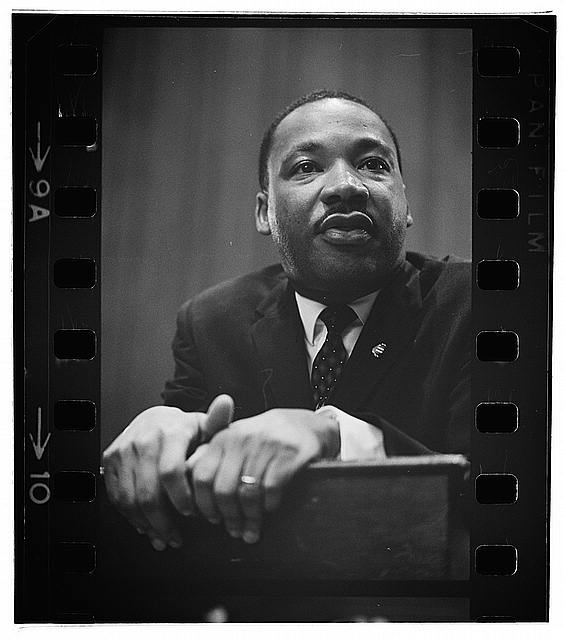
January 15 would have been the 96th birthday of Dr. Martin Luther King, Jr. born in 1929 in Atlanta, Georgia. It was a long road to the third Monday of the month when all 50 states observe the federal holiday named in his honor. Largely owed for making the dream of MLK Day a reality is Stevie Wonder: Back in 1980, he wrote the pointed song, “Happy Birthday,” then launched a 41-city U.S. tour (and invited Gil Scott-Heron along) to promote the idea which was first mooted by Rep. John Conyers in 1968. The musical efforts were ultimately the key in collecting the millions of citizen signatures that had a direct impact on Congress passing the law signed by President Ronald Reagan in 1983, declaring a day for MLK.

Observed for the first time in 1986, some states were late to participate, however, by the turn of the 21st Century, all were united in some form of remembrance of the civil rights giant. “Happy Birthday,” which served as Wonder’s King holiday campaign theme (and is now the “official” King holiday tune) is the last track on Hotter Than July. The album also features “Master Blaster,” Wonder’s tribute to Bob Marley (Marley had been scheduled for the tour until he fell too ill which was how Scott-Heron came to participate). In his memoir The Last Holiday, Scott-Heron details his own journey with music and activism, as he retraces the long and winding road Wonder took to bring home the last US federal holiday, with the help of a song.

The Hotter Than July tour brought Scott-Heron and Wonder to Oakland, where they played in the name of King, along with Rodney Franklin and Carlos Santana. In a weird turn of events, the concert on December 8, 1980, coincided with the night John Lennon was killed. The musicians and crew learned of the tragedy from a backstage television, and the job fell to Wonder, with Scott-Heron and the other musicians at his side, to deliver the shocking news to an arena of music fans.

“For the next five minutes he spoke spontaneously about his friendship with John Lennon: how they’d met, when and where, what they had enjoyed together, and what kind of man he’d felt Lennon was,” wrote Scott-Heron.  “That last one was key, because it drew a line between what had happened in New York that day and what had happened on that motel balcony in Memphis, Tennessee, a dozen years before.  And it drew a circle around the kind of men who stood up for both peace and change.”   Scott-Heron devotes the final pages of The Last Holiday to a remembrance of how the murder of Lennon fueled the final drive to push for a federal observance of the official MLK Day.

The politics of right and wrong make everything complicated

To a generation who’s never had a leader assassinated

But suddenly it feels like ’68 and as far back as it seems

One man says “Imagine” and the other says “I have a dream” -Gil Scott-Heron

Scott-Heron was a lifelong campaigner and champion for human rights himself, beginning on his 1970 live album Small Talk at 125th and Lenox. There is no doubt he would have much to say of the unfortunate confluence of this year’s King holiday with the inauguration and the project known as 2025. The parenthetical title refrain from his song, “Alien (Hold On To Your Dreams)” (see clip below following his topical poem, “Whitey on the Moon/(Mars)”) has been spinning around in my head, alongside the words of Dr. King collected from one of his sermons from the early ’60s. Whatever confronts us today, whatever dangers real or perceived that touch our friends, families and fellow humans in these perilous times, in these words and songs may you find comfort and be inspired to act in love.

Returning hate for hate multiplies hate, adding deeper darkness to a night already devoid of stars. Darkness cannot drive out darkness; only light can do that. Hate cannot drive out hate; only love can do that. Hate multiplies hate, violence multiplies violence, and toughness multiplies toughness in a descending spiral of destruction. – MLK, Jr.

Hold on to the dream.

Filed under: anti-racist, anti-war, Arts and Culture, Bob Marley, Concerts, Dr. Martin Luther King Jr., Gil Scott-Heron, Immigration Reform, income disparity, Poetry, , , , , , , , ,

Len Chandler: He, too, sang at the March on Washington

images

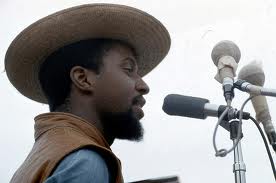
photo of Len Chandler at Newport Folk Festival, 1964, by John Rudoff

Today marks the 55th anniversary of the historic March on Washington for Jobs and Freedom.  Among those assembled to help Dr. King push forward his dream of racial harmony and economic justice was Len Chandler (often overlooked in the history of civil rights work), one of the voices in a trio that day which included Bob Dylan and Joan Baez (he appears at about 17 minutes into the following clip, though the whole 25 minutes is worth your time).


Chandler would march with Dr. King and travel throughout the South in the name of voter registration, informing rural Southerners of their polling rights, often at great risk to his own life. His poems were recognized by Langston Hughes, he wrote the folk standard “Green, Green Rocky Road” with poet Bob Kaufman, and recorded two albums for Colombia Records, but little is known about him or his life.  I sought him out when I wrote Keep on Pushing, my text that tracks the origins and evolution of freedom music, and its roots in African American resistance and liberation movement: a fraction of what we discussed was included in the book. I remain curious why seven years after publication, few scholars have pursued the lead and why so little is known about him…

Originally from Akron, Ohio, and studying on scholarship at Columbia in the ’50s, Chandler made his way to Greenwich Village folk music by accident: Lured to the sounds of Washington Square Park by the downtown youths he was mentoring, he easily fell into the scene based on his natural ear for songwriting and his familiarity with the songs of Lead Belly, Big Bill Broonzy, and Woody Guthrie.  Following a performance at the popular Village coffeehouse, the Gaslight Cafe,  Chandler landed a contract to go to Detroit, writing and performing topical songs for local television. A few months later, when he returned to New York, the folk thing was in full swing:  Bob Dylan was the latest arrival to town and the pair started to trade ideas and songs.

“I hadn’t yet begun writing streams of songs like I would, but Len was, and everything around us looked absurd—there was a certain consciousness of madness at work,” wrote Dylan in his book Chronicles.  Chandler remembers it like this in Keep on Pushing:  “The first song I ever heard of Dylan’s was ‘Hey ho, Lead Belly, I just want to sing your name,’ stuff like that.”  Dylan used Chandler’s melody for his song, “The Death of Emmett Till.” “Len didn’t seem to mind,” Dylan wrote (today, as it happens, is the anniversary of the murder of Emmett Till).

Chandler went on to record two albums for Columbia:  To Be a Man and The Loving People. He continued to work as a topical songwriter, a peace and civil rights advocate, and as a songwriting teacher; his tour of Pacific Rim bases with Donald Sutherland, Jane Fonda, Holly Near and Paul Mooney was documented in the Francine Parker film, FTA, a must-see for anyone interested in US history and anti-war efforts within military ranks. Catch a glimpse of Chandler at the end of this trailer for the film:

It was an extreme privilege (and I have since found out a rare opportunity) to meet one of the true unsung heroes of singing activism (as well as his wife Olga James, a pioneering performer in her own right), and have him tell his story to me. Though largely retired from performing, he remains well- informed on human rights, politics, and the arts and will step up and step out for civil rights. You can read a portion of our talks in Keep on Pushing, and someday I will post the complete unedited transcripts, though for now, enjoy the voice of Chandler from back in the day, when singing was a huge part of moving the movement forward.


Filed under: anti-capitalist, anti-war, Arts and Culture, Bob Dylan, Civil Rights, Dr. Martin Luther King Jr., Folk, Keep On Pushing, , , , , ,

Your Golden Sun Still Shines, an anthology of San Francisco writing, now available

Your Golden Sun Still Shines, the new collection of San Francisco stories I edited for Manic D Press is now available at independent bookstores everywhere (and directly through the publisher’s website).  I had a most gratifying experience working with all of the writers I invited and eventually selected for inclusion in the book: Part of the process for me was connecting with each individual’s writing style and finding my own voice as an editor. I found I really enjoyed the whole process, especially working one on one with fellow writers and San Franciscans and learning more about their stories. Together, we compiled what I hope is an enjoyable portrait of the City in the here and now, with flashes of the past and future added for context and your reading pleasure. Here’s a snippet from the blurb:

This collection of uniquely San Francisco stories from a wide range of voices wrests wisdom from chaos and channels boundless progressive energy into lyrical short stories and personal narratives, demonstrating that grace and resilience under pressure are as much a measure of San Francisco’s legacy as they are a determination of its future.

We had a wonderful book launch event in October at our annual literary festival Litquake. As we continue to do readings throughout this fall, winter and next spring, we hope you’ll join us (our next event is on November 12 at Adobe Books in San Francisco at 4 PM:  Featured readers are Tony Robles, Shizue Seigel and Norman Zelaya.  All three writers are also poets and fiercely proud San Franciscans whose work shares that special ingredient, “friscosity”).  On November 19 at 4 PM, San Francisco poet laureate Kim Shuck, Kelly Dessaint, Broke-Ass Stuart, Alvin Orloff, Shizue Seigel and I will be in discussion at City College San Francisco for the Howard Zinn Book Fair. The remaining contributors to the collection include Dee Allen., Jorge Tetl Argueta, Peter Case, Patsy Creedy, Stefanie Doucette, Lynell George, John Goins, E. Hagan, Michael Koch, Raluca Ioanid, Sylvia J. Martinez, Alice Elizabeth Rogoff, Don Skiles, Anna Maria Smith and Barbara Stuaffacher Solomon. I have nothing but love and respect for all of the writers, and I truly appreciate their efforts to make Your Golden Sun shine.  Please drop us a line and let us know what you think of our book.  And I’ll keep you posted on upcoming appearances and news here, too.  Thank you!

Filed under: Arts and Culture, Book news, Books, San Francisco News, Tales of the Gentrification City, ,

RIP: Leonard Cohen, 1934-2016

636125692605136396-MJS-COHEN17-CUE-PORTER-7-SOUNDCHECK18-30913553.JPG

As if Tuesday’s election result wasn’t enough to knock out poets, artists, activists, and other sentient beings, Thursday’s announcement that singer-songwriter and poet Leonard Cohen, 82, had died earlier in the week was simply too much bad news in an already unprecedented year of loss. Not only will Cohen obviously be missed by fans and fellow artists who relied on his wisdom, but women have rarely known an artist of Cohen’s generation who loved, admired, honored, respected, and employed them in the studio and on the road as consistently as he did.

The women in Cohen’s life were not simply ornaments, adjuncts, or names in song titles: Marianne, and Suzanne were famously real people as was Joan of Arc. But Cohen who notoriously loved the company of women, was also an advocate for working women artists and paid them (we hope equally as their male counterparts) to write with him, produce and engineer his records, and sing on the road. Even in the so-called liberal, open-minded and progressive music business, there are relatively few working female producers and engineers and too few top name recording artists who employ them. But Cohen consistently placed female collaborators in the highest levels of operation. That he should be such a hit with us is no surprise. Elevating women in song and verse is one thing but having the knowledge and humility to take our value into the workplace added a layer and depth to his own art. His actions are pretty much unprecedented in the male-dominated music business, unless I’m missing something: Jennifer Warnes, Sharon Robinson, Leanne Ungar, Perla Battala, Anjani Thomas, Julie Christensen and Rebecca De Mornay were among his most frequent collaborators; I’ve missed some, but you get the idea. Cohen’s biographer was Sylvie Simmons and Lian Lunson directed the 2005 concert film, I’m Your Man.

Read entire article at Down With Tyranny!

Filed under: Arts and Culture, new article, , ,

Artists Endorse Aaron Peskin to Lead Fight For Affordable San Francisco

Cafe Zoetrope in North Beach was overflowing on Monday evening with politically engaged artists, Artists for Aaron (center). Photo by Stewart Bloomwriters, and neighbors gathered to support Aaron Peskin, candidate for Supervisor. A longtime affordable housing advocate and former chair of the SFDCCC, Peskin termed out of his Supervisor’s seat in 2008, but a return to the Board representing District Three could mean a restoration to sanity in the City’s legislative chamber if he succeeds in ousting the Ed Lee appointee, Julie Christensen.
READ THE ENTIRE ARTICLE at:

Filed under: Arts and Culture, San Francisco News, ,

For National Poetry and Jazz Appreciation Month: Langston Hughes

Chronicling the New Negro Movement of the 1920s and 1930s, Langston Hughes was a leading figure in the Harlem Renaissance.  Writing about life in a familiar and authentic vernacular, he incorporated the sound of music into his prose and poems:  “Take Harlem’s heartbeat, Make it a drumbeat, Put it on a record, Let it whirl.”  Originally a midwesterner with a family history that included mixed-race people and abolitionists, Hughes’ ability to distill truth and outrage while maintaining an uncommon faith in humankind made a deep impression on the voices of the Freedom Movement in the ’60s. His style was a breakthrough in modern literature and its lyricism translated into the development of blacker voices in music, too.  Nina Simone, Len Chandler, Richie Havens and Gil Scott-Heron are among the musical artists who say they were profoundly influenced by Hughes’ jazz-inspired work.  As decades wore on, his imprint resounded in the work of poets Amiri Baraka, Al Young, Jayne Cortez, Sonia Sanchez, Nikki Giovanni and many more.  Decades later, Hughes remains a continuous source of inspiration and influence, his words impacting the work of artists and scholars diverse as Cambio and Dr. Cornel West.

Filed under: Arts and Culture, Freedom Now, Gil Scott-Heron, Greenwich Village, Harlem, Jazz, Poetry, Richie Havens, video, , , , ,

For National Poetry and Jazz Appreciation Month: Gil Scott-Heron

April marks National Poetry Month and Jazz Appreciation Month. This month’s posts will attempt to shine a light on great moments and people in jazz and poetry history, specifically where the two forms meet and get real. Gil Scott-Heron is a timeless poet and performer who published poems and prose, in addition to performing songs on piano–often classified as jazz–but with an emphasis on words. Truth was, there were echoes of blues and gospel, rock’n’soul in his grooves, though if ever you go and seek his work in the record bins, cross-check the jazz or “miscellaneous” sections and you’re likely to find discs there. Come April 19, Record Store Day, there will actually be a new slab of wax in the stacks by Scott-Heron: Nothing New is a collection of stripped down tracks, recorded in 2005.  This sample cut, “Alien (Hold On To Your Dreams),” was originally released on the 1980 Gil Scott-Heron and Brian Jackson album, 1980. Amazing how timely the song and its sentiments remain, though that is of course the nature of visionary poetry–and jazz. 

In 1970, Gil Scott-Heron was barely 21 when his first novel, The Vulture, was published and his startling, spoken-word record, Small Talk at 125th and Lenox, caught his incisive cool on tape. “I consider myself neither poet, composer, or musician. These are merely tools used by sensitive men to carve out a piece of beauty or truth that they hope may lead to peace and salvation,” he wrote in the album’s liner notes. Accompanied only by conga drums and percussion, Small Talk at 125th and Lenox featured a reading of “The Revolution Will Not Be Televised”, Scott-Heron’s most enduring work and an early masterpiece, its flow combining elements of both poetry and jazz.

“The revolution will not be brought to you by Xerox

In four parts without commercial interruptions.”

Excoriating the media and marketing, the song’s structure burrowed its way into the collective consciousness of musicians—both mainstream and underground—and listeners alike; it is referenced throughout music, and rather un-ironically the title phrase has been repurposed to advertise consumer goods, from sneakers to television itself. The piece is also, of course, foundational to hip-hop, its words potent and direct, even if some of the allusions and references may be lost on those uneducated in ‘60s or ‘70s culture. It also sounds great, which explains why it’s a standard-bearer for all music, whether it be politicized rock’n’soul, funk or jazz. Pulsing throughout the piece is Scott-Heron’s projection, a foreshadowing of the realities of global connectivity and the pacifying effect on the brain produced by viewing from a small screen. Heron’s vision was a word to the wise:

“The revolution will not give your mouth sex appeal…
The revolution will not make you look five pounds
thinner, because the revolution will not be televised.”

Positing a necessary parsing of media-generated “reality” from truth and setting his poem to music on his 1971 album, Pieces of a Man, Scott-Heron was caught in the chasm between jazz and soul, poetry and rock, and few knew just what to do with the new poet and big bass voice on the scene, though time would reveal his impact: As the years rolled by, this poet of vision would weigh in on matters environmental and racial, as well as political and social. Though Scott-Heron’s voice was too often a cry in wilderness, it served as a clarion for future generations of conscious writers and thinkers.

Born in Chicago April 1, 1949, Scott-Heron was raised in Tennessee by his grandmother until he and his single mother, a librarian, eventually moved north to New York City. As a teenager, he excelled at writing and earned enrollment at Fieldston, a progressive Ivy League preparatory school. Upon graduation, he chose to attend Lincoln University in Philadelphia, quite simply because it was the alma mater of poet Langston Hughes. As a musician, Scott-Heron’s style was conjoined with the word styles of Hughes, as well as those of talkers like Malcolm X and Huey Newton. But it was “musicians more than writers” who inspired him, and he used the rhythms of folk, blues, soul, and jazz to fulfill the intensity of his emotion. “Richie Havens—what he does with the images and themes, Coltrane—the time defiant nature and thrust of his work. Otis Redding—the way he sings lyrics so that they come through as sounds. You can really appreciate how close a saxophone is to the human voice when you hear Otis singing. I sometimes write poetry, in a way, like Otis sings. The sounds form shapes. Like clouds banging into each other. That’s how I get loud sounds in my poetry,” said Scott-Heron to Jazz and Pop‘s Nat Hentoff.

Read: More on Gil Scott-Heron in Keep on Pushing.

Filed under: Arts and Culture, cross cultural musical experimentation, Earth Day Music, Environmental Justice, Gil Scott-Heron, Immigration Reform, Poetry, Protest Songs, vinyl, , , , , , ,

Archives

Recent Posts

Browse by subject or theme