
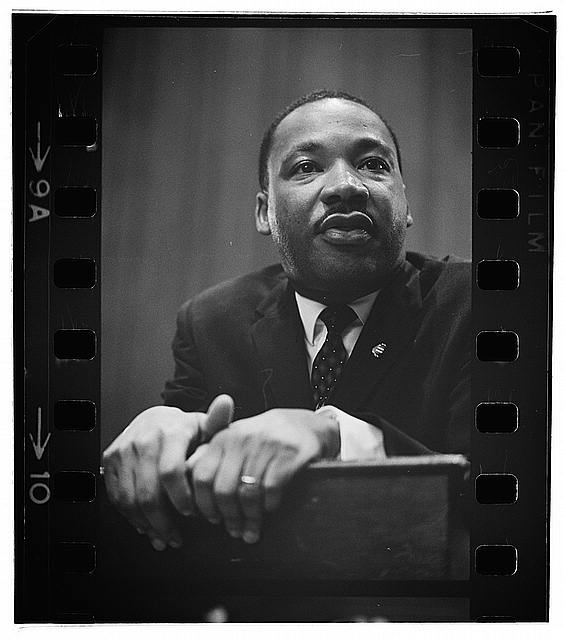
January 15 would have been the 96th birthday of Dr. Martin Luther King, Jr. born in 1929 in Atlanta, Georgia. It was a long road to the third Monday of the month when all 50 states observe the federal holiday named in his honor. Largely owed for making the dream of MLK Day a reality is Stevie Wonder: Back in 1980, he wrote the pointed song, “Happy Birthday,” then launched a 41-city U.S. tour (and invited Gil Scott-Heron along) to promote the idea which was first mooted by Rep. John Conyers in 1968. The musical efforts were ultimately the key in collecting the millions of citizen signatures that had a direct impact on Congress passing the law signed by President Ronald Reagan in 1983, declaring a day for MLK.
Observed for the first time in 1986, some states were late to participate, however, by the turn of the 21st Century, all were united in some form of remembrance of the civil rights giant. “Happy Birthday,” which served as Wonder’s King holiday campaign theme (and is now the “official” King holiday tune) is the last track on Hotter Than July. The album also features “Master Blaster,” Wonder’s tribute to Bob Marley (Marley had been scheduled for the tour until he fell too ill which was how Scott-Heron came to participate). In his memoir The Last Holiday, Scott-Heron details his own journey with music and activism, as he retraces the long and winding road Wonder took to bring home the last US federal holiday, with the help of a song.
The Hotter Than July tour brought Scott-Heron and Wonder to Oakland, where they played in the name of King, along with Rodney Franklin and Carlos Santana. In a weird turn of events, the concert on December 8, 1980, coincided with the night John Lennon was killed. The musicians and crew learned of the tragedy from a backstage television, and the job fell to Wonder, with Scott-Heron and the other musicians at his side, to deliver the shocking news to an arena of music fans.
“For the next five minutes he spoke spontaneously about his friendship with John Lennon: how they’d met, when and where, what they had enjoyed together, and what kind of man he’d felt Lennon was,” wrote Scott-Heron. “That last one was key, because it drew a line between what had happened in New York that day and what had happened on that motel balcony in Memphis, Tennessee, a dozen years before. And it drew a circle around the kind of men who stood up for both peace and change.” Scott-Heron devotes the final pages of The Last Holiday to a remembrance of how the murder of Lennon fueled the final drive to push for a federal observance of the official MLK Day.
The politics of right and wrong make everything complicated
To a generation who’s never had a leader assassinated
But suddenly it feels like ’68 and as far back as it seems
One man says “Imagine” and the other says “I have a dream” -Gil Scott-Heron
Scott-Heron was a lifelong campaigner and champion for human rights himself, beginning on his 1970 live album Small Talk at 125th and Lenox. There is no doubt he would have much to say of the unfortunate confluence of this year’s King holiday with the inauguration and the project known as 2025. The parenthetical title refrain from his song, “Alien (Hold On To Your Dreams)” (see clip below following his topical poem, “Whitey on the Moon/(Mars)”) has been spinning around in my head, alongside the words of Dr. King collected from one of his sermons from the early ’60s. Whatever confronts us today, whatever dangers real or perceived that touch our friends, families and fellow humans in these perilous times, in these words and songs may you find comfort and be inspired to act in love.
Returning hate for hate multiplies hate, adding deeper darkness to a night already devoid of stars. Darkness cannot drive out darkness; only light can do that. Hate cannot drive out hate; only love can do that. Hate multiplies hate, violence multiplies violence, and toughness multiplies toughness in a descending spiral of destruction. – MLK, Jr.
Hold on to the dream.
Filed under: anti-racist, anti-war, Arts and Culture, Bob Marley, Concerts, Dr. Martin Luther King Jr., Gil Scott-Heron, Immigration Reform, income disparity, Poetry, Civil Rights, Gil Scott-Heron, John Lennon, mlk, MLK birthday, MLK Day, music, Poetry, Stevie Wonder

 Denise Sullivan