Denise Sullivan

Author, Arts & Cultural Reporter and Worker

The Complete Unknowns

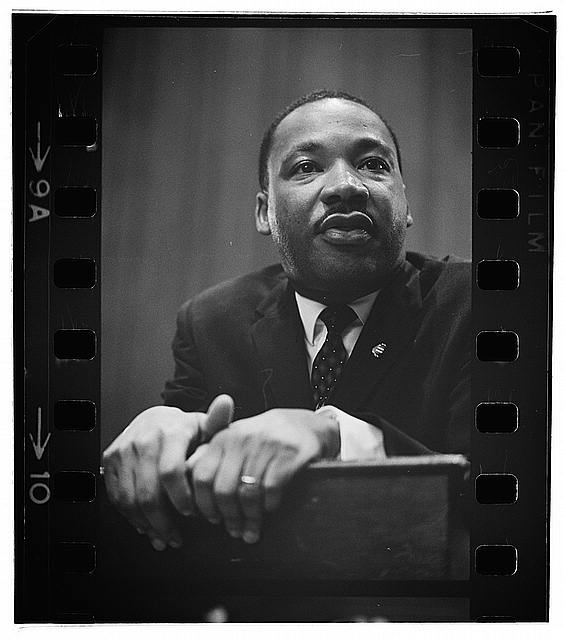
Martin Luther King Jr., Joan Baez and Harry Belafonte

Joan Baez was a junior at Palo Alto High School when she first heard Martin Luther King, Jr. speak at a conference for young Quakers. She would go on to sing for the non-violent movements for civil rights, social, economic and racial justice and against the war in Vietnam.

“King was giving voice to my passionate and ill-articulated beliefs,” wrote Baez in her memoir. Her “exhilarating sense of ‘going somewhere’ with my pacifism” in the aftermath of that speech would lead her to join King on marches in the Jim Crow south and at the historic March on Washington.

If you don’t already know about Baez’s history as a lifelong activist, you certainly would not get it from a viewing of the ahistorical Bob Dylan biopic, A Complete Unknown, released in US theaters this Christmas.

Loosely based on Dylan’s arrival in New York City in 1961, the film covers the songwriter’s introduction to the Greenwich Village scene, his meetings with Woody Guthrie and Pete Seeger, and his intimate relationships with Baez and the fictional Sylvie Russo, a stand-in for his real life steady, Suze Rotolo.

“During the height of the civil rights era Bob wrote, among other songs, ‘The Lonesome Death of Hattie Carroll,’ ‘The Death of Emmett Till,’ [‘Only A Pawn In Their Game’] and of course, ‘Blowing in the Wind,’ which became a kind of anthem,” Rotolo wrote in her own memoir of the Village in the ‘60s. In the film, “Blowing in the Wind” is framed in his repertoire to be more like an annoyance or an albatross.
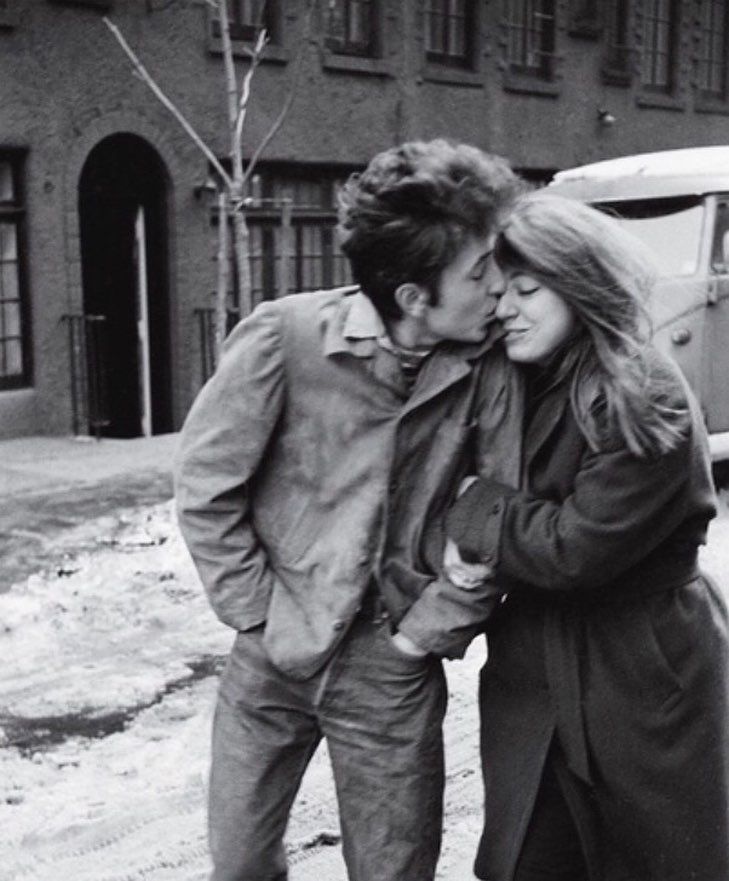
There’s a scene recreating Dylan and Rotolo’s meeting at a 1961 folk-a-thon at the Riverside Church, the historic hub of progressive gathering in New York City. And there is a brief moment when the Russo character explains to a befuddled Dylan that she works at the Congress for Racial Equality (CORE), organizing the Freedom Rides from North to South — in fact one of Rotolo’s jobs in the era.

Facts are also, that in 1963, Dylan walked off the all-important nationally broadcast The Ed Sullivan Show when he was asked not to play his song, “Talkin’ John Birch Society Blues.” For those unacquainted, the John Birch Society is a radical far right group and the song is a satire.

That not much is made of the realities of the causes and concerns that moved both Baez and Rotolo to become immersed in movement work and the folk scene is perhaps understandable: A Complete Unknown is after all, a version of a story of Dylan becoming Dylan. But the gaps in the story of Dylan’s own connections to civil rights and the songs he wrote in their favor are woefully understated in the film, as are his friendships with the people in his circle (where, for example, were the nods to Ramblin’ Jack Elliott? Phil Ochs? Odetta? Lead Belly, at least, appears in an 8×10 photograph). There are also no poets, comedians or jazz musicians in the film’s version of the Village, though they are among those who also contributed to it being America’s bohemian center of its time.

Nor are there any three dimensional Black artists or musicians depicted in the film. The one scene in which a Black musician has a speaking role was made out of whole cloth and is particularly egregious: The fictional bluesman, Jesse Moffette (portrayed by Big Bill Morganfield whose father in real life was blues legend Muddy Waters) is played as a drunken mess when he appears with Dylan on Seeger’s public television show, Rainbow Quest. That Rainbow Quest really existed and featured musicians Rev. Gary Davis, Mississippi John Hurt and Sonny Terry and Brownie McGee is undeniable. The inclusion of any one of those artists would’ve made an interesting, albeit fictional meeting between Black and white, established and next generation musicians. But the creation of a fictionalized and stereotypical bluesman is not only in poor taste, it was a missed opportunity to introduce new listeners to the musicians who influenced Dylan and generations of future folk, blues and rock musicians.

One full episode of Rainbow Quest was devoted to Dylan’s friend and contemporary, Len Chandler, another figure on the Village scene who was eliminated from the story told in A Complete Unknown. It was Chandler who drove Dylan on the back of his motorbike to deliver his first album to Guthrie in the hospital.

“We took out our guitars and played Woody songs,” said Chandler.

Chandler and Dylan hung out, traded songs, learned their trade and celebrated their song publications in folk journals, Broadside and Sing Out! And while Chandler spent considerably more time in the South fighting for the rights of Black Americans (like Baez, it was his calling), it’s significant that Dylan appeared shoulder to shoulder with both of them at the March on Washington (though the film makes a bungle of computer generated imagery to recreate his appearance there).

Considering what could’ve been is a fool’s game but I’ll play it anyway: Dylan’s first recording session was as a harmonica player on another one of his heroes records: Harry Belafonte’s “Midnight Special.” The often told story of Dylan throwing his harps in the trashcan afterward would’ve made a great cinematic moment. The inclusion of a civil rights giant would’ve again been a nice prompt for a young viewer to dig deeper into Belafonte’s role in American civil rights, music and Dylan’s own history.

Oh but there’s more: Dylan famously had a crush of the wanting to marry her kind on Mavis Staples. Here again, was another missed opportunity to demonstrate how the singer’s dreams listening to and playing music with his inspirers became his reality. Instead, there is a Black woman of intrigue in the film who Dylan dumps in short order after her appearance. We have no idea who she is or is supposed to be standing in for, but a little like the nameless “mistress” played by Angela Bassett in Masked in Anonymous, she is there to let us know the main dude is an equal opportunity romancer.

The studio players on Dylan’s recordings, Paul Griffin, Sam Lay, Bruce Langhorne, as well as his producer Tom Wilson, could all have been elevated to characters with even one or two-line speaking roles, if only to let the audience know these cats were not just extras to add color to the cast: These were seasoned professionals hand-picked for the records that transitioned Dylan from solo folky to serious, original artist.

And then there is the short shrift given to Dr. King, whose “I Have A Dream” speech Dylan and Chandler listened to in real time, on the day it was delivered.

“That’s what I remember from the speech, being behind another monument with Dylan and silencing ourselves, and sitting in amazement as we heard that wonderful speech unfold,” Chandler remembered. But the take on historic Black preaching in A Complete Unknown, comes in the form of a man in a fedora and trench coast on a soap box. Listed in the credits as “civil rights speaker,” the character is but a token symbol for the movement that reached its very apex during the era depicted in the film. The scenes at the Newport Folk Festival would take me another viewing to de/reconstruct but they suffer from similar missed opportunities to display Black excellence and inspiration (Lightnin’ Hopkins, Willie Dixon, Fannie Lou Hamer, for God’s sake).

What could’ve been a simple and effective portrait of young Dylan and the ways folk musicians, women, and Black Americans intersected with the Civil Rights Movement and helped to shape the counterculture and ideals that came to define the ’60s, is in the end, just another piece of product, a part of the Dylan Industrial Complex: The books for days, the several documentaries, a museum and archive, a brand of liquor, a Christmas album, ornaments, and a line of bobbleheads…these are but a fraction of the branded, approved, licensed and unlicensed materials on offer in his name. Why should I have wished that a biopic be anything more than a distraction, an entertainment?

In the end, the contributions to the Civil Rights Movement made by women and Black Americans are the real hidden figures and unknowns obscured in the Hollywood retelling of Dylan’s own early ‘60s story. As impenetrable as the “real Dylan” may be or seem to be, I left the film not thinking about him, but wanting to ask the folks living and passed over, how does it feel?

Filed under: anti-capitalist, Arts and Culture, Blues, Bob Dylan, Civil Rights, film, Folk, Greenwich Village, Poetry, Protest Songs, , , , , , , , , , , , , , ,

For MLK Day: Len Chandler’s Shadow Dream – in memory of a singer, a movement & its leader

Len Chandler was a protest singer, movement worker and unsung hero from the Civil Rights Era, a frontline campaigner in the fight for voting rights, racial and economic justice and against wars of aggression. He performed with Bob Dylan and Joan Baez at the March on Washington For Jobs and Freedom in 1963 where Dr. Martin Luther King, Jr. delivered his historic “I Have A Dream” speech. In 2021, I was commissioned to write a piece on Chandler and his relationship to Bob Dylan in front of the opening of the Bob Dylan Center in Tulsa, OK. The essay is emerging here for the first time before its publication as a commemorative limited edition booklet on the life of Chandler (with expanded content). A portion of the book’s earnings will be contributed to voting rights organizations. Order here: Len Chandler: Shadow Dream Chaser of Rainbows/In memory of a movement hero

“You have to take the lead from somewhere and there were only a few performers around who wrote songs, and of them, my favorite was Len Chandler,” wrote Bob Dylan in his book, Chronicles.

Among the singing foot soldiers in the civil rights movement, the students and teachers from coast to coast who sat in, stood up and rode on freedom’s highway, and of all the folksinging pamphleteers and poets who swarmed Greenwich Village in the late ‘50s and early ‘60s, only Len Chandler emerged from that fabled period an under-looked groundbreaker and a foundational freedom singer, a kind of cosmic twin to Bob Dylan.

“We talked all the time,” said Chandler. “I can’t remember what we talked about but half the time, it would be philosophical, our different approaches to things. We could talk for two days on whether it’s a straight line or circle,” he said, recalling that vortex, that wrinkle in time in Greenwich Village where the cultural happenings of the ‘60s were beginning to reveal themselves. “I’d argue today that it’s a circle. The circle is built into everything. It’s built into our DNA, it’s built into the way the cosmos is formed. Everything is circular.”

The Village swirled with poets, playwrights, and artists of all stripes, mixed with locals and others from afar, far-out people who sought a fluid place to become who they thought they were meant to be – the kind of place and kind of time where young Len Chandler (from Ohio) and young Bob Dylan (from Minnesota) could meet, become friends and learn how to frame, shape and deliver a song.

“He sang quasi-folk stuff with a commercial bent and was energetic, had that thing that people call charisma,” Dylan wrote. “Len performed like he was mowing down things. His personality overrode his repertoire. Len also wrote topical songs, front-page things.”

Ordering info Len Chandler: Shadow Dream Chaser of Rainbows

Filed under: anti-racist, anti-war, Bob Dylan, Civil Rights, Dr. Martin Luther King Jr., Poetry, , , ,

Four Little Girls and Two Songs

On September 15, 1963, four Birmingham, Alabama girls, Addie Mae Collins, Denise McNair, Carole Robertson and Cynthia Wesley, lost their lives during the bombing of the Sixteenth Street Baptist Church.  In 2011, a marker was finally dedicated in their names at the site of the vicious, racially motivated, murderous attack.

Just three months after the murder of Medgar Evers in Jackson, Mississippi, and two weeks after the March on Washington and Dr. King’s momentum-building “I Have a Dream” speech in 1963, the Alabama tragedy became the pivotal event in the Civil Rights Movement. Singer Nina Simone wrote “Mississippi Goddam” in immediate response to hearing the news: “I shut myself up in a room and that song happened,” she said of the song that begins, “Alabama’s got me so upset.” From that moment forward, Simone was committed to writing and performing material that would jolt people awake or into action.  It remains her most enduring work.

Joan Baez had of course walked alongside Dr. King at the marches in the South all along; her tribute was a recording of “Birmingham Sunday” by her brother-in-law, the writer Richard Fariña.  Each girl was remembered by name in the verses, set to the tune of a beautiful folk melody. Fifty-plus years on, both songs remain painful reminders of the brutalities waged by so-called humanity, here and yonder, year in and year out, against women, girls and Black lives.

Filed under: anti-capitalist, anti-war, Arts and Culture, Origin of Song, Protest Songs, racism, , , , , , , , , ,

Len Chandler: He, too, sang at the March on Washington

images

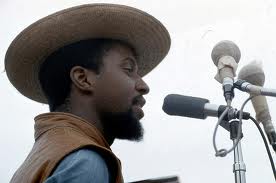
photo of Len Chandler at Newport Folk Festival, 1964, by John Rudoff

Today marks the 55th anniversary of the historic March on Washington for Jobs and Freedom.  Among those assembled to help Dr. King push forward his dream of racial harmony and economic justice was Len Chandler (often overlooked in the history of civil rights work), one of the voices in a trio that day which included Bob Dylan and Joan Baez (he appears at about 17 minutes into the following clip, though the whole 25 minutes is worth your time).


Chandler would march with Dr. King and travel throughout the South in the name of voter registration, informing rural Southerners of their polling rights, often at great risk to his own life. His poems were recognized by Langston Hughes, he wrote the folk standard “Green, Green Rocky Road” with poet Bob Kaufman, and recorded two albums for Colombia Records, but little is known about him or his life.  I sought him out when I wrote Keep on Pushing, my text that tracks the origins and evolution of freedom music, and its roots in African American resistance and liberation movement: a fraction of what we discussed was included in the book. I remain curious why seven years after publication, few scholars have pursued the lead and why so little is known about him…

Originally from Akron, Ohio, and studying on scholarship at Columbia in the ’50s, Chandler made his way to Greenwich Village folk music by accident: Lured to the sounds of Washington Square Park by the downtown youths he was mentoring, he easily fell into the scene based on his natural ear for songwriting and his familiarity with the songs of Lead Belly, Big Bill Broonzy, and Woody Guthrie.  Following a performance at the popular Village coffeehouse, the Gaslight Cafe,  Chandler landed a contract to go to Detroit, writing and performing topical songs for local television. A few months later, when he returned to New York, the folk thing was in full swing:  Bob Dylan was the latest arrival to town and the pair started to trade ideas and songs.

“I hadn’t yet begun writing streams of songs like I would, but Len was, and everything around us looked absurd—there was a certain consciousness of madness at work,” wrote Dylan in his book Chronicles.  Chandler remembers it like this in Keep on Pushing:  “The first song I ever heard of Dylan’s was ‘Hey ho, Lead Belly, I just want to sing your name,’ stuff like that.”  Dylan used Chandler’s melody for his song, “The Death of Emmett Till.” “Len didn’t seem to mind,” Dylan wrote (today, as it happens, is the anniversary of the murder of Emmett Till).

Chandler went on to record two albums for Columbia:  To Be a Man and The Loving People. He continued to work as a topical songwriter, a peace and civil rights advocate, and as a songwriting teacher; his tour of Pacific Rim bases with Donald Sutherland, Jane Fonda, Holly Near and Paul Mooney was documented in the Francine Parker film, FTA, a must-see for anyone interested in US history and anti-war efforts within military ranks. Catch a glimpse of Chandler at the end of this trailer for the film:

It was an extreme privilege (and I have since found out a rare opportunity) to meet one of the true unsung heroes of singing activism (as well as his wife Olga James, a pioneering performer in her own right), and have him tell his story to me. Though largely retired from performing, he remains well- informed on human rights, politics, and the arts and will step up and step out for civil rights. You can read a portion of our talks in Keep on Pushing, and someday I will post the complete unedited transcripts, though for now, enjoy the voice of Chandler from back in the day, when singing was a huge part of moving the movement forward.


Filed under: anti-capitalist, anti-war, Arts and Culture, Bob Dylan, Civil Rights, Dr. Martin Luther King Jr., Folk, Keep On Pushing, , , , , ,

“Lord, they cut George Jackson down”

GeorgeJacksonGerFrontBob GeorgeJacksonSpainFrontBob Dylan’s 1971 single, “George Jackson,” a remembrance for the radicalized convict and Black Panther who died in a San Quentin prison shoot-out on August 21, 1971, remains one of his most mysterious recordings.  Not only does “George Jackson” mark the songwriter’s return to topical song form and to touring after a long hiatus, his subject remains as misunderstood to a general audience as does the singer and his songs.
Less than a month after the prison shooting in California, a historic event at Attica Correctional Facility wherein prisoners took control of the prison to protest its poor conditions resulted in more fatalities—an unmistakable call for prison reform. Perhaps it was that call to which Dylan was responding when in November, he cut and released “George Jackson,” a 45-rpm record that reached the Top 40 in January of 1972.
Opening with the blues trope, “I woke up this morning,” Dylan’s “George Jackson” is not a typical blues song, though it surely addresses the larger topic of racial and socio-economic oppression from which a certain style of blues was born. It also leaves a record of Jackson and his story.
“The power of George Jackson’s personal story remains painfully relevant to our nation today, with its persistent racism, its hellish prisons, its unjust judicial system, and the poles of wealth and poverty that are at the root of all that,” wrote historian Howard Zinn in an updated version of Jackson’s Soledad Brother. Wresting larger truths from the events of 1971, Dylan delivered his summation in these often quoted lines from “George Jackson”

Sometimes I think this whole world
Is one big prison yard
Some of us are prisoners
The rest of us are guards

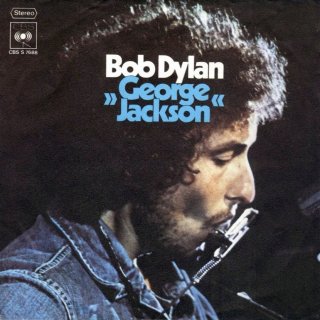
Dylan cut two versions of “George Jackson” for a double sided seven-inch: A “big band” version featuring Kenny Buttrey (drums), Ben Keith (steel guitar), and Leon Russell (bass), and a solo acoustic version. Among the various issues of the single—and there are many—is a picture sleeve with an image of Dylan performing at the Concert for Bangladesh (pictured above, it remains sought-after by record collectors). Here’s a version of Dylan’s song recorded by reggae band, Steel Pulse:

The details of the Jackson case are still debated today by scholars, historians, and those who remember the events. As the story goes, it was a 70-dollar robbery that landed Jackson in state prison, his sentence indeterminate. Guards took an instant dislike to Jackson on the inside and his sentences were extended following events occurring at Soledad State Prison in which three Black inmates and a white guard were killed.  Using his time in solitary to educate himself, Jackson studied psychologist Franz Fanon (The Wretched of the Earth), Marx, and Mao, and came to understand the incarceration of poor Blacks for petty crime in a political context. A leader in moving prisoners to radicalize, Jackson joined the Black Panthers and became one of the group’s most celebrated members, despite  J. Edgar Hoover’s declaration in 1969 that the Black Panthers were public enemy number one.

Published in 1971, Soledad Brother: The Prison Letters of George Jackson, was greeted with a positive reception by intellectuals and political progressives. That Jackson had been framed for conspiring to kill a guard in the Soledad incident was a widely held belief; his defenders were vocal and his case was a cause célèbre. But a few days before the Jackson trial was to begin, a riot broke out in San Quentin in which inmates and guards were again slain and Jackson was among those killed as he ran across the yard in an alleged escape attempt. In 2015, Hugo Pinell, the last incarcerated member of the San Quentin Six, was killed while serving his life sentence, much of it in solitary confinement.

The following is a live recording of Joan Baez singing “George Jackson.”

Advertisements

Occasionally, some of your visitors may see an advertisement here,

Filed under: Angela Davis, Arts and Culture, Black Power,, Bob Dylan, Protest Songs, , , , ,

“George Jackson” and Bob Dylan

GeorgeJacksonGerFront.jpgGeorgeJacksonSpainFront.jpg
Against a backdrop of escalating war in Vietnam and social and political mayhem to accompany it at home, by the late ’60s and early ’70s, the conditions were perfect for hard-hitting topical rock and soul songs to step in and document the times. John Lennon put forth “Imagine,” the follow-up to his and Yoko Ono’s initial bursts of song devoted to giving peace a chance. Marvin Gaye voiced his concerns in “Inner City Blues (Makes Me Wanna Holler),” “What’s Going On?” and “Mercy, Mercy Me (The Ecology),” while Cat Stevens boarded the “Peace Train” that would ultimately take him to study the Qur’an and inspire a conversion to Islam. At the height of the era of music for change, it was more or less expected serious artists would weigh in during times of trouble with a song. From the chart-busting Motown artists who began to draw from a repertoire that was Blacker and stronger, to the rush-released recording by Crosby, Stills, Nash and Young of “Ohio” concerning the shooting tragedy at Kent State, the appetite for topical songs in the US was spurred on by their chart successes. Of course it was Bob Dylan’s early ‘60s pro-civil rights and anti-war songs that were the catalysts for the decade’s new strain of rock and soul music with a message.

Dylan’s arrival in Greenwich Village in 1961, to a scene informed equally by poetry and politics as it was jazz and folk, found him mastering pointed and topical song form early on, from “Blowin’ in the Wind,” “Masters of War,” and “A Hard Rain’s A-Gonna Fall,” to “The Times They Are A-Changin’,” “Only A Pawn In Their Game,” “Ballad of Hollis Brown,” and “The Lonesome Death of Hattie Carroll.”  He followed his first act with his famous retreat from political songs and folk music. Resisting the tag, “voice of a generation,” he leaned more toward poetical and philosophical lyric forms, rather than those polemical or topical and developed his own world of song perhaps best exemplified by the rambles, “Like A Rolling Stone,” “Desolation Row,” and other epics on the trilogy of albums, Bringing It All Back Home, Highway 61 Revisited, and Blonde on Blonde.  From 1966 through much of 1971 Dylan remained in self-imposed exile, off the road and away from the spotlight.

Making his way back to performing in public for the first time since his Isle of Wight concert in 1969, Dylan appeared at Madison Square Garden on August 1st, 1971 at the Concert for Bangladesh, the model for all of today’s all-star charity events. Organized by George Harrison and Ravi Shankar, the rally for Bangladesh raised awareness and funds for the residents of East Pakistan and Bengal India, regions beset by complications of war plus a cyclone and the flooding and famine that followed. An already troubled region was now devastated, and as Shankar outlined the situation for concert-goers, Dylan helped to draw them, performing “A Hard Rain’s A-Gonna Fall,” as well as a handful of more apolitical songs. Not long after the concert, on August 21, 1971, George Jackson was shot to death during an alleged prison escape and Dylan would once again  pluck his subject matter from the headlines, returning to his roots as a social and racial justice singer. One could suggest it was Harrison’s and Shankar’s example of engaging with the world outside their door that inspired Dylan’s subject, though perhaps it was more a matter of his coming to terms with his own gift for topical songs.
Dylan’s relationship to the political world and the matters he chooses to champion or protest have been the subject of much debate, discussion, and inspiration for over 50 years; his life and songs have been over-analyzed and well-examined, but the 1971 single, “George Jackson,” a remembrance for the radicalized convict and Black Panther who died in a San Quentin prison shoot-out remains one of his most intriguing cuts.  Not only does “George Jackson” mark the songwriter’s return to topical song form and to touring, its subject remains almost mysterious and misunderstood to the general audience as the singer himself.
Landing in California following a life on the streets of Chicago, a 70-dollar robbery is what landed Jackson in state prison, his sentence indeterminate. Jackson immediately found trouble on the inside too when guards took an instant dislike to him and his sentences were extended following events occurring at Soledad State Prison in which three Black inmates and a white guard were killed.  Using his time in solitary to educate himself, Jackson studied psychologist Franz Fanon (The Wretched of the Earth), Marx, and Mao, and came to understand the incarceration of poor Blacks for petty crime in a political context. A leader in moving prisoners to radicalize, Jackson joined the Black Panthers and became one of the group’s most celebrated members. However by 1969, J. Edgar Hoover had declared the Black Panthers to be public enemy number one and set out to decimate them. Nevertheless, Soledad Brother: The Prison Letters of George Jackson was published in 1971 and was greeted by a positive reception by intellectuals and political progressives. That Jackson had been framed for conspiring to kill a guard in the Soledad incident was a widely held belief; his defenders were vocal and his case was a cause célèbre. But a few days before the Jackson trial was to begin, a riot broke out in San Quentin in which inmates and guards were again slain and Jackson was among those killed as he ran across the yard in an alleged escape attempt.
Less than a month after the prison shooting in California, a historic event at Attica Correctional Facility wherein prisoners took control of the prison to protest its poor conditions resulted in more fatalities—an unmistakable call for prison reform. Perhaps it was the call to which Dylan was responding when in November, he cut and released “George Jackson”, a 45-rpm record that reached the Top 40 in January of 1972. Opening with the blues trope, “I woke up this morning,” Dylan’s “George Jackson” is not a typical blues song, though it surely addresses the larger topic of racial and socio-economic oppression from which a certain style of blues was born. It also leaves a record of Jackson and his story.
“The power of George Jackson’s personal story remains painfully relevant to our nation today, with its persistent racism, its hellish prisons, its unjust judicial system, and the poles of wealth and poverty that are at the root of all that,” wrote historian Howard Zinn in an updated version of Jackson’s Soledad Brother. Wresting larger truths from the events of 1971, Dylan delivered his summation in these often quoted lines from “George Jackson”:

Sometimes I think this whole world
Is one big prison yard
Some of us are prisoners
The rest of us are guards

The following is a live recording of Joan Baez singing “George Jackson.”

Filed under: Black Power,, Bob Dylan, California, Civil Rights, video, , , ,

“George Jackson” by Bob Dylan

bob+dylan+george+jacksonBob Dylan’s relationship to the political world and the matters he chooses to champion or protest have been the subject of much debate, discussion, and inspiration for over 50 years now. His arrival in Greenwich Village in 1961, to a scene informed as equally by poetry and politics as it was jazz and folk, marked the beginning of his relationship with topical song, followed by a famous retreat from it, as well as his resistance to the tag, “voice of a generation.” And yet, as the ‘70s began, Dylan was once again plucking his subject matter from the news, returning to his roots as a social justice singer with “George Jackson”, a memorial for the radicalized convict and Black Panther who died in a San Quentin prison shoot-out on August 21, 1971.
Against a backdrop of escalating war in Vietnam and social and political mayhem to accompany it at home, by the late ’60s and early ’70s, the climate made necessary topical rock and soul songs which documented the times. John Lennon put forth “Imagine”, the follow-up to his and Yoko Ono’s initial bursts of song devoted to giving peace a chance. Marvin Gaye voiced his concerns in “Inner City Blues (Makes Me Wanna Holler)”, “What’s Going On?”, and “Mercy, Mercy Me (The Ecology)”, while Cat Stevens boarded the “Peace Train” that would ultimately take him to study the Qur’an and inspire a conversion to Islam. It was also more or less expected that in these times of trouble, serious artists would weigh in on the events with a song. From the chart-busting Motown artists who began to draw from a repertoire that was blacker and stronger, to the rush-released recording by Crosby, Stills, Nash and Young of “Ohio” concerning the shooting tragedy at Kent State, the appetite for topical songs in the US was fuelled by chart successes. Bob Dylan’s early ‘60s pro-civil rights and anti-war songs were largely the catalyst for the strain of rock music with a message that thrived throughout the decade. And while it’s true that from 1966 through much of 1971 Dylan remained in self-imposed exile from touring, leaning more towards poetical and philosophical lyric forms, rather than those polemical or topical, “George Jackson” was his wildly unexpected return form.Performing in public for the first time since his Isle of Wight concert in 1969, Dylan appeared at Madison Square Garden on August 1st at the Concert for Bangladesh, the model for today’s all-star rock charity events. Organized by George Harrison and Ravi Shankar, the rally for Bangladesh raised awareness and funds for the residents of East Pakistan and Bengal India, regions beset by complications of war plus a cyclone and the flooding and famine that followed. An already troubled region was now devastated, and as Shankar outlined the situation for concert-goers, Dylan helped to draw them, performing “A Hard Rain’s A-Gonna Fall”, as well as a handful of more apolitical songs.

Later that month at San Quentin in the summer of 1971, George Jackson was shot to death during an alleged escape attempt following a prison riot in which five inmates and a guard were killed. Less than a month after the Jackson incident in California, a historic event at Attica Correctional Facility wherein prisoners took control of the prison to protest its poor conditions resulted in more fatalities—an unmistakable call for prison reform. Perhaps it was the call to which Dylan was responding when in November, he cut and released “George Jackson”, a 45-rpm record that reached the Top 40 in January of 1972. Opening with the blues trope, “I woke up this morning,” Dylan’s “George Jackson” is not a typical blues song, though it surely addresses the larger topic of racial and socio-economic oppression from which a certain style of blues was born. It also tells the story of Jackson.

Having made it to California from the streets of Chicago, a 70-dollar robbery landed Jackson in prison, his sentence indeterminate. He found trouble on the inside when guards took an immediate dislike to him; his sentences were extended—chiefly behind events occurring at Soledad State Prison in which three black inmates and a white guard were killed.  Using his time in solitary to educate himself, he studied psychologist Franz Fanon (The Wretched of the Earth), Marx, and Mao, and came to understand the incarceration of poor Blacks for petty crimes in a political context. A leader in moving prisoners to radicalize, Jackson joined the Black Panthers and became one of the group’s most celebrated members. However by 1969, J. Edgar Hoover—declaring the Black Panthers to be public enemy number one—had set out to decimate them, and other groups like them. Nevertheless, Soledad Brother: The Prison Letters of George Jackson was published in 1971 and was greeted by a positive reception by intellectuals and political progressives. That Jackson had been framed for conspiring to kill a guard in the Soledad incident was a widely held belief; his defenders were vocal and his case was a cause celebre. But a few days before his trial was to begin, a riot broke out in San Quentin in which inmates and guards were again slain; this time it was Jackson who was shot while running across the yard in an alleged escape attempt.

“The power of George Jackson’s personal story remains painfully relevant to our nation today, with its persistent racism, its hellish prisons, its unjust judicial system, and the poles of wealth and poverty that are at the root of all that,” wrote historian Howard Zinn in an updated version of Jackson’s Soledad Brother. Wresting larger truths from the events of 1971, Dylan delivered his summation in these often quoted lines from “George Jackson”:

“Sometimes I think this whole world
Is one big prison yard
Some of us are prisoners
The rest of us are guards”

The following is a live recording of Joan Baez singing “George Jackson.”

Filed under: Bob Dylan, California, , , , , ,

50 Years Ago: Four Little Girls and Two Songs

It was 50 years years ago that the four Birmingham, Alabama girls, Addie Mae Collins, Denise McNair, Carole Robertson and Cynthia Wesley, lost their lives during the bombing of the Sixteenth Street Baptist Church.  In 2011, a marker was finally dedicated in their names at the site of the vicious, racially motivated attack.

Just three months after the murder of Medgar Evers in Jackson, Mississippi, and two weeks after the March on Washington and Dr. King’s momentum-building “I Have a Dream” speech in 1963, the Alabama tragedy became the pivotal event in the Civil Rights Movement. Singer Nina Simone wrote “Mississippi Goddam” in immediate response to hearing the news: “I shut myself up in a room and that song happened,” she said of the song that begins, “Alabama’s got me so upset.”  From that moment forward, Simone was committed to writing and performing material that would jolt people awake or into action.  It remains her most enduring work.

http://www.youtube.com/watch?v=fVQjGGJVSXc

Joan Baez,  had of course walked alongside Dr. King at the marches in the South all along; her tribute was a recording of “Birmingham Sunday” by her brother-in-law, the writer Richard Fariña.  Each girl was remembered by name in the verses, set to the tune of a beautiful folk melody. Fifty years on, both songs remain painful reminders of the brutalities waged here and yonder, year in and year out, by so-called humanity.

Filed under: Angela Davis, Arts and Culture, Dr. Martin Luther King Jr., Freedom Now, Keep On Pushing, Nina Simone, Protest Songs, , ,

Len Chandler: Fifty Years of Marching and Singing the Songs of Freedom

As most readers know, today is the 50th anniversary of the the historic March on Washington for Jobs and Freedom.  What you may not know, even as an astute observer of civil rights and music history and where they meet, is the name Len Chandler:  He was among those assembled to help Dr. King push forward his dream of racial harmony and economic justice on that day, as well as on the marches in the Southern States.  At the March on Washington, Chandler was one of the voices in a trio that included Bob Dylan and Joan Baez. He marched with Dr. King and traveled through the South in the name of voter registration, informing rural Southerners of their polling rights, at risk to his own life. It was a now-you-see-it-now-you- don’t YouTube clip of Chandler’s inspirational performance of “Eyes on the Prize” that contributed to inspiring me to track him down and move forward with the writing of Keep on Pushing, my text that unpacks the origins of freedom music, and its roots in African American struggle and triumph.images

Originally from Akron, Ohio, and studying on scholarship at Columbia in the ’50s, Chandler made his way to Greenwich Village folk music a bit by accident. Lured to the sounds of Washington Square Park by the downtown youths he was mentoring, he easily fell into the scene based on his natural ear for songwriting and his familiarity with the songs of Lead Belly, Big Bill Broonzy, and Woody Guthrie.  Following a performance at the popular Village coffeehouse, the Gaslight Cafe,  Chandler landed a contract to go to Detroit, writing and performing topical songs for local television. A few months later when the gig was through, he returned to New York to find the folk thing in full swing:  Bob Dylan was the latest arrival to town and the pair started to trade ideas and songs. “I hadn’t yet begun writing streams of songs like I would, but Len was, and everything around us looked absurd—there was a certain consciousness of madness at work,” wrote Dylan in his book Chronicles, remembering when.  Chandler remembers it like this in Keep on Pushing:  ”The first song I ever heard of Dylan’s was ‘Hey ho, Lead Belly, I just want to sing your name,’ stuff like that.”  Dylan used Chandler’s melody for his song, “The Death of Emmett Till.” “Len didn’t seem to mind,” wrote Dylan.

Chandler went on to record two albums for Columbia:  To Be a Man and The Loving People.  He continued to work as a topical songwriter, a peace and civil rights advocate, and as a songwriting teacher; his tour of Pacific Rim bases with Donald Sutherland, Jane Fonda, Holly Near and Paul Mooney was documented in the Francine Parker film, FTA, a must-see for anyone interested in US history and anti-war efforts within military ranks. Catch a glimpse of Chandler at the end of this trailer for the film:

Today, Chandler is largely retired from performing, but he remains well- informed on human rights, politics, and the arts, and can write and perform songs that still pack a punch.  I must say it was a privilege to meet one of the true unsung singing activists of my lifetime (as well as his wife Olga James, a pioneering performer in her own right), and have him tell his story in Keep on Pushing (which is where you will find more straight talk from Chandler, as well as my own perspectives on his contribution to civil rights history). I had hoped to see him on television today,  in the crowd in Washington, or better yet, onstage with Peter and Paul, reviving a freedom song for our times. Perhaps I missed him, but Len Chandler belongs on the guest list of esteemed names assembled for any kind of 50th anniversary commemoration of the March, the Civil Rights Era, and anywhere Freedom Songs are still sung.

Filed under: anti-war, Arts and Culture, Bob Dylan, Dr. Martin Luther King Jr., Folk, Freedom Now, Greenwich Village, Keep On Pushing, , , , ,

Songs for the Occupation

Tuesday May 15 saw the release of Occupy This Album, a 4-disc collection of 99 topical songs, with all proceeds going toward supporting the Occupy movement. I have not yet read a review of the album that makes any sense to me, which is reason for me to get busy listening and to write one of my own (though if you have read anything thoughtful and well-rendered, please bring it to my attention). Until I’ve prepared my piece, I thought I’d repost a column I wrote last fall titled Songs for the Occupation—a kind of call for topical songs and a roll call of musicians who declared themselves 99 percent friendly from the start. No doubt the good people at Paste won’t mind if I post the previously published article here, since it pertains to a good cause and all.

NOVEMBER 2011—Early last month, when the Occupy Wall Street movement was still building, an East Bay punk rocker asked me what I thought people had hoped to achieve by occupying city centers and marching in the streets. Since the movement is without spokespeople, it wasn’t my place to say, but personally, I was taking it as a good sign that people are finally coming together in the name of social and economic justice. “I think it’s time to bring compassion back into style” I said. “Good luck with that,” he replied, and no, he wasn’t being sincere, which took me aback for about a minute until I remembered that punk rock is supposed to be snotty, cynical and nihilistic and he was just doing his part to keep the franchise alive.

Michael Franti at OWS

It must be said that plenty of punk-rock people are as interested in building things anew as they are in tearing down the old down, and that music people of all orientations have always brought soul, sounds and heart to social and political movements. So far, only the true lionhearts of contemporary music have turned out for the Occupation, though each week brings more surprises: Ever-ready artist/activist Michael Franti showed up in the first week of October to “Yell Fire.” Talib Kweli, longtime resident in the trenches of conscious hip hop, dropped by to drop some rhymes and weigh in with a powerful new piece he called “Distractions”: “Skip the religion and the politics and head straight for the compassion, everything else is a distraction,” he rapped. Tom Morello, who as The Nightwatchman, shows up with his ax wherever injustice is served, came out to lead a chorus of “This Land is Your Land,” the old Woody Guthrie song that’s easy enough to sing along to, even if you don’t know the words. And the generally apolitical Jeff Mangum of Neutral Milk Hotel delivered a rare, impromptu set of songs to the delight of park dwellers. In particular, the line “we know who are enemies are” from the fan favorite, “Oh Comely,” drew cheers from the crowd. Mangum’s appearance, if not his topically unspecific songs, provided the people with entertainment and support, the kind of unique companionship that only a song can provide in the cold, cold night. Sure the protesters have each other for company—for now—but as rousts and arrests increase, winter sets in and the drum circle decibels rise, the park may see fewer folks willing to stand strong, and that means fewer professional musicians out there, leading the singalongs.

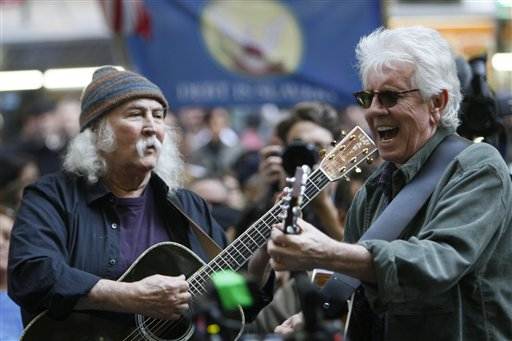
“Our idea was to go down and raise their spirits,” said David Crosby, who with Graham Nash sang for the Zuccotti Park crowd in early November. “What music is doing is unifying the people, bringing them together,” Nash told Rolling Stone.

“Everybody has a point, everybody has an idea everybody has a perspective on the world,” said rapper Lupe Fiasco when asked about musician participation in OWS. Stressing that celebrities are just like the rest of the occupiers, except in a higher tax bracket, he noted, “The leader is Occupy; it is the movement.”

Simmons and West, OWS

Hip hop organizer and mogul Russell Simmons is among those on the street with the 99 percent; part of his role there has been shepherding visitors like the Rev. Al Sharpton and Kanye West through the Zuccotti Park encampment. During the week of West’s and Jay-Z’s Madison Square Garden concerts in November, Simmons was pictured with Jay-Z wearing an “Occupy All Streets” t-shirt, manufactured by his line, Rocawear (it’s unclear where the proceeds are going, though one can only hope the merch is made in America).

The Occupy movement for social and economic equality has been called by scholar Cornel West a “democratic awakening,” while those less enamored with the movement call it a disorganized mess. Call it what you like but whether the occupiers maintain their ground at the park or are forced to leave it, songs—the kind with roots, that are built to last—will provide some sustenance through the winter. Truth is, the people can always use a few more good tunes (or at least some remixes of old ones) to sing on the long march home.

Back in the salad days of protest—the ’60s civil rights, free speech, anti-war and black power movements—rewriting the old songs with the intention of forging something new was common practice—it’s called folk tradition. Rewriting and reviving spirituals for the secular world—or at least a world in which all faiths and traditions get equal respect—was an area mined by Pete Seeger, who along with Joan Baez, helped to turn “We Shall Overcome,” into an unofficial anthem of the Civil Rights Movement (most memorably, Baez sang it at the 1963 historic March on Washington; Seeger recently sang it at OWS).

Originally based on the gospel song, “I’ll Overcome Some Day,” composed by the Rev. Charles Albert Tinley and dating back to the African American Methodist Episcopal Church of the early 1900s, “We Shall Overcome” has changed shape through the years; also contributing to the version as we know it were elements of the spiritual “We’ll Overcome (I’ll Be All Right)”, another hymn from the immediate post-slavery period. But it wasn’t long after its arrival in church hymnals that “I’ll Overcome Some Day” was picked up by striking miners and laborers who went on to use it throughout their organizing fights in the ’20s, ’30s and ’40s. Sung by miners in the North as well as tobacco workers in the South, “We Shall Overcome” became a staple at the Highlander Folk School, the training ground for civil rights workers. Highlander teacher Guy Carawan helped to popularize the song among the forming Student Nonviolent Coordinating Committee (SNCC) in 1960 and the song was spread far and wide by Seeger who changed up the verses a bit. By and by, the melody to “We Shall Overcome” came closer to echoing another slave time spiritual, “No More Auction Block” (once sung by Paul Robeson and Odetta and used by Bob Dylan as the tune for “Blowin’ in the Wind”) than Tinley’s “I Shall Overcome” did. In essence, two folk standards emerged from one spiritual.

Crosby and Nash, OWS

But more than its fairly tame melody, the strength of “We Shall Overcome” lies in its extraordinarily bold lyrical affirmations: We are not afraid/the truth shall make us free/we shall live in peace. These sentiments are as ripe for the current moment, as they were when the United Farm Workers used it in their fight for their rights, as when South Africans sang it in their struggle against Apartheid, and when Czechs sang it during the Velvet Revolution that overthrew communism. “We Shall Overcome” has been deployed in struggles in India and Ireland. It’s been sung by Bruce Springsteen and was recorded for his Seeger Sessions; Seeger, now 92, is still singing it. Though I’d say it’s time for someone from the youngest generation of American singer/songwriter/activists to adopt and adapt it, and lead the singalong. “We Shall Overcome” needn’t be consigned to folk’s moldy or buttoned-up past; rather, it’s protest gold, a song that hasn’t lost its value for over 50 years and counting. If it seems strange, update it. If it seems square, give it a beat (djembe will work just fine). But traditional songs need to get sung and sung loud, as if your life depended on them because in fact there are people whose do: Overseas wars cost not only money but lives; poverty is killing people here at home. Workplace and housing discrimination, poor schools, environmental degradation, job disintegration—these are just some of the grievances that will end up in songs as the movement keeps moving on.

Dr. Martin Luther King Jr. knew what music could bring to a non-violent protest effort: he asked gospel great Mahalia Jackson to accompany him and Harry Belafonte to help organize his efforts. Belafonte’s life is a demonstration of just how important a role a singer can play in effecting change as well as how education in the arts can save young lives (Belafonte tells his own story in the new film, Sing Your Song, and new book, My Song: A Memoir). Nina Simone; Curtis Mayfield; Bob Marley; Peter, Paul and Mary; Sam Cooke; and many, many more singers and musicians contributed to positive social change and quite possibly political change with their music. You may laugh at this notion of change, like the East Bay punker I talked to last month did, but it’s not so funny when you think about Oakland: People from all walks of life, all genders, all religious backgrounds, colors and sexual orientations, there and elsewhere, are standing up to the indignities served up to their communities: It’s one nation time—under a groove.

So here’s to you, Occupiers and musicians: To Michael Franti, Jeff Mangum, Pete Seeger, Tom Morello, Joan Baez, Crosby and Nash, Joseph Arthur and Talib Kweli in NYC, Boots Riley in Oakland and Ozomatli in L.A. The hearts of Joe Strummer, Nina Simone, Phil Ochs and Paul Robeson are on your sleeves now. Every movement, from abolition to women’s suffrage to labor and civil rights has its songs, and this moment in time has its songs too. Thank you—to the singers and your songs—songs that one night might be the only thing between the darkness, cold, tear gas and rubber bullets raining on someone’s soul. Thank you for occupying—so that we shall all overcome, someday.


Filed under: Occupy Wall Street, Songs for the Occupation, , , , , , , ,

Archives

Recent Posts

Browse by subject or theme