Denise Sullivan

Author, Arts & Cultural Reporter and Worker

What Would Jerry Do? Notes on Dead & Company, Inc.® © ™

Back in the Paleolithic era, I worked as front desk receptionist for concert promoter Bill Graham and had several encounters with members of the Grateful Dead family. Not that I knew who they were at the time: it was a big part of my identity as a modern music lover to not know, though I’ve come around to their sound and specifically to Jerry Garcia.

For the sake of a prequel and partial sequel to the business at hand, I accidentally experienced the Dead at a Day on the Green concert in 1976 when they co-headlined with The Who. At the time I didn’t know or care that the big events staged at Oakland’s stadium would became a kind of testing ground for the full scale festival tours we know today. It didn’t help I didn’t know “Scarlett Begonias” from “China Cat Sunflower” or to that to my unformed mind, experiencing the Dead was just a three hour endurance test before the Who hit the stage. I was not transformed, my consciousness was not altered by their music, as some members of the band and the people who love them claim, though today, I quite like most all of Garcia’s and lyricist Robert Hunter’s material. I like to think I have grown into it.

But even back when, I knew Jerry was Jerry, and later in my role as receptionist, I certainly knew enough about receiving office visitors that I was not to waylay people of his renown at the entrance with formalities like announcing their arrival. In the flash it took me to recognize a musician, he could walk past me, nod, and in Jerry’s case, with his cherubic smile, head bowed and hands jammed in his pockets, proceed without pause, into the open main office, then in the direction of Bill’s corner sanctum. Same went for Carlos. Santana. He and Jerry were of course legends by then, their reputations enshrined thanks to their inimitable, celestial guitar styles. I was less generous about their music then, but showed respect anyway: These were people born in the same decade as my parents. Then again, I can’t claim to have displayed anything resembling even courtesy the day an even older man dressed in a fur loin cloth and carrying a walking stick announced his arrival.

“Bear for Bill.”
“Excuse me?”
I couldn’t hide my contempt, buzzing over the line to Bill’s assistant.
“Someone named Bear is here for Bill?”
“Send him in.”
The shock registered on my face compelled a co-worker witnessing the scene to whisper my way.
“Bear is Owsley.”
“And?”
“He invented acid.”
I get it now.

On another day, Mountain Girl announced herself. My lack of exposure to hippie culture was pitiable and the name drew a complete blank. I said something like, “Say what now?”  I feel sorry for being just one more person to judge Carolyn Garcia based on her chosen name and hope she can forgive me. Perhaps we might even agree that Jerry would be “rolling in his grave” in connection with some of events of the last few weeks celebrating the 60th anniversary of the formation of the Grateful Dead. 
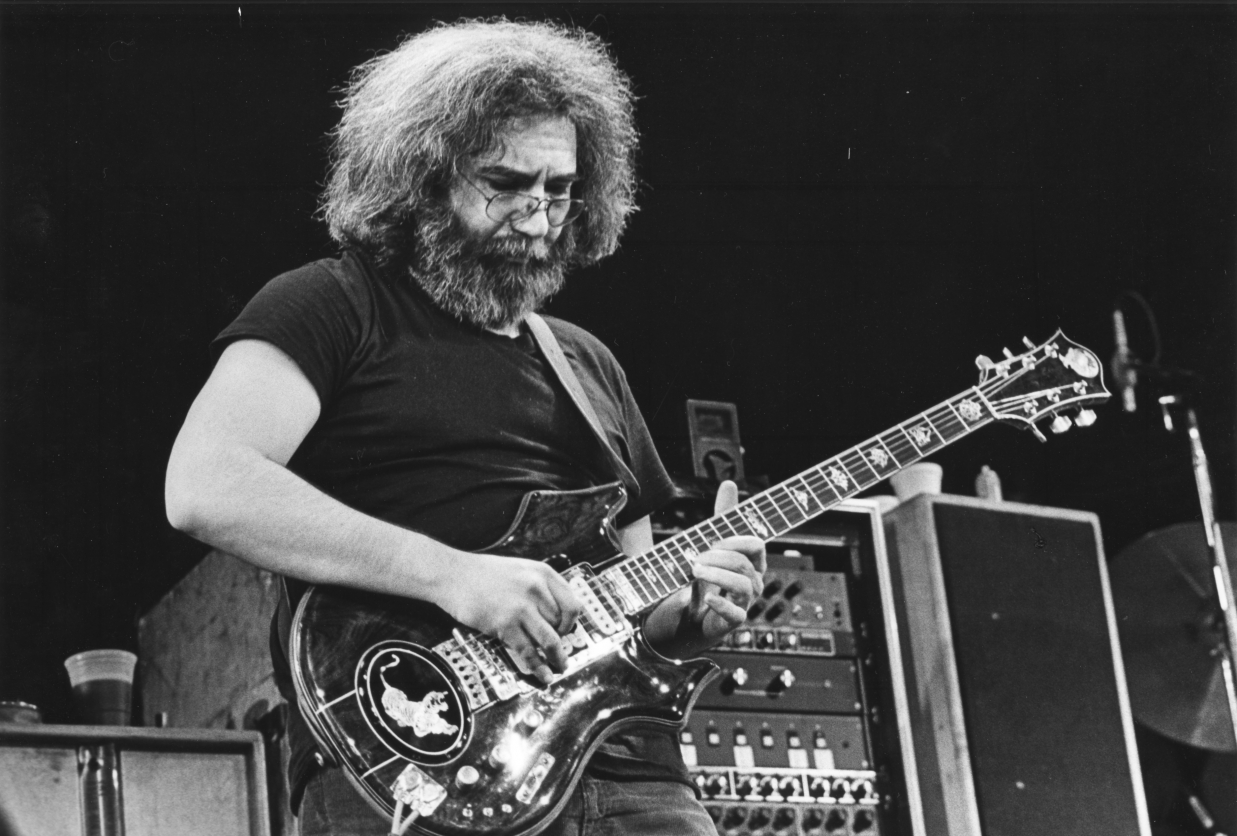
Thirty years ago, on August 9, 1995, Jerry Garcia died. His diabetes raged, his heart gave out and his body failed him while detoxing from a lifetime of drug dependence. A few days later, his life was celebrated with a public memorial concert in Golden Gate Park. By that time, the Dead had been doing big business for some time, thanks to constant touring and their first top 40 hit, “A Touch of Gray.” Never mind then that Garcia’s health was down and his addictions were up: The show must go on as the Dead’s touring, merch and ticket sales were doing the kind of big boring business the music industry represents today.

The bands formed in Jerry’s wake include The Other Ones, The Dead, Further, Ratdog, Phil Lesh & Friends and the Rhythm Devils (there are more). But the extreme monetization of all things rock ’n’ roll, psychedelic and Dead had been well under way for several decades. The Grateful Dead as corporation was just another aspect of its long strangely quirky and contradictory trip.

Beginning in 2015, Dead members Bob Weir and Mickey Hart began billing themselves Dead & Company; by 2023, they played to bid goodbye to touring with their Fare Thee Well shows. Those dates, according to published accounts in music industry trade magazines and other media outlets, grossed $114.7 million over 28 shows, though they were hardly the end. In 2024, Weir, Hart and an amalgamation of musicians played a 30 show stand at the Sphere in Las Vegas and earned $130 million that year as Dead & Company. This year’s Dead & Company returned from the dead, again, for 18 shows at the Sphere and three in Golden Gate Park to mark the 60th anniversary of the formation of the Grateful Dead and 30 years since Jerry’s passing. The tour receipts for this year have not yet been published, though some fiscal facts are known.

Tickets for the Golden Gate Park weekend ranged from $600 for three days and went up to $7k for the VIP Package. The concerts brought $150 million to the city’s economy, $7 million into the Parks and Recreation Dept. according to local media, and some untold sum for promoter, Another Planet Entertainment, not to mention the band, its agents, managers and other profiteers. I don’t know much about the Grateful Dead but I’ve read the books and can tell you that profit was not a big motivator when the band was founded. Money and possessions were seemingly of little interest to Garcia.

To say it another way, Dead & Company do not embody the spirit of the Dead and its commitment to alternatives to commercialism and mainstream culture. That is if there is such a thing as a spirit of a band: In the Dead’s case, that bird has definitely flown. I can say more, much more, but won’t now except: In 1996 I spent six weeks on the road with the Further festival. It was unpleasant to say the least and I survived it by immersing myself in nightly sets by Los Lobos, a band I am certain has a spirit because I can feel it. 

And yet, there are still some traces of Jerry’s spirit around if you are looking for it in the city that raised him. Whether its the makeshift shrines in the Haight, stenciled Jerry bears on sidewalks around town, or the annual Jerry Day free concert at McLaren Park, I could swear some days, especially in August which marks his birth and death, he hovers.

Jerry Day was established in 2003 to celebrate the Excelsior District’s most famous son; this year a street there was named for him. But the future of Jerry Day is imperiled due to “lack of funding” and city support. How could this be in a city of 80 billionaires? How could this be in a city whose mayor is worth millions made from the profits of Levi Strauss, the jeans favored by hippies and punks and everyone else, you may ask and I will answer: We are a city that creates and then commodifies everything: From rock ’n’ roll, psychedelics, and cannabis, to the Grateful Dead, to mention but a fraction of what comes from Northern California. We even have a Counterculture Museum to keep the idea of an underground in place. 

No, I don’t blame the latest generation who want to partake in their own rituals or a virtual tribal love rock musical: It’s the cost to play the game I can’t relate to. There’s also the carbon in/carbon out trucking and busing of staging and sound equipment on public park grounds, our much-needed oasis in a largely concrete residential neighborhood that’s hard to get your head around. 

Jerry loved Golden Gate Park. It’s east to west world map of flora and fauna literally inspired his guitar playing. But following the three dates of Dead & Company there, the three-day Outside Lands festival and last week’s straight vanilla “alt-country” event, the concerts have trampled the landscape and turned the largely working class, Democratic voting blocks of the outer Richmond and outer Sunset neighborhoods into a parking lot.  And we did nothing to prevent it. Oh sure, we voted to make the Great Highway a park, but we got very little in return for that either.

The highway, its nearby grid of avenues, and the park itself, were built on sand dunes. They were not designed with an in and out flow of 60,000 non-residents a day in mind. These neighborhoods of families, people with disabilities, seniors and people of all ages who speak more languages than in any other area of the city are boxed in. Many of us are in the work force and use the roads to travel to and from our jobs. There are hospitals and other services that bookend the park and people need access. And then there is the wildlife that has been displaced for a month by top volumes, distracting spotlights, and cyclone fencing not to mention the human footprints marring their paths home.

Jerry used the park himself to find peace and quiet: That’s where he was found one morning in his car in 1985 with a shit ton of drugs on him and in him (in 2025, concert goers in the park enjoy the brain freezing drug of nitrous oxide). Communing with nature takes many forms but the combination of numbing out in these times seems less like a tribute and more like a cop-out.

Granted, my distress is not about the disruption outside my window but is intertwined with the upheavals worldwide. If you’re reading this, you wake up screaming in some form or another, whether about detainment, displacement, about the genocides, dictatorships, rolled back rights and the current incompetence at most levels of leadership [release the files]. And yet these cries are signs of our human connection, our consciousness, the kind once encouraged by the Dead or psychedelics or a combination of the two. 

Even though now it seems like no one is listening, those of us who are awake and alive are the miracles we are seeking. The shakedown, whether in the park, at the Dead & Company HQ or on the national stage is just another version of life in all its stages: good, bad, ugly and beautiful.  So I keep doing what I do. Live my life accordingly. Sometimes I ask myself, what would Jerry do? And while I choose not to check out, I can’t deny we’re living in a blast furnace. Yet I see no choice but to play it through, and just keep truckin’ on.

Filed under: anti-capitalist, anti-racist, anti-war, Arts and Culture, California, rock 'n' roll, Rock Birthdays, San Francisco News, , , , , ,

For Cinco de Mayo: The Mexican American Rock y Roll Connection

It all started with Ritchie Valens and “La Bamba” and The Champs and “Tequila”  in 1958, though it would be another decade before Santana took Tito Puente’s “Oye Como Va” and freaked it out in 1970. Los Lobos brought Spanish language to LA punks with “Anselma” in the early ’80s and to the masses in 1987 with a remake of “La Bamba”; in 2002, they tore it up Chicano style with “Good Morning Aztlán.” Of course, these names of Latino rock royalty can twist a phrase en español—it is their birthright. But what about los gringos without Latino roots who’ve brought a Mexican vibe to their rock ‘n’ roll? And the bands that feature lesser known Mexican-American musicians, plus los otros conquistadors of south-of-the-border sound? Well, they are the subject of this Cinco de Mayo post, claro que si.

There are any number of starting points I could choose to begin the story of Latin rock and the use of Spanish language in rock ‘n’ roll, but since I’m not a scholar of the stuff and just an admiradora, I’ll apologize upfront for any mismanagement of details, mangling of the language, and my Anglo-centric survey of the music. Let’s just say for the sake of ease we start with 1948 and Don Tosti’s recording of “Pachuco Boogie”, a swingin’ tune about the rebellious zoot-suiters featuring a conversation or street rap in Caló, the urban dialect of the Pachuco subculture. The Pachucos donned the zoot suit and started a ’40s fashion and attitude riot that asserted individuality and anger in the face of having been stripped of a cultural identity. What, you are asking yourself, does this have to do with music? Well, Southwestern Chicanos adopted the baggy trouser/knee-length jacket uniform that had previously been seen on the Harlem jazz scene, and Don Tosti earned the nickname “the Godfather of Latin Rhythm and Blues.” Alongside Lalo Guerrero, “the Father of Chicano Music,” who also sang of Pachuco life as well as farm laborers’ rights, Tosti opened the door for an ethnocentric brand of music to cross into the mainstream (“Pachuco Boogie” was a massive seller), though it wouldn’t be until the late ’60s that the Chicano Movement would come to organize in the name of cultural identity. “Suavecito”, the 1972 hit by Malo (the group led by Santana’s brother Jorge), is an example of Caló y Latin rhythms coming together in one classic R&B/rock ballad. But what happened between “Pachuco Boogie” and the day when Santana threw down at Woodstock before even releasing a debut album?

Well, that would be the invention of Latin rock by California son, Ritchie Valens, a rocker whose “Come On, Let’s Go” and “Donna” are ’50s standards, but who happens to be most remembered for the music of his cultural heritage. As we know, the music died on February 3, 1959 when Buddy Holly, the Big Bopper, Valens, and the pilot died in a plane crash in Iowa, yet “La Bamba”, the el hefe of Spanish language rock songs, lives on. Starting out as a hundreds year-old Mexican folk song, Valens rocked it up and delivered a three-chord wonder that eventually any garage or punk-rock band could play. The Plugz, an LA band by way of El Paso, featuring Tito Larriva and Charlie Quintana, self-released their cranked-up version of “La Bamba” in 1981. The Plugz also recorded two long-playing rare classics, Electrify Me and Better Luck, before morphing into the Cruzados and then eventually going their separate ways, but not before their “El Clavo y La Cruz” and “Hombre Secreto” (as in “Secret Agent Man”) gave the right touch to Repo Man, the punky midnight movie about “the LA experience.” In 1987, Los Lobos were asked to re-record some Valens songs for the soundtrack to La Bamba, a Hollywood bio depiction of the Richie Valens story starring Lou Diamond Phillips. It was then the band, formed in 1973 in East LA, rose to a new level of fame (their take on “La Bamba” went to number one). Debuting in 1976 with Si Se Puede! benefitting the United Farm Workers, and inspired by music diverse as Bob Dylan and Traffic, R&B, Mexican folkloric music, Jimi Hendrix  and Marvin Gaye, Los Lobos are as American and rock’n’roll as they come, while they continue to clutch the roots of their musical  heritage, masterfully incorporating traditional corridos and norteño sounds into their alternately furious rock’n’roll and  laid back jams.

Los Lobos were also inspired by the Eastside sound of Thee Midnighters and Little Willie G (more on them in a minute), as well as Carlos Santana y Jerry Garcia, and the Sir Douglas Quintet, distinguished by Augie Meyers’ Vox Continental organ sound and the soulful singing of Doug Sahm who started their band in San Antonio, Texas. Their greatest hit, “She’s About a Mover,” as released in 1965. Sir Douglas Quintet belonged to the handful of US groups who brought the spirit of the British Invasion (English musicians doing American music), back into the hands of Americans by tricking the public into thinking they were playing British-styled music like the Beatles and the Stones, rather than American music by Americans. It was Sir Doug that officially added the Tex-Mex sound to the American music mix, while Sahm would also go on to sing of the border and other Mexican concerns (“Michoacan”). In later years, Sahm and Meyers would also join forces with Mexican-American rock and genre-straddling songwriter Freddie Fender and accordion virtuoso Flaco Jimenez as the Texas Tornados.

The Farfisa organ sound and the count-off uno, dos, one-two, tres cuatro would become recognized around the world that same year as the opening to “Wooly Bully” by Sam the Sham and the Pharaohs. Led by a Texas-born son of Mexican immigrants, Domingo (Sam) Samudio, the song is about nothing really and was said to be named after his cat. Domingo worked as an itinerant musician and reportedly as a carny before forming the Pharaohs, who took their name from Yul Brynner because he looked tough as the character in The Ten Commandments, one of those epic 1950s Bible movies. “Wooly Bully” became a staple of the frat-rock genre though it was more distinctive than just serving as the soundtrack to AnimalHouse-style hijinks. The song spent an incredible 18-week stand on the charts, and by the end of 1965, it was named Billboard magazine’s Number One Record of the Year and had helped dislodge singles on the charts by the aforementioned pesky British bands of the era. Sam the Sham’s “Li’l Red Riding Hood” was certainly another fine moment for the band, but it lacked the Tex-Mex organ sound that would crop up on the great singles of the ’60s made by another legendary group of Mexican-Americans: “96 Tears” by Question Mark & the Mysterians, who hailed from Michigan and were fronted by Question Mark aka Rudy Martinez and featured a teenaged organ player, Frank Rodriguez, Jr. The organ riffing would also inspire the group’s “Can’t Get Enough of You, Baby.” In 1998, Smash Mouth from San Jose, California, had a hit with the song alongside their hit remake of “Why Can’t We Be Friends?” by War, a mixed-race funk band whose big hit “Low Rider” was a hats-off to cruisin’, Chicano style.

Of course, when it comes to cruisin’ Chicano style, the band for that is East LA’s Thee Midniters. Known for their instrumental jam “Whittier Boulevard”

The band and their especially soulful singer Willie Garcia, better known as Little Willie G, was a big inspiration to the future members of Los Lobos. The song was a natural to cover for Los Straitjackets, the contemporary (mostly) all-instrumental band that performs in Mexican wrestler masks. Okay, so copping a Spanish name and wearing a mask does not make a Mexican rocker. But by virtue of using the article “los” in their names, Los Straitjackets, as well as Texas rockers Los Lonely Boys, are filed in American record stores with the other “los bands,” like Los Bravos, the rock group from Spain whose 1966 hit, “Black Is Black”, did not contain a word of Spanish. Nor to my knowledge did the Zeros, the Mexican-American band from San Diego, ever sing in Spanish, though as members of the class of ’77,
they are distinguished as first-wave punk rockers; they also sprung Robert Lopez, aka El Vez, the Mexican Elvis. Somewhere, there exists a rare single of their anthem “I Don’t Wanna” backed with “Li’l Latin Lupe Lu”, a cover of the first Righteous Brothers hit made even more famous by Mitch Ryder.

I have only scratched the surface of the Latino influence on rock, precisely because it is inescapable and inextricable. I never got to point toward the “Spanish” sound on all those Brill Building and Phil Spector hits, or delve deep into the Afro Cuban percussive roots of rock (best exemplified by Bo Diddley borrowing the rhumba-like clave beat), nor did we open the pandora’s box of disco that partially paved the road to hip hop and other forms of dance music.  There is so much to uncover, from Devendra Banhart’s musings en español on Cripple Crow to the Mission District’s #1 son, Jerry Garcia (that is if you don’t count figure #1a, Tijuana-born Carlos Santana). I had planned to wax on about Jack White’s and Beck Hansen’s Mexican-American neighborhood origins as well as the exact definition of un perdedor as heard in Beck’s “Loser,” but I will leave that to you to explore. While were are here, let’s not forget the great Spanish-lover, Joe Strummer, whose Mexico City childhood allowed him to open his corazón to the Spanish-speaking world, and they to him. I had hoped to remind you to remember to forget U2’s lame-o uno, dos, tres, catorce countdown to “Vertigo”, but who am I to talk when all I can offer are my own gabacha sign-offs, ay, caramba y que lástima. Yo no soy una roquera, lo siento. Pero, in the hands of the Mars Volta, Ozomatli, Zack de la Rocha, La Santa Cecilia, Cambio, y todos los músicos, there is mas y mas y mas y mas musica: Rest assured, La Raza rocks on. Wishing all a safe and sane Cinco de Mayo.

The research compiled in this column was originally published some years ago in my Crawdaddy! column, The Origin of Song.

Filed under: Arts and Culture, Civil Rights, cross cultural musical experimentation, Immigration Reform, income disparity, Latino culture, Origin of Song, , , , ,

Archives

Recent Posts

Browse by subject or theme