(UPDATE, December 19: I have since seen the film in its entirety and the “Green Green Rocky Road” scene is the best part. Though Len Chandler and the histories of some of the other folksingers of color on the scene—Odetta, Richie Havens, Buffy Sainte-Marie—have been well-documented, the filmmakers chose to render invisible their counterparts or composites in their deeply cynical look at Greenwich Village folk).
Inside Llewyn Davis, the new Coen Brothers film concerning a fictional folksinger from the early ‘60s Greenwich Village scene (based loosely in post-modern style on some incidents from the life of actual folksinger Dave Van Ronk and other figures of the Village scene) opened in select theaters this weekend.
I have not yet seen the film, but gathered from the soundtrack the title character played by Oscar Isaac, performs “Green, Green Rocky Road,” which Van Ronk himself went as far as to call his “theme song.” With melodic and rhythm roots in the Georgia Sea Islands and before that, West Africa, readers of Keep on Pushing will remember the songwriting credit for “Green, Green Rocky Road” belongs to Len Chandler and Robert Kaufman (yes, as in Beat poet, Bob Kaufman).
I had the great and rare honor to interview songwriter and activist Chandler in 2007; large portions of our interview appeared throughout Keep on Pushingand on this site. Chandler spoke highly of Kaufman, Van Ronk, and of course Bob Dylan, who detailed their shared history and collaborations in his book, Chronicles. And yet, it is “Green, Green Rocky Road,” a song Chandler never recorded, that may be one of his most enduring achievements, despite the fact he was a singing hero of the Civil Rights Movement (his contributions to African American/US political and social history remain obscured and inexplicably, largely unsung).
Here’s a clip of Van Ronk performing the song, followed by a clip of Chandler performing his own “Keep on Keepin’ On,” from his rare Columbia album, To Be A Man.
“Abraham, Martin and John” was written by Dick Holler and first released by Dion (DiMucci) in 1968. Neither Holler nor DiMucci were known for being particularly political in their music, but the assassination of Robert Kennedy inspired the question, delivered in a song.
Smokey Robinson and Marvin Gaye also recorded “Abraham, Martin and John.” Here’s a clip of Robinson singing it at the White House, followed by Gaye’s version, featuring full text of the lyrics.
Countless artists have performed or recorded variations on the song and it has more than once reached the charts; comedian Moms Mabley took it to number two. For those seeking further illumination on the relationship between the Kennedy brothers and Black America, read this.
Though the assassinations are no mystery, and 50 years later the grief lingers on, liberty and justice await, and hope is still awake in the song.
Preservation of the stories of music’s most unsung participants is my job, though there are times I’ve questioned the motivation and sanity behind my choice in career. Thanks to a quick trip to Texas, I can recommit to my own calling, writing the stories of the under-looked and unjustly underappreciated people of arts and letters who make history everyday by living creatively and pursuing their own truth, sometimes at great risk: They are paying the wages of our liberation. The freedom singers profiled in Keep on Pushing had plenty of experience with perseverance and faith-keeping; it’s partly why I went in search of their stories at such a deeply troubled time in our history. I also could venture a guess that ninety percent of the interviews archived here feature artists who persist, despite the revelation, there are no free refills for the taking: They are the ones who inspire me not only to write and storytell, but to live authentically myself.
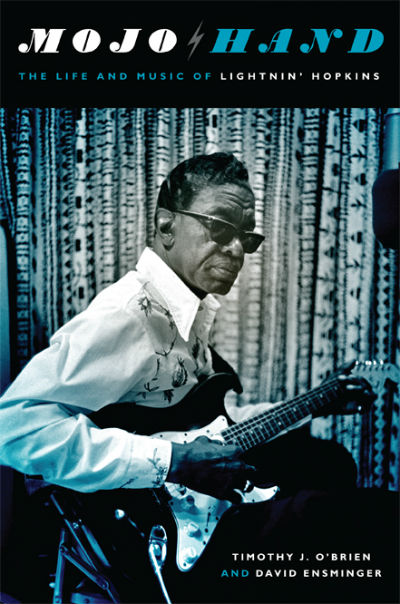
Following a four-day weekend in Austin for MEOWCon and Texas Book Festival, the importance of documenting our untold stories and the theme of living history were driven home to me at every turn. It was a much-needed validation and dare I say vindication of a life spent in music’s trenches, a role which author, folklorist and professor David Ensminger assures me is vital and necessary. As “culture workers,” we share a passion for recording and preserving the contributions made by artists who have gone unembraced by mainstream media and the consumer culture, while digging for lesser-told stories by musiciains of renown. Ensminger also maintains the Center for Punk Arts and holds a vast archive of flyers and ephemera, most of it viewable online. Appearing in conversation at the Texas Book Festival on Sunday to talk with me about his two new music history books: Left of the Dial, a collection of interviews with punk legends, and Mojo Hand: The Life and Times of Lightnin’ Hopkins, the biography he co-authored with Tim O’Brien, as people who experienced punk’s dawn firsthand, we agreed we can identify with the outsiders who conceived, lived, breathed its ethos but more importantly, made the music. They aren’t much different from the outlaw blues heroes of yore who also adhered to an anti-authoritarian credo, while kicking against the confines of a society designed to keep them on the outside (or in the parlance of the prison system, on the inside). And yet, these cross generational musicians not only survived the system, they lived to make life-changing music; in many cases they also did it with incomparable style (particularly in the case of the one-of-a-kind playing and haberdashery of Lightin’). As we talked, Ensminger and I tuned into Texas musicians who found the heat on them so oppressive, they migrated to California, where it was easier to be themselves. And yet, wherever these Lone Stars roamed, their spirit shone through in the music, with its yowling chords of liberation and the harmonica of injustice, never veering far from South-bound roots. In an interesting twist, Ensminger and I delivered our talk on fringe musicmakers in chambers at the State Capitol (we had no doubt the irony of our presence there would not be lost on our subjects from Lightnin’ and the Big Boys, to the Dicks, the Stains and MDC, while I prayed it would not be noticed by the state’s right wing nut cases).
Across town at MEOWCon, a couple hundred women convened for the first-ever event organized to honor women’s history and contribution to rock, roll, and other popular music, with the intention of bringing along younger women and empowering them with tools for equal opportunity. After 50 years of taking part in rock’n’roll collectively, many of us still find rock’s smoke, mirrors and glass ceiling firmly in place, discouraging our participation in it on all levels, from music to media. It’s only when we come together that we realize, we can and have done every aspect of the business well, and yet the history of our success has largely gone unrecorded. This theme of under-documentation emerged again and again at the three-day conference. It was present while Suzi Quatro played (where was the national press for this rare stateside appearance by one of rock’s living, vital foremothers?); it took a direct hit during Kathy Valentine’s keynote address (as she pointedly asked why she and her band the Go-Gos still hold the record for being the only female band to have written and recorded a number one album?) and it was upended during the panel and performance by the women of These Streets: Seattle grunge players who’ve taken it upon themselves to document the scene they were wholly a part of, yet the role of women rarely gets a mention in texts devoted to the ’90s music explosion there. I would say the same for the Q&A with Frightwig, the reunited band from ‘80s San Francisco who though under-appreciated in their first incarnation will go down as vastly influential, especially as they continue to bring new meaning to what it means to be a mid-life, punk generation woman playing on in the 21st Century.
Meeting and mingling with women who paved the road for us, from Patricia Kennealy Morrison and Robin Lane, to solid sisters like Julie Christensen, and young women like Aly Tadros, Shelby Figueroa, and Wendy Griffiths of Changing Modes to whom we hand the torch, was an experience I hope to repeat, and document more extensively. Thanks to Carla DeSantis Black for the putting together the whole shebang: Many years ago, the editor/publisher of ROCKRGIRL printed my piece on Jane Weidlin, and today it lives in an anthology titled A Girl’s Guide to Taking Over the World: Writings From the Girl Zine Revolution. I’m humbled to have witnessed and survived that revolution, and recommit to finding more untold stories of women—and the men who support us—rising, as we document and preserve our herstory.
Marcus Books and its supporters won a small victory in the ongoing fight to save the store when this week, the San Francisco Board of Supervisors unanimously passed a resolution supporting the preservation of the historic building. In business for over 50 years, Marcus is America’s oldest black-owned bookstore and a San Francisco literary institution that’s hosted James Baldwin, Malcolm X, and Toni Morrison, among countless other writers and thinkers; it is a huge part of the City’s African American heritage. Before it became a bookstore, the Victorian building originally located on Post Street was home to Jimbo’s Bop City, the legendary Fillmore District club that staged Billie Holiday, Miles Davis, and John Coltrane, among other jazz giants. The resolution put forth by Supervisors London Breed and Malia Cohen, and supported by Supervisors of all districts, urges the new owners of the property to “uphold the building’s community serving purpose.”
At a rally and press conference Tuesday afternoon, hours before the resolution was passed, about 100 community and church leaders, as well as activists, artists and supporters gathered on the steps of City Hall (never mind the persistent sound of horns you will hear in this clip—in a separate but related issue, cab drivers were protesting the rogue transportation companies that have taken over the roadways in the face of SF’s latest tech boom).
“Tell everyone you know who loves truth and justice and tell them to get involved,” said Archibishop Franzo King of Saint John Coltrane African Orthodox Church. The Fillmore has historically been the scene of systematic removal of it residents, whether the internment of Japanese Americans in the ‘40s or the ‘50s and ‘60s relocation of its African American dwellers who were promised housing that never materialized. After a decades-long, so-called redevelopment project (which is now widely and finally acknowledged at the city government level as a failed undertaking), the Fillmore has rebuilt and rebooted more than once, but the well-documented exodus of middle to low-income people of color, and the working and artist classes from throughout San Francisco continues unabated. To state the plainly obvious, unlike buildings, people cannot be replaced.
“This isn’t just about the bookstore,” said Marcus Books owner Greg Johnson. “It’s about humanity.”
“This is about transfer of wealth, out of the hands of working class black folk…” said Rev. Arnold Townsend, Vice President of the local NAACP, at Tuesday’s press conference.
Most all of the speakers noted the persistent effort to save Marcus Books goes beyond highlighting the failing of brick and mortar book stores in the 21st Century; it touches realms of historical preservation of culture and ideas, and bores straight into matters regarding maintenance of a community hub. Literacy, education, and generally freely traded knowledge of self and others are also at stake.
“When we lose our artists, we lose our stories,” said Tony Robles of grassroots arts organization, POOR Magazine.
“I would not be where I am without this book store,” stated devorah major, author, educator, and a San Francisco poet laureate.
The Marcus situation is sadly indicative of the changing demographics of the so-called sanctuary City of St. Francis, “with its widely advertised liberal and cosmopolitan tradition.” But San Francisco’s track record with its African American population is not good, a contradiction that did not escape the notice of James Baldwin who participated in a film specially broadcast on public television station KQED in 1963. I recommend the entire series of clips that follow from Take This Hammer. And I especially commend San Francisco’s elected officials for taking the matter of Marcus Books and the larger problems it represents with the seriousness it demands.
Injustice in the music business is one of the themes shared by three summer music documentaries now playing in theaters or on demand. Twenty Feet From Stardom, A Band Called Death and Big Star: Nothing Can Hurt Me all concern the lives of musicians who did not reap the benefits of success their superstar counterparts or even their industry’s executives enjoy. These tales of a typically unkind, fickle and often unethical music business are told far too often: There is of course a long tradition of broke and hungry blues singers and ripped-off rock’n’rollers; perhaps most famous are the Funk Brothers, creators of the Motown sound, whose untold history became Standing in the Shadows of Motown, the blueprint for these kind of behind the veil stories. And yet, the background vocalists of Twenty Feet… and the musicians of the ironically named ‘70s bands, Death and Big Star, though largely overlooked, unsung, and often underpaid themselves, also delivered life-giving music of lasting value—music far more focused and accomplished than many of their more successful name brand peers.
Much to the younger generation of musicians in their family’s delight, the Hackney brothers co-created punk rock in early ‘70s Detroit. A Band Called Death is their story, as told by surviving brothers Bobby and Dannis, with credit due to brother David for the vision. Inspired by their minister dad’s insistence they watch the Beatles on Ed Sullivan, the boys formed a band; as rock evolved, so did their sound. David aimed to combine the guitar chords of Pete Townshend of the Who with the leads of Jimi Hendrix. With Bobby’s vocals and bass, and Dannis’ agility on drums central to the crunch, David’s idea came into focus, though it had also been shaped by forces much stranger than spine-chilling rock’n’roll. Impacted by the accidental death of their father, David’s idea—a hard rock threesome named Death with a triangular mind-body-spirit logo was an entire concept, though it turned out to be a bit much for listeners to metabolize in the post-‘60s hour of segregated rock and soul. It is generally agreed among band and family, record industry personnel and public perception that David’s extreme construct did the band no favors, particularly when they were very close to getting a record deal with Clive Davis and David wouldn’t budge. “First you let them change your name and then…” You may as well surrender your soul is the implication, and there is truth in those words. Though he and his brothers’ band were consigned to the rare and forgotten records rack for 30 years, David’s vision, that Death would one day be poplar after he was gone, turned out to be prophecy. A Band Called Death lets that story unfold, as it unleashes the power and excitement of the music, highlighting its timelessness and virtuosity. For non-believers, their pure rock’n’roll single, “Keep on Knocking,” may be the convincer: I never tire of it and could happily spin it over and over and over again.
If there is such a thing as rock justice, revived career status may also be in the balance for some of the singers profiled in Twenty Feet From Stardom, a look at the ladies (and one man) who sing the background vocals to the soundtrack of your life. To their tremendous credit, director Morgan Neville and producer and industry vet Gil Friesen don’t flinch from the cruelty of the record business, a model that has historically cheated its true talent while rewarding mediocre copycats. The film debuted at the Sundance Festival and screened earlier this year at the San Francisco International Film Festival and is told by the vocalists Darlene Love, Merry Clayton, Claudia Lennear, their contemporary counterparts, Lisa Fischer and Judith Hill, and the musicians they sing for (Stevie Wonder, Bruce Springsteen, Sting and Mick Jagger). With differing degrees of yearning for the spotlight, each woman shares her own tale of what it was like to sing behind Ray Charles, the Rolling Stones and Michael Jackson and in the case of Love, for producer Phil Spector (now serving a prison sentence for murder). Both Fischer and Lennear, emerge as the pair who crave little more than what they have: Fischer’s devoted to her gift and married to the music and a life on a road. Lennear stepped back and became a teacher, though as a result of the film and revisiting her years alongside George Harrison, Joe Cocker, and Ike and Tina Turmer, she’s been inspired to reclaim her place in the spotlight. Here’s her version of the Beatles song, “Let It Be.”
Perhaps most depressing in this downbeat trio of tales is Big Star: Nothing Can Hurt Me, a story of unrequited loves and life let downs. Chris Bell, who alongside Alex Chilton, was a principle songwriter on the Memphis group’s first album, left the fold under what the film portrays as mysterious circumstances. What’s clear however, is that he was touched by substance abuse, and sexual and religious confusion, and all the troubles conspired to takeaway his life at the cursed rock’n’roll age of 27. It didn’t help that Big Star’s record label, Ardent, was affiliated with Stax, though while giants of the soul industry were experiencing business and reorganization troubles just as they crossed the bridge toward releasing rock’n’roll records. And then there is Chilton, a vocal talent with qualities so chameleon-like, and a reticence to be interviewed, that he’s hard to pin down. The teenaged soul singer of “The Letter” shifted gears in Big Star, and yet again in his post-band, punkish years; he passed away in 2010 before the completion of the film, and his presence in it is confined to audio and performance clips. It would’ve been interesting to hear what he might say of his former band from a 60-year-old’s vantage point, but without him or Bell to speak for themselves, the real story of Big Star largely remains a mystery, to be filed under bands that never made it, but could have, if only the stars had aligned in their favor. Though their story is grim, their recording legacy is the prize: “The Ballad of El Goodo” from #1 Record, is a collaborative effort between Chilton and Bell, a power-pop freedom song:
Though I would not characterize any one of these music documentaries as uplifting, within the frames of each reel, and certainly within the individual stories, there are flashes of reverence, bright spots of humor, and in all cases, impeccable music. There is no shortage of stories like these, ready to unspool and cast the music business as it was once known in its true, unflattering light. I don’t want to say I’m happy that everyone can see for themselves the hit parade of human sacrifice, left in the wake of what it takes to create superstar entertainment for the masses. Nor do I delight in the music industry’s complete and total rupture. But it’s no doubt valuable for music consumers, just like consumers of other goods, to know a little bit more about what goes into the making of product they love so much. The music business is a killer, with very little to do with the art of its creators. Certainly it has shown little to no compassion for the health and welfare of musicians, without whom, there would be no primary product. Perhaps it’s best we no longer fool ourselves into thinking that talent and excellence are qualifications for success, no matter what business we may find ourselves. The artist or worker without a killer instinct, will need to make a choice: Take a backseat willingly, or be content, to be left standing in the shadows.
It’s been 50 years since civil rights leader Medgar Evers was slain in his driveway, returning home from a meeting over matters in the NAACP. Following the cold-blooded killing by a white supremacist, and coinciding with the period of ever-intensifiying racial hostility in the South, writers got more and more direct with their songs of southern hate. “The Ballad of Megar Evers” is an a cappella spiritual by the Freedom Singers (a different group than the one founded by Cordell Reagon); Bob Dylan covered the Evers tragedy and its political ramifications in “Only a Pawn in Their Game;”
Phils Ochs weighed in with “Too Many Martyrs.”
Perhaps most famously, there was Nina Simone’s “Mississippi Goddam.”
Though it was the bombing of the four little girls at Sixteenth Street Baptist that forced Simone’s lyric, the situation in Mississippi culminating in the assassination of Evers earned the song its title. Evers’ killer was finally convicted in 1994.
Extraordinary musician and activist Richie Havens has passed today, Earth Day, following a heart attack. Havens was a performing songwriter, though by his own admission, specialized in performing the songs of other writers. Havens’ life and how he came to be an activist through song throughout his career was central to the narrative of my book, Keep on Pushing; starting as a Doo-wop singer in Bed-Stuy, his curiosity led him to the Greenwich Village clubs of the late ’50s where he was exposed to folk music and poetry, and was encouraged by Allen Ginsberg to perform. His journey through the heart of the counter culture was the source of much inspiration as I wrote, and I will forever be grateful for the gift of our conversation, along with the beautiful songs he left us. Havens will be missed by music lovers and friends of the earth throughout the world. I would like to send my condolences to his family, friends, and fans, and will take the rest of this precious day to honor his memory by doing something for the earth. Thank you, Richie Havens, for your soulful lifetime contributions to our planet, Earth.
Update: There will be a public memorial for Richie Havens on Monday, April 29, at City Winery in New York City.
When 80,000 barrels of oil spilled into the waters of the Santa Barbara Channel in January of 1969, the crude-splattered water, beaches, and birds along the California coast in its aftermath became the symbols of modern eco-disaster. While the ensuing public outcry helped hasten the formalization of the environmental movement as we now know it, for musician Van Dyke Parks, the spill and “the revelation of ecology,” as he calls it, was a very personal, life-altering occasion. “It changed my M.O. and changed my very reason for being,” he says. The Union Oil rig rupture in Santa Barbara made Parks go calypso.
“When I saw the Esso Trinidad Steel band, I saw myself in a Trojan Horse,” he says. “We were going to expose the oil industry. That’s what my agenda was. I felt it was absolutely essential.” From 1970 to 1975, Parks waged awareness of environmental and race matters through the music and culture of the West Indies, though in the end, “You don’t know whether to laugh or cry. That’s what makes Van Gogh go,” he says, “That’s what great art does.” Though Parks is referring directly to Esso Trinidad’s happy/sad steel drum sounds, he could just as easily be talking about his own experience during his Calypso Years.
My interview with Van Dyke Parksoriginally appeared in the pages of Crawdaddy! in 2009. Four years later, the story of one man’s adventures in art and activism The Day Van Dyke Parks Went Calypso, remains the most most-read and most searched piece here at denisesullivan.com. Parks had a goal and an idea ahead of its time: To forge environmental healing through music made by instruments made of cast-off oil drums. Read the full story here or at the link above. And happy Earth Day.
Classic Track: “Everybody Needs Somebody to Love.” Recorded by the Rolling Stones, Wilson Pickett, the 13th Floor Elevators, the North Mississippi Allstars, and even the Blues Brothers, Solomon Burke used his tune to testify his message of love until the very end (he was born on March 21, 1940 in Philadelphia and died on the morning of October 10, 2010 on his way to a sold-out gig at the world famous rock club, the Paradiso in Amsterdam). Burke first hit the Top 10 R&B charts in 1961 and 1962 with “Just Out of Reach (Of My Open Arms)” which was immediately recorded by Betty Harris, and followed with the Bert Berns song, “Cry to Me”, also cut by the Rolling Stones in 1965. That year Burke scored an R&B number one with his own song, “Got to Get You Off Of My Mind.” The decades in between the ’60s and the present have in part been described by Burke as his “pits of hell,” but by the millennium he’d made a comeback: Don’t Give Up On Me was a 2002 Grammy-winning blues album featuring songs by Elvis Costello, Brian Wilson, Nick Lowe, Bob Dylan, Van Morrison, and Tom Waits.
Career Highs: Crowned by a DJ who called him the King of Rock ‘n’ Soul in 1964, Burke took the scepter and the cape and ran with the gimmick, paying no mind to what James Brown or anyone else had to say about the title. Performing perched atop his onstage throne, Burke was inducted into the Rock and Roll Hall of Fame in 2001. He was extraordinarily honored to have performed at the Vatican for Pope John Paul II.
Career Low: He perceived that Atlantic Records honcho Jerry Wexler stonewalled his dream project, the Soul Clan, a super-group projected to make bank and fund much-needed community-based projects in the late ’60s. Initially conceived to include Otis Redding and Wilson Pickett, Redding’s death by plane crash was the first devastation. Pickett’s exit followed, which left Burke, Don Covay, Ben E. King, Arthur Conley, and Joe Tex to record a rousing single, “Soul Meeting”/”That’s How I Feel.” But when the recording budget was withdrawn, the album was filled-out with substandard tracks. “Those dreams got crushed… it shattered us,” Burke told me in 2008.
Essential Listening: Burke’s swansong Nothing’s Impossible was released in 2010; it may also be considered his masterpiece: An old-school Memphis soul recorded made in collaboration with legendary producer Willie Mitchell, they recorded it at Mitchell’s Royal Recorders, home of Al Green’s and Ann Peebles’ hits, and it got the stylized, Hi Records rhythm and sound—a fitting farewell from two soul masters.
And if you like that:Nashville (2006) a nod to his love of country music, was produced by Buddy Miller and features duets with Dolly Parton, Emmylou Harris, Gillian Welch, and Patty Griffin.
Quotable: “The best soul singer of all time.” – R&B Producer Jerry Wexler
This column originally appeared in Crawdaddy! October 11, 2010
Scottish songbird Annie Lennox wrote “Sisters are Doin’ it For Themselves” with her musical partner Dave Stewart of Eurythmics with the intention of the song becoming a feminist anthem. Nearly 30 years later, the song stands as a female-positive statement, bolstered by the vocal accompaniment of Aretha Franklin, the unheralded originator of feminist song. Before the women’s movement officially started to roll, in 1967, Franklin famously cut the Otis Redding tune, “Respect,” and turned it on its head when she sang, “all I ask for is a little respect when you come home.” Sitting in with Lennox on “Sisters” was a sly way to acknowledge Franklin’s pioneering status as a strong, statement-maker in song. The accompanying video is visual verification of the idea that as women, we move forward together, or not at all. According to She’s A Rebel, The History of Women in Rock & Roll by Gillian Gaar, Lennox initially approached Tina Turner who reportedly called the song “too feminist.” Too bad: “Sisters Are Doin’ It For Themselves” hit Top 20 and did no harm to Franklin whose Who’s Zoomin’ Who album brought her back after a long absence from the airwaves and yielded another high charting hit with “Freeway of Love.” Sisters did it again. Amen.




 Denise Sullivan