April 18 marked the beginning of Beat poet Bob Kaufman’s centennial year, and San Francisco celebrated with three days of poetry, film and talks about the often overlooked but finally fully recognized artist. From about 1958-1986, he wrote poetry and made his home in the North Beach and Mission districts of San Francisco. He was a forceful presence on the scene, even as he had taken a vow of silence against the Vietnam War.
“He’s the quintessential representation of a San Francisco poet,” said San Francisco poet, Josiah Luis Alderete. In France, he was dubbed “The Black Rimbaud.”
For some time, it was hard to come by Kaufman’s slim volumes of poetry, but in 2019, City Lights Books published his first-ever collected works, with a forward by devorah major and edited by Neeli Cherkovski, Raymond Foye, and Tate Swindell. I wrote a long piece about him and his influence on modern day poets for the San Francisco Chronicle with more detail on his background and his surrealist’s eye.
A hundred years since he came into this world and nearly 40 since he left it, Kaufman’s poems against racism, injustice and war are as powerful now as they were then. San Francisco poet Kim Shuck said, “Bob Kaufman was so far and away the best…”
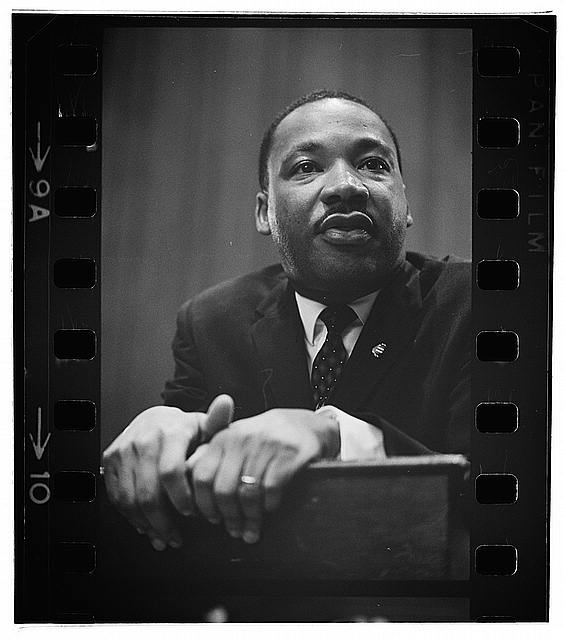
January 15 would have been the 96th birthday of Dr. Martin Luther King, Jr. born in 1929 in Atlanta, Georgia. It was a long road to the third Monday of the month when all 50 states observe the federal holiday named in his honor. Largely owed for making the dream of MLK Day a reality is Stevie Wonder: Back in 1980, he wrote the pointed song, “Happy Birthday,” then launched a 41-city U.S. tour (and invited Gil Scott-Heron along) to promote the idea which was first mooted by Rep. John Conyers in 1968. The musical efforts were ultimately the key in collecting the millions of citizen signatures that had a direct impact on Congress passing the law signed by President Ronald Reagan in 1983, declaring a day for MLK.
Observed for the first time in 1986, some states were late to participate, however, by the turn of the 21st Century, all were united in some form of remembrance of the civil rights giant. “Happy Birthday,” which served as Wonder’s King holiday campaign theme (and is now the “official” King holiday tune) is the last track on Hotter Than July. The album also features “Master Blaster,” Wonder’s tribute to Bob Marley (Marley had been scheduled for the tour until he fell too ill which was how Scott-Heron came to participate). In his memoir The Last Holiday, Scott-Heron details his own journey with music and activism, as he retraces the long and winding road Wonder took to bring home the last US federal holiday, with the help of a song.
The Hotter Than July tour brought Scott-Heron and Wonder to Oakland, where they played in the name of King, along with Rodney Franklin and Carlos Santana. In a weird turn of events, the concert on December 8, 1980, coincided with the night John Lennon was killed. The musicians and crew learned of the tragedy from a backstage television, and the job fell to Wonder, with Scott-Heron and the other musicians at his side, to deliver the shocking news to an arena of music fans.
“For the next five minutes he spoke spontaneously about his friendship with John Lennon: how they’d met, when and where, what they had enjoyed together, and what kind of man he’d felt Lennon was,” wrote Scott-Heron. “That last one was key, because it drew a line between what had happened in New York that day and what had happened on that motel balcony in Memphis, Tennessee, a dozen years before. And it drew a circle around the kind of men who stood up for both peace and change.” Scott-Heron devotes the final pages of The Last Holiday to a remembrance of how the murder of Lennon fueled the final drive to push for a federal observance of the official MLK Day.
The politics of right and wrong make everything complicated
To a generation who’s never had a leader assassinated
But suddenly it feels like ’68 and as far back as it seems
One man says “Imagine” and the other says “I have a dream” -Gil Scott-Heron
Scott-Heron was a lifelong campaigner and champion for human rights himself, beginning on his 1970 live album Small Talk at 125th and Lenox. There is no doubt he would have much to say of the unfortunate confluence of this year’s King holiday with the inauguration and the project known as 2025. The parenthetical title refrain from his song, “Alien (Hold On To Your Dreams)” (see clip below following his topical poem, “Whitey on the Moon/(Mars)”) has been spinning around in my head, alongside the words of Dr. King collected from one of his sermons from the early ’60s. Whatever confronts us today, whatever dangers real or perceived that touch our friends, families and fellow humans in these perilous times, in these words and songs may you find comfort and be inspired to act in love.
Returning hate for hate multiplies hate, adding deeper darkness to a night already devoid of stars. Darkness cannot drive out darkness; only light can do that. Hate cannot drive out hate; only love can do that. Hate multiplies hate, violence multiplies violence, and toughness multiplies toughness in a descending spiral of destruction. – MLK, Jr.
Martin Luther King Jr., Joan Baez and Harry Belafonte
Joan Baez was a junior at Palo Alto High School when she first heard Martin Luther King, Jr. speak at a conference for young Quakers. She would go on to sing for the non-violent movements for civil rights, social, economic and racial justice and against the war in Vietnam.
“King was giving voice to my passionate and ill-articulated beliefs,” wrote Baez in her memoir. Her “exhilarating sense of ‘going somewhere’ with my pacifism” in the aftermath of that speech would lead her to join King on marches in the Jim Crow south and at the historic March on Washington.
If you don’t already know about Baez’s history as a lifelong activist, you certainly would not get it from a viewing of the ahistorical Bob Dylan biopic, A Complete Unknown, released in US theaters this Christmas.
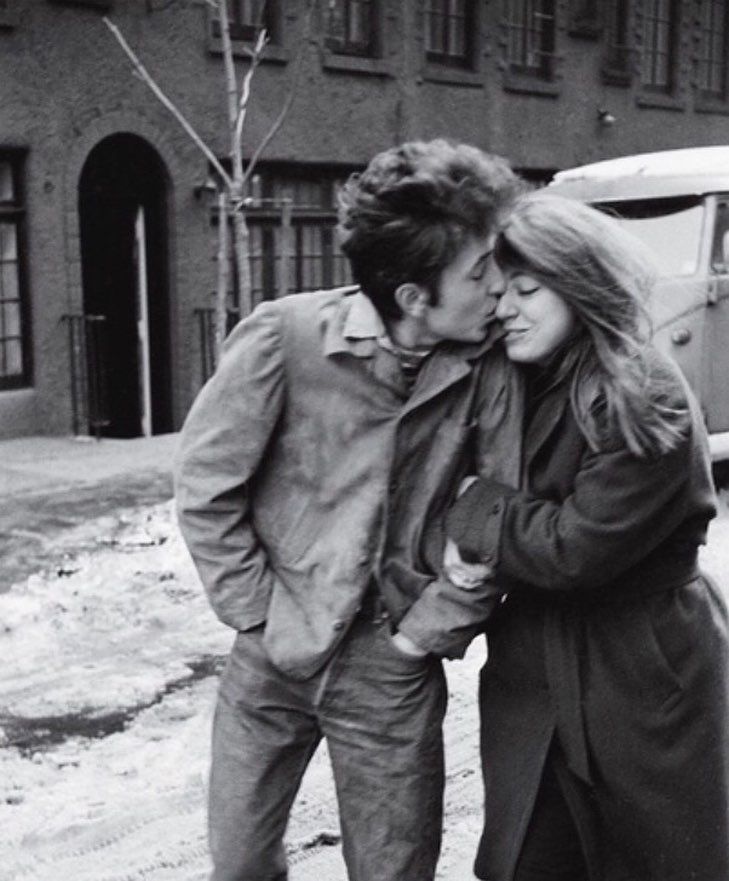
Loosely based on Dylan’s arrival in New York City in 1961, the film covers the songwriter’s introduction to the Greenwich Village scene, his meetings with Woody Guthrie and Pete Seeger, and his intimate relationships with Baez and the fictional Sylvie Russo, a stand-in for his real life steady, Suze Rotolo.
“During the height of the civil rights era Bob wrote, among other songs, ‘The Lonesome Death of Hattie Carroll,’ ‘The Death of Emmett Till,’ [‘Only A Pawn In Their Game’] and of course, ‘Blowing in the Wind,’ which became a kind of anthem,” Rotolo wrote in her own memoir of the Village in the ‘60s. In the film, “Blowing in the Wind” is framed in his repertoire to be more like an annoyance or an albatross.
There’s a scene recreating Dylan and Rotolo’s meeting at a 1961 folk-a-thon at the Riverside Church, the historic hub of progressive gathering in New York City. And there is a brief moment when the Russo character explains to a befuddled Dylan that she works at the Congress for Racial Equality (CORE), organizing the Freedom Rides from North to South — in fact one of Rotolo’s jobs in the era.
Facts are also, that in 1963, Dylan walked off the all-important nationally broadcast The Ed Sullivan Show when he was asked not to play his song, “Talkin’ John Birch Society Blues.” For those unacquainted, the John Birch Society is a radical far right group and the song is a satire.
That not much is made of the realities of the causes and concerns that moved both Baez and Rotolo to become immersed in movement work and the folk scene is perhaps understandable: A Complete Unknown is after all, a version of a story of Dylan becoming Dylan. But the gaps in the story of Dylan’s own connections to civil rights and the songs he wrote in their favor are woefully understated in the film, as are his friendships with the people in his circle (where, for example, were the nods to Ramblin’ Jack Elliott? Phil Ochs? Odetta? Lead Belly, at least, appears in an 8×10 photograph). There are also no poets, comedians or jazz musicians in the film’s version of the Village, though they are among those who also contributed to it being America’s bohemian center of its time.
Nor are there any three dimensional Black artists or musicians depicted in the film. The one scene in which a Black musician has a speaking role was made out of whole cloth and is particularly egregious: The fictional bluesman, Jesse Moffette (portrayed by Big Bill Morganfield whose father in real life was blues legend Muddy Waters) is played as a drunken mess when he appears with Dylan on Seeger’s public television show, Rainbow Quest. That Rainbow Quest really existed and featured musicians Rev. Gary Davis, Mississippi John Hurt and Sonny Terry and Brownie McGee is undeniable. The inclusion of any one of those artists would’ve made an interesting, albeit fictional meeting between Black and white, established and next generation musicians. But the creation of a fictionalized and stereotypical bluesman is not only in poor taste, it was a missed opportunity to introduce new listeners to the musicians who influenced Dylan and generations of future folk, blues and rock musicians.
One full episode of Rainbow Quest was devoted to Dylan’s friend and contemporary, Len Chandler, another figure on the Village scene who was eliminated from the story told in A Complete Unknown. It was Chandler who drove Dylan on the back of his motorbike to deliver his first album to Guthrie in the hospital.
“We took out our guitars and played Woody songs,” said Chandler.
Len Chandler and Bob Dylan at Newport Folk Festival, 1964, photo by Jim Marshall
Chandler and Dylan hung out, traded songs, learned their trade and celebrated their song publications in folk journals, Broadside and Sing Out! And while Chandler spent considerably more time in the South fighting for the rights of Black Americans (like Baez, it was his calling), it’s significant that Dylan appeared shoulder to shoulder with both of them at the March on Washington (though the film makes a bungle of computer generated imagery to recreate his appearance there).
Considering what could’ve been is a fool’s game but I’ll play it anyway: Dylan’s first recording session was as a harmonica player on another one of his heroes records: Harry Belafonte’s “Midnight Special.” The often told story of Dylan throwing his harps in the trashcan afterward would’ve made a great cinematic moment. The inclusion of a civil rights giant would’ve again been a nice prompt for a young viewer to dig deeper into Belafonte’s role in American civil rights, music and Dylan’s own history.
Oh but there’s more: Dylan famously had a crush of the wanting to marry her kind on Mavis Staples. Here again, was another missed opportunity to demonstrate how the singer’s dreams listening to and playing music with his inspirers became his reality. Instead, there is a Black woman of intrigue in the film who Dylan dumps in short order after her appearance. We have no idea who she is or is supposed to be standing in for, but a little like the nameless “mistress” played by Angela Bassett in Masked in Anonymous, she is there to let us know the main dude is an equal opportunity romancer.
The studio players on Dylan’s recordings, Paul Griffin, Sam Lay, Bruce Langhorne, as well as his producer Tom Wilson, could all have been elevated to characters with even one or two-line speaking roles, if only to let the audience know these cats were not just extras to add color to the cast: These were seasoned professionals hand-picked for the records that transitioned Dylan from solo folky to serious, original artist.
And then there is the short shrift given to Dr. King, whose “I Have A Dream” speech Dylan and Chandler listened to in real time, on the day it was delivered.
“That’s what I remember from the speech, being behind another monument with Dylan and silencing ourselves, and sitting in amazement as we heard that wonderful speech unfold,” Chandler remembered. But the take on historic Black preaching in A Complete Unknown, comes in the form of a man in a fedora and trench coast on a soap box. Listed in the credits as “civil rights speaker,” the character is but a token symbol for the movement that reached its very apex during the era depicted in the film. The scenes at the Newport Folk Festival would take me another viewing to de/reconstruct but they suffer from similar missed opportunities to display Black excellence and inspiration (Lightnin’ Hopkins, Willie Dixon, Fannie Lou Hamer, for God’s sake).
What could’ve been a simple and effective portrait of young Dylan and the ways folk musicians, women, and Black Americans intersected with the Civil Rights Movement and helped to shape the counterculture and ideals that came to define the ’60s, is in the end, just another piece of product, a part of the Dylan Industrial Complex: The books for days, the several documentaries, a museum and archive, a brand of liquor, a Christmas album, ornaments, and a line of bobbleheads…these are but a fraction of the branded, approved, licensed and unlicensed materials on offer in his name. Why should I have wished that a biopic be anything more than a distraction, an entertainment?
In the end, the contributions to the Civil Rights Movement made by women and Black Americans are the real hidden figures and unknowns obscured in the Hollywood retelling of Dylan’s own early ‘60s story. As impenetrable as the “real Dylan” may be or seem to be, I left the film not thinking about him, but wanting to ask the folks living and passed over, how does it feel?
Len Chandler was a protest singer, movement worker and unsung hero from the Civil Rights Era, a frontline campaigner in the fight for voting rights, racial and economic justice and against wars of aggression. He performed with Bob Dylan and Joan Baez at the March on Washington For Jobs and Freedom in 1963 where Dr. Martin Luther King, Jr. delivered his historic “I Have A Dream” speech. In 2021, I was commissioned to write a piece on Chandler and his relationship to Bob Dylan in front of the opening of the Bob Dylan Center in Tulsa, OK. The essay is emerging here for the first time before its publication as a commemorative limited edition booklet on the life of Chandler (with expanded content). A portion of the book’s earnings will be contributed to voting rights organizations. Order here: Len Chandler: Shadow Dream Chaser of Rainbows/In memory of a movement hero
“You have to take the lead from somewhere and there were only a few performers around who wrote songs, and of them, my favorite was Len Chandler,” wrote Bob Dylan in his book, Chronicles.
Among the singing foot soldiers in the civil rights movement, the students and teachers from coast to coast who sat in, stood up and rode on freedom’s highway, and of all the folksinging pamphleteers and poets who swarmed Greenwich Village in the late ‘50s and early ‘60s, only Len Chandler emerged from that fabled period an under-looked groundbreaker and a foundational freedom singer, a kind of cosmic twin to Bob Dylan.
“We talked all the time,” said Chandler. “I can’t remember what we talked about but half the time, it would be philosophical, our different approaches to things. We could talk for two days on whether it’s a straight line or circle,” he said, recalling that vortex, that wrinkle in time in Greenwich Village where the cultural happenings of the ‘60s were beginning to reveal themselves. “I’d argue today that it’s a circle. The circle is built into everything. It’s built into our DNA, it’s built into the way the cosmos is formed. Everything is circular.”
The Village swirled with poets, playwrights, and artists of all stripes, mixed with locals and others from afar, far-out people who sought a fluid place to become who they thought they were meant to be – the kind of place and kind of time where young Len Chandler (from Ohio) and young Bob Dylan (from Minnesota) could meet, become friends and learn how to frame, shape and deliver a song.
“He sang quasi-folk stuff with a commercial bent and was energetic, had that thing that people call charisma,” Dylan wrote. “Len performed like he was mowing down things. His personality overrode his repertoire. Len also wrote topical songs, front-page things.”
Ordering infoLen Chandler: Shadow Dream Chaser of Rainbows
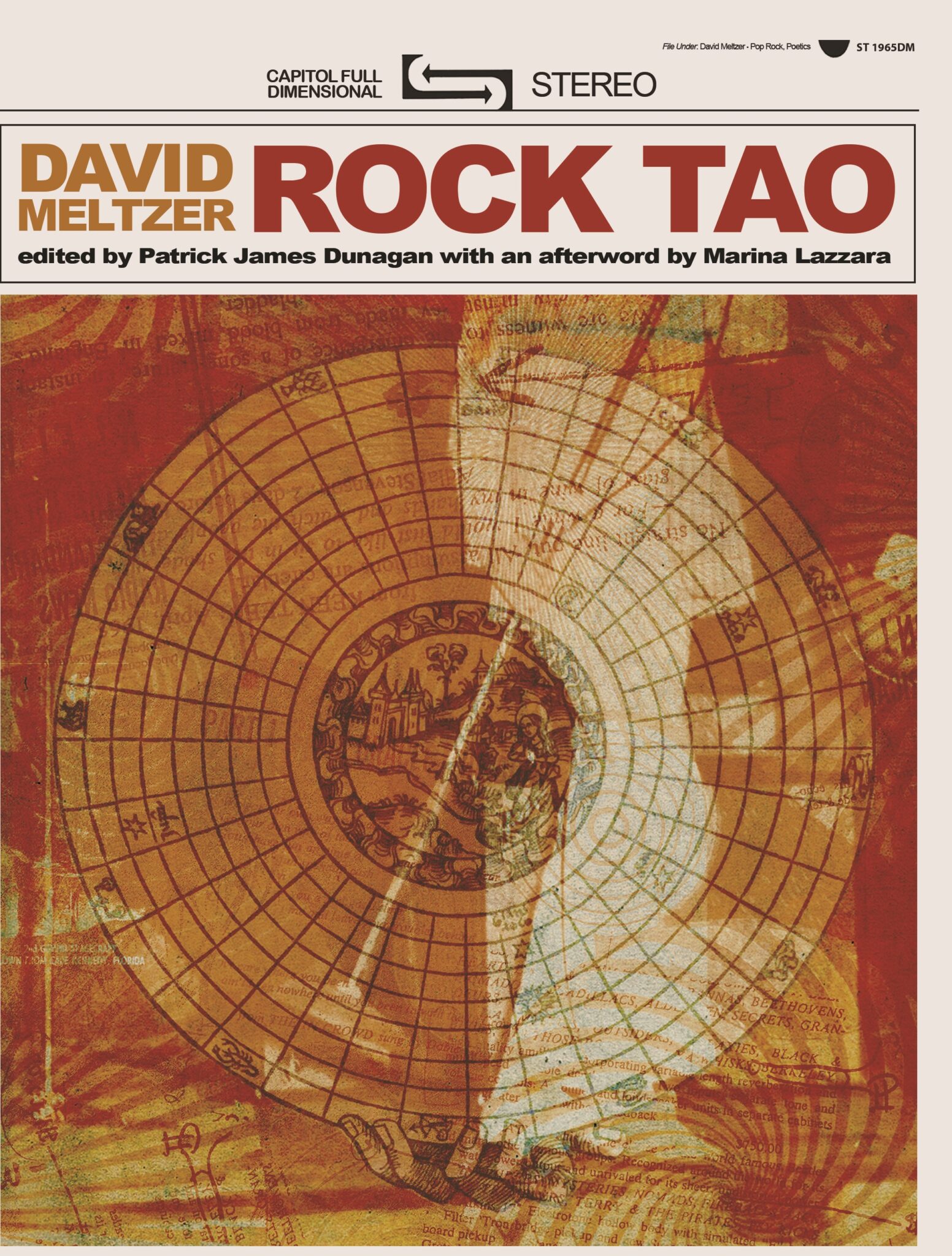
“If the Tao is a way of doing something in concert with its essential nature, David Meltzer’s ‘Rock Tao,’ a relic from the 1960s published for the first time this year by Lithic Press, is an aptly named guide. It’s a book as mysterious, ageless and full of contradiction as rock music itself.
Presented on the page as a textual collage in six parts, Meltzer alternates quotations from the I Ching with Greek philosophy and lyrics by the Supremes. He expounds on the teen appeal of the Beatles and the Rolling Stones, and touches on the artistry of Sam Cooke and showmanship of James Brown, among others. Weaving in and out of the music with scene-changing headlines, Meltzer chronicles, annotates, observes and critiques his times in “Rock Tao,” providing a portal into the mind of an insider.” Read the full story, my latest for Datebook in the San Francisco Chronicle
Today April 30, marks the end of National Poetry Month and Jazz Appreciation Month. The bookend to my April 1 post on musician, poet, and literary artist Gil Scott-Heron is in tribute to Tongo Eisen-Martin, San Francisco’s newly appointed poet laureate, and a multidisciplinary artist in his own right. Eisen-Martin’s inaugural address and the reading he curated for the occasion was live-streamed on April 22 by the San Francisco Public Library in cooperation with local literary institutions, City Lights Books and Litquake. You can watch the entire 90 minute program here:
Please be patient as I am only just now realizing the how and why of Eisen-Martin’s standing as a natural torch-bearer for a modern style of poetry the likes of which Scott-Heron forged and the performing hip hop poets of the ’90s brought back into vogue: Both Eisen-Martin, like Scott-Heron, make substantive use of revolutionary rhetoric and their dead serious lived experience as Black men in America. While rooted in Black experience, the content expresses a profoundly deep love of and want for liberation of all oppressed peoples which leads with the dismantling of the structure of a capitalist society built on white supremacy, the one we historically and presently inhabit. That’s a lot for some folks, I know. There is also a spiritual core to the content that veers from the satirical to the surreal, all of it of a piece with its message.
Scott-Heron famously followed in the footsteps of his inspiration Langston Hughes, and Eisen-Martin has direct links to that lineage of jazz and blues poets: I’m not going to give away the hand, so if you’re interested you can dig around on your own and make the connections.
Though familiar as I am with Scott-Heron’s work, and in the several hours I’ve talked poetry and in the many more spent reading and listening to Eisen-Martin, Scott-Heron didn’t come up. Why? Well, Gil is the poet most often checked when people not-so-well-acquainted with poetry, Black poets, hip hop, Black music or Black Arts think of the first time they hear Eisen-Martin at work: I didn’t want to be that person, so I didn’t say so. Besides, that, I knew Eisen-Martin was more likely to name revolutionary, feminist, activist poet Audre Lorde, as someone he’d read widely and revered; that he’d studied with scholar Manning Marable, who’s written extensively on Malcolm X, and that he has appreciation for a spectrum of music, from Handy to Hendrix. But anyone who’s a regular at Eisen-Martin’s virtual readings will have noticed the image tacked to wall of his Zoom background: A picture of Scott-Heron, preaching to thousands.
For his inaugural event, friends, family, fans and San Francisco poet laureates emeritas Janice Mirikitani, devorah major and Kim Shuck were in attendance as Eisen-Martin passed the virtual mic to a cast of extraordinary poets, their work helping to give him his start and sustain him: They were, in no particular order here, his brother, Biko Eisen-Martin; early supporter, Marc Bamuthi Joseph; running mates during his New York years, Jive Poetic, Anthony Morales and Mahogany L. Browne, and the local network upon his Bay Area return: poet Joyce Lee, community organizer Uncle Damien and Alie Jones, co-founder of his newly established independent publishing house, Black Freighter Press. All contributed to making the poet and his inaugural event unprecedented in its power and presence. The humility of Eisen-Martin, and all of the poets, their collective ability to be attentive to each other’s work as they prepared to respond then perform their own considerable pieces without any interruption to their respective flows was part of the revelation. The intensely personal and political content was extraordinary, alive with excellence, contributing to the livestream’s immediacy, prescience and what will be its staying power: It was epic, in all respects. These poets of the Bay Area and beyond are the voices of the here and now, speaking to our precarious times, to neverending police violence and murder of Black people, and the everlasting oppression of indigenous people, women and the environment – matters that impact all people – delivered through Black (and Brown) lenses.
I hope readers of this space will set aside time to listen to the 90 necessary and critical minutes archived here, so that you may see and hear what we are doing here in San Francisco under Eisen-Martin’s steady guidance. “It’s the best decision this country ever made,” said Mahogany L. Browne of Mayor London Breed’s appointment of Eisen-Martin. “You’re a soul survivor – you are the best of us,” said brother Biko Eisen-Martin. ”Tongo might be the greatest poet of our generation but he’s a very, very good man,” said Marc Bamuthi Joseph in an introduction that also served as a lead up to a piece in which he conjured the life, slow death and words of Gil Scott-Heron.
And so the month ends where we began it: The revolution is in good hands.
April marks National Poetry Month and Jazz Appreciation Month. This month’s posts will attempt to shine a light on great moments and people in jazz and poetry, past and present.
Gil Scott-Heron is a timeless poet and performer who published poems and prose, in addition to performing songs on piano–often classified as jazz–but with an emphasis on words. There are echoes of blues and gospel, rock’n’soul in his grooves. And prophecy. Always ahead of the game and yet right on time. Alien (Hold On To Your Dreams) is one of his classics, a song I think of often in these trying times for
In 1970, Gil Scott-Heron was barely 21 when his first novel, The Vulture, was published and his startling, spoken-word record, Small Talk at 125th and Lenox, caught his incisive cool on tape. “I consider myself neither poet, composer, or musician. These are merely tools used by sensitive men to carve out a piece of beauty or truth that they hope may lead to peace and salvation,” he wrote in the album’s liner notes. Accompanied only by conga drums and percussion, Small Talk at 125th and Lenox featured a reading of “The Revolution Will Not Be Televised”, Scott-Heron’s most enduring work and an early masterpiece, its flow combining elements of both poetry and jazz.
“The revolution will not be brought to you by Xerox
In four parts without commercial interruptions.”
Excoriating the media and marketing, the song’s structure burrowed its way into the collective consciousness of musicians—both mainstream and underground—and listeners alike; it is referenced throughout music, and rather un-ironically the title phrase has been repurposed to advertise consumer goods, from sneakers to television itself. The piece is also, of course, foundational to hip-hop, its words potent and direct, even if some of the allusions and references may be lost on those uneducated in ‘60s or ‘70s culture. It also sounds great, which explains why it’s a standard-bearer for all music, whether it be politicized rock’n’soul, funk or jazz. Pulsing throughout the piece is Scott-Heron’s projection, a foreshadowing of the realities of global connectivity and the pacifying effect on the brain produced by viewing from a small screen. Heron’s vision was a word to the wise:
“The revolution will not give your mouth sex appeal… The revolution will not make you look five pounds thinner, because the revolution will not be televised.”
Positing a necessary parsing of media-generated “reality” from truth and setting his poem to music on his 1971 album, Pieces of a Man, Scott-Heron was caught in the chasm between jazz and soul, poetry and rock, and few knew just what to do with the new poet and big bass voice on the scene, though time would reveal his impact: As the years rolled by, this poet of vision would weigh in on matters environmental and racial, as well as political and social. Though Scott-Heron’s voice was too often a cry in wilderness, it served as a clarion for future generations of conscious writers and thinkers.
Born in Chicago April 1, 1949, Scott-Heron was raised in Tennessee by his grandmother until he and his single mother, a librarian, eventually moved north to New York City. As a teenager, he excelled at writing and earned enrollment at Fieldston, a progressive Ivy League preparatory school. Upon graduation, he chose to attend Lincoln University in Philadelphia, quite simply because it was the alma mater of poet Langston Hughes. As a musician, Scott-Heron’s style was conjoined with the word styles of Hughes, as well as those of talkers like Malcolm X and Huey Newton. But it was “musicians more than writers” who inspired him, and he used the rhythms of folk, blues, soul, and jazz to fulfill the intensity of his emotion. “Richie Havens—what he does with the images and themes, Coltrane—the time defiant nature and thrust of his work. Otis Redding—the way he sings lyrics so that they come through as sounds. You can really appreciate how close a saxophone is to the human voice when you hear Otis singing. I sometimes write poetry, in a way, like Otis sings. The sounds form shapes. Like clouds banging into each other. That’s how I get loud sounds in my poetry,” said Scott-Heron to Jazz and Pop‘s Nat Hentoff.
“My poems are a product of a complete life of resistance,” said Tongo Eisen-Martin when I interviewed him for the San Francisco Examiner in 2018. On Friday, the San Francisco-born movement worker, educator and poet was named the city’s Eighth Poet Laureate.
With the civic appointment and as author of (the award-winning) “Heaven Is All Goodbyes,” No. 61 in the prestigious City Lights Books “Pocket Poets Series” — which includes “Howl and Other Poems” by Allen Ginsberg and “Lunch Poems” by Frank O’Hara — Eisen-Martin is receiving the kind of recognition it often takes poets a lifetime to achieve. Yet, he is exceedingly humble, his head in his work as a social and racial justice teacher, and his eyes on the prize.
“The best reality for me is the reality that’s better for everybody,” he said, his extra-tall self contained in what looks to be a chair too tiny for him in the back of a Mission District bookstore. “If not that, I’m deluding myself and not living the ideas I’m championing in my poems.
This week, and what a week it was, I’m pleased to introduce you to several writers living and working in San Francisco, all of them striving
Poet and activist Thea Matthews in the Mission District on Wednesday, June 3, 2020. (Kevin N. Hume/S.F. Examiner)
toward a more just and equitable society in their own unique ways. First, poet and activist Thea Matthews is a San Francisco born and raised writer, celebrating the publication of her first poetry collection for a local press. She’s also deeply involved and on the frontlines of the Movement 4 Black Lives. Read more about where she’s been and where she’s going in this week’s San Francisco Examiner column, SFLives.
Also publishing today, a story I was reporting on and off for about five months on the Writers Grotto, a community of authors who found they needed to recreate their organization so that it would be more inviting to writers of color. You can read the full story in today’s San Francisco Chronicle Datebook (and one day, I promise to a write story about the process of reporting it).
I love my work, seeking out the stories on the lives of the people and places that show San Francisco at its best. What a privilege it is to be trusted to tell these stories and deliver them to you, especially in these times. As ever, I thank you for taking the time to read and I bid the best to you and your families as the pandemic runs its course. May the moral arc of the universe continue its bend toward justice.











 “My poems are a product of a complete life of resistance,” said Tongo Eisen-Martin when I interviewed him for the San Francisco Examiner in 2018. On Friday, the San Francisco-born movement worker, educator and poet was named the city’s Eighth Poet Laureate.
With the civic appointment and as author of (the award-winning) “Heaven Is All Goodbyes,” No. 61 in the prestigious City Lights Books “Pocket Poets Series” — which includes “Howl and Other Poems” by Allen Ginsberg and “Lunch Poems” by Frank O’Hara — Eisen-Martin is receiving the kind of recognition it often takes poets a lifetime to achieve. Yet, he is exceedingly humble, his head in his work as a social and racial justice teacher, and his eyes on the prize.
“The best reality for me is the reality that’s better for everybody,” he said, his extra-tall self contained in what looks to be a chair too tiny for him in the back of a Mission District bookstore. “If not that, I’m deluding myself and not living the ideas I’m championing in my poems.
“My poems are a product of a complete life of resistance,” said Tongo Eisen-Martin when I interviewed him for the San Francisco Examiner in 2018. On Friday, the San Francisco-born movement worker, educator and poet was named the city’s Eighth Poet Laureate.
With the civic appointment and as author of (the award-winning) “Heaven Is All Goodbyes,” No. 61 in the prestigious City Lights Books “Pocket Poets Series” — which includes “Howl and Other Poems” by Allen Ginsberg and “Lunch Poems” by Frank O’Hara — Eisen-Martin is receiving the kind of recognition it often takes poets a lifetime to achieve. Yet, he is exceedingly humble, his head in his work as a social and racial justice teacher, and his eyes on the prize.
“The best reality for me is the reality that’s better for everybody,” he said, his extra-tall self contained in what looks to be a chair too tiny for him in the back of a Mission District bookstore. “If not that, I’m deluding myself and not living the ideas I’m championing in my poems.

 Denise Sullivan