Denise Sullivan

Author, Arts & Cultural Reporter and Worker

Howie Klein: One of a kind

Howie Klein 1948-2025

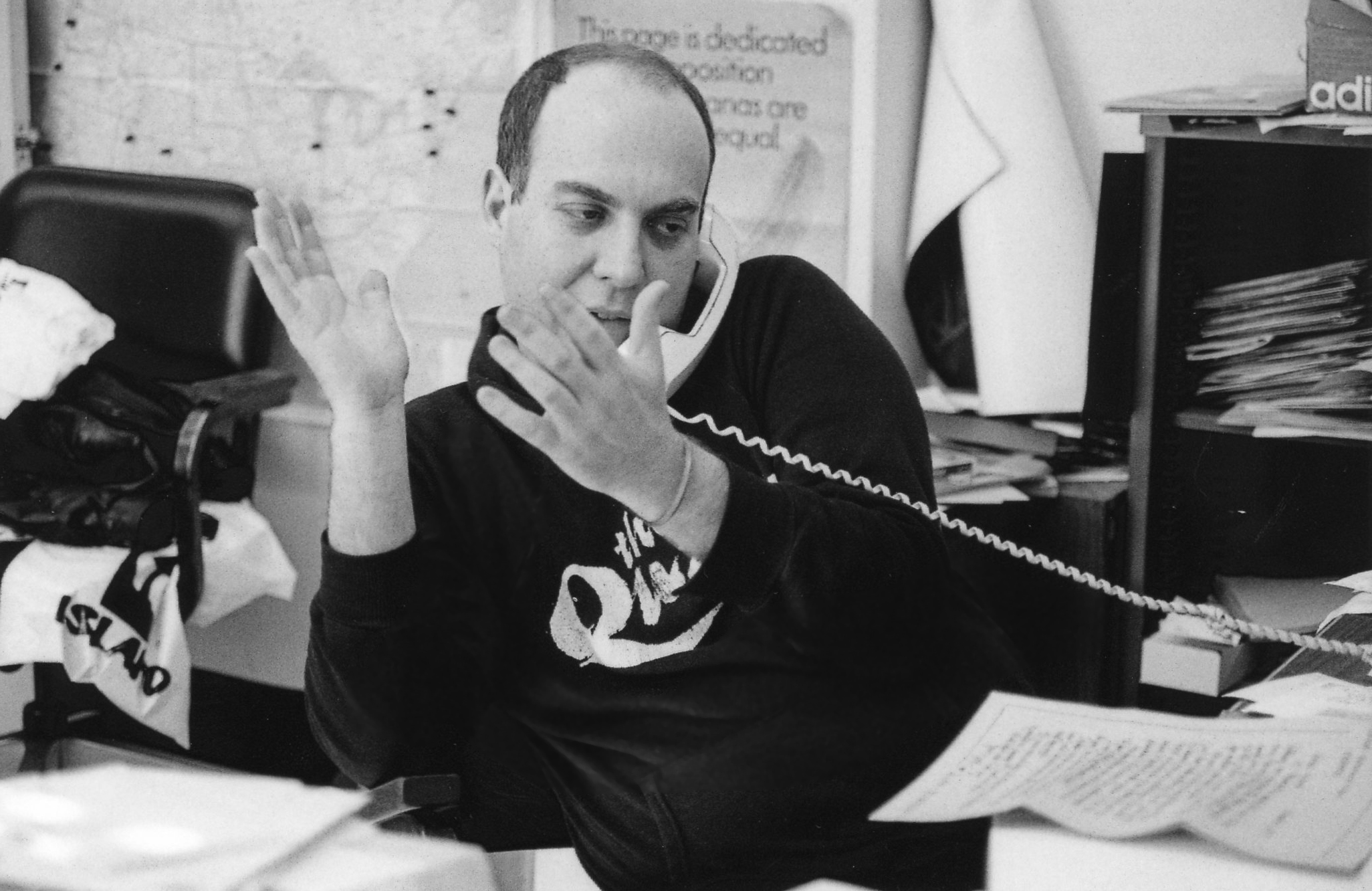
Writer, political activist, broadcaster, and record man Howie Klein’s life was large, unique and apparently complete as it came to a close on December 24. The work, his work–what some might call magic–was largely invisible, so much of it occurring out of the public eye, yet he leaves an indelible imprint on politics and culture, both on the underground and in the mainstream, as well on the individual lives he touched. Boiling down his life and legacy to a few paragraphs or simple words isn’t possible, especially today, Christmas, one day after he left our present reality for parts unknown. It’s particularly poignant that he should exit at this time of year when I think he secretly loved the holiday (his longtime annual Christmas shift as Howie Klaus on KUSF-FM was the giveaway).

Following an outstanding career in the record business in which he became known as an artist and First Amendment advocate, he spent the past 20 years fighting fascism as a commentator and as an ally for politically progressive candidates, while tending to several bouts of long term illness.

I met Howie about 45 years ago, when I was still a teenager, though before that, I heard his voice on the radio, broadcasting on KSAN-FM from the Sex Pistols final concert at Winterland. Lucky for us, he’s left behind a catalog of his life and times on the hippie trail, at Harvey Milk’s camera store, at Neil Young’s Broken Arrow Ranch and on the White House dancefloor, in writing and images, all to be compiled for publication as a memoir (more news on that in the new year). For now, I send love and condolences to all who knew and cared for him and leave you with his own words, on what it means to write and remember.

HOWIE KLEIN: So, as you probably know, I’m trying to write this memoir… but I don’t have the greatest memory in the world. Neither do most of my friends. Neither do most people in general it turns out. I explained how this has been impacting my work when I wrote about DEVO and Dolly Parton last month. How did “Mr B’s Ballroom” get written? My recollection was that I brought DEVO there and they wrote the song. My friend Michael Snyder, who I brought there, said DEVO wasn’t with us and that we told DEVO about the place and Mark Mothersbaugh wrote the song afterwards. I called Mark and he confirmed Michael’s version. I had such vivid “memories” of DEVO aghast at “Mr. B’s!”

I don’t remember exactly when I read Anne Rice’s Interview With A Vampire but I remember where I read it— San Francisco… and I remember discussing it with Harvey Milk, who was assassinated in 1978, so it was probably that year or the year before. No one had to tell me that the vampire myth was a metaphor for homosexuality long before Anne Rice came along and I was explaining that to Harvey while I was reading the book, which isn’t nearly as queer as the new TV series running on AMC now.

In that series (the 3rd episode), Daniel Molloy is interviewing Louis de Pointe du Lac in his Dubai penthouse and Louis seems to say that Lestat was the actual creator of “Wolverine Blues,” the jazz classic by Jelly Roll Morton, recorded in 1923. Daniel gets pissed off and accuses Louis of being an unreliable witness. As a defense, Louis explains the theory of the “odyssey of recollection” by reading from Daniel’s own memoir: “I am in my Buick, staring in the rearview mirror at my daughter in the car seat, an hour after I gave Derek, a guy I don’t know, the last 30 bucks I had. My editor reminds me, it’s seven years before car seats are mandatory. My ex-wife reminds me, I never owned a Buick. This is the odyssey of recollection.”

Sometimes there’s irrefutable— more or less— evidence, proof. That Iceland story I wrote was based on a daily diary I kept of our visit to the island early in 1969. When I asked Martha, now an internationally renowned neuroscientist, then my girl friend and traveling companion, what she thought of the page I posted about the trip, she had no recollection of Mario and Frances, the two American professors we met on the plane who asked us to chip in with them for a car and explore the country. We were with them for over a week, had plenty of adventures and dramas. Martha couldn’t even recall their existence.

I also sent [a] photo of Martha and Autumn Haze at our off-campus house in Rocky Point on Long Island (probably 1967 or ’68). Martha and Autumn didn’t like each other at all; they kind of tolerated each other. So this was a sweet and rare photo I found of them. I asked Martha what she recalls about the photo. She immediately remembered her blouse, she told me. She said she doesn’t recall I had a dog.

Memory does not work like a recording device. Elizabeth Loftus is a psychologist and memory expert, specializing in studying false memories. She explains her work in this TED Talk in Scotland, which has been viewed by over 5.8 million people on the Ted Talk site and another 2 million on YouTube. “Our memories,” she said, “are constructive. They’re reconstructive. Memory works a little bit more like a Wikipedia page: You can go in there and change it, but so can other people.” She discusses misinformation in this talk three years before Trump slithered into the White House.

She concluded her talk with the kind of statement that must be the bane of every memoir writer: “Most people cherish their memories, know that they represent their identity, who they are, where they came from. And I appreciate that. I feel that way too. But I know from my work how much fiction is already in there. If I’ve learned anything from these decades of working on these problems, it’s this: just because somebody tells you something and they say it with confidence, just because they say it with lots of detail, just because they express emotion when they say it, it doesn’t mean that it really happened. We can’t reliably distinguish true memories from false memories. We need independent corroboration.”

In 1802 William Wordsworth wrote “The Rainbow” (also known as ‘My Heart Leaps Up’) which was published in 1807. In high school we were asked to memorize the last three lines, which are also featured in the even more famous “Ode: Imitations of Immortality,” which Wordsworth started the day after he wrote “The Rainbow.”

My heart leaps up when I behold

A rainbow in the sky:

So was it when my life began;

So is it now I am a man;

So be it when I shall grow old,

Or let me die!

The Child is father of the Man;

I could wish my days to be

Bound each to each by natural piety.

©Howie Klein

Filed under: Obituary, Punk, rock 'n' roll, , , , , , , ,

The world according to Les McCann

Jazz musician Les McCann died of pneumonia in Los Angeles on December 29, 2023 at age 88. As a leader and sideman, he recorded countless albums and made major contributions to the soul-jazz music of the ’60s and ’70s. His piano work has also been sampled frequently in the modern hip hop era. McCann has been most often remembered and celebrated for his performance of the Eugene McDaniels song, “Compared To What.” Performed live with Eddie Harris at the Montreux Jazz Festival in 1969 and released on their album, Swiss Movement, McCann on vocals and piano gave the song a certain punch and swagger. This is an edited transcript of my talk with McCann, about the origin of the song widely considered to be the greatest protest song of the Vietnam eraand his thoughts on life in 2016, from his then 80-year-old vantage point. May he rest in peacewith condolences to his surviving loved ones and friends.

“When I began my career in LA we had immediate attention. And whenever you have attention, you have other people coming around, trying to get your attention. I was performing with my trio at LA City College and Eugene McDaniels came by one night. I didn’t know who he was, but he liked what were doing and started hanging out. I thought he was the greatest male voice I’d ever heard. I invited him to join my group.

We started working together, and the money wasn’t good, but it was the beginning of us being professionals. He was different from all of us. He could speak English. A lot of people who didn’t like him, didn’t like him because of that. He was a very bright man, very clever. He knew what he was doing and he went after it. I believe he was the son of a pastor.

We were kinda like friends, he’d sit in, but we also hung out. We had a vocal group, a choir, and we’d get together and sing, 12 people, but all were potentially looking for their own career. When he came to us, and said, “I got a record deal, they gave me a lot of money,” we were happy for him, but not only did he stop singing the music we loved for him to do, he started doing all these other things. When they offered him the big money, some people thought he was being a traitor to jazz. But we were all just trying to make it. I was his reminder, the one who told him, don’t forget where you came from, don’t forget why you’re here.

He didn’t know he was a songwriter, but he’d ask me what I thought: Everything he showed me was unbelievable. I didn’t know he loved Bob Dylan. When I first heard “Compared To What,” it was just a set of words, there was no music. It had the words “God dammit” in it, and it was one of the reasons stations wouldn’t play it. No one had ever done that before. They were his words and I was speaking them: This was Gene son of a preacher, questioning whether he should speak his truth, which involved speaking words a preacher’s son shouldn’t say. It also involved a man speaking perfect English and being Black.

I could do what I wanted on my record label and so I recorded the song. But it was nothing like it was six years later when we did it on Swiss Movement. All that happened right there. We were just doing what we thought was great. It took me six years, but the way everyone now hears it happened in a moment, instantly onstage.

_____

“We think we’re unique, that nobody knows what we go through, but it’s not about the singing it’s about being a human, living in this world. These are lessons on learning how to love, trying to find our place and be who we are…You need to deal with the fear and the bullshit. We’re taught to be afraid of everything. Don’t do this or that: It’s said on purpose, part of the curriculum of this earthly school. Everyone has a blueprint, everyone sets out to do their thing. It’s all here, for us to learn. I’ve never stopped learning.

Earth ain’t meant to be heaven. We’re all angels having an earthly experience. Everything you can think of happens right here on this earth. If it wasn’t for sex and money and fighting, there would be no problems. It’s all how you look at things. We all have intuition.The real truth is in the quiet of who you are. I walk hand in hand with who I really am.

I remember my other lifetimes. I don’t want to do the same things over and over. It might take many times but the choice is whether we decide to live in love or in the things we fear.

Every time you do an interview, ask yourself the questions you want the answers to, ask everything you want to know of yourself: You’ll hear things you never heard before. You already know all this. It’s not anything you haven’t heard before.

Fear or love.

You have go through it and deal with it.

It’s how get to where we want to be by the time we die.

Did we really answer the call?

Did you live the life you wanted to live?”

c. 2016, Denise Sullivan

Filed under: anti-racist, anti-war, Arts and Culture, Jazz, Obituary, Origin of Song, Soul, , , , ,

Remembering 4 Little Girls + 2 Songs

It was 55 years years ago that the four Birmingham, Alabama girls, Addie Mae Collins, Denise McNair, Carole Robertson and Cynthia Wesley, lost their lives during the bombing of the Sixteenth Street Baptist Church.  In 2011, a marker was finally dedicated in their names at the site of the vicious, racially motivated attack.

Just three months after the murder of Medgar Evers in Jackson, Mississippi, and two weeks after the March on Washington and Dr. King’s momentum-building “I Have a Dream” speech in 1963, the Alabama tragedy became the pivotal event in the Civil Rights Movement. Singer Nina Simone wrote “Mississippi Goddam” in immediate response to hearing the news:“I shut myself up in a room and that song happened,” she said of the song that begins, “Alabama’s got me so upset.”  From that moment forward, Simone was committed to writing and performing material that would jolt people awake or into action.  It remains her most enduring work.

Joan Baez,  had of course walked alongside Dr. King at the marches in the South all along; her tribute was a recording of “Birmingham Sunday” by her brother-in-law, the writer Richard Fariña.  Each girl was remembered by name in the verses, set to the tune of a beautiful folk melody. Fifty-five years on, both songs remain painful reminders of the brutalities waged here and yonder, year in and year out, by so-called humanity.

0:04 / 4:08


Filed under: Civil Rights, Obituary, video, , , , , , , ,

Remembering Tom Petty

Tom Petty was born today in 1950 in Gainesville, Florida.  He died suddenly earlier this month at home in Los Angeles.

Like countless rock ‘n’ roll fans of my generation, I loved the music of Tom Petty and the Heartbreakers from the first notes I heard.  I saw the band perform countless times in every decade they worked, from an early band show at the Santa Cruz Civic Auditorium, to an intimate gig at McCabe’s Guitar Shop, where Petty and guitarist Mike Campbell sat in with J.J. Cale.  The Heartbreakers and their leader made it look easy, in the way that only musicians who are of one mind do: The mastery of their musicianship and its intensity, particularly over the three nights I saw them during their historic Fillmore run, remains burned in my consciousness. When I call up the memory, I can feel the room levitate as it did each night during “Runnin’ Down A Dream.” Not every concert is like that.

This month’s column is dedicated to the music and memory of Tom Petty with a focus on his quiet work as a philanthropist, and not so quiet work as a rock ‘n’ roll giant.  READ THE WHOLE ARTICLE at Tourworthy.


Filed under: Obituary, rock 'n' roll, Rock Birthdays, , , ,

Heaven Loves Ya: David Bowie, 1947-2016

maxresdefault-1It’s been a day of mourning throughout the rock’n’roll nation: David Bowie, 69, died last night. The worldwide outpouring of grief transcended racial, gender and sexual orientation, economic, and national boundaries, just as the Brixton-born artist’s music did. The last thing any of us need are more words or further analysis of an already well-documented life and depth of the art: Bowie’s creative expression of rebellion will ring in the hearts of anyone with their mind set on freedom for generations to come. And now here goes anyway…
Read the entire remembrance at Down With Tyranny!

Filed under: Arts and Culture, Obituary, rock 'n' roll, ,

Now Playing: “Yes We Can Can”

Pointer-Sisters-first-album-coverThis is a repost in memory of Allen Toussaint passing today.

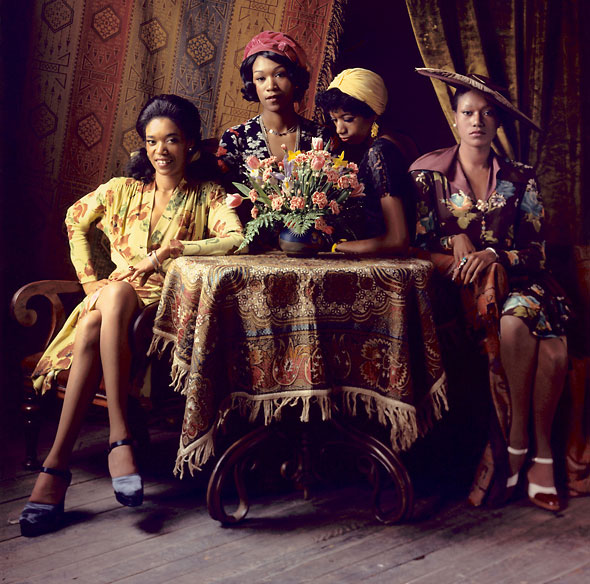
I was thinking about the Pointer Sisters today—The 1973 Pointer Sisters—and how their first album was one that rarely left my turntable that year. I was a child and mercifully I’ve held on to most of my records from then; curiously, this one’s  in pretty good condition—too good I’d say, to have belonged to a kid—which leads me to believe it’s not my original. Back then, I was in the habit of marking all my LP records with a DYMO tape sticker that said DENISE. Just like that, all caps, white letters on orange or green, sometimes red or blue though rarely yellow. But because the DYMO tape or any evidence of having been stuck by DYMO tape is missing (I like typing DYMO), I’m thinking the copy I’m holding of the Pointer Sisters’ self titled album on the Blue Thumb label was at some point reacquisitioned, between 1973 and now.

It’s uncharacteristic of me not to know exactly when I came by a record; that’s just how it is with people who collect records (or if you collect anything, you know what I’m talking about). Obtaining the object is part of its memory, which I find is selective and often obscured by all kinds of clouds and things. But records are the proverbial madeleine that take us back to the land that time (and sometimes I) forgot; songs may come and go, but it’s the record that helps me remember.

Opening the gatefold sleeve today, I recalled a few things: How as a girl, I preferred the portraits on the outer sleeve to the stylized inner sleeve which I bitterly critiqued as “staged.” The outer sleeve was real, or so I thought, not knowing photos were taken at a thing called a photo shoot, set up by a photographer (H.B. Greene according to the sleeve notes) who has an assistant. Preferring the sepia-toned “authentic” 1940s styling on the outer sleeve to the glossy, deco design on the inside, I’d pegged the Pointers as down-to-earth, regular people, not Hollywood types; they were after all local, from Oakland. This is how it should be, them living in a Victorian-styled house like the one pictured on the cover,  them dressed in ’40s casual, just as they would everyday.  I never talked to a single other kid about The Pointer Sisters first album or what they wore or how they wore it, I just know I’d still give my right arm for a dress just like the one June is wearing in the photo, perfect as it is in every way. Anyone who remembers these things like I do will tell you that baby June, the youngest Pointer, had the style thing completely locked-up. Such a fashion icon she was, it’s a wonder I didn’t take to wearing a turban like she did, though I think I intuited it probably wouldn’t go over very well at school. Where did a child obtain a turban anyway?

As for the music, what can I tell you that you don’t already know? Forty years later, we all know everything about everything and all I’ve got is my stale madeleine from the early ’70s and my Pointer Sisters reverie. The first time I heard the Willie Dixon song, “Wang Dang Doodle,” it was not performed by Etta James; rather, it was right there in my bedroom with the yellow floral wallpaper, at the end of side two of The Pointer Sisters.  For sure, that was also the first time I ever saw the name A. Toussaint on a writing credit.  Allen Toussaint is of course a legend of New Orleans piano style and the songwriting giant who wrote the album’s opener, “Yes We Can Can.”  Why do I waste my breath? You knew that. Heck, even I knew as a small fry that Lee Dorsey was known for doing the song first; he’d been around the prior decade with “Ya Ya.”  I knew that one by heart for reasons I can’t possibly relay right now without getting way off course. Put it this way: “It may sound funny but I don’t believe she’s coming home” rung some bells for me.  I also liked the smooth vocals in “Jada,” one of the songs the Sisters themselves are partially credited with writing.  But really, what I was most concerned with in 1973 wasn’t the music but in getting hold of some old plastic fruit, likely the cherries from the bowl at my great-grandmother’s house, so I could fashion a bunch into a corsage that I could wear on the lapel of my Eisenhower jacket from Lerner’s, to be worn with some wide-bell high-waist pants and platform sandals. Pointer Sisters style, for real.

In closing, I was going to say I don’t remember what we did without You Tube but that would be a big fat lie. I remember perfectly well what we did and that was, we’d watch really bad video tapes that were hard to store and even harder to find on shelves, usually caked with dust. Once we got the tape in the VCR it had to be fast forwarded and rewound so many times, so maybe, just maybe you could find that segment of Soul Train you were looking for but started to regret you ever taped in the first place, since if you hadn’t taped it, you wouldn’t be messing around with a stupid remote control that never worked because the battery was like 10 years old to begin with.  Recalling this foolishness, I am wasting my own time and now yours, when all I mean to say is,  just try to imagine how I felt when I found this clip of “Yes We Can Can” today, because I can’t possibly describe the feeling of joy, such joy—not in 250 words or less I couldn’t—though I will add this:  If there is one song to have had burned into your consciousness, to have been etched onto your soul, and sent with you on your way into the world, this one isn’t a bad one to have to be. Bless you, Mr. Allen Toussaint and Ms. Pointers, Anita, Ruth, Bonnie, and June. Thank you for the record—and for my memories.  Great gosh all mighty.

Filed under: Arts and Culture, California, Obituary, Roots of Rock'n'Soul, , , ,

RIP: Rubin “Hurricane” Carter

Rubin “Hurricane” Carter passed away on Easter Sunday at the age of 76. “Hurricane” was Bob Dylan’s protest song concerning the story of the middleweight boxer and the flawed judicial process that sent him away for an unjust term. The recording was a landmark: Over eight minutes long, it was released at a time when the media perceived Dylan to have moved away from topical subjects and protest songs; moreover, the song played a contributing role in Carter’s case to have his sentence overturned.  Here was clear-cut evidence of music attempting to forge change actually doing so.

As a listener, the song forever changed me: I will never forget the moment I heard the song on the radio, its content crashing with my understanding of the American judicial system, the clarity of the message and the dissonance it created so upending to me as a young person, I froze.  For many years, I could only refer to Dylan’s line from the song as a way to describe what I felt: “Couldn’t help but make me feel ashamed to live in a land where justice is a game.” Not knowing what to do or say or think about these matters, without access to organizations for change or discussion about it, “Hurricane” would become why I would write about music with meaning, though I would not know that for many years to come.

The following, reprinted in the spirit of the memory of Carter, picks up threads I’ve written on Dylan’s post-“political period,” the time in which he wrote and recorded “George Jackson” and “Hurricane.”

While Dylan’s late ’60s and early ’70s performances were scarce and scarcely political, his albums Self Portrait and New Morning were the personal reflections of a more inwardly directed songwriter. Though he stepped out with the Band for Planet Waves and a tour in a new era of big-time rock ‘n’ roll concert business, he retreated again, against the backdrop of a marital disintegration that famously produced Blood on the Tracks in 1975. By summer of that year, he was ready to come out again, swinging.

“Here comes the story of the Hurricane
The man the authorities came to blame
For something that he’d never done
Put him in a prison cell but one time
He coulda been the champion of the world”

Speaking to criminal injustice, Dylan took on the plight of  Rubin “Hurricane” Carter, serving time on a triple murder conviction in a New Jersey state prison. Impressed with Carter’s book, The Sixteenth Round, in which the boxer outlined his history as a vocal supporter of black rights and his framing by New Jersey law enforcement, Dylan was moved to visit him on the inside. As the story goes, following a five- or six-hour talk with Carter, Dylan set about writing a tribute with Jacques Levy, his collaborator at the time.

“Look, there’s an injustice that’s been done and Rubin’s gonna get out, there’s no doubt about it,” Dylan told author Larry Sloman. “But the fact is, it can happen to anybody.”

This photo is a re-recreation of Dylan's prison visit to Carter.

This photo is a re-recreation of Dylan’s prison visit to Carter.

“Hurricane” transcends simple topical protest song. Broadcasting as clearly as pistol shots in that New Jersey night, Dylan sets the scene and creates a detailed picture of a world unfamiliar to the majority of his listenership—many of them now younger than his original folk peers, and for the most part unacquainted with the political world, much less the combustible state of race relations in Patterson, New Jersey, circa 1966. Certainly the name Rubin Carter would be remembered in boxing and prison justice activism even if his story had not been the subject of a Dylan song. Yet the song comes by special stature, not only for increasing awareness among rock fans of the shortcomings of a criminal justice system in need of reform, but for reinforcing a perennially misunderstood concept: All human life is of equal value, no matter a person’s race, class or crime–real or imagined.

During his 1975-’76 Rolling Thunder Revue, Dylan and friends performed “Hurricane” onstage every night. The entourage, including Allen Ginsberg, Joan Baez, Joni Mitchell, T Bone Burnett, Bob Neuwirth, and Ramblin’ Jack Elliott, rolled into Madison Square Garden in December of 1975. They were joined that evening by singer Roberta Flack and boxer Muhammad Ali for a benefit billed as “The Night of the Hurricane.” Ali addressed the crowd playfully, in characteristic rhyme. “I’m so glad to see you all with the cause because you have the connection with the complexion to get the protection,” he said from the stage.

Carter also spoke that night, his words delivered through the house PA via telephone. “Muhammad… on a serious note, my brother Bob Dylan once wrote, ‘Walk upside down inside handcuffs, throw up my legs and kick them off. Say all right, I’ve had enough. Now what else can you show me?’” Carter said, quoting from “It’s Alright Ma (I’m Only Bleeding).” “Speaking from deep down in the bowels of the state prison of New Jersey, the fact that I’m speaking to you and the other brothers and sisters in the audience, that’s revolutionary indeed.” Praising the love of his wife and daughter, Carter said his hope was alive. “I knew that if I remained alive, that if I kept myself well… I knew they were going to come to my rescue, and tonight, here you are.”

The song’s intensity, a unity of frantic fiddle and verse, stirs feelings of empathy and compassion; it becomes a companion for believers in the cause to free Rubin Carter, as well as others wrongly imprisoned behind false testimonies and racial bias. Following the release of the song as a single in 1975 and the formation of a grassroots movement for Carter’s freedom based on the false evidence used to convict him, the boxer was released on bail and granted a new trial the following year. His conviction was finally overturned in 1988. Eventually all charges against Carter were dropped and he was exonerated; Carter went on to become an activist for falsely accused prisoners.

Richie Havens, a frequent interpreter of Dylan’s songs who opens all his shows with “All Along the Watchtower” (to name just one of Dylan’s pointed “post-protest” era tunes), says that “Hurricane” remains his favorite among all of Dylan’s songs. “That was an incredible job of going in there and winning, getting him out of there. Unbelievable,” Havens told me in 2008.

“Hurricane” is my favorite song by Dylan too: It spoke to matters for me that as a young person in 1975,  I had little experience with, and yet I felt the truth in the lines, especially the one about the criminals in their coats and ties and how they put the wrong man behind bars. I couldn’t wait for the song to come on the radio so I could stop whatever I was doing for an entire eight minutes and be transported, away from whatever real or imagined injustice was happening in my own adolescent world. Dylan’s exciting “return” to protest was my first meaningful engagement with a protest song.  Though it took many years for me to unpack its importance to who I am personally and professionally,  it was this song that set me in a direction for further discovery of folk and story songs, topical singing, freedom movement, liberation, and message music, the kind that holds secret, hidden histories of ourselves and our country that you won’t often find written about in history text books; rather these relevancies to American social, political and cultural history are handed down in oral tradition, read in books like Carter’s and heard in Bob Dylan’s songs.

a version of this originally published on May 24, 2011 in Crawdaddy!


Filed under: Arts and Culture, Bob Dylan, Concerts, Keep On Pushing, Obituary, Origin of Song, Protest Songs, video, , , ,

RIP Pete Seeger (1919-2014)

The folksinger, activist, songcatcher, banjo-picker, environmentalist, family man and non-violent resistor Pete Seeger was inspiration and forbear to any man or woman who uses their songs for economic and social justice—and doesn’t ever stop. Persecuted for his beliefs by federal law enforcement, the House Un-American Activities Committee and the public, he pressed on to become the greatest singing activist of our time.  “These days my purpose is in trying to get people to realize that there may be no human race by the end of the century unless we find ways to talk to people we deeply disagree with,” Seeger told his biographer Alec Wilkinson, author of The Protest Singer. “Whether we cooperate from love or tolerance, it doesn’t much matter, but we must treat each other nonviolently.” Seeger will be an irreplaceable force on the protest scene, not only for his songs and actions, but for his pure belief in the promise that we shall overcome someday.

Filed under: anti-war, Arts and Culture, Bob Dylan, Buffy Sainte-Marie, Civil Rights, Dr. Martin Luther King Jr., Environmental Justice, Folk, Freedom Now, Immigration Reform, Latino culture, Never Forget, Obituary, Occupy Wall Street, Protest Songs, Songs for the Occupation,

Rest in Power, Amiri Baraka

Nobody sings anymore.

And then last night, I tiptoed upamiribw

To my daughter’s room and heard her

Talking to someone, and when I opened

The door, there was no one there …

Only she on her knees, peeking into

Her own clasped hands.

-LeRoi Jones, excerpt from Preface to a Twenty Volume Suicide Note… 1961

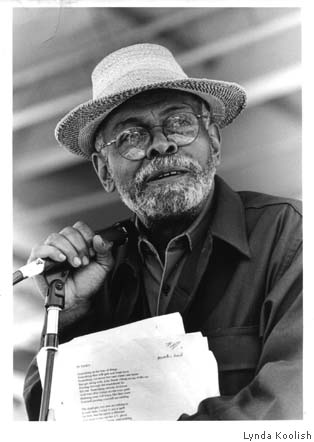
“Never settle for the given.  What is it that hasn’t been mentioned? What is beyond that?” These are the words of activist, actor, poet, playwright, director, and music critic Amiri Baraka. He passed today in Newark, NJ at the age of 79.  “Art is supposed to unlock you, make the world more available to you,” he said.  It was the way he felt when he heard Thelonious Monk for the first time. I heard Baraka speak at the Hammer Museum in Los Angeles two years ago this month,  in conversation with his daughter, Kellie Jones, curator of the wildly successful exhibit, Now Dig This! Art and Black Los Angeles 1960—1980, discussing art and family, though the conversation inevitably turned to Baraka’s recurrent theme, surviving America. “Do you understand the world?…What do you think?… What is important to you?…What is it you want to say?…How do you say what the world is?…How do you tell us who lives on this planet?…How do you make something speak to the world?…” These are the questions he asked of himself and of other artists, for over 50 years.

Born Everett Leroy Jones in 1934 in Newark, NJ, where he lived until the end, he changed his name to LeRoi and chronicled the birth of free jazz as a journalist; he wrote an Obie award-winning play, The Dutchman, and he is the author of Blues People, one of the first books to make connections between music and social history. Equally informed by the poetry of Langston Hughes, the politics of Malcolm X and the Black Mountain College poets, Allen Ginsberg and the Beat movement, in the mid-‘60s, Baraka founded the Black Arts Repertory Theater/School (BARTS) in Harlem which contributed to the development of a new, unapologetically black style of writing, its creation dovetailing with the Black Power movement’s cultural agenda. By the late ’60s he’d changed his name to Baraka; his album It’s Nation Time—African Visionary Music, for Motown’s Black Forum label, features his Black Nationalist poetry set to music.

Stirring it up for 50 years, in 2002, Baraka was named Poet Laureate of New Jersey and of the Newark Public Schools amidst controversy over his poem, “Somebody Blew Up America” (who? who?  who?). That same year, The Roots accompanied him on “Something in the Way of Things (In Town),” on their album, Phrenology. Condolences to the surviving members of the Jones and Baraka families.

(More on Amiri Baraka, the Black Arts Movement, and his connections to music, from blues to hip hop in Keep on Pushing) 

Filed under: Book news, Books, cross cultural musical experimentation, Jazz, Obituary, , ,

Remembering Paul Williams and His Greatest Hits (Again)

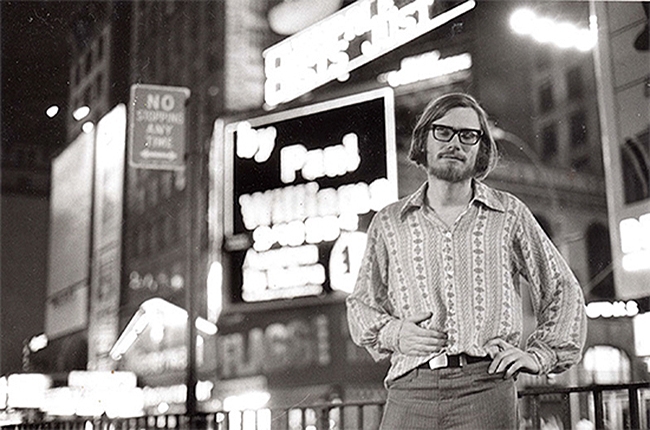
Crawdaddy Litquake PosterTonight is the Lit Crawl, the final night of San Francisco’s annual festival of books, Litquake. For the occasion, I organized a tribute to writer Paul Williams  who at age 17 founded Crawdaddy! the first national magazine of serious rock criticism.  From John and Yoko’s bed-in for peace, to the back-to-the-land movement, and a literary association with Philip K. Dick, Williams wrote over 25 books on his travels through rock ‘n’roll and underground culture. The night’s offerings by, about, and inspired by Williams were prepared by Trina Robbins, Rudy Rucker, James Greene Jr., Ron Colone and Williams’ wife, Cindy Lee Berryhill, who (with the exception of Robbins) will be there to read them. The following is a repost of my remembrance of Paul Williams on the occasion of his passing on March 27, 2013, at the age of 64. 

Crawdaddy! founder Paul Williams, widely considered to be the creator of modern rock’n’roll criticism, has died in Encinitas, California, following a long struggle with early onset dementia, the result of traumatic brain injury sustained following a bicycling accident in 1995.

In 1966, a 17-year-old Williams wrote, edited and distributed Crawdaddy! from his dorm room at Swarthmore College.  As a young man at the epicenter of ‘60s music and movement, Williams had what is now recognized as incredible access as a journalist on the scene, whether taking calls from Bob Dylan, sitting in on a studio session and riding a plane with Jim Morrison and the Doors, partying with Beach Boy Brian Wilson, or running a gubernatorial campaign for Timothy Leary.

Here’s a clip of Paul with John Lennon and Yoko Ono at the celebrated Bed-in for Peace (he’s wearing a brown shirt, back-to-the-camera, front and center).

Williams had keen powers of observation and while his intellect was sharp, it was the emotional content of music that he attempted to unravel in his writing. Over time, Williams grew Crawdaddy! into a magazine with a circulation of 25,000—about the right size to serve his niche audience of music geeks, the diehards who lived the counterculture rock ‘n’ roll lifestyle. Williams, however, turned out to be more of a back-to-the-land guy. He left the city and turned over the magazine to capable hands while he pursued other roads—like a love of literary science fiction and tracing the evolving career of Bob Dylan as a live performer.  Eventually becoming executor of the Philip K. Dick estate and editing a book of Theodore Sturgeon stories, the science fiction community also mourns the loss of Williams today.

In the ‘90s, Williams revived Crawdaddy! briefly as a newsletter; compiled by hand and from the heart, much the way he started it, his close-knit and handcrafted care contributed to Crawdaddy! maintaining its cachet through the years. It was in his middle period, of attending Bob Dylan concerts that I became acquainted with Williams while I was  attempting to get my own career as a music writer up and running.  He encouraged me to write my first book and introduced me to my first publisher. Williams was the closest person I had as a mentor among rock writers, though how I ended up writing for the online edition of Crawdaddy! from 2007-2011 was not related to our acquaintance.  By that time, Williams had sold the rights to his magazine to an entity known as Wolfgang’s Vault and they hired me as a contributor there where it was my privilege to interview a crazy-long list of rock legends who gave me access largely based on the reputation of the magazine produced by Williams. Richie Havens, Yoko Ono, Van Dyke Parks, Eddie Kramer, Janis Ian, and John Sinclair, among others, all remembered howCrawdaddy! contributed to shaping the culture of music fan journalism, and all were happy to give back what Williams had so freely given to them with his magazine and with his words.paul-williams-crawdaddy-650-1

My interactions with Williams, a couple of handfuls of times over two decades, and just twice during his extended illness, were marked by a spark of familiarity—the kind that is shared by people who live and write inside the music, among a community of friends whose own lives are intertwined with art and music, the beauty of the everyday, and the struggle to survive it. Through the years, I closely observed Williams, watching as he maintained his dignity, despite the diminishing returns encountered by his rock writing.  I noticed that he refused to compromise, that he did things for love instead of money, and admired that he remained a fan while maintaining his professional status on the inside track. As it turned out, taking a path like that is no way to make a living in the rock ‘n’ roll business, but it was a great way to live a rich life, full of love and friendship, full of writing, and full of rock’n’roll.

His passing last night comes as little surprise; the grieving process for family and friends had begun some years ago when Williams could no longer care for himself and became confined to an assisted living facility not far from the home he shared with his wife, singer-songwriter Cindy Lee Berryhill, and their son, Alexander. Last weekend in New York, Williams and his life’s work was celebrated at a one-day show of his manuscripts at the Boo-Hooray Gallery, organized by the Patti Smith Group’s Lenny Kaye. The intention of the exhibit was to shine a light on the vast literary contribution Williams made to rock journalism, science fiction, and to the study of Bob Dylan’s evolution as a performing artist in the late 20th Century.

Goodbye, Paul, with love and thanks to you for all you gave to the music, to the encouragement you gave to me as a writer, and with condolences to your friends, your sons, and your devoted wife, Cindy Lee.

Here’s a link to a piece I wrote about the love shared by Berryhill and Williams and how his longterm illness impacted and ultimately inspired her music. Some of text of this remembrance was borrowed from the piece that originally appeared in Crawdaddy! online in July 2011.

Filed under: anti-war, Arts and Culture, Bob Dylan, Book news, Books, Obituary, , , , , , , , ,

Archives

Recent Posts

Browse by subject or theme