Denise Sullivan

Author, Arts & Cultural Reporter and Worker

Free Marcus Books

June 2013

Western San Francisco, June 2013

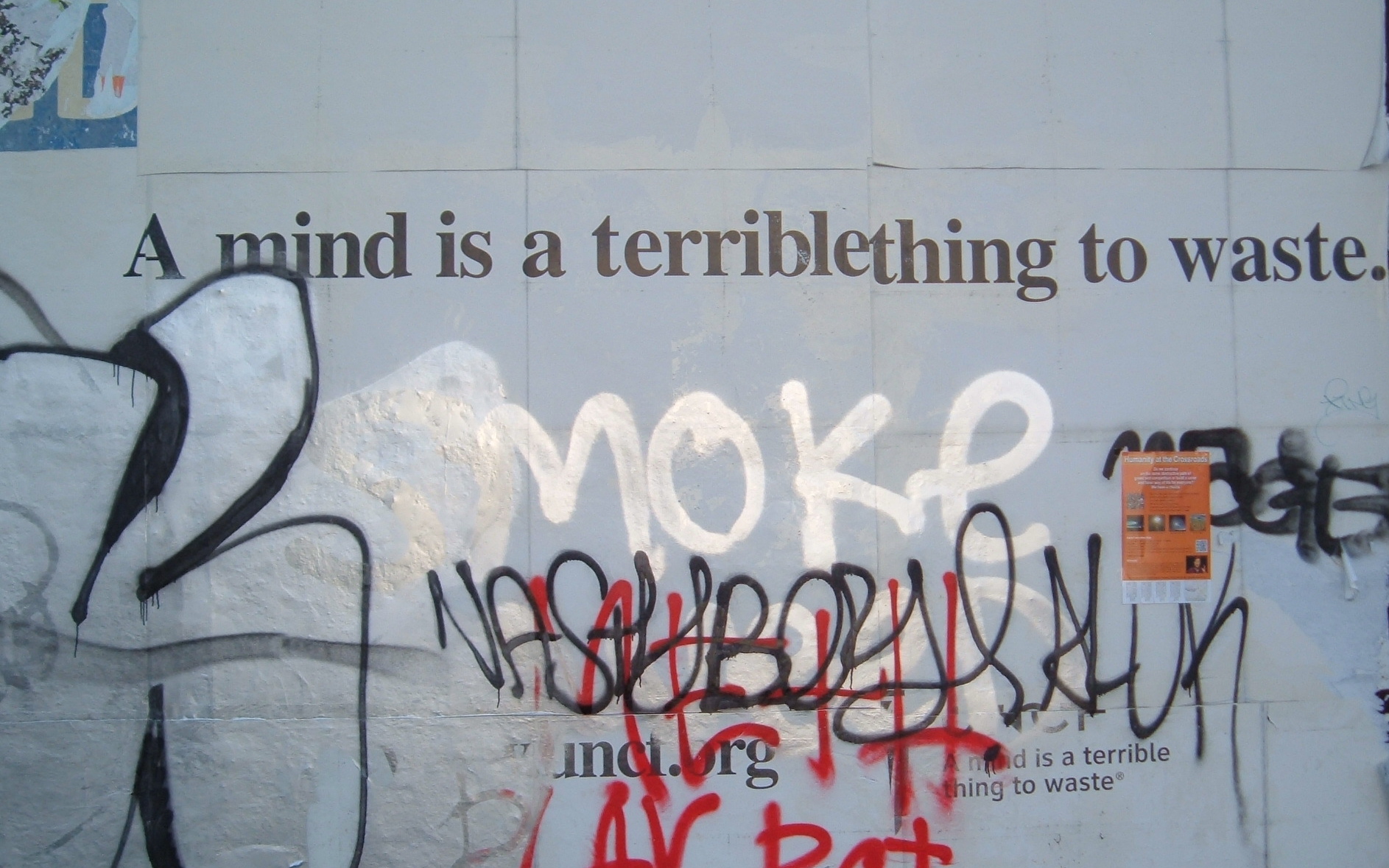
GOOD OL’ USA–June has been quite a month so far:  Bradley Manning’s trial kick-off was the first troubling thing, while jury selection for the George Zimmerman case must’ve been way more than just troubling for the family of Trayvon Martin. For those strung out on the injustice of the young man’s  killing in 2012, it is post-traumatic revisitation time.  Then there was the terrible mass shooting in Santa Monica. Just as my heart broke in two, thinking of friends and old neighbors we’d left behind there, we got the news (?) the N.S.A. is surveilling just plain folks on the regular. I thought we knew this already and so I just figure time is going backwards now. Incidentally, while all this was going down,  I saw a defaced billboard/piece of street art that seemed to fit the mood ’round these parts.

“I have so much trouble on my mind,” I told my husband, not even counting the day to day personal challenges of survival.  “I know,”  he said, though at least we could laugh at me quoting Chuck D accidentally without irony. Meanwhile, a national historic landmark, located in San Francisco, was moving into jeopardy.

The Richardson-Johnson family,  proprietors of the Marcus Book Store in the Fillmoreslider-2 district, have been on a course of change for over 50 years here and have survived those changes royally. Founders Julian and Raye Richardson were directly invested in the struggle for civil rights and equality, first with their Success printing company, followed by the opening of their bookstore.  To cite just one example: During the historic student strike at SF State in 1968, they used their home as collateral, to pay the bail for those arrested in the demonstration. They also printed the student paper when no one else would touch it. The result of the student action, by the way, are today’s multicultural studies departments and diversity programs  enjoyed on college campuses from here to Timbuktu (and when I say Timbuktu I do mean Timbuktu, quite literally).

Marcus Books, named after Marcus Garvey, specializes in books about Africa and African Americans, books by and about black people, among other things.  The authors they’ve hosted are those great writers, thinkers, poets, and humanitarians of the 2oth Century: James Baldwin, Amiri Baraka, Angela Davis, Ishmael Reed, and those are just a few of them. Toni Morrison, Nikki Giovanni, bell hooks, Wanda Coleman, Cornel West, Tavis Smiley, Walter Mosely and Oprah Winfrey have also passed through the doors at one of their two locations (the other is in Oakland). In San Francisco, the purple building stands near the corner of Post,  at the former location of Jimbo’s Bop City, the Fillmore’s premier jazz spot, back in the day.  I mention all this on the first day of what I expect will be a long hot summer here in our chilly little town, because some of us are concerned about such things. Yes, it’s for some of the usual reasons small businesses and booksellers have been struggling in the Amazonian jungle for a decade, exacerbated by the economy’s mess, but the wages of income disparity have also come to bear, the way it makes some people in town go boom while the rest of us go bust are also mixed up in it. You can read more about the store’s situation; as these circumstances do not resolve overnight, the fight to save Marcus Books has really only just begun.

As a native daughter of western San Francisco, I’ve recently returned home following some years in Atlanta, Los Angeles and on another side of town, and Marcus Books has since became my new favorite old place here. There are only a handful of places like that here, where I find it harder and harder to recognize the people and places I used to know as uniquely San Francisco. But some of what I remember best about our town’s openness, and willingness, I re-found at Marcus. There, if you are so inclined, you might talk to Karen Johnson about James Jamerson. Or Charles Mingus, Soul Train and Don Cornelius; Fillmore Street’s jazz heritage, quantum physics, Marvin Gaye and the beginning of all life in Africa. Self-reliance, self-knowledge, the rise and fall of Egypt, astrology, numerology; Harry Belafonte, Smokey and Stevie may come up, depending how you go. I don’t know about you but there aren’t too many places in town where people are conversant in the things I want to talk about and that’s just my own personal reason for wanting Marcus to hang around. The other is that I care about Karen, her family, and of course the general community in the Sucka Free City, served by the book store.

It has been said that the Fillmore is the heart and soul of San Francisco; certainly I have been witness to those flavors at work at Marcus Books in the hands of the Richardson-Johnson family. And because there is hardly any other place on earth I’d rather be than in a friendly neighborhood book or record store, chances are if you’ve read this far, I suspect you feel the same way too. So please, if you will, sign the petition to help Marcus Books, the oldest African American Bookstore in the United States stay around not only to educate the young and curious, the avid reader and casual seeker, but to stand as one of the longest standing community safe places for black authors and black people, and all folks, even those who are white, like me.

A gathering of concerned customers and citizens will convene at the store on Saturday June 22 at noon. Marcus Books is located at 1712 Fillmore Street in San Francisco.

Filed under: Book news, Harry Belafonte, income disparity, , , , , ,

We Shall Overcome (Again)

This piece is adapted from an column that appeared in Paste in late 2011.

Alongside organizers, activists and orators, music people of all orientations have long brought the soul, sound, and heart to social and political movements. During 2011’s income disparity protests, the lionhearts of contemporary music  turned out for the Occupation: Ever-ready artist/activist Michael Franti showed up to “Yell Fire.” Talib Kweli, longtime resident in the trenches of conscious hip hop, dropped some rhymes, weighing in with a powerful piece called “Distraction”: “Skip the religion and the politics and head straight for the compassion, everything else is a distraction,” he rapped. Tom Morello, who as The Nightwatchman, shows up with his ax wherever injustice is served, came out to lead a chorus of “This Land is Your Land,” the old Woody Guthrie song that’s easy enough to sing along to, even if you don’t know the words. And the generally apolitical Jeff Mangum of Neutral Milk Hotel delivered a rare, impromptu set of songs to the delight of Occupiers. In particular, the line “we know who are enemies are” from the fan favorite, “Oh Comely,” drew cheers from the crowd. Mangum’s appearance, if not his topically unspecific songs, provided the people with entertainment and support, the kind of unique companionship that only a song can provide in the cold, cold night.

“Our idea was to go down and raise their spirits,” said David Crosby, who with Graham Nash sang for the Zuccotti Park crowd. “What music is doing is unifying the people, bringing them together,” Nash told Rolling Stone.

“Everybody has a point, everybody has an idea everybody has a perspective on the world,” said rapper Lupe Fiasco when asked about musician participation in OWS. Stressing that celebrities are just like the rest of the occupiers, except in a higher tax bracket, he noted, “The leader is Occupy; it is the movement.”

Hip hop organizer and mogul Russell Simmons was among those on the street with the 99 percent; part of his role there was shepherding visitors like the Rev. Al Sharpton and Kanye West through the New York encampment.

The historic Occupy moment for social and economic equality was called by scholar Cornel West a “democratic awakening,” while throughout history, every freedom movement has had its own soundtrack or anthem for the long march home. And yet, there was not one dominant or lead song to emerge from the throng, an echo perhaps of the mass chorus of a movement without one soloist. Back in the high days of student organizations, protest and topical songs—the ’60s civil rights, free speech, anti-war and black power movements—marchers relied on folk tradition (reviving the old songs with the intention of forging something new). Rewriting spirituals for the secular world—or at least a world in which all faiths and traditions get equal respect—was an area mined by Pete Seeger, who along with Joan Baez, helped to turn “We Shall Overcome,” into an unofficial anthem of the Civil Rights Movement (most memorably, Baez sang it at the 1963 historic March on Washington; Seeger sang it at OWS).

Originally based on the gospel song, “I’ll Overcome Some Day,” composed by the Rev. Charles Albert Tinley and dating back to the African American Methodist Episcopal Church of the early 1900s, “We Shall Overcome” has changed shape through the years; also contributing to the version as we know it were elements of the spiritual “We’ll Overcome (I’ll Be All Right)”, another hymn from the immediate post-slavery period. But it wasn’t long after its arrival in church hymnals that “I’ll Overcome Some Day” was picked up by striking miners and laborers who went on to use it throughout their organizing fights in the ’20s, ’30s and ’40s. Sung by miners in the North as well as tobacco workers in the South, “We Shall Overcome” became a staple at the Highlander Folk School, the training ground for civil rights workers. Highlander teacher Guy Carawan helped to popularize the song among the forming Student Nonviolent Coordinating Committee (SNCC) in 1960 and the song was spread far and wide by Seeger who changed up the verses a bit. By and by, the melody to “We Shall Overcome” came closer to echoing another slave time spiritual, “No More Auction Block” (once sung by Paul Robeson and Odetta and used by Bob Dylan as the tune for “Blowin’ in the Wind”) than Tinley’s “I Shall Overcome” did. In essence, two folk standards emerged from one spiritual.

But more than its fairly tame melody, the strength of “We Shall Overcome” lies in its extraordinarily bold lyrical affirmations: We are not afraid/the truth shall make us free/we shall live in peace. These sentiments are as ripe for the current moment, as they were when the United Farm Workers used it in their fight for their rights, as when South Africans sang it in their struggle against Apartheid, and when Czechs sang it during the Velvet Revolution that overthrew communism. “We Shall Overcome” has been deployed in struggles in India and Ireland. It’s been sung by Bruce Springsteen and was recorded for his Seeger Sessions; Seeger, now in his ’90s, is still singing it. Though I’d say it’s time for someone from the youngest generation of American singers, songwriters and activists to adopt and adapt it, and lead the singalong. “We Shall Overcome” needn’t be consigned to folk’s moldy or buttoned-up past; rather, it’s protest gold, a song that hasn’t lost its value for over 50 years and counting. If it seems strange, update it. If it seems square, give it a beat. But traditional songs need to get sung and sung loud, as if your life depended on them because in fact there are people whose do: Overseas wars cost not only money but lives; poverty is killing people here at home. Workplace and housing discrimination, poor schools, environmental degradation, job disintegration—these are just some of the grievances that will end up in songs as the movement keeps moving on.

Dr. Martin Luther King Jr. knew what music could bring to a non-violent protest effort: he asked gospel great Mahalia Jackson to accompany him and Harry Belafonte to help organize his efforts. Belafonte’s life is a demonstration of just how important a role a singer can play in effecting change as well as how education in the arts can save young lives Nina Simone; Curtis Mayfield; Bob Marley; Peter, Paul and Mary; Sam Cooke; and many, many more singers and musicians contributed to positive social change and quite possibly political change with their music. You may laugh at this notion of change, but people from all walks of life, all genders, all religious backgrounds, colors and sexual orientation, here and elsewhere in the world, are standing up to the indignities served up to their communities.

So here’s to you, activists and musicians: To Michael Franti, Pete Seeger, Tom Morello, Talib Kweli, Boots Riley, Ozomatli and Ben Harper:  Every movement, from abolition to women’s suffrage to labor and civil rights has its songs, and this moment in time has its songs too. Thank you—to the singers and your songs—songs that one night might be the only thing between the darkness, cold, tear gas and rubber bullets raining on someone’s soul. Thank you for singing, so that we shall all overcome, someday.

Origin of Song columnist Denise Sullivan is the author of Keep on Pushing: Black Power Music From Blues to Hip-Hop.

Filed under: anti-war, Hip Hop, income disparity, Occupy Wall Street, Origin of Song, Protest Songs, Songs for the Occupation

Archives

Recent Posts

Browse by subject or theme