Sen. Robert F. Kennedy was preparing his bid for the presidency, looking as if he would surely be the one chosen to lead his country through the deep water. Like Dr. King, he had grown in favor of withdrawing troops from Vietnam. From his seat on Capitol Hill, he had become a fierce advocate of civil rights and economic justice and the social programs to accompany those ends, supported by a progressive belief within his faith. Following his victory in the California primary election, on June 5, 1968, he too was shot down, two months after the loss of Dr. King.
Has anybody here seen my old friend Bobby? Can you tell me where he’s gone?
So went the Dick Holler song, “Abraham, Martin and John,” it’s final verse devoted to “Bobby.” Written in response to the 1968 assassinations, it was first recorded by Dion DiMucci; Smokey Robinson, Marvin Gaye, and Harry Belafonte were also moved to record the song, as were others as time and the years wore on.
In this clip, Smokey Robinson sings and talks a bit about what the song has meant to him, during a 2010 performance at the White House.
Last month, Harry Belafonte passed the torch of singing activism to Tom Morello and presented him with the Officer’s Award from the Sidney Hillman Foundation, honoring excellence in journalism in service of the common good. From Libertyville, Illinois and Los Angeles, California to Madison, Wisconsin and Occupy Wall Street, this weekend Morello, also known as the Nightwatchman, brought his songs to Chicago, where he stood with the National Nurses United and Iraq and Afghanistan Veterans Against the War and is scheduled to play a Woody Guthrie Centennial celebration. Earlier this week, Bill Moyers took the time to speak to Morello, a discussion that will surely solder his status as a link in the chain of the tradition of singing for justice—though his actions have already spoken loud and clear.
In honor of this weekend’s most auspicious collision of Record Store Day and Earth Day, Saturday and Sunday respectively, I decided to reprise a story about where environmentalism meets record collecting, which as it happens is also the most-read article here at denisesullivan.com. The Day Van Dyke Parks Went Calypso, originally appeared in the pages of Crawdaddy! in 2009, 40 years after the Santa Barbara oil spill and the birth of the environmental movement, and upon the occasion of the re-reissue of Parks’ long out-of-print productions for calypso artists, the Esso Trinidad Steel Band, and the Mighty Sparrow. Parks had a goal and an idea ahead of its time: To forge environmental healing through music made by instruments made of cast-off oil drums. The story further explains one man’s adventures in art and activism and begins after the clip below: Taken from a documentary on the Esso Trinidad Steel Band,you won’t find the rest of the film on youtube, though you will find it with the reissued Esso, available at your local record store.
When 80,000 barrels of oil spilled into the waters of the Santa Barbara Channel in January of 1969, the crude-splattered water, beaches, and birds along the California coast in its aftermath became the symbols of modern eco-disaster. While the ensuing public outcry helped hasten the formalization of the environmental movement as we now know it, for musician Van Dyke Parks, the spill and “the revelation of ecology,” as he calls it, was a very personal, life-altering occasion. “It changed my M.O. and changed my very reason for being,” he says. The Union Oil rig rupture in Santa Barbara made Parks go calypso.
“When I saw the Esso Trinidad Steel band, I saw myself in a Trojan Horse,” he says. “We were going to expose the oil industry. That’s what my agenda was. I felt it was absolutely essential.” From 1970 to 1975, Parks waged awareness of environmental and race matters through the music and culture of the West Indies, though in the end, “You don’t know whether to laugh or cry. That’s what makes Van Gogh go,” he says, “That’s what great art does.” Though Parks is referring directly to Esso Trinidad’s happy/sad steel drum sounds, he could just as easily be talking about his own experience during his Calypso Years.
Over a five-year period, Parks produced albums by the Esso Trinidad Steel band (1971) and Bob Dylan favorite, the Mighty Sparrow (Hot and Sweet, 1974); he also recorded his own calypso-inspired works, Discover America (1972) and Clang of the Yankee Reaper (1976). Born from his passion for popular song and launched at a time when grassroots protest was at an all-time high, Parks had every reason to believe calypso consciousness would prevail. But he hadn’t factored in the complications of taking on big oil, nor of touring the US with a 28-man steel drum corps from the Caribbean. He was unable to predict that the sessions with Mighty Sparrow would be fraught with rage, and that his efforts would earn him the enmity of Bob Marley, whose production requests he ignored in favor of calypso. And yet, you get the feeling he’d agree in one hot minute to do it all over again the exact same way if given a chance to revisit this section of his checkered recording history. Read the rest of this entry »
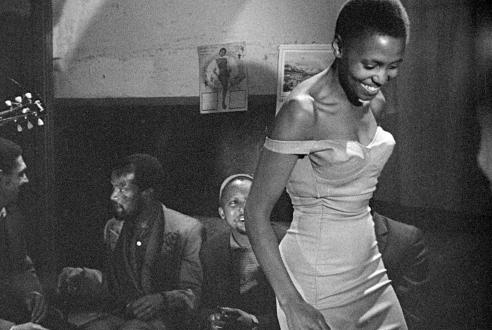
Come Back, Africa is a rare piece of cinema: Not only will fans of cinéma vérité, Italian neorealist, and French new wave film find much to love about its style, historians will find it to be a valuable film document of an otherwise largely unrecorded period in Africa’s history. At once a brilliant documentary and strong anti-apartheid statement, Come Back, Africa is also jammed with music: From the streets and townships of South Africa to its speakeasies or shebeens, Come Back, Africa introduced singer Miriam Makeba to the world. Among those impressed by the Lionel Rogosin film was Harry Belafonte; the actor/singer/activist would become a mentor, friend and benefactor to Makeba, would help her secure gigs, and would set her in the direction of performing the sounds of South Africa around the globe, while spreading the word against apartheid.
With South African writers, Bloke Modisane and Lewis Nkosi, Rogosin developed a filmic narrative driven by the dilemma of people being forceable removed from their land. Come Back, Africa “laid bare apartheid’s ruthless cruelties,” wrote Belafonte, as it tells the story of Zacharia, a man who leaves his country life, his wife Vinah, and their children, to seek work in Johannesburg. What he finds there are unfamiliar laws rooted in racism and a series of dead-end jobs. He confronts inadequate housing and street violence, though a handful of souls provide sanctuary; he is introduced to political ideas and dialogue by the artists and writers of the Sophiatown Renaissance.
Putting non-actors to work amidst the unrest, Come Back, Africa depicted dignity and tragedy; it exposed tremendous human failing, and it revealed glimpses of humanity and compassion. A prize-winning documentarian for his first film On the Bowery (concerning the men on New York’s Skid Row in the late ‘50s), Rogosin made Come Back, Africa largely in secrecy, under the pretense that he was making a travelogue of South African music. He was eventually granted permission to make the film; Time Magazine called it one of the best films of 1960 (alongside The Apartment and Elmer Gantry). “I took a vow at the end of World War II to fight fascism and racism wherever I saw it,” he said.
Writer, producer and director Rogosin was characterized by John Cassevettes as “probably the greatest documentary filmmaker of all time.” He founded the Bleeker Street Cinema and would continue to make films, though later in life, he would have trouble finding the funding for his projects.
Come Back, Africa, starring Zacharia Mgabi, Vinah Bendile, and featuring Miriam Makeba, has been beautifully restored and is currently in re-release. It screens at San Francisco’s Roxie Theater from February 3-8.
Read more about Miriam Makeba, Harry Belafonte and the music of anti-apartheid in
It should come as no surprise that both Harry Belafonte and Angela Davis figure prominently in the text of Keep on Pushing: both are great American activists, with essential ties to the Civil Rights and Black Power Movements and the political and cultural events that shaped their times—then and now. This week I had the good fortune to hear both of them speak in person: Monday, Harry Belafonte addressed an audience in discussion with Tim Robbins, at a benefit for the Actor’s Gang, a community theater organization that also works with the prison population. Then on Thursday evening, a talk between Angela Davis and Robin Levi was aimed at raising awareness about the prison industrial complex, specifically the California prison situation and the women in them. Held at the UCLA/Hammer Museum, the event coincided with Now Dig This, a survey of LA African American-themed art, which is the runaway hit and must-see show of the city-wide Pacific Standard Time art exhibit. As Davis explained, many of the visual artists on display were also “of the movement.”
Born and raised in Birmingham Alabama and educated at Brandeis University, while studying French and philosophy in Paris, Angela Davis learned of the bombing of the 16th Street Baptist Church that killed the four little girls with whom she’d been acquainted at home as a child. Continuing her studies at home and abroad, she eventually returned to UCLA and Los Angeles in 1969, a time where the heat was turned up high on the Black Panthers, as well as anyone else interested in the politics of revolution; the UC Board of Regents made it difficult for her to teach peacefully. When she was falsely accused of being an accomplice in the kidnapping and murder of Marin County Judge, Harold Haley, she served time in a California detention center. A nationwide, grassroots campaign to liberate her contributed to her being set free after 18 months and her ultimate acquittal. In 1972 the Rolling Stones recorded “Sweet Black Angel” about her on their epic set, Exile on Main Street; John and Yoko/Plastic Ono Band cut “Angela” on their Some Time in New York City album (the Stones sing “keep on pushing,” while John and Yoko tell her to “keep on moving”).
In the decades since she made headlines and the FBI’s most-wanted list, Davis has continued to work as an activist, educator and author. After teaching at one prestigious university after another, ironically, she returned to the UC system, to become a Distinguished Professor Emerita at UC Santa Cruz’s History of Consciousness Department. She also founded the prison abolition organization, Critical Resistance, “dedicated to opposing the expansion of the prison industrial complex.”
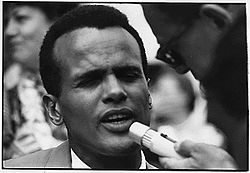
Harry Belafonte was inspired by the works of singer-actor Paul Robeson, who became a mentor. Early in his career as an actor turned singer, he reached out to foster a cross-cultural alliance with South African artists like Miriam Makeba and Hugh Masekela. On the Greenwich Village music scene, Belafonte had familiarized himself with traditional American folk songs through his work in the theater. In 1956, he released Calypso for which he turned to his Caribbean roots; it would sell in the millions. Choosing his roles and repertoire with precision, Belafonte was uncompromising as an artist which earned him a commanding reputation; he explained that sometimes it was difficult for his peers to metabolize his energies, though he didn’t mean for it to be this way. As it was, he was the obvious choice for Dr. King who needed his assistance organizing the entertainment communities and their financial resources for the Freedom/Civil Rights movement. Helping to organize the March on Washington, Belafonte became not only a confidante of Dr. King’s but he helped introduce African music to wider audiences. His relationship to South Africa and the struggle against apartheid grew deeper; he became an intimate of Nelson Mandela. From famine relief in Ethiopia to working with the incarcerated in the USA, Belafonte’s artistic gifts landed him on the frontlines of activism, which is where he’s lived for over 50 years.
The similarities between Belafonte’s and Davis’ stories are striking, a man and woman, two different generations, one a drop-out, the other highly educated. Yet both told stories of their mothers, young country girls who had to overcome resistance, obstacles and indignities to get themselves schooled, then went on to become fierce defenders of education. Today, both Belafonte and Davis are advocates for education, especially among prisoners—the people Davis calls “the other one percent”—who need to know their basic human rights. Education has also been proven as a solution to recidivism, and contributes to the greater good of humankind, inside and outside prison walls. Both activists also share a vocal and visible enthusiasm for the Occupy Wall Street Movement; both had visited the New York encampment, while Davis has visited and spoken at various Occupy demonstrations. She said that on November 2, the day the Port of Oakland was shut down, she joined somewhere between 10,000—to 15,000 people on the street, some of them from her own generation, all of them cheered by the protests led by the new generation of activists. As for President Obama, and to anyone who may be disillusioned by his performance after three years on the job, Davis offered a reminder.
“Let us not forget that moment,” she said, referring to election night, 2008, as well as the collective amnesia that afflicts American consciousness. “It was a triumphant moment,” she said. Reiterating that protest and pressure is an American tradition she added, “We cannot allow one of these Republicans to get elected,” she said. While Belafonte had a few things to say about Herman Cain…
I probably don’t need to add that Mr. Belafonte, 84, and Ms. Davis, 67, were both extraordinarily gracious while greeting their public after their formal presentations. They took time, meeting each gaze and responding to the individual requests of handshakes and photos with them. Their love for the people, has made them much beloved by the people. The warmth generated in the rooms they occupied in LA during the blustery last week of November/first week of December will sustain some of us through the upcoming season—the one that passes for winter around here.



 Denise Sullivan