Denise Sullivan

Author, Arts & Cultural Reporter and Worker

Bob Neuwirth: Here and Then And Now

Bob_NeuwirthBob Neuwirth is one of those characters from the secret history of rock ‘n’ roll; if you know, you know. In 2011, on the occasion of a retrospective of his paintings showing in LA, I seized a rare opportunity to interview him for Crawdaddy! and got a few words on the state of 21st Century music and art.

Update: Neuwirth died on May 18, 2022. With deepest condolences to his partner, his family and many friends, I’m reposting this brief in his memory.

“I think it was Matisse who said artists should have their tongues cut out,”  says Bob Neuwirth. As a visual artist and songwriter, his large abstract canvases are rarely shown, but enjoyed by collectors privately, while his solo singer-songwriter albums Back to the Front and 99 Monkeys are appreciated by connoisseurs of the form.

A great teller of tales, as opposed to a tale-teller, Neuwirth has remained largely in the shadows since his ’60s and ’70s associations at the epicenter of music and culture, but through the years, he’s played a unique role in the lives of his fellows: He’s served as an ear and inspirer to friends in the arts for five decades. Often the a catalyst to epic songs, he lived the moments we read about in history books.

“Art is everywhere,” explains Neuwirth. “Though it takes a different set of eyes to recognize it. If it’s music, it’s a different set of ears…Just because something is reproduced in multiples doesn’t make it good,” he says. “Turn on the radio.  What you hear on the radio is for people who aren’t really listening.”

Sometimes what Neuwirth is rapping sounds as cryptic as a zen koan, though he’s earned a right to wax on as one who actually pulled-off the great American hat trick of living a rich artist’s life while remaining under the radar of mass success. An original hipster—back when it was still cool to be cool—his tales of beatnik glory took him from Boston’s Back Bay, hanging out with folk guitarist Sandy Bull, to checking into art school (“but not for long,” as he sings in his semi-autobiographical song, “Akron,” the rubber city from which he ran). From Boston it was on to busking in Paris with Ramblin’ Jack Elliott; from there, to Berkeley where he developed his abstract-expressionist painting and tried winging it as a folksinger who “couldn’t sing and couldn’t play,” he says.

In his time, he was insulted by Lenny Bruce, kissed on the mouth by Miles Davis, and invited to meet the Beatles while on tour with Bob Dylan in England, a trip he took in exchange for art supplies.

“He said I’ll give you a leather jacket and all the canvas you can paint on,” remembers Neuwirth of the deal with Dylan.  The resulting tour was documented in D.A. Pennebaker’s milestone rock documentaries, Don’t Look Back and the follow-up, Eat the Document, which Neuwirth also had a hand in technically assisting. He remained a confidante of Dylan’s (he was there when they switched on the electricity at Newport, and was also invited on board the Rolling Thunder Revue).  He’s been a compadre to Kris Kristofferson, a friend to Janis Joplin (he co-wrote “Mercedes Benz”), a companion to Jim Morrison and a filmmaker for the Doors.

In the ’70s  Neuwirth moved on to pre-punk New York and the Max’s Kansas City scene, a legendary hanging place for visual artists. He brought in songwriters like Willie Nelson and Waylon Jennings (who weren’t as well-appreciated in that period as they are now), and contributed to the club’s culture while making music and gathering more fuel for his great untold stories of rock’n’roll.

“Then the New York Dolls showed up, and that was pretty much it,” he says of the temporary displacement of folk-inspired, singer-songwriters from Manhattan. And yet, Neuwirth had a direct hand in the changing of the guard when he advised one of the club’s regulars, Patti Smith, to turn her poems into songs: “Next time I see you I want a song out of you,” is how Smith remembered his encouragement in her autobiography, Just Kids.

Going on to collaborate with John Cale on The Last Day on Earth, a prescient musical theater piece concerning the apocalypse, and working on projects that took him from Cuba (Havana Midnight) to Appalachia (Down From the Mountain), Neuwirth remained in the orbit of collaboration with musicians and artists of all stripes. There are plenty more stories where these came from, though between his brushes with greatness, Neuwirth stayed devoted to his own art, attempting to collage and paint his masterpiece. Bumping around from studio to 20110409115304-2studio, he lived in a loft (“rat-infested,” by his description) formerly occupied by jazzman Eric Dolphy. By then, New York and the art scene had changed. The roads for struggling artists to take had gradually began to close down and the art and music inspired by the ideas that emerged in the ‘60s and ‘70s were subsumed into a new age of mass consumerism. Could Neuwirth imagine the culture returning to a time when artists and musicians held as much influence as 15 minutes of Internet fame do today?

“In the 21st Century, everyone thinks they’re an artist,” he says, “But trying to do anything good is harder than it looks. There’s lots of good around but that doesn’t make it excellent and it doesn’t make it art. Someone actually just said to me that they thought banking was an art,” he says.

So where does one find art in the culture today?

“If people want art, they have to look for art,” he says. “There are plenty of musicians with things to say. There’s plenty of jazz…classical….there are really good paintings around—maybe not for sale. ”

“There’s something to be said for beauty being in the eye of the beholder,” he says, staking his claim. “Bad art is better than good bombs.”

Filed under: anti-war, Arts and Culture, Bob Dylan, California, film, Folk, Interview, video, , , , ,

Phranc: Your Basic Average All-American Jewish Lesbian Folksinger

From her time on the LA scene during the first wave of punk, and through a 25-year solo singer-songwriter career that’s served as inspiration to a new generation of queercore and riot grrrl artists, Phranc is embedded in California’s rich musical landscape. Temporarily sidelined from performing in recent years, Phranc is officially back to art and music and fuels her creativity by pursuing her favorite activities offshore, from swimming and sailing, to surfing.

“Going surfing is a big part of my creative process,” she says. “I’ve surfed since I was nine years old. Leaving land is my favorite part of it. I like being in a separate reality.”

Phranc’s day-to-day reality includes making cardboard art (she shows in galleries and museums on both coasts) and writing songs. Some of her work is topical like “Bloodbath” (which took on apartheid in South Africa) and “Condoleezza”; other creations are more whimsical (“Rodeo Parakeet” comes to mind). But whether whimsical or topical, Phranc’s art and music always has a story to tell.

“It’s still my favorite thing, to listen to a story through a song. It’s like nothing else. A song can preserve time and memory and history in a way that words or a picture alone can’t. A song can capture it all,” she says. In recent years, Phranc wrote about her beloved hometown of LA; like souvenir postcards, she hopes to incorporate the songs in a package that merges her audio and visual media.

Growing up in the beach community of Mar Vista near Venice, California, Phranc took a ’70s pilgrimage to San Francisco, figuring she’d fall in with its world class gay community; instead, she discovered a world of artists, actors, and ne’er-do-wells who introduced her to punk rock. “It was a great time and a life-changing time for me. I felt like I had a peer group. Not only did I identify as far as politics and music, but also age-wise. I had been with people because they were lesbian and women and we had a lot in common but they were all a lot older. So for once, I fit in. Where could a freak fit in? In punk rock!”

Morrissey and Phranc strike a pose

Unable to secure a day job outside of a stint as a nude model at the Art Institute, Phranc returned to LA. “So I came back from San Francisco and the only people I knew here were lesbians, and no way man, I wanted punk rock! I started going out to punk shows. I would put on a little suit and tie and I would go there and try to look so cool though I didn’t know a soul.” Hanging out on the street by herself at a SoCal Avengers show, she was spotted by Edward Stapleton. “He walks up to me and says, ‘Hey, want to be in a band?’ Not, ‘Can you play anything?’ And I’m like ‘Yeah.’ He said, ‘Good. The band’s Nervous Gender, you’d be perfect.'” From keyboards in that band she moved on to guitar in Catholic Discipline, and eventually landed in Castration Squad. You can catch a glimpse of Phranc in Catholic Discipline, alongside bandmates Claude Bessey/Kickboy Face from Slash magazine and Robert Lopez, aka El Vez, in the Penelope Spheeris film, The Decline of Western Civilization.

By this time, it was about 1979, and punk was already changing. “The fashions changed and the politics changed and people were wearing the swastika, which they hadn’t been up to that time. Because I’m Jewish I would notice and it pissed me off. So I wrote a song called ‘Take Off Your Swastika.’ It was right around the same time the Dead Kennedys wrote ‘Nazi Punks F**k Off.’ I wrote the song as a direct personal reaction to the swastikas and I decided to play it on my acoustic guitar. Up ’til then, I’d been playing electric guitar and synthesizer. Nobody in punk was really playing acoustic guitar at that time, and the reason I did it was because I really wanted the words to be heard. Because, as far as I’m concerned, punk rock is the folk music of today… though I didn’t play it at some folk club, I played it at punk rock clubs.”

folksingerPhranc was as amazed as anyone when people’s response was overwhelmingly positive. “People would yell and I’d get heckled and stuff, but on the whole it was pretty great. I remember playing at the Whisky and seeing a couple of guys taking off their swastikas.”
In 1985, her solo debut, Folksinger, was released on Rhino Records; she’d recorded the album with money she saved from teaching swimming lessons. It wasn’t long after that she became the designated support act for artists like Morrissey, Hüsker Dü, and the Pogues. “My audience has always been very diverse. People assume because I’ve been out as a dyke that my audience is lesbians and that’s not true. The audience that really supported me and continually has is a mixed bag of men and women, gay and straight. Still to this day, people come up to me because they heard me at college. My songs are for everybody. I like to reach as many different kind of people as I possibly can at one time.”

Read more about Phranc in Keep on Pushing

Filed under: Arts and Culture, Folk, video, Women in Rock, , , , , , , , , ,

RIP Pete Seeger (1919-2014)

The folksinger, activist, songcatcher, banjo-picker, environmentalist, family man and non-violent resistor Pete Seeger was inspiration and forbear to any man or woman who uses their songs for economic and social justice—and doesn’t ever stop. Persecuted for his beliefs by federal law enforcement, the House Un-American Activities Committee and the public, he pressed on to become the greatest singing activist of our time.  “These days my purpose is in trying to get people to realize that there may be no human race by the end of the century unless we find ways to talk to people we deeply disagree with,” Seeger told his biographer Alec Wilkinson, author of The Protest Singer. “Whether we cooperate from love or tolerance, it doesn’t much matter, but we must treat each other nonviolently.” Seeger will be an irreplaceable force on the protest scene, not only for his songs and actions, but for his pure belief in the promise that we shall overcome someday.

Filed under: anti-war, Arts and Culture, Bob Dylan, Buffy Sainte-Marie, Civil Rights, Dr. Martin Luther King Jr., Environmental Justice, Folk, Freedom Now, Immigration Reform, Latino culture, Never Forget, Obituary, Occupy Wall Street, Protest Songs, Songs for the Occupation,

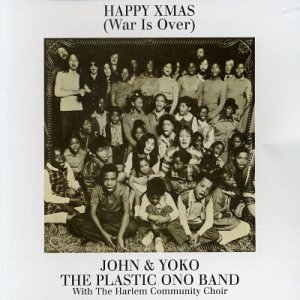
Happy Xmas (War is Over)

Sometime in New York City, 1971, John Lennon and Yoko Ono came up with a Christmas song for the ages, its subject peace on earth during wartime, its melody extraordinarily similar to “Stewball,” a hoary folk song about a racehorse. Behind its veil of bluegrass, “Stewball” has deep roots plus class and race resonances (if you’ve got the time to delve into these matters, there’s more where this came from, including clips and further linkage), but only a tangential connection to the “Happy Xmas” song.

In his final major interview, Lennon explained, “‘Happy Christmas’ Yoko and I wrote together. It says, ‘War is over if you want it.’ It was still that same message—the idea that we’re just as responsible as the man who pushes the button. As long as people imagine that, somebody’s doing it to them and they have no control, then they have no control.” Lennon and Ono had used the slogan “War Is Over! (If You Want It)” in their 1969 billboard campaign that sold peace to the people just as aggressively as consumer goods and war were promoted in the public sphere.

Recorded in October at the Record Plant and assisted by producer Phil Spector, the Plastic Ono Band (who for this session included Jim Keltner, Nicky Hopkins, and Hugh McCracken) were joined by the children of the Harlem Community Choir (they sing, “War is over if you want it”). The single was released in the US on December 6th and held until the following November of 1972 for release in the UK.

Spector’s influence is clearly a presence on the track—you can hear his signature claustrophobic effects, similar to those on the Paris Sisters’ “I Love How You Love Me” and the Teddy Bears’ “To Know Him Is to Love Him.”  But there is another ghost of rock and roll past in the room: The song borrows the feeling and the melody of “Pledging My Love” by Johnny Ace, a well- known Lennon favorite.

As for the slogan War is Over, the Doors had previously  used it in their 1968 anti-war song, “Unknown Solider” as had W.S. Merwin in his anti-Vietnam poem, “When the War Is Over,” published in 1967.  “Happy Xmas” bears traces of all the aforementioned melodies and influences, in addition to their somber moods, along with the note-for-note cadence of “Stewball.” Opening with a whisper to their children from whom they were estranged at the time (“Happy Christmas Kyoko, Happy Christmas Julian”), the lyrics open with a rather pointed question (“And so this is Christmas, and what have you done?”) and wishes for a better world to follow. All is forgiven by the final uplift.

As most readers know, Spector is currently serving time in a California state prison for using a firearm to murder Lana Clarkson. Legend has it Johnny Ace shot himself by accident, and the persecution of peacenik Lennon as well as his end have been well-documented. Ono continues to work for peace and against gun violence.  The song “Happy Xmas (War Is Over)” itself has inspired many covers,  none of them worth mentioning, and at least one (Billy Bob Thornton) worth calling out as being unmentionable. The only version worth a bleep I’ve ever heard is the original:  It just might be the best rock’n’roll song to capture the spirit of Christmas. Though if, by now you are seeking something a bit cheerier to spin, I wouldn’t blame you, so I’ve included a clip of “Run Rudolph Run” by Chuck Berry—original rock’n’roller and another Lennon-inspirer. Merry Christmas Everybody, and God Bless Us, Everyone.

Filed under: anti-war, Arts and Culture, Folk, Origin of Song, Protest Songs, , , , , , , , ,

Promenade in Green

(UPDATE, December 19: I have since seen the film in its entirety and the “Green Green Rocky Road” scene is the best part. Though Len Chandler and the histories of some of the other folksingers of color on the scene—Odetta, Richie Havens, Buffy Sainte-Marie—have been well-documented, the filmmakers chose to render invisible their counterparts or composites in their deeply cynical look at Greenwich Village folk).

Inside Llewyn Davis, the new Coen Brothers film concerning a fictional folksinger from the early ‘60s Greenwich Village scene (based loosely in post-modern style on some incidents from the life of actual folksinger Dave Van Ronk and other figures of the Village scene) opened in select theaters this weekend.

I have not yet seen the film, but gathered from the soundtrack the title character played by Oscar Isaac, performs “Green, Green Rocky Road,” which Van Ronk himself went as far as to call his “theme song.”  With melodic and rhythm roots in the Georgia Sea Islands and before that, West Africa, readers of Keep on Pushing will remember the songwriting credit for “Green, Green Rocky Road” belongs to Len Chandler and Robert Kaufman (yes, as in Beat poet, Bob Kaufman).

I had the great and rare honor to interview songwriter and activist Chandler in 2007; large portions of our interview appeared throughout Keep on Pushing and on this site.  Chandler spoke highly of Kaufman, Van Ronk, and of course Bob Dylan, who detailed their shared history and collaborations in his book, Chronicles. And yet, it is “Green, Green Rocky Road,” a song Chandler never recorded, that may be one of his most enduring achievements, despite the fact he was a singing hero of the Civil Rights Movement (his contributions to African American/US political and social history remain obscured and inexplicably, largely unsung).

Here’s a clip of Van Ronk performing the song, followed by a clip of Chandler performing his own “Keep on Keepin’ On,” from his rare Columbia album, To Be A Man.

Filed under: Bob Dylan, film, Folk, Greenwich Village, Poetry, video, , , , , , , ,

Graham Nash: Wild Tales of a Protest Singer

“We need people like Bradley Manning,” said singer Graham Nash on Friday night at the Nourse Auditorium in San Francisco, in conversation about his new book, Wild Tales:  A Rock & Roll Life.  The evening ended with questions from the crowd, a convention that in lieu of any interesting questions coming from the stage often provides the most interesting parts of these so-called public discussions.

“Where is the anger?” someone from the audience asked. “Why aren’t we rising up?”

“Do you think they really want protest songs on the airwaves? Do you think they want people singing about these things on TV?” answered Nash with more questions, while further noting the media has largely turned its back on free speech matters.  Though he suggested our first and fifth amendment rights were our country’s greatest assets, his questions were perhaps an acknowledgement that we can no longer rely on a free press to help us protect those rights to speech, a fair trail, or to keep us truly free.

Advocating for truth-speaking and against torture, as well as for solar power and ending world hunger, Nash isn’t just a one-size-fits-all protest singer; rather, he’s one who’s consistently stood strong against nuclear power, supports the science behind climate change, and was on the side of the Occupiers on Wall Street. The musician of conscience has consistently weighed in with songs of resistance since the dawn of his career, as a solo artist, as a member of the duo, Crosby & Nash, and the supergroup, Crosby, Stills, Nash & Young. Last week I posted Nash and James Raymond’s song for Bradley Manning; his earlier works like “Chicago” and “Immigration Man,” among others, bear his mark of vocal excellence combined with pointed, topical concerns.

Among his known charitable activities, Nash co-founded the Musicians United for Safe Energy in 1978; he participated in 1985’s Live Aid, spotlighting famine in Africa and he toured with CSNY in 2006 on the Freedom of Speech tour, a traveling protest roadshow.  “We knew what we had to say, especially about George Bush,” Nash said, though the message was not entirely popular, particularly as they crossed the red states.  “I’d never been on a tour where there were bomb-sniffing dogs.  I’d never been on a tour where people walked out. You bought a ticket to a Crosby, Stills, Nash & Young concert…what did you expect?”

On Friday, the crowd was comprised largely of freethinkers, baby-boomers, and progressives in accordance with Nash’s views, clued-in enough to ask: Had he ever requested his FBI files? Born in Blackpool, England but a citizen here since 1978 Nash answered with yet another question: “Why would I care if they have papers on me?” He shouldn’t.  But rest assured, they do. And had I held a mic that night, I would’ve first and foremost thanked Graham Nash—bold enough to sing the contents of his heart and mind for over 50 years—no questions asked.

Filed under: anti-war, Arts and Culture, Book news, Books, Environmental Justice, Folk, Immigration Reform, income disparity, Occupy Wall Street, Protest Songs, San Francisco News, Songs for the Occupation, ,

Goodbye Columbus: Hello Buffy Sainte-Marie and Debora Iyall

Buffy Sainte-Marie is one of the central figures in Keep on Pushing: As unique musically as she is direct lyrically, Sainte-Marie was born on the Piapot Cree Indian reservation in Saskatchewan and adopted by a family in Maine. She says that as a child she was artistic innately, as well by necessity. Befriended by a Narragansett couple who lived near her family in Maine, it was from them she learned about cultural handcrafts and kindness. “They didn’t sit around and give me Indian lessons,” she said, “But on the other hand, they didn’t chase me away.”  As a young student, Sainte-Marie was drawn to philosophy and religion, while she simultaneously developed her musical side, as a folk performer. Her unique vibrato and innovative song style are what first drew me to finding out more about her story; what I found, moved me to the core, from the volume of hardship and turmoil she described, to her refusal to study war, which landed her among Nixon’s enemies.  “I don’t think many people, even today, understand how much blacklisting has gone on of artists in the record business,” she says.  In the face of the hassles, Sainte-Marie continued to innovate, as an electronic musician as well as a computer-based visual artist. Committed to teaching, to passing on what was given freely to her as well as what she fought to achieve, Sainte-Marie’s work still offers a pointed critique of war, greed, injustice and the anti-people policies that impact indigenous people all over this land.

Debora Iyall is one of the artists  directly descended from Sainte-Marie’s example of native creativity:  A singer, a songwriter, a poet, and a visual artist, Iyall’s story also unfolds throughout Keep on Pushing, beginning with her time as a teenager during the Indians of All Tribes’ Occupation of Alcatraz.  Her punk-rooted style bears little resemblance to Sainte-Marie’s folk roots (Iyall was most influenced by Patti Smith), but a close connection to arts education and her roots in the Cowlitz tribe made her a unique presence in San Francisco art-punk band, Romeo Void. Iyall had the guidance of elders—her mother and the Natives she met at pow-wows and on Alcatraz—who supported her creative discoveries. “I felt like I had these little nuggets of information or culture to hang on to,” she said.  Today, Iyall exudes confidence in her work as a performer and visual artist and is also a teacher and advocate, for artists of all colors and dimensions.

I was honored and humbled to have been allowed access to the lives of both Debora Iyall and Buffy Sainte-Marie—two women whose works have uplifted and inspired, not only their brothers and sisters native to the Americas, but their fellow artists and anyone who’s ever been broke or hungry, tired, or cast aside, and helped them to keep on keeping on: Their complete stories are told in Keep on Pushing.

Filed under: anti-war, Arts and Culture, Buffy Sainte-Marie, Folk, Punk, Women's rights, , , , ,

Len Chandler: Fifty Years of Marching and Singing the Songs of Freedom

As most readers know, today is the 50th anniversary of the the historic March on Washington for Jobs and Freedom.  What you may not know, even as an astute observer of civil rights and music history and where they meet, is the name Len Chandler:  He was among those assembled to help Dr. King push forward his dream of racial harmony and economic justice on that day, as well as on the marches in the Southern States.  At the March on Washington, Chandler was one of the voices in a trio that included Bob Dylan and Joan Baez. He marched with Dr. King and traveled through the South in the name of voter registration, informing rural Southerners of their polling rights, at risk to his own life. It was a now-you-see-it-now-you- don’t YouTube clip of Chandler’s inspirational performance of “Eyes on the Prize” that contributed to inspiring me to track him down and move forward with the writing of Keep on Pushing, my text that unpacks the origins of freedom music, and its roots in African American struggle and triumph.images

Originally from Akron, Ohio, and studying on scholarship at Columbia in the ’50s, Chandler made his way to Greenwich Village folk music a bit by accident. Lured to the sounds of Washington Square Park by the downtown youths he was mentoring, he easily fell into the scene based on his natural ear for songwriting and his familiarity with the songs of Lead Belly, Big Bill Broonzy, and Woody Guthrie.  Following a performance at the popular Village coffeehouse, the Gaslight Cafe,  Chandler landed a contract to go to Detroit, writing and performing topical songs for local television. A few months later when the gig was through, he returned to New York to find the folk thing in full swing:  Bob Dylan was the latest arrival to town and the pair started to trade ideas and songs. “I hadn’t yet begun writing streams of songs like I would, but Len was, and everything around us looked absurd—there was a certain consciousness of madness at work,” wrote Dylan in his book Chronicles, remembering when.  Chandler remembers it like this in Keep on Pushing:  ”The first song I ever heard of Dylan’s was ‘Hey ho, Lead Belly, I just want to sing your name,’ stuff like that.”  Dylan used Chandler’s melody for his song, “The Death of Emmett Till.” “Len didn’t seem to mind,” wrote Dylan.

Chandler went on to record two albums for Columbia:  To Be a Man and The Loving People.  He continued to work as a topical songwriter, a peace and civil rights advocate, and as a songwriting teacher; his tour of Pacific Rim bases with Donald Sutherland, Jane Fonda, Holly Near and Paul Mooney was documented in the Francine Parker film, FTA, a must-see for anyone interested in US history and anti-war efforts within military ranks. Catch a glimpse of Chandler at the end of this trailer for the film:

Today, Chandler is largely retired from performing, but he remains well- informed on human rights, politics, and the arts, and can write and perform songs that still pack a punch.  I must say it was a privilege to meet one of the true unsung singing activists of my lifetime (as well as his wife Olga James, a pioneering performer in her own right), and have him tell his story in Keep on Pushing (which is where you will find more straight talk from Chandler, as well as my own perspectives on his contribution to civil rights history). I had hoped to see him on television today,  in the crowd in Washington, or better yet, onstage with Peter and Paul, reviving a freedom song for our times. Perhaps I missed him, but Len Chandler belongs on the guest list of esteemed names assembled for any kind of 50th anniversary commemoration of the March, the Civil Rights Era, and anywhere Freedom Songs are still sung.

Filed under: anti-war, Arts and Culture, Bob Dylan, Dr. Martin Luther King Jr., Folk, Freedom Now, Greenwich Village, Keep On Pushing, , , , ,

Occupy Turns One

Hats off to West Coast artists Tom Morello, Jello Biafra and Michelle Shocked for joining Lee Ranaldo and Co.at New York’s Foley Square Park last Sunday for the kick off of the one year anniversary week of Occupy. Shocked performed “99 Ways to Loathe Your Lender,” sung to the tune of Paul Simon’s “50 Ways to Leave Your Lover.” Though Shocked discourages filming of her shows, I hope she won’t mind that I found a barely viewed clip of her performing it (she follows Biafra’s spoken word piece). The protest standard, “Which Side Are You On,” was performed as a singalong (it’s as close as any song the movement has to an official anthem).  Happy Anniversary Occupy, and thank you to the Occupiers and musicians who represent the 99 percent.

Filed under: anti-war, Civil Rights, Coal Mining Songs, Concerts, Dr. Martin Luther King Jr., Folk, Occupy Wall Street, Punk, Songs for the Occupation, , , ,

Len Chandler and the March on Washington

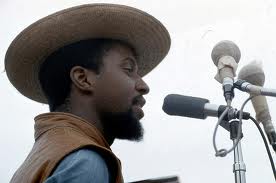
photo of Len Chadler at the 1964 Newport Folk Festival by John Rudoff.

August 28 marks the 49th anniversary of the the historic March on Washington for Jobs and Freedom.  Among those assembled to help Dr. King push forward his dream of racial harmony and economic justice on that day was Len Chandler, one of the voices in a trio that included Bob Dylan and Joan Baez. Chandler would march with Dr. King and travel through out the South in the name of voter registration, informing rural Southerners of their polling rights, at risk to his own life. It was a now-vanished YouTube clip of Chandler’s inspirational performance of “Eyes on the Prize” that contributed to inspiring me to track him down and move forward with the writing of Keep on Pushing, my text that tracks the origins of freedom music, and its roots in African American struggle and triumph.

Originally from Akron, Ohio, and studying on scholarship at Columbia in the ’50s, Chandler made his way to Greenwich Village folk music a bit by accident. Lured to the sounds of Washington Square Park by the downtown youths he was mentoring, he easily fell into the scene based on his natural ear for songwriting and his familiarity with the songs of Lead Belly, Big Bill Broonzy, and Woody Guthrie.  Following a performance at the popular Village coffeehouse, the Gaslight Cafe,  Chandler landed a contract to go to Detroit, writing and performing topical songs for local television. A few months later when the gig was through, he returned to New York to find the folk thing in full swing:  Bob Dylan was the latest arrival to town and the pair started to trade ideas and songs. “I hadn’t yet begun writing streams of songs like I would, but Len was, and everything around us looked absurd—there was a certain consciousness of madness at work,” wrote Dylan in his book Chronicles, remembering when.  Chandler remembers it like this in Keep on Pushing:  “The first song I ever heard of Dylan’s was ‘Hey ho, Lead Belly, I just want to sing your name,’ stuff like that.”  Dylan used Chandler’s melody for his song, “The Death of Emmett Till.” “Len didn’t seem to mind,” Dylan wrote.

Chandler went on to record two albums for Columbia:  To Be a Man and The Loving People.  He continued to work as a topical songwriter, a peace and civil rights advocate, and as a songwriting teacher; his tour of Pacific Rim bases with Donald Sutherland, Jane Fonda, Holly Near and Paul Mooney was documented in the Francine Parker film, FTA, a must-see for anyone interested in US history and anti-war efforts within military ranks. Catch a glimpse of Chandler at the end of this trailer for the film:

 Today, Chandler is largely retired from performing, but he remains well- informed on human rights, politics, and the arts.  I must say it was a privilege to meet one of the true unsung heroes of singing activism (as well as his wife Olga James, a pioneering performer in her own right), and to tell his story in Keep on Pushing which is where you will find more straight talk from Chandler, as well as my own perspectives on his contribution to civil rights history. If there is any chance that Harry Belafonte intends to organize the musical presentation for next year’s 50th anniversary of the March on Washington, I hope he will consider issuing an invitation to Chandler for another chorus of “Eyes on the Prize”  (hold on).

Filed under: Dr. Martin Luther King Jr., Folk, Freedom Now, , , , , , ,

Archives

Recent Posts

Browse by subject or theme