Against a backdrop of escalating war in Vietnam and social and political mayhem to accompany it at home, by the late ’60s and early ’70s, the conditions were perfect for hard-hitting topical rock and soul songs to step in and document the times. John Lennon put forth “Imagine,” the follow-up to his and Yoko Ono’s initial bursts of song devoted to giving peace a chance. Marvin Gaye voiced his concerns in “Inner City Blues (Makes Me Wanna Holler),” “What’s Going On?” and “Mercy, Mercy Me (The Ecology),” while Cat Stevens boarded the “Peace Train” that would ultimately take him to study the Qur’an and inspire a conversion to Islam. At the height of the era of music for change, it was more or less expected serious artists would weigh in during times of trouble with a song. From the chart-busting Motown artists who began to draw from a repertoire that was Blacker and stronger, to the rush-released recording by Crosby, Stills, Nash and Young of “Ohio” concerning the shooting tragedy at Kent State, the appetite for topical songs in the US was spurred on by their chart successes. Of course it was Bob Dylan’s early ‘60s pro-civil rights and anti-war songs that were the catalysts for the decade’s new strain of rock and soul music with a message.
Dylan’s arrival in Greenwich Village in 1961, to a scene informed equally by poetry and politics as it was jazz and folk, found him mastering pointed and topical song form early on, from “Blowin’ in the Wind,” “Masters of War,” and “A Hard Rain’s A-Gonna Fall,” to “The Times They Are A-Changin’,” “Only A Pawn In Their Game,” “Ballad of Hollis Brown,” and “The Lonesome Death of Hattie Carroll.” He followed his first act with his famous retreat from political songs and folk music. Resisting the tag, “voice of a generation,” he leaned more toward poetical and philosophical lyric forms, rather than those polemical or topical and developed his own world of song perhaps best exemplified by the rambles, “Like A Rolling Stone,” “Desolation Row,” and other epics on the trilogy of albums, Bringing It All Back Home, Highway 61 Revisited, and Blonde on Blonde. From 1966 through much of 1971 Dylan remained in self-imposed exile, off the road and away from the spotlight.
Making his way back to performing in public for the first time since his Isle of Wight concert in 1969, Dylan appeared at Madison Square Garden on August 1st, 1971 at the Concert for Bangladesh, the model for all of today’s all-star charity events. Organized by George Harrison and Ravi Shankar, the rally for Bangladesh raised awareness and funds for the residents of East Pakistan and Bengal India, regions beset by complications of war plus a cyclone and the flooding and famine that followed. An already troubled region was now devastated, and as Shankar outlined the situation for concert-goers, Dylan helped to draw them, performing “A Hard Rain’s A-Gonna Fall,” as well as a handful of more apolitical songs. Not long after the concert, on August 21, 1971, George Jackson was shot to death during an alleged prison escape and Dylan would once again pluck his subject matter from the headlines, returning to his roots as a social and racial justice singer. One could suggest it was Harrison’s and Shankar’s example of engaging with the world outside their door that inspired Dylan’s subject, though perhaps it was more a matter of his coming to terms with his own gift for topical songs.
Dylan’s relationship to the political world and the matters he chooses to champion or protest have been the subject of much debate, discussion, and inspiration for over 50 years; his life and songs have been over-analyzed and well-examined, but the 1971 single, “George Jackson,” a remembrance for the radicalized convict and Black Panther who died in a San Quentin prison shoot-out remains one of his most intriguing cuts. Not only does “George Jackson” mark the songwriter’s return to topical song form and to touring, its subject remains almost mysterious and misunderstood to the general audience as the singer himself.
Landing in California following a life on the streets of Chicago, a 70-dollar robbery is what landed Jackson in state prison, his sentence indeterminate. Jackson immediately found trouble on the inside too when guards took an instant dislike to him and his sentences were extended following events occurring at Soledad State Prison in which three Black inmates and a white guard were killed. Using his time in solitary to educate himself, Jackson studied psychologist Franz Fanon (The Wretched of the Earth), Marx, and Mao, and came to understand the incarceration of poor Blacks for petty crime in a political context. A leader in moving prisoners to radicalize, Jackson joined the Black Panthers and became one of the group’s most celebrated members. However by 1969, J. Edgar Hoover had declared the Black Panthers to be public enemy number one and set out to decimate them. Nevertheless, Soledad Brother: The Prison Letters of George Jackson was published in 1971 and was greeted by a positive reception by intellectuals and political progressives. That Jackson had been framed for conspiring to kill a guard in the Soledad incident was a widely held belief; his defenders were vocal and his case was a cause célèbre. But a few days before the Jackson trial was to begin, a riot broke out in San Quentin in which inmates and guards were again slain and Jackson was among those killed as he ran across the yard in an alleged escape attempt.
Less than a month after the prison shooting in California, a historic event at Attica Correctional Facility wherein prisoners took control of the prison to protest its poor conditions resulted in more fatalities—an unmistakable call for prison reform. Perhaps it was the call to which Dylan was responding when in November, he cut and released “George Jackson”, a 45-rpm record that reached the Top 40 in January of 1972. Opening with the blues trope, “I woke up this morning,” Dylan’s “George Jackson” is not a typical blues song, though it surely addresses the larger topic of racial and socio-economic oppression from which a certain style of blues was born. It also leaves a record of Jackson and his story.
“The power of George Jackson’s personal story remains painfully relevant to our nation today, with its persistent racism, its hellish prisons, its unjust judicial system, and the poles of wealth and poverty that are at the root of all that,” wrote historian Howard Zinn in an updated version of Jackson’s Soledad Brother. Wresting larger truths from the events of 1971, Dylan delivered his summation in these often quoted lines from “George Jackson”:
Sometimes I think this whole world Is one big prison yard Some of us are prisoners The rest of us are guards
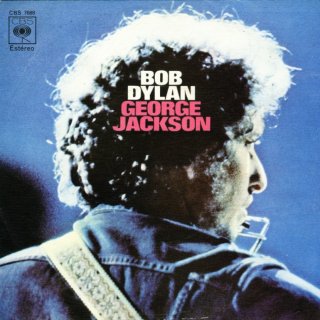
Dylan cut two versions of “George Jackson” for a double sided seven-inch: A “big band” version featuring Kenny Buttrey (drums), Ben Keith (steel guitar), and Leon Russell (bass), and a solo acoustic version. Among the various issues of the single—and there are many—is a picture sleeve with an image of Dylan performing at the Concert for Bangladesh; it remains sought-after by record collectors.
The details of the George Jackson case are still debated today by scholars, historians, and those who remember the events. Last year, the last incarcerated member of the San Quentin Six, Hugo Pinell, was killed while serving his life sentence, much of it in solitary confinement.
The following is a live recording of Joan Baez singing “George Jackson.”
In a recent post for Down With Tyranny!, I report on the forced resignation of the Chief of SFPD and the way forward in the fight by the Frisco 5 to reclaim San Francisco. The activists who recently survived a 17-day hunger strike had a volunteer attending physician, Dr. Rupa Marya: She’s since founded the University of California San Francisco (UCSF) Do No Harm Coalition of medical professionals with participation of students from SF State, and has declared the epidemic of police brutality a public health emergency (with data to back up the claim). Read the full story at Down With Tyranny! and be sure to enjoy this clip of Dr. Marya’s work away from the hospital, as leader of the group Rupa and the April Fishes (watch for the cameo by Bay Area activist/musician, Boots Riley).
This is a repost in memory of Allen Toussaint passing today.
I was thinking about the Pointer Sisters today—The 1973 Pointer Sisters—and how their first album was one that rarely left my turntable that year. I was a child and mercifully I’ve held on to most of my records from then; curiously, this one’s in pretty good condition—too good I’d say, to have belonged to a kid—which leads me to believe it’s not my original. Back then, I was in the habit of marking all my LP records with a DYMO tape sticker that said DENISE. Just like that, all caps, white letters on orange or green, sometimes red or blue though rarely yellow. But because the DYMO tape or any evidence of having been stuck by DYMO tape is missing (I like typing DYMO), I’m thinking the copy I’m holding of the Pointer Sisters’ self titled album on the Blue Thumb label was at some point reacquisitioned, between 1973 and now.
It’s uncharacteristic of me not to know exactly when I came by a record; that’s just how it is with people who collect records (or if you collect anything, you know what I’m talking about). Obtaining the object is part of its memory, which I find is selective and often obscured by all kinds of clouds and things. But records are the proverbial madeleine that take us back to the land that time (and sometimes I) forgot; songs may come and go, but it’s the record that helps me remember.
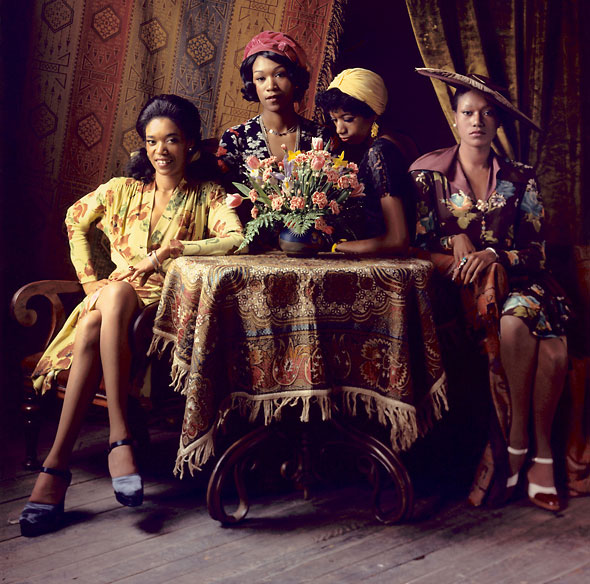
Opening the gatefold sleeve today, I recalled a few things: How as a girl, I preferred the portraits on the outer sleeve to the stylized inner sleeve which I bitterly critiqued as “staged.” The outer sleeve was real, or so I thought, not knowing photos were taken at a thing called a photo shoot, set up by a photographer (H.B. Greene according to the sleeve notes) who has an assistant. Preferring the sepia-toned “authentic” 1940s styling on the outer sleeve to the glossy, deco design on the inside, I’d pegged the Pointers as down-to-earth, regular people, not Hollywood types; they were after all local, from Oakland. This is how it should be, them living in a Victorian-styled house like the one pictured on the cover, them dressed in ’40s casual, just as they would everyday. I never talked to a single other kid about The Pointer Sisters first album or what they wore or how they wore it, I just know I’d still give my right arm for a dress just like the one June is wearing in the photo, perfect as it is in every way. Anyone who remembers these things like I do will tell you that baby June, the youngest Pointer, had the style thing completely locked-up. Such a fashion icon she was, it’s a wonder I didn’t take to wearing a turban like she did, though I think I intuited it probably wouldn’t go over very well at school. Where did a child obtain a turban anyway?
As for the music, what can I tell you that you don’t already know? Forty years later, we all know everything about everything and all I’ve got is my stale madeleine from the early ’70s and my Pointer Sisters reverie. The first time I heard the Willie Dixon song, “Wang Dang Doodle,” it was not performed by Etta James; rather, it was right there in my bedroom with the yellow floral wallpaper, at the end of side two of The Pointer Sisters. For sure, that was also the first time I ever saw the name A. Toussaint on a writing credit. Allen Toussaint is of course a legend of New Orleans piano style and the songwriting giant who wrote the album’s opener, “Yes We Can Can.” Why do I waste my breath? You knew that. Heck, even I knew as a small fry that Lee Dorsey was known for doing the song first; he’d been around the prior decade with “Ya Ya.” I knew that one by heart for reasons I can’t possibly relay right now without getting way off course. Put it this way: “It may sound funny but I don’t believe she’s coming home” rung some bells for me. I also liked the smooth vocals in “Jada,” one of the songs the Sisters themselves are partially credited with writing. But really, what I was most concerned with in 1973 wasn’t the music but in getting hold of some old plastic fruit, likely the cherries from the bowl at my great-grandmother’s house, so I could fashion a bunch into a corsage that I could wear on the lapel of my Eisenhower jacket from Lerner’s, to be worn with some wide-bell high-waist pants and platform sandals. Pointer Sisters style, for real.
In closing, I was going to say I don’t remember what we did without You Tube but that would be a big fat lie. I remember perfectly well what we did and that was, we’d watch really bad video tapes that were hard to store and even harder to find on shelves, usually caked with dust. Once we got the tape in the VCR it had to be fast forwarded and rewound so many times, so maybe, just maybe you could find that segment of Soul Train you were looking for but started to regret you ever taped in the first place, since if you hadn’t taped it, you wouldn’t be messing around with a stupid remote control that never worked because the battery was like 10 years old to begin with. Recalling this foolishness, I am wasting my own time and now yours, when all I mean to say is, just try to imagine how I felt when I found this clip of “Yes We Can Can” today, because I can’t possibly describe the feeling of joy, such joy—not in 250 words or less I couldn’t—though I will add this: If there is one song to have had burned into your consciousness, to have been etched onto your soul, and sent with you on your way into the world, this one isn’t a bad one to have to be. Bless you, Mr. Allen Toussaint and Ms. Pointers, Anita, Ruth, Bonnie, and June. Thank you for the record—and for my memories. Great gosh all mighty.
“For those of us who are progressive, who believe the City of San Francisco should work for everyone, it’s a difficult time to be at City Hall…it’s a difficult time to be in that building,” said Supervisor David Campos over the weekend as he helped to launch Vision SF, a grassroots group primed to reclaim San Francisco from the forces of greed, corruption and narcissism that have poisoned municipal waters.
Representing the Mission, the City’s Latino cultural district and locus of its housing crisis, Supervisor Campos brought the additional dimension of the broken immigration system to the event conceived as a pre-election housing initiative forum. Referring to Donald Trump scapegoating immigrants following a recent murder committed by an undocumented person here, Campos cleaved to San Francisco’s sanctuary city status and pressed to keep local law enforcement out of the business of immigration. “Our sanctuary policy already says we’re not going to tolerate criminal activity,” underscored Campos. “No human being is illegal and every human being regardless of immigration status has human dignity.”
Intended to rally grassroots community organizations and free range citizens and spur them into a cohesive voting block for this election, there wasn’t much talk of San Francisco’s homeless population, though the ballot’s housing initiatives perhaps imply a way toward that solution too. Propositions A, F, I, J and K concern affordable housing, regulating Airbnb, pausing development of market-rate housing, protecting legacy businesses and using city-owned surplus land respectively—and were elaborated on by the Housing Rights Committee’s Sara Shortt, former assemblyman and supervisor Tom Ammiano, lifelong human rights advocate Cleve Jones and artist Roberto Hernandez (who learned to organize directly from Cesar Chavez). The activists were joined by committed singer-songwriter Tom Heyman, young filmmakers Joe Talbot and Jimmie Fails, comedian Mike Evans, and poet laureate, Alejandro Murguía, among others. A clip of Alexandra Pelosi’s new film, San Francisco 2.0, was to be screened but Vision-SF co-founder David Talbot announced that venture capitalist Ron Conway succeeded in scaring HBO and the filmmaker’s family from showing the film and attending the event (not exactly a good portent for the region that sparked the Free Speech movement).
Talbot and co-host, former supervisor and housing rights activist Christina Olague presided over the program that generally advocated coalition building across race, age, and economic lines. Addressing the need to include young, exploited tech workers in the movement for economic and housing justice, Cleve Jones invoked the name of his friend Harvey Milk which brought the crowd to a eerie hush. “It’s over,” Jones remembered, as he recalled the moment of seeing the slain body of Milk being removed from City Hall, “All I could think was, “it’s over’,” he said. Though as night fell and the streets filled with San Franciscans from all walks of life, candles lit to mourn the fallen at the evening’s march and vigil in 1978, Jones found a way to be inspired to push forward. “This is just the beginning,” he said, and it was that message he impressed on the crowd who left with house signs and a renewed spirit of solidarity.
Meanwhile, across town, thousands of San Franciscans and tourists reveled in Golden Gate Park while musicians, many with counter-culture roots of their own, entertained at the annual three-day music festival sponsored by deceased private equity investor, Warren Hellman. Mega-producer T Bone Burnett used his stage time to speak truth to power: “Who’s going to call this darkness, darkness. Somebody’s got to locate the bomb, dot com.” The founders and members of Vision-SF are trying, man, but they’re going to need a whole lotta help from their friends.
Among reasons to like Bernie Sanders, he supports the ERA and the Paycheck Fairness Act, he advocates for increasing minimum wage, has commited to expanding health and reproductive rights, and believes that childcare, preschool, and parental leave should be available to all Americans, not just a privileged few. While I don’t know where punk rocker Alice Bag stands on Bernie Sanders, I recently heard her perform “Equality in the USA” with Frightwig in San Francisco at the Punk Renaissance, a week long festival organized by Punk Rock Sewing Circle, former punk rockers committed to social justice. Interestingly, Sanders has ties to punk rock, when as mayor of Burlington, he approved the Mayor’s Youth Office and punk gathering spot, 242 Main. Not only do I think there could be a valuable meeting of the minds here– as in a coalition of punk rockers for Sanders– but Bag’s powerful punk performance once again reminded me of my generation’s musical ability to change hearts and public opinion in fundamental ways. Read entire article at
The following is an extract from, Keep on Pushing, Black Power Music From Blues to Hip Hop, a perhaps unlikely source for a chapter featuring a mini, concise history of punk rock, with a San Francisco-bias. It’s a subject I’ve been interested in since Patti Smith’s Horses reached me in the Summer of 1976. On September 24, I will be among the panelists at SF Punk Renaissance for Punk: What Went Wrong…or Right?a discussion on the music and movement that inspired my generation.
All over the world, youth were collectively inspired to take back rock and put it into the hands of their generation, and they did it themselves, without corporations or websites or even a whole lot of love behind them. They did it with spit, muscle, sweat, and even Sid Vicious’s blood, and a couple of copies of Raw Power between them.
“It seemed like it had to go back to the three-minute song, something immediate and direct,” says Buzzcocks’ Steve Diggle. “And from that people came alive again.”
Among punk rock’s targets was the comfortable numbness of quotidian life, partially provided by expensively produced (Pink Floyd, the Eagles, Steely, Dan, and Fleetwood Mac) and lightweight (James Taylor and Carly Simon) rock. The back-to-basics music style combined with the anti-authority philosophy meant punk was largely a scene without leaders, organization or infrastructure. It can’t be said enough that in the United States there was virtually no commercial airplay for the music and there was very little in the way of favorable aboveground rock press for it either. But self-starting had its own rewards.
“People gained confidence in who they were, even ourselves, even with all our insecurities,” says Diggle. “It wasn’t like we were the big show business act to come to entertain people, it was more like…These guys are the same as us,” he says. “It was real people singing about real things and when we go up on stage we just put on guitars and there’s no big act.”
The do-it-yourself directive also lead to the resurgence and proliferation of the self-released seven-inch single, a format that had virtually become extinct with the popularization of seventies album rock. Buzzcocks was one of the first bands of the punk surge in England to release its own record, debuting with their Spiral Scratch EP in January of 1977. That spring the Ramones, with the Nerves and Pere Ubu, took the first murmurings of punk all across the USA. Though at the surface the punk pop of the Buzzcocks wasn’t political, “It was about personal politics,” explains Diggle. “It questioned things on many levels.” A song like “Autonomy” was about “self-rule.” And ‘Fast Cars’ was about the business of having a fast car,” he says.
Whether it was the words they sang—at once passionate and dispassionate—the way they sang them, or the fact that they sang them at all, songs like “Fast Cars” telegraphed something that went beyond the general speed limit: It confronted individuality and choice in a market-driven culture. “I hate fast cars!” was a radical statement, a rejection of values prized by a capitalist society.
The Ramones and the Sex Pistols have both been called the Johnny Appleseeds of punk, crisscrossing their respective countries and crossing the Atlantic while punk bands were breaking out like a spotty rash in places likely (London) and unlikely (Akron, Ohio). The Ramones brought their show to San Francisco’s Savoy Tivoli in 1976 and inspired a few artists and musicians to form bands of their own. The Sex Pistols did the same, bringing their show to the United States in early 1978, though the resulting media circus marked the end of the Pistols and the death of the early phase of punk. Penelope Houston’s band the Avengers opened the last-ever Sex Pistols show at Winterland in San Francisco. Less influenced by the entertainment of the Sex Pistols and the fun of the Ramones, Houston was a punk rocker of the battling kind. “I definitely recognized that Dylan was fighting against the things he saw as wrong but I would say my biggest singing influence would be Patti Smith,” she says.
The blank generation, a term coined by poet Richard Hell, found its muse, its voice, and its generation’s answer to Bob Dylan in Smith who released her first punk single in 1974. Having escaped a New Jersey childhood for the Chelsea Hotel, the young poet was also the girlfriend of photographer Robert Mapplethorpe and together they made art before she ever had the idea of making a record. Through the course of her bookstore clerk days and Max’s Kansas City nights, Smith emerged an androgynous, rock ‘n’ roll type, a person with more in common with Dylan and Keith Richards than any woman in rock.
Smith went to the San Francisco Bay Area in 1974—high Watergate season—to perform at Rather Ripped Records on the North Side of Berkeley campus. At the time, it was one of the few places you could buy an independent seven-inch record, what you might call the broadside of the late seventies. Smith’s new single was “Hey Joe,” the song with which Jimi Hendrix had ended his fateful set at Woodstock in 1969. The A-side began with a poem titled Sixty Days:
“Patty, you know what your daddy said, Patty, he said, he said, Well, sixty days ago she was such a lovely child , and how here she is with a gun in her hand.”
The Patty to whom she referred was Patricia Campbell Hearst, the newspaper heiress who’d taken the name Tania following her abduction by the Symbionese Liberation Army, an armed band of radicals, one group among a host of urban predators and terrorists raising hell in the Bay Area during the protracted aftermath of the Summer of Love. Tania had seemingly joined her captors in the class war struggle; “Hey Joe,” marked the official arrival of the new generation.
“I’m nobody’s million dollar baby, I’m nobody’s Patsy anymore, and I feel so free.”
From the decaying urbanscapes epitomized by the rotting Big Apple and the Rust Belt cities, and especially in hippie haven San Francisco, the post-sixties air of revolution hung heavy; Smith was the something new that blew in, wild, from the streets. San Francisco would remain the scene of more high times and inexplicable crimes throughout the decade. Home to the historic free speech and antiwar movement gatherings in the sixties, the Bay Area continued to be a place where minds behind movement and invention—whether high tech or slow food—converged. Its consecration as a gay mecca at that time is well known, while the role disco music played in gay liberation movement, and the role San Francisco played in the development of the punk rock movement, remain less documented. Perhaps these stories go some way toward providing necessary connections, as might the next section on punk’s relationship to reggae and hip hop.
Bob Dylan’s relationship to the political world and the matters he chooses to champion or protest have been the subject of much debate, discussion, and inspiration for over 50 years now. His arrival in Greenwich Village in 1961, to a scene informed as equally by poetry and politics as it was jazz and folk, marked the beginning of his relationship with topical song, followed by a famous retreat from it, as well as his resistance to the tag, “voice of a generation.” And yet, as the ‘70s began, Dylan was once again plucking his subject matter from the news, returning to his roots as a social justice singer with “George Jackson”, a memorial for the radicalized convict and Black Panther who died in a San Quentin prison shoot-out on August 21, 1971.
Against a backdrop of escalating war in Vietnam and social and political mayhem to accompany it at home, by the late ’60s and early ’70s, the climate made necessary topical rock and soul songs which documented the times. John Lennon put forth “Imagine”, the follow-up to his and Yoko Ono’s initial bursts of song devoted to giving peace a chance. Marvin Gaye voiced his concerns in “Inner City Blues (Makes Me Wanna Holler)”, “What’s Going On?”, and “Mercy, Mercy Me (The Ecology)”, while Cat Stevens boarded the “Peace Train” that would ultimately take him to study the Qur’an and inspire a conversion to Islam. It was also more or less expected that in these times of trouble, serious artists would weigh in on the events with a song. From the chart-busting Motown artists who began to draw from a repertoire that was blacker and stronger, to the rush-released recording by Crosby, Stills, Nash and Young of “Ohio” concerning the shooting tragedy at Kent State, the appetite for topical songs in the US was fuelled by chart successes. Bob Dylan’s early ‘60s pro-civil rights and anti-war songs were largely the catalyst for the strain of rock music with a message that thrived throughout the decade. And while it’s true that from 1966 through much of 1971 Dylan remained in self-imposed exile from touring, leaning more towards poetical and philosophical lyric forms, rather than those polemical or topical, “George Jackson” was his wildly unexpected return form.Performing in public for the first time since his Isle of Wight concert in 1969, Dylan appeared at Madison Square Garden on August 1st at the Concert for Bangladesh, the model for today’s all-star rock charity events. Organized by George Harrison and Ravi Shankar, the rally for Bangladesh raised awareness and funds for the residents of East Pakistan and Bengal India, regions beset by complications of war plus a cyclone and the flooding and famine that followed. An already troubled region was now devastated, and as Shankar outlined the situation for concert-goers, Dylan helped to draw them, performing “A Hard Rain’s A-Gonna Fall”, as well as a handful of more apolitical songs.
Later that month at San Quentin in the summer of 1971, George Jackson was shot to death during an alleged escape attempt following a prison riot in which five inmates and a guard were killed. Less than a month after the Jackson incident in California, a historic event at Attica Correctional Facility wherein prisoners took control of the prison to protest its poor conditions resulted in more fatalities—an unmistakable call for prison reform. Perhaps it was the call to which Dylan was responding when in November, he cut and released “George Jackson”, a 45-rpm record that reached the Top 40 in January of 1972. Opening with the blues trope, “I woke up this morning,” Dylan’s “George Jackson” is not a typical blues song, though it surely addresses the larger topic of racial and socio-economic oppression from which a certain style of blues was born. It also tells the story of Jackson.
Having made it to California from the streets of Chicago, a 70-dollar robbery landed Jackson in prison, his sentence indeterminate. He found trouble on the inside when guards took an immediate dislike to him; his sentences were extended—chiefly behind events occurring at Soledad State Prison in which three black inmates and a white guard were killed. Using his time in solitary to educate himself, he studied psychologist Franz Fanon (The Wretched of the Earth), Marx, and Mao, and came to understand the incarceration of poor Blacks for petty crimes in a political context. A leader in moving prisoners to radicalize, Jackson joined the Black Panthers and became one of the group’s most celebrated members. However by 1969, J. Edgar Hoover—declaring the Black Panthers to be public enemy number one—had set out to decimate them, and other groups like them. Nevertheless, Soledad Brother: The Prison Letters of George Jackson was published in 1971 and was greeted by a positive reception by intellectuals and political progressives. That Jackson had been framed for conspiring to kill a guard in the Soledad incident was a widely held belief; his defenders were vocal and his case was a cause celebre. But a few days before his trial was to begin, a riot broke out in San Quentin in which inmates and guards were again slain; this time it was Jackson who was shot while running across the yard in an alleged escape attempt.
“The power of George Jackson’s personal story remains painfully relevant to our nation today, with its persistent racism, its hellish prisons, its unjust judicial system, and the poles of wealth and poverty that are at the root of all that,” wrote historian Howard Zinn in an updated version of Jackson’s Soledad Brother. Wresting larger truths from the events of 1971, Dylan delivered his summation in these often quoted lines from “George Jackson”:
“Sometimes I think this whole world
Is one big prison yard
Some of us are prisoners
The rest of us are guards”
Dylan cut two versions of “George Jackson” for a double sided seven-inch: A “big band” version featuring Kenny Buttrey (drums), Ben Keith (steel guitar), and Leon Russell (bass), and a solo acoustic version. Among the various issues of the single—and there are many—is a picture sleeve with an image of Dylan performing at the Concert for Bangladesh; it remains sought-after by record collectors.
The details of the George Jackson case are still debated today by scholars, historians, and those who remember the events. Just this month, the last incarcerated member of the San Quention Six, Hugo Pinell, was killed while serving his life sentence, much of it in solitary confinement.
The following is a live recording of Joan Baez singing “George Jackson.”
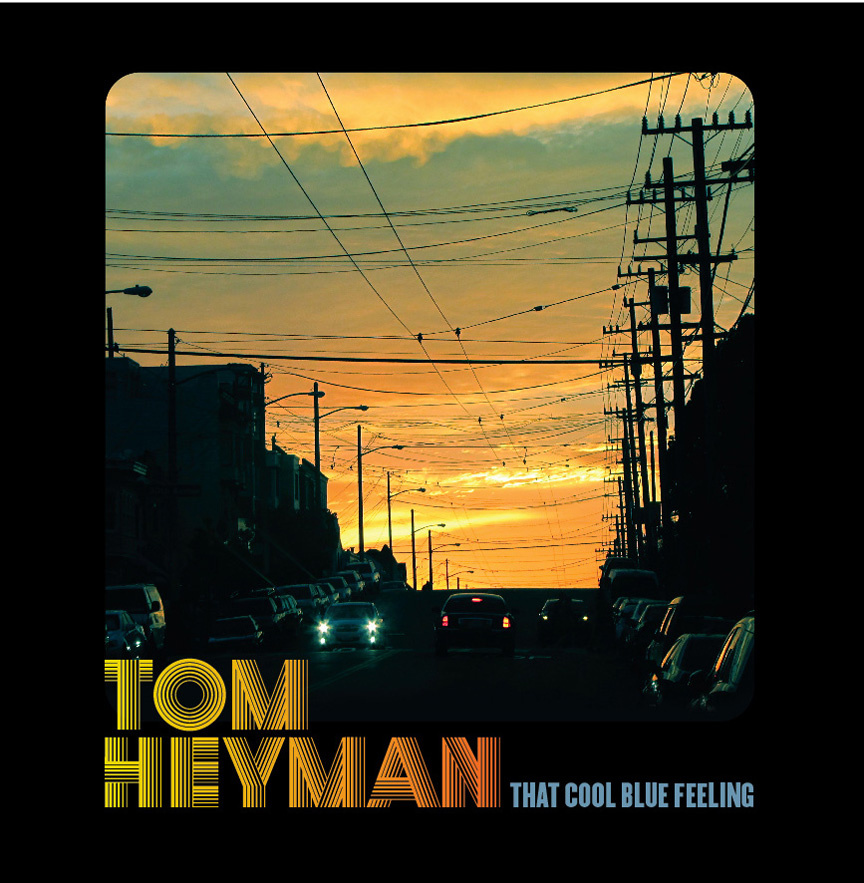
I’ve been working on a new column series based on real life stories from the heart of Gentrification City. The first one concerns songwriter and recording artist Tom Heyman and visual artist and community college instructor Deirdre White, a couple of longtime Mission District residents who’ve found a way to survive in high-tech town as working artists.
That Cool Blue Feeling album by Tom Heyman. Cover photo of sunset in the Outer Richmond by Deirdre White
Debuting this week at Down With Tyranny, I’m seeking a permanent home for the serial (it might be here, there or elsewhere). Until then, please find the first installment here and let me know what you think: The story is just beginning. Turns out this 49(ish) square mile patch of scenic beauty is smaller than ever before. The lives of those of us who remain here are all very much interconnected.
I look forward to sharing the stories of 21st Century San Francisco with you and am exceedingly grateful I’ve been given the opportunity to do so. Until the next installment, I’ll be here riding the waves and the ropes, too. Stand strong people: They can’t take away our souls or the songs in our hearts…
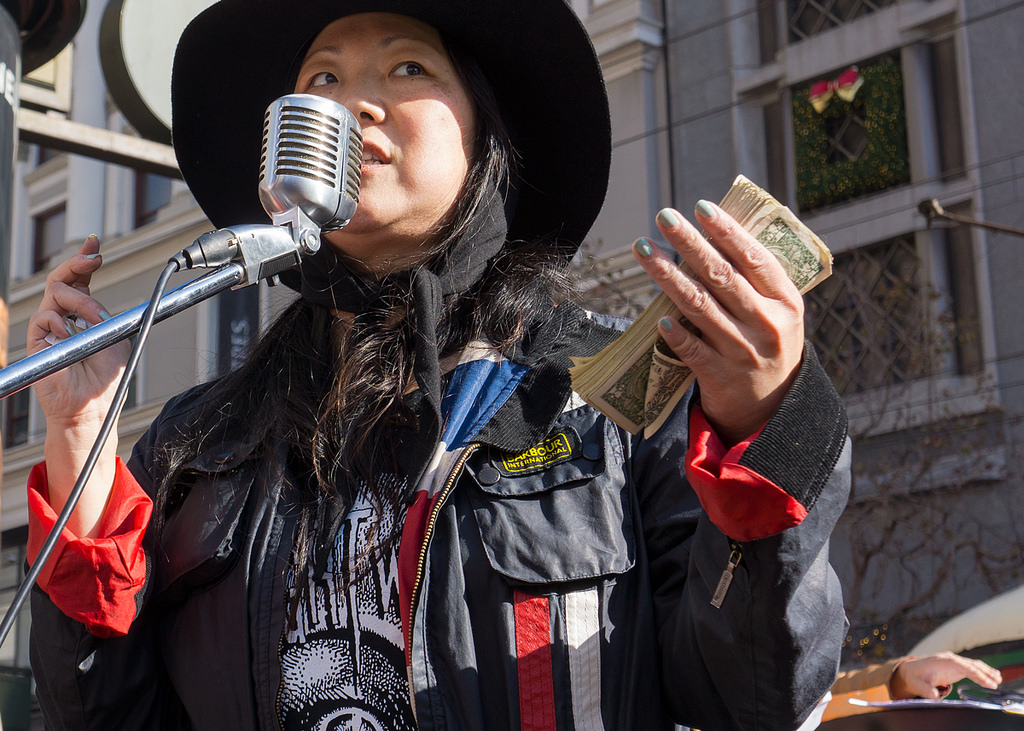
“If you have, give. If you need, take.” That is comedian and San Francisco native Margaret Cho’s simple, seasonal message to the people of her hometown and so far the directive is working: Staging impromptu street performances, Cho is devoting two months to raising awareness and much-needed funds and supplies for the homeless here, in memory of her philanthropic comic inspirer, Robin Williams.
Cho for change, Market and Powell, San Francisco (photo courtesy Gerard Livernois)
“With Comic Relief he raised 70 million dollars for homelessness causes,” claims Cho of the series of televised charity shows and events hosted for over 20 years by Williams, Whoopi Goldberg, and Billy Crystal. Calling from San Antonio where she was performing her stand up act over the weekend, Cho explained, “He had written into his contracts that a certain percentage of homeless workers had to be employed on the set. He was very conscious of homeless people and he turned in perhaps the greatest performance of a homeless person ever in The Fisher King.” The loss of Williams this year she says, was more than the death of a dangerously depressed fellow comedian and street theater vet. “We lost a passionate activist.”
On November 20, 1969, All Tribes of the Native Nations occupied the island of Alcatraz in the San Francisco Bay. The taking of the former state penitentiary (the one that once held down gangster Al Capone and the notorious “Birdman,” famous for escaping it) was a major awareness-raising event, illuminating the treatment and near-extinction of Native people in the US. Issues like land theft and other deceptions served to Americans were in process of being clarified for all of us by members of the Native Nations: the Indians had longer-term plans to establish a culture center on the Rock, but federal authorities ultimately ended the peaceful occupation—with force—after a 19-month stand. Today, the former prison operates as a museum; it is presently hosting an art installation of work by renowned Chinese artist Ai Weiwei, with reference to the island’s Native American protest past)
Among those who heard the call to gather in 1969 was John Trudell (Santee Sioux) who served as a broadcaster, the Voice of Alcatraz. Radio Free Alcatraz reached the airwaves daily via KPFA in Berkeley and KPFK in Los Angeles (the Pacifica radio network). “He is extremely eloquent, therefore extremely dangerous,” says the note in Trudell’s FBI file. In 1979, Trudell lost his wife, his three children and his mother-in-law in a mysterious house fire. The event was a turning point toward his life as a poet, musician and actor; miraculously his spirit remains outspoken and free.
Deborah Iyall (Cowlitz) was just a teenager at the time of the occupation: She ran away from her childhood home (with her mother’s blessing) to join the protestors on Alcatraz. “I remember a song this woman Oona taught me at the powwow… I felt like I had these little nuggets and culture to hang on to.” Iyall remained on the Rock for a few foggy and cold nights before returning home, but her introduction to a creative Native person helped shape her own identity as a professional visual artist, poet and musician (Iyall recorded and toured as the frontwoman of Romeo Void and remains a solo artist. Read more on the lives of Debora Iyall, the work of John Trudell, Buffy Sainte-Marie and other artists inspired by the American Indian Movement in Keep on Pushing).
The anniversary of the Alcatraz occupation, the annual sunrise Thanksgiving Day ceremony there, the team sports protests and the ongoing violation of Indian lands made it an Indian news-filled week here in Nor Cal, but then, here in the US, everyday is an opportunity to remember what the Indian people sacrificed for US and to say thank you for their land which the rest of us occupy.
Thanks to Mary Jean Robertson—host of Voices of the Native Nation, broadcasting every second, third, and fourth Wednesday of the month on KPOO—for bringing the news to Natives and their allies. Last night she played the above clip by Redbone, released in 1970 at the height of the occupation, with footage collected from more recent sunrise ceremonies.




 Denise Sullivan