What was meant to be a short, between books project is now officially a new ebook, Shaman’s Blues. As an author from traditional publishing and as a person who spends much of her energy as a books advocate and activist, it’s a strange twist that my own title is available through that infamous bookstore-eating electronic channel. Let’s just say it’s an experiment for this writer and others like me: We’re in processing of discovering whether it’s possible to earn a living from our books instead of owing our publishers infinitely. Whether it’s possible to do that, as I’ve heard some writers have done, remains to be discovered. The good news in all this is a hardcover edition of the book will be available October 1 at independent booksellers and libraries (ordering details will appear here soon). And if you’re a traveler or fan of e-reading, Shaman’s Blues is available to you at no cost, beginning Friday August 22-Sunday August 24. For now, please visit the Blooming Twig/Sumach-Red blog for a taste of what you’ll find inside. And thanks for taking a chance on Shaman’s Blues.
In February: Mayor Ed Lee (center) of San Francisco signs the historic landmark designation for 1712-1716 Fillmore Street, former home of Marcus Books and Greg and Karen Johnson (also pictured).
Since the May eviction of Marcus Books in San Francisco, the speculators who purchased the property have waged a hateful campaign against the historic, landmarked Jimbo’s Bop City building that housed the oldest black bookstore in the US and the Richardson-Johnson family, its longtime proprietors. Theft of valuable store inventory and business tools, destruction of irreplaceable cultural artifacts, displacement of four generations, and most recently a slander campaign against the family who ran the store for 50 years are the contributions made by new owners, the Sweises, to 1712-1716 Fillmore Street. That the City of San Francisco has done little to prevent the attacks, aside from rubber-stamping the building and business as a community and cultural resource with a landmark designation earlier this year, isn’t that surprising: Since the 2009 Mayor’s Task Force Report on African American Out-Migration, few of the recommendations for education, economic development, and cultural and social life have been implemented. But the City’s negligence and complicity in this recent act of cultural genocide in the black community was so shocking, it must not be allowed to stand unchecked.
The continual and unrestrained despoiling of predominately black and brown neighborhood resources is not a newsflash: There has been a concerted effort toward black neighborhood “redevelopment” since at least the early ’60s. Certainly evictions overall have been unprecedented on Mayor Ed Lee’s watch, but the way in which the dismantling of the Marcus Bookstore was carried out was particularly aggressive. Small business owners, especially those of color, know well the lack of protections for their tenant and human rights, but the Marcus Books story was under-reported by local media and the details remained largely a mystery to those outside the community until this response by the Johnsons was published on Friday.
In May: Contents of the Marcus Bookstore in process of being dumped and prepared for hauling away.
Following the store’s eviction, the new owners broke several moving dates, then took hostage the store’s books, art work and equipment. Said to be put in storage, to date the materials have not been returned. Community members suspect most all of what was contained in the bookstore—including 50 years of history and ephemera documenting black San Francisco—was either stolen or destroyed, hauled away in a landscaping truck by day workers. That the historic Marcus Bookstore should be physically dismantled in broad daylight as District Supervisors, various commissioners, Mayor’s Office and the NAACP leadership who supported the motion to preserve the property stood by and did nothing to prevent it is the question that remains shamefully unanswered. That passerby were allowed to rifle through the dump truck and take what they liked is simply further evidence of the uncivil and unjust treatment of a community’s history, co-signed by the City.
As a native San Franciscan, an author, and community advocate for the preservation of our most valuable cultural assets—in this case books and literacy—I support the campaign to return the Marcus Bookstore to its Fillmore location. As witness to the community meetings, in store events, Board of Supervisors and Historic Preservation Commission proceedings, and desecration of the property, I have observed and documented with astonishment the trail of broken promises and lies told by District supervisors, Mayor’s Office appointees, and the African American community’s own faith leaders about the bookstore and its proprietors. These erroneous claims–that a bookstore is an unsustainable model for 21st Century business–entirely misses the point. The campaign to support Marcus Books goes beyond keeping open the doors of a mom and pop bookshop: It is an attempt to shine a light on and preserve African American culture, community and literacy, particularly for readers of the future. The removal of Marcus Books on the block could once and for all to erase the rich cultural heritage African Americans created in San Francisco—through art, music, literature, civic engagement and action and replace it with a whitewashed version of history that does not include black contributions. Further, it negates the interests of the wider community of black and other interested folks who relied on the Marcus Bookstore’s products, services, warmth, and humanity.
In July: The vacant and vulnerable historic landmark at 1712 Fillmore Street.
I am curious how the City officials and employees who reportedly bought their first books at the store, who sat at the owners feet as teenagers and said they were in support of the store can now step back and refuse to take notice or phone calls and deny their previous public statements of support. But I’m not surprised that the landmarking of Marcus Books was insincere and just another photo op: The City’s allegiance to money and power is well known: Given an opportunity, I can imagine Mayor Lee selling his own ancestors down the river. Expecting him and his regime to understand the struggle waged by Marcus Books as a cultural one was a non-starter from the gate. But there is no doubt Lee and Co. failed to “Provide full support of the Fillmore Jazz Heritage District and to make sure that African American culture is fully respected and highlighted in the effort” according to Out-migration Report recommendations.
Despite the setbacks, the original owners of 1712 Fillmore and its family of supporters continue to fight injustice in their community and reclaim justice for all. We have not heard the last from the Marcus Bookstore.
If you are interested in expressing support and solidarity with the owners of Marcus Books San Francisco, please contact the Support Marcus Books site directly. If you are a bookseller, author, or publishing professional interested in joining a new alliance of Bay Area independent bookstores, please contact keepon.keepon.pushing@gmail.com and you will be added to an email list.
If buildings could talk, the Marcus Books property on San Francisco’s Fillmore Street, the onetime “Harlem of the West,” would tell a tale of two cities for over 50 years. Once the jazz club Bop City (where John Coltrane, Charles Mingus and Billie Holiday performed), the purple Victorian structure is central to a neighborhood that has survived the internment and return of its Japanese American residents, an urban renewal project that resulted in the permanent exodus of African Americans when promises for new homes never materialized, and a blueprint for a “Jazz District” that failed to launch. Now, the neighborhood faces a final act as Marcus Books, the oldest seller of books “by and about black people” in the entire US, attempts to uphold black history and culture, a part of which its founders helped create, while the mayor’s office and for-profit developers look instead to the influx of tech companies and their workers as the City’s future.
It’s taken decades, but the Mahattanization of San Francisco is nearly complete: The immigrants, artists and native-born who built the City and gave it its unique flavor can no longer afford to live here; with San Francisco’s African American population largely banished to Oakland and points beyond, alongside the working and artists classes, the freethinking lifestyle that attracted so many people to the Bay Area in the first place has largely been and gone. “What is crucial, is whether or not the country, the people of the country, the citizenry, is able to recognize that there is no moral distance between the facts of life in San Francisco, and the facts of life in Birmingham,” said James Baldwin on a fact-finding trip to San Francisco in 1963 at the height of the Civil Rights Movement, a time at which he would have also visited Marcus Books.
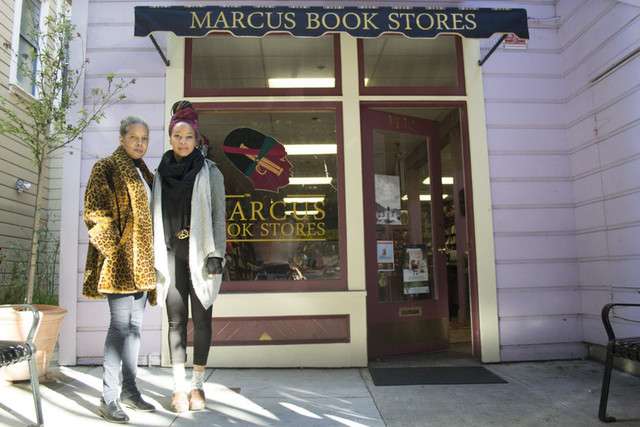
Every black writer and intellectual in the US and throughout the African Diaspora knows the store; Celebrities, activists, athletes and literary giants, from Malcolm X, Rosa Parks, Muhammad Ali, Walter Mosely, Alice Walker, Oprah Winfrey and Toni Morrison have all passed through the doors of the San Francisco or Oakland stores. Founded by Drs. Julian and Raye Richardson in 1960, their leadership and the store itself served as sanctuary for thinkers, authors and community members during every watershed of black cultural and political movement, from the Voting Rights Act, through the Black Power Movement and historic student strike at SF State in 1968 (resulting in the establishment of multicultural study programs which still exist at universities today). Many of San Francisco’s African American faith, civic, arts and culture leaders were educated through the program at State, either by the Richardsons themselves or the books they stocked at Marcus; 50 years later, the Richardsons’ daughter, granddaughter and extended family remain in San Francisco, providing black children with their very first books, as well as a safe community space where elders and organizers may engage in discussions on their journeys, from Jim Crow to the first black president. Yet for the past year, Marcus Books, one of those rare brick and mortar stores that operates in the black, has been waging a program for its own survival: The City’s community activists, elected supervisors and appointed commissioners achieved landmark status for the historic building, attorneys brokered a buyback after the property was sold at auction, and the store’s fund drive with a deadline at the end of Black History month is in its final stretch. But Marcus is not the only community-serving destination that’s been diverted from its core mission to enlighten and educate: If a city’s bookstores are any indication of its cultural diversity and intellectual health, San Francisco is on the critical list. With City Lights the only vestige of the town’s Beat Generation past, the City’s last gay bookstore was laid to rest three years ago; it’s most progressive political book outlet in the Mission District is on the brink. A similar fate for Marcus Books would mean the end to longstanding black-owned businesses in the Fillmore, the so-called “heart and soul of the city,” a neighborhood once so diverse it was dubbed the “Little United Nations.” Seems The City That Knows How has forgotten where it came from and San Francisco is no longer the most progressive place on earth. Baldwin’s 1963 quote may’ve been specifically about Jim Crow ways and law, but a blow to Marcus Books could mean his message remains the same: San Francisco’s reputation as a kindly city of love, tolerance and diversity will be forever tarnished; in fact, it may have been false advertising all along.
Marcus Books will be holding a hackathon on Saturday afternoon in San Francisco.
-LeRoi Jones, excerpt from Preface to a Twenty Volume Suicide Note… 1961
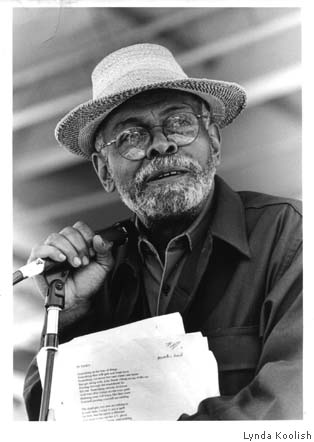
“Never settle for the given. What is it that hasn’t been mentioned? What is beyond that?” These are the words of activist, actor, poet, playwright, director, and music critic Amiri Baraka. He passed today in Newark, NJ at the age of 79. “Art is supposed to unlock you, make the world more available to you,” he said. It was the way he felt when he heard Thelonious Monk for the first time. I heard Baraka speak at the Hammer Museum in Los Angeles two years ago this month, in conversation with his daughter, Kellie Jones, curator of the wildly successful exhibit, Now Dig This! Art and Black Los Angeles 1960—1980, discussing art and family, though the conversation inevitably turned to Baraka’s recurrent theme, surviving America. “Do you understand the world?…What do you think?… What is important to you?…What is it you want to say?…How do you say what the world is?…How do you tell us who lives on this planet?…How do you make something speak to the world?…” These are the questions he asked of himself and of other artists, for over 50 years.
Born Everett Leroy Jones in 1934 in Newark, NJ, where he lived until the end, he changed his name to LeRoi and chronicled the birth of free jazz as a journalist; he wrote an Obie award-winning play, The Dutchman, and he is the author of Blues People, one of the first books to make connections between music and social history. Equally informed by the poetry of Langston Hughes, the politics of Malcolm X and the Black Mountain College poets, Allen Ginsberg and the Beat movement, in the mid-‘60s, Baraka founded the Black Arts Repertory Theater/School (BARTS) in Harlem which contributed to the development of a new, unapologetically black style of writing, its creation dovetailing with the Black Power movement’s cultural agenda. By the late ’60s he’d changed his name to Baraka; his album It’s Nation Time—African Visionary Music, for Motown’s Black Forum label, features his Black Nationalist poetry set to music.
Stirring it up for 50 years, in 2002, Baraka was named Poet Laureate of New Jersey and of the Newark Public Schools amidst controversy over his poem, “Somebody Blew Up America” (who? who? who?). That same year, The Roots accompanied him on “Something in the Way of Things (In Town),” on their album, Phrenology. Condolences to the surviving members of the Jones and Baraka families.
(More on Amiri Baraka, the Black Arts Movement, and his connections to music, from blues to hip hop in Keep on Pushing)
(UPDATE, December 19: Morrison’s notebook reportedly sold for the unverified amount of $200,000 on December 18, 2013).
This week’s news that Jim Morrison’s “Paris” notebook will be auctioned later next month, 10 days after what would’ve been the singer and poet’s 70th birthday, hasn’t exactly set the night on fire. The headline, characterizing the discovery as his “druggy musings” makes it sound like more of the same, and yet, we’re talking about the recovery of a holy relic of rock’n’roll history here. Media and mythology strike again, though the story managed to uncover the seller of the notebook as Graham Nash. He and the Doors shared a manager who gifted Nash with the collection of notes and sketches, valued to be worth approximately $320,000. There was no mention of who shall benefit from the sale of the artifact which likely dates back to the singer’s life in the pre-Doors dawn, during his time spent at UCLA, his interests more focused on poetry and film than on songs. The inside flap of the book features a quote from a 1963 Paris Review interview with Norman Mailer (Morrison was an avowed fan) alongside an image of the artist Francis Bacon, artistic inspirers from the early ’60s.
As for Morrison, deceased since 1971, the ‘60s most idolized rock star was no doubt plagued by alcoholism and drug addiction, and yet, he was able to keep his artistic life somewhat sacrosanct; it is said when he left for Paris he took only his poems, filed in old notebooks, and his canisters of film with him. The notebook, with its so-called musings are presumably continuations of his creations, a winnowing and distillation of the things he’d been jotting down in notebooks he carried with him at all times, even since before he arrived to the California coast as a student from Florida. The writings in his own hand offer more than “a window into the mind of the deep-thinking singer, known for his drug abuse, in the run up to his death.” They are a closer look at his process as an artist, a chance to examine the singer’s life through a new pair of glasses, one that isn’t too concerned with ‘60s nostalgia, preserving mystique or cashing in on it. Whatever its true origins, I would hope that the notebook will be purchased with the intent to publicly display it.
It is time to retire the persistent media portrait of the artist as a semi-dimensional party dude with a quasi-mystic side. My forthcoming book, Shaman’s Blues, The Art and Influences Behind Jim Morrison and the Doors, to be published early next year, attempts to cancel some of the old notions, and replace them with the source of Jim’s ideas and what he was creating with his body of work. I went in search of the building blocks that make his songs and poems meaningful to each new generation, his messages, and even his meanderings, still relevant to listeners in the 21st Century.
To better appreciate Morrison’s “druggy musings” is to understand his complete devotion to Arthur Rimbaud’s systematic derangement of the senses, the principles behind Antonin Artaud’s Theater of Cruelty, Bertolt Brecht’s dramaturgy, and Julian Beck’s Living Theater, among other sources of his inspiration. One must have a general sense, if not knowledge, of what those historic, artistic precedents were about to fully appreciate the Doors’ work. I took on the project as an opportunity to investigate the people, places and other worlds alluded to in Morrison’s songs, to seek the poetry at the core of the stories, and the diligence that went into creating the Doors’ own dark music. And then I tried to unravel some of all that for the general reader without boring people to death by use of academic language, while striving to make Morrison more whole, less of an icon, and more of a human. Because behind the Hollywood and media representations of him, Morrison has largely been remembered well by family and friends. He was said to be thoughtful, loving, humorous, artistic, and pretty decent young cat, when he wasn’t under the influence (though there would also appear to reasons for his discontent, in addition to a predisposition to alcoholism). I make no apologies for the drunk and disorderly behavior; it is on the record and clearly a part of who he was, but it was not all of Jim Morrison. And that’s part of why I’m so interested in the news of the notebook going on the market: It is part of the ongoing rehabilitation of Morrison’s legacy, the process of demythologizing the mythic Lizard King.
I’m pleased to say I’m not a voice in the wilderness in my attempts to bring more light to the other side of Morrison’s work. His friend Frank Lisciandro, who has long worked to keep Jim’s poetry and filmmaking in the public consciousness, is compiling Jim Morrison: Friends Gathered Together, an oral history of the singer’s pre-Doors years. And filmmakers Jeff and Jess Finn continue work on Before the End: Jim Morrison Comes of Age, a documentary take on the tale we all (think we) know so well, as told by Jim’s closest intimates, guided by the filmmakers’ access and own intuitive sense of his Jimness.
When I hear Jim speak or sing, on the page and on audio and video, on his clear days he seems thoughtful, interesting and right-on to me too. This is the Morrison I wanted to capture in Shaman’s Blues, and I certainly hope it is received in that spirit, though a writer cannot predict how she will be read. Perhaps there is no better example than Jim Morrison’s own legacy, to illustrate the dichotomy of the saying about one man’s trash: Welcome to “The Soft Parade.”
“We need people like Bradley Manning,” said singer Graham Nash on Friday night at the Nourse Auditorium in San Francisco, in conversation about his new book, Wild Tales: A Rock & Roll Life. The evening ended with questions from the crowd, a convention that in lieu of any interesting questions coming from the stage often provides the most interesting parts of these so-called public discussions.
“Where is the anger?” someone from the audience asked. “Why aren’t we rising up?”
“Do you think they really want protest songs on the airwaves? Do you think they want people singing about these things on TV?” answered Nash with more questions, while further noting the media has largely turned its back on free speech matters. Though he suggested our first and fifth amendment rights were our country’s greatest assets, his questions were perhaps an acknowledgement that we can no longer rely on a free press to help us protect those rights to speech, a fair trail, or to keep us truly free.
Advocating for truth-speaking and against torture, as well as for solar power and ending world hunger, Nash isn’t just a one-size-fits-all protest singer; rather, he’s one who’s consistently stood strong against nuclear power, supports the science behind climate change, and was on the side of the Occupiers on Wall Street. The musician of conscience has consistently weighed in with songs of resistance since the dawn of his career, as a solo artist, as a member of the duo, Crosby & Nash, and the supergroup, Crosby, Stills, Nash & Young. Last week I posted Nash and James Raymond’s song for Bradley Manning; his earlier works like “Chicago” and “Immigration Man,” among others, bear his mark of vocal excellence combined with pointed, topical concerns.
Among his known charitable activities, Nash co-founded the Musicians United for Safe Energy in 1978; he participated in 1985’s Live Aid, spotlighting famine in Africa and he toured with CSNY in 2006 on the Freedom of Speech tour, a traveling protest roadshow. “We knew what we had to say, especially about George Bush,” Nash said, though the message was not entirely popular, particularly as they crossed the red states. “I’d never been on a tour where there were bomb-sniffing dogs. I’d never been on a tour where people walked out. You bought a ticket to a Crosby, Stills, Nash & Young concert…what did you expect?”
On Friday, the crowd was comprised largely of freethinkers, baby-boomers, and progressives in accordance with Nash’s views, clued-in enough to ask: Had he ever requested his FBI files? Born in Blackpool, England but a citizen here since 1978 Nash answered with yet another question: “Why would I care if they have papers on me?” He shouldn’t. But rest assured, they do. And had I held a mic that night, I would’ve first and foremost thanked Graham Nash—bold enough to sing the contents of his heart and mind for over 50 years—no questions asked.
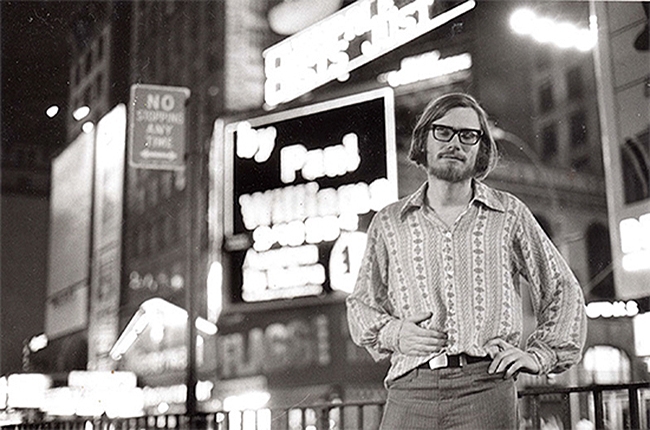
Tonight is the Lit Crawl, the final night of San Francisco’s annual festival of books, Litquake. For the occasion, I organized a tribute to writer Paul Williams who at age 17 founded Crawdaddy! the first national magazine of serious rock criticism. From John and Yoko’s bed-in for peace, to the back-to-the-land movement, and a literary association with Philip K. Dick, Williams wrote over 25 books on his travels through rock ‘n’roll and underground culture. The night’s offerings by, about, and inspired by Williams were prepared by Trina Robbins, Rudy Rucker, James Greene Jr., Ron Colone and Williams’ wife, Cindy Lee Berryhill, who (with the exception of Robbins) will be there to read them. The following is a repost of my remembrance of Paul Williams on the occasion of his passing on March 27, 2013, at the age of 64.
Crawdaddy! founder Paul Williams, widely considered to be the creator of modern rock’n’roll criticism, has died in Encinitas, California, following a long struggle with early onset dementia, the result of traumatic brain injury sustained following a bicycling accident in 1995.
In 1966, a 17-year-old Williams wrote, edited and distributed Crawdaddy! from his dorm room at Swarthmore College. As a young man at the epicenter of ‘60s music and movement, Williams had what is now recognized as incredible access as a journalist on the scene, whether taking calls from Bob Dylan, sitting in on a studio session and riding a plane with Jim Morrison and the Doors, partying with Beach Boy Brian Wilson, or running a gubernatorial campaign for Timothy Leary.
Here’s a clip of Paul with John Lennon and Yoko Ono at the celebrated Bed-in for Peace (he’s wearing a brown shirt, back-to-the-camera, front and center).
Williams had keen powers of observation and while his intellect was sharp, it was the emotional content of music that he attempted to unravel in his writing. Over time, Williams grew Crawdaddy! into a magazine with a circulation of 25,000—about the right size to serve his niche audience of music geeks, the diehards who lived the counterculture rock ‘n’ roll lifestyle. Williams, however, turned out to be more of a back-to-the-land guy. He left the city and turned over the magazine to capable hands while he pursued other roads—like a love of literary science fiction and tracing the evolving career of Bob Dylan as a live performer. Eventually becoming executor of the Philip K. Dick estate and editing a book of Theodore Sturgeon stories, the science fiction community also mourns the loss of Williams today.
In the ‘90s, Williams revived Crawdaddy! briefly as a newsletter; compiled by hand and from the heart, much the way he started it, his close-knit and handcrafted care contributed to Crawdaddy! maintaining its cachet through the years. It was in his middle period, of attending Bob Dylan concerts that I became acquainted with Williams while I was attempting to get my own career as a music writer up and running. He encouraged me to write my first book and introduced me to my first publisher. Williams was the closest person I had as a mentor among rock writers, though how I ended up writing for the online edition of Crawdaddy! from 2007-2011 was not related to our acquaintance. By that time, Williams had sold the rights to his magazine to an entity known as Wolfgang’s Vault and they hired me as a contributor there where it was my privilege to interview a crazy-long list of rock legends who gave me access largely based on the reputation of the magazine produced by Williams. Richie Havens, Yoko Ono, Van Dyke Parks, Eddie Kramer, Janis Ian, and John Sinclair, among others, all remembered howCrawdaddy! contributed to shaping the culture of music fan journalism, and all were happy to give back what Williams had so freely given to them with his magazine and with his words.
My interactions with Williams, a couple of handfuls of times over two decades, and just twice during his extended illness, were marked by a spark of familiarity—the kind that is shared by people who live and write inside the music, among a community of friends whose own lives are intertwined with art and music, the beauty of the everyday, and the struggle to survive it. Through the years, I closely observed Williams, watching as he maintained his dignity, despite the diminishing returns encountered by his rock writing. I noticed that he refused to compromise, that he did things for love instead of money, and admired that he remained a fan while maintaining his professional status on the inside track. As it turned out, taking a path like that is no way to make a living in the rock ‘n’ roll business, but it was a great way to live a rich life, full of love and friendship, full of writing, and full of rock’n’roll.
His passing last night comes as little surprise; the grieving process for family and friends had begun some years ago when Williams could no longer care for himself and became confined to an assisted living facility not far from the home he shared with his wife, singer-songwriter Cindy Lee Berryhill, and their son, Alexander. Last weekend in New York, Williams and his life’s work was celebrated at a one-day show of his manuscripts at the Boo-Hooray Gallery, organized by the Patti Smith Group’s Lenny Kaye. The intention of the exhibit was to shine a light on the vast literary contribution Williams made to rock journalism, science fiction, and to the study of Bob Dylan’s evolution as a performing artist in the late 20th Century.
Goodbye, Paul, with love and thanks to you for all you gave to the music, to the encouragement you gave to me as a writer, and with condolences to your friends, your sons, and your devoted wife, Cindy Lee.
Here’s a link to a piece I wrote about the love shared by Berryhill and Williams and how his longterm illness impacted and ultimately inspired her music. Some of text of this remembrance was borrowed from the piece that originally appeared in Crawdaddy! online in July 2011.
Marcus Books and its supporters won a small victory in the ongoing fight to save the store when this week, the San Francisco Board of Supervisors unanimously passed a resolution supporting the preservation of the historic building. In business for over 50 years, Marcus is America’s oldest black-owned bookstore and a San Francisco literary institution that’s hosted James Baldwin, Malcolm X, and Toni Morrison, among countless other writers and thinkers; it is a huge part of the City’s African American heritage. Before it became a bookstore, the Victorian building originally located on Post Street was home to Jimbo’s Bop City, the legendary Fillmore District club that staged Billie Holiday, Miles Davis, and John Coltrane, among other jazz giants. The resolution put forth by Supervisors London Breed and Malia Cohen, and supported by Supervisors of all districts, urges the new owners of the property to “uphold the building’s community serving purpose.”
At a rally and press conference Tuesday afternoon, hours before the resolution was passed, about 100 community and church leaders, as well as activists, artists and supporters gathered on the steps of City Hall (never mind the persistent sound of horns you will hear in this clip—in a separate but related issue, cab drivers were protesting the rogue transportation companies that have taken over the roadways in the face of SF’s latest tech boom).
“Tell everyone you know who loves truth and justice and tell them to get involved,” said Archibishop Franzo King of Saint John Coltrane African Orthodox Church. The Fillmore has historically been the scene of systematic removal of it residents, whether the internment of Japanese Americans in the ‘40s or the ‘50s and ‘60s relocation of its African American dwellers who were promised housing that never materialized. After a decades-long, so-called redevelopment project (which is now widely and finally acknowledged at the city government level as a failed undertaking), the Fillmore has rebuilt and rebooted more than once, but the well-documented exodus of middle to low-income people of color, and the working and artist classes from throughout San Francisco continues unabated. To state the plainly obvious, unlike buildings, people cannot be replaced.
“This isn’t just about the bookstore,” said Marcus Books owner Greg Johnson. “It’s about humanity.”
“This is about transfer of wealth, out of the hands of working class black folk…” said Rev. Arnold Townsend, Vice President of the local NAACP, at Tuesday’s press conference.
Most all of the speakers noted the persistent effort to save Marcus Books goes beyond highlighting the failing of brick and mortar book stores in the 21st Century; it touches realms of historical preservation of culture and ideas, and bores straight into matters regarding maintenance of a community hub. Literacy, education, and generally freely traded knowledge of self and others are also at stake.
“When we lose our artists, we lose our stories,” said Tony Robles of grassroots arts organization, POOR Magazine.
“I would not be where I am without this book store,” stated devorah major, author, educator, and a San Francisco poet laureate.
The Marcus situation is sadly indicative of the changing demographics of the so-called sanctuary City of St. Francis, “with its widely advertised liberal and cosmopolitan tradition.” But San Francisco’s track record with its African American population is not good, a contradiction that did not escape the notice of James Baldwin who participated in a film specially broadcast on public television station KQED in 1963. I recommend the entire series of clips that follow from Take This Hammer. And I especially commend San Francisco’s elected officials for taking the matter of Marcus Books and the larger problems it represents with the seriousness it demands.

 What was meant to be a short, between books project is now officially a new ebook, Shaman’s Blues. As an author from traditional publishing and as a person who spends much of her energy as a books advocate and activist, it’s a strange twist that my own title is available through that infamous bookstore-eating electronic channel. Let’s just say it’s an experiment for this writer and others like me: We’re in processing of discovering whether it’s possible to earn a living from our books instead of owing our publishers infinitely. Whether it’s possible to do that, as I’ve heard some writers have done, remains to be discovered. The good news in all this is a hardcover edition of the book will be available October 1 at independent booksellers and libraries (ordering details will appear here soon). And if you’re a traveler or fan of e-reading, Shaman’s Blues is available to you at no cost, beginning Friday August 22-Sunday August 24. For now, please visit the Blooming Twig/Sumach-Red blog for a taste of what you’ll find inside. And thanks for taking a chance on Shaman’s Blues.





 Denise Sullivan