April 18 marked the beginning of Beat poet Bob Kaufman’s centennial year, and San Francisco celebrated with three days of poetry, film and talks about the often overlooked but finally fully recognized artist. From about 1958-1986, he wrote poetry and made his home in the North Beach and Mission districts of San Francisco. He was a forceful presence on the scene, even as he had taken a vow of silence against the Vietnam War.
“He’s the quintessential representation of a San Francisco poet,” said San Francisco poet, Josiah Luis Alderete. In France, he was dubbed “The Black Rimbaud.”
For some time, it was hard to come by Kaufman’s slim volumes of poetry, but in 2019, City Lights Books published his first-ever collected works, with a forward by devorah major and edited by Neeli Cherkovski, Raymond Foye, and Tate Swindell. I wrote a long piece about him and his influence on modern day poets for the San Francisco Chronicle with more detail on his background and his surrealist’s eye.
A hundred years since he came into this world and nearly 40 since he left it, Kaufman’s poems against racism, injustice and war are as powerful now as they were then. San Francisco poet Kim Shuck said, “Bob Kaufman was so far and away the best…”
It takes an extraordinary effort to write a book and see it through to completion. That might seem like an obvious and plain thing to say, but it’s true: Though many folks like to think they can do it or try to, fewer actually do. Perhaps that is why publication day and month is most always a big deal for writers: Congratulations cards, flowers and gifts are in order! Short of those things, I’ve got a couple of articles I wrote about two very different writers with two very different books celebrating mutual publication dates to share with you.
“Sexy Life, Hello!” is the first book for Michelle Kircherer. Her debut novella is also the premiere release of her independent publishing venture, Banana Pitch Press. Kicherer is an ambitious performer, writing coach and instructor and has a big vision for her multimedia venture, without any of the yuckiness associated with the big three publishing houses. She will be reading from her book and discussing it at Green Apple on the Park in San Francisco on March 6 and at Clio’s in Oakland on March 8. You can read more about Michelle in my profile of her for the San Francisco Chronicle.
“The Mansion” (Gnashing Teeth Publishing) is the tenth collection of poems by Dee Allen. A performance poet, Dee has been writing and performing his work in San Francisco, Oakland and beyond for over 20 years. I had the good fortune to first hear him read in 2012, or maybe it was 2013 — at any rate, that was several books ago for Dee. I try never to miss his publications and readings, but they are coming so fast and furious, I accidentally skipped 2024’s collection “Discovery.” It’s time to catch up and that’s exactly what we’ll be doing during a live-streamed conversation from Bird and Beckett Books and Records on Sunday March 9 at 10 a.m. A sneak preview of what’s likely to come up is in this profile forBay City News, published today.
Congratulations to Michelle and Dee on their respective new publications. Though writing is its own reward, sometimes it helps to know there are those of us reading and appreciating the work, respecting what goes into the process and identifying with it. Thanks to this pair of authors for making our Bay Area literary community particularly unique, for making my job reporting on them easy, and for helping to keep the spirit of independent publishing alive in these unreal times.
Now that it’s September and the clouds here in San Francisco have cleared, I have some news to share: A new publication – the slim volume pictured above is on a new press – and it was made not only in memory of a movement hero, but in support of voting rights for all.
The story of Len Chandler is one of a path taken by chance. Among the countless singers, students and teachers from coast to coast who sat in, stood up and rode freedom’s highway for the voting rights of their fellow Americans in the Jim Crow South, Chandler had an extraordinary knack for topical songwriting and an unwavering dedication to racial justice. From his home in Akron, to the heart of the Greenwich Village folk scene, Chandler was introduced in short order to humorist Hugh Romney aka Wavy Gravy, poets Bob Kaufman and Langston Hughes, and folksingers Dave Van Ronk and Bob Dylan. Swiftly recruited by Pete Seeger to join the singing organizers with the Student Nonviolent Coordinating Committee, he was sent to Arkansas to register voters.
“You have to take the lead from somewhere and there were only a few performers around who wrote songs, and of them, my favorite was Len Chandler,” said Dylan. Compiled from rare interviews with Chandler by the author, Denise Sullivan’s concise tribute, Shadow Dream Chaser of Rainbows, pays homage to an unsung folk hero and provides instruction and inspiration for artists and activists pushing for change in perilous times.
This project has been long in the making: It started nearly 20 years ago when I embarked on the research for Keep on Pushing. It was resurrected when I was invited by the Bob Dylan Center to contribute an essay to a proposed catalog, and it was completed with the creation of a small press, Lyon Editions. Your purchase of Len Chandler: Shadow Dream Chaser of Rainbows will not only support its makers, it will contribute toward supporting voting rights and poll watching organizers, specifically in Georgia.
Rest assured Chandler is missed this election season, but let’s vote in his memory and in the memory of Medgar Evers, Viola Liuzzo, James Chaney, Andrew Goodman, Michael Schwerner, Martin Luther King, Jr. and others who lost their lives in the name of civil rights. A vote for Kamala Harris will see to it that the John R. Lewis Voting Rights Advancement Act is passed, ending voter suppression in all its forms, once and for all.
Thank you to our friends at Bird and Beckett Books and Records for the proper launch on August 28 as we commemorated 61 years since the March on Washington for Jobs and Freedom, and one year to the day of the passing of Chandler. Full book talk and discussion here. Purchase books here. Thank you.
As one who started writing about music for publication in high school and started working professionally as a columnist for a regional music paper before college graduation, some might say I’ve earned space to vent about the state of the music press. Lucky for all of us, Paul Gorman wrote Totally Wired! The Rise and Fall of the Music Press, so I didn’t have to. A well-considered overview of the 100-year-old music press, it’s almost the book I would’ve written (though without the British accent. I wouldn’t have confused Penelope Houston for Penelope Spheeris, though I probably would’ve confused every guy who wrote for Rolling Stone named David, so there’s that). Anyway, I loved the book and you can read more about Totally Wired in my latest column for Tourworthy. And if you want a little bit more about my life writing about rock, there’s this:
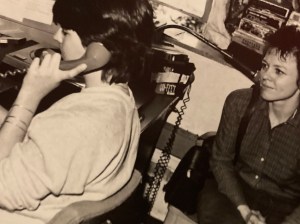
By the time I was writing full-time in the ‘90s, it was a good time to earn a dime by writing about music, on assignment and for hire, with or without a byline, and for cranking out content for the nascent Internet which had very little in the way of information on offer until we entered the data.
(Me getting it together while Laurie Anderson patiently looks on – photo by Bobby Castro)
I contributed to what was called the first online music magazine, Addicted to Noise (consult the Wayback Machine) and the reboot of Crawdaddy! and newsstand magazines like Paste, Harp, Ray Gun, Q, MOJO, and others I care not to name. Digital back issues are hard to come by with rights having been bought, sold, and rendered inaccessible by the general public. Every few years I write a plea like this, hoping a tech savvy reader will lend a sister a hand and free my digital archives (no such luck). If a print edition existed, I have at least one copy archived (in case anyone is seeking material for a time capsule or a bonfire).
Even without digital evidence of my work, I continue to gather knowledge, form wild opinions and indulge in some meandering riffs, online and in print. I’ve written on jazz and blues, punk and hip hop, and all forms of arts and culture. But my interest in rock has waned, considerably, and perhaps understandably given its late stage decline (see: latest works by the AI-assisted Beatles and the ungodly Rolling Stones). I am rarely surprised when I hear the music business or the publishing trade being cited for racism, sexism and homophobia, or when artists and writers claim victimization (I often cover these angles in my occasional Soundinista columns). The latest case of the Go-Go’s co-founder Jane Wiedlin and several more women accusing DJ Rodney Bingenheimer of sexually assaulting them when they were teenagers at his underage disco is disturbing and heartbreaking (though for those of us paying attention, not entirely unexpected).
Sometimes it’s unclear to me what I would do if I could ascertain whether rock ‘n’ roll never forgets or rock ‘n’ roll always forgets; whether time waits for no one, if I could turn back time or if time has told me. I do know at one time I loved rock ‘n’ roll and everything about it — the way it sounded, its hair and its clothes. The music imprinted my soul, provided sanctuary and inspiration, gave me a lifetime of listening and a wide, now small, circle of friends. Yes, I’m certain that’s all true and yet, these are the good times.
It feels like something changed this Fourth of July: On the morning of the fifth, I woke up to one radio report after another in which people, ordinary American citizens, were expressing their disbelief, distress and general fatigue at being sold a story about our country’s origins that doesn’t quite add up to the truth. This, it would seem, is a good thing: More and more people have woken up to the idea that all is not well with us, that their children have been and continue to be misled and are ill-prepared for the future. To prevent further erosion to our democracy, our planet, and life at large, it’s time for all of us to participate in some form of direct action. At least that’s my interpretation of things on the morning after a restless night of listening to cherry bombs bursting in air, for the sake of our freedoms.
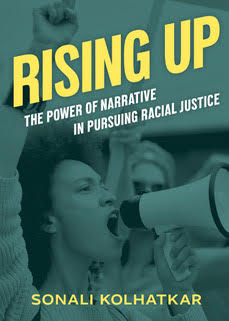
But despite sustained political efforts to constrict our liberties and suppress the truth of the United States’ origins (as in the current opposition to teaching critical race theory and the trend toward banning books and criminalizing the teaching of history) there are other ways to forge change to a tired old story. In Rising Up: The Power of Narrative in Pursuing Racial Justice, Sonali Kolhatkar has constructed a guide to the ways in which we can all participate in a sea change by becoming better consumers of the media and resisting the stories we are told. She offers tools for more critical thinking, productive discussion and ways to create empathy as opposed to enmity. As racial justice editor of Yes! magazine and host of Pacifica Radio’s Rising Up With Sonali, Kolhatkar is a solutions-oriented journalist, focused on progress rather than problems. I have long been a fan of her broadcasts and was delighted to talk to her more about the pursuit of racial justice.
My full interview with Kolhatkar appears in Bay City News/Local News Matters. For now, free speech and a free press remain among the cornerstones to democratic society. I hope you’ll take a moment to read the profile and support independent voices inside and outside the media.
The stats are in: 66 songs, 110 writers, four songs performed by women and seven written by them. The woman pictured between Little Richard and Eddie Cochran is Alis Lesley, an obscure pioneer of rock ‘n’ roll. Nicknamed “The Female Elvis Presley,” she recorded one single and left the business before ever getting started. Lesley is a footnote in rock history and a link in the chain of so many women before, and thousands more after, who helped shape modern song as we know it today.
But this is not a further critique of the exclusion of women in Bob Dylan’s The Philosophy of Modern Song: you may read my review and plenty more elsewhere (though they don’t get much better than this one). In fact, in the best case scenario, the book’s omission of women is an invitation to further exploration – an opportunity to learn more about say, Sharon Sheeley, Cochran’s occasional co-writer and girlfriend and the youngest woman to reach the top of the charts with “Poor Little Fool,” the song she wrote for Ricky Nelson. But I’m not so sure it’s that simple. Or complicated…
“It seems reasonable to hope that an artist of Dylan’s magnitude would publish words in solidarity with half of humankind in this critical hour of rights rescinded, rather, he chooses demeaning stereotypes,” I wrote in the San Francisco Chronicle. “There are also several admonishments on “political correctness” that, given the current moment of extreme polarization, are disappointing, especially coming from an artist who is known for his care with language.”
There is hardly anything that bothers me more than a missed opportunity: A book publishing in yet another long, wintry season in America could’ve served as a chance to lift up women when we really need some light – allies, friends and champions. What we want are equal rights and justice. What we need is for men to stand with us. What this woman can’t use are more vulgar characterizations, slights and crude names leveled at us – whether in the name of art or satire. The world is cruel enough. Yes, for the historical record, there have been many demeaning names for women, and Dylan chose to use as many as could be called to mind. He did not choose to do the same with racist epithets throughout the book.
“As a people, we tend to feel very proud of ourselves because of democracy,” writes Dylan in his essay on the song, “War,” one of the book’s central pieces. “We walk into that booth and cast our votes and wear that that adhesive “I Voted” sticker as if it is a badge of honor. But the truth is more complex. We have as much responsibility coming out of the booth as going in.”
Dylan is writing here about voters electing officials who will wage peace instead of war. Much of the content of the passage regarding personal responsibility for war echoes the old song “Universal Soldier,” written by Buffy Sainte-Marie. There is no mistaking Dylan’s point of view: He’s taking a clear stance on a divisive issue as old as time. My sadness, on this election day in the US, is that he didn’t make a similarly clear, simple and strong statement toward a collective responsibility to women and our never ending war with an unjust system.
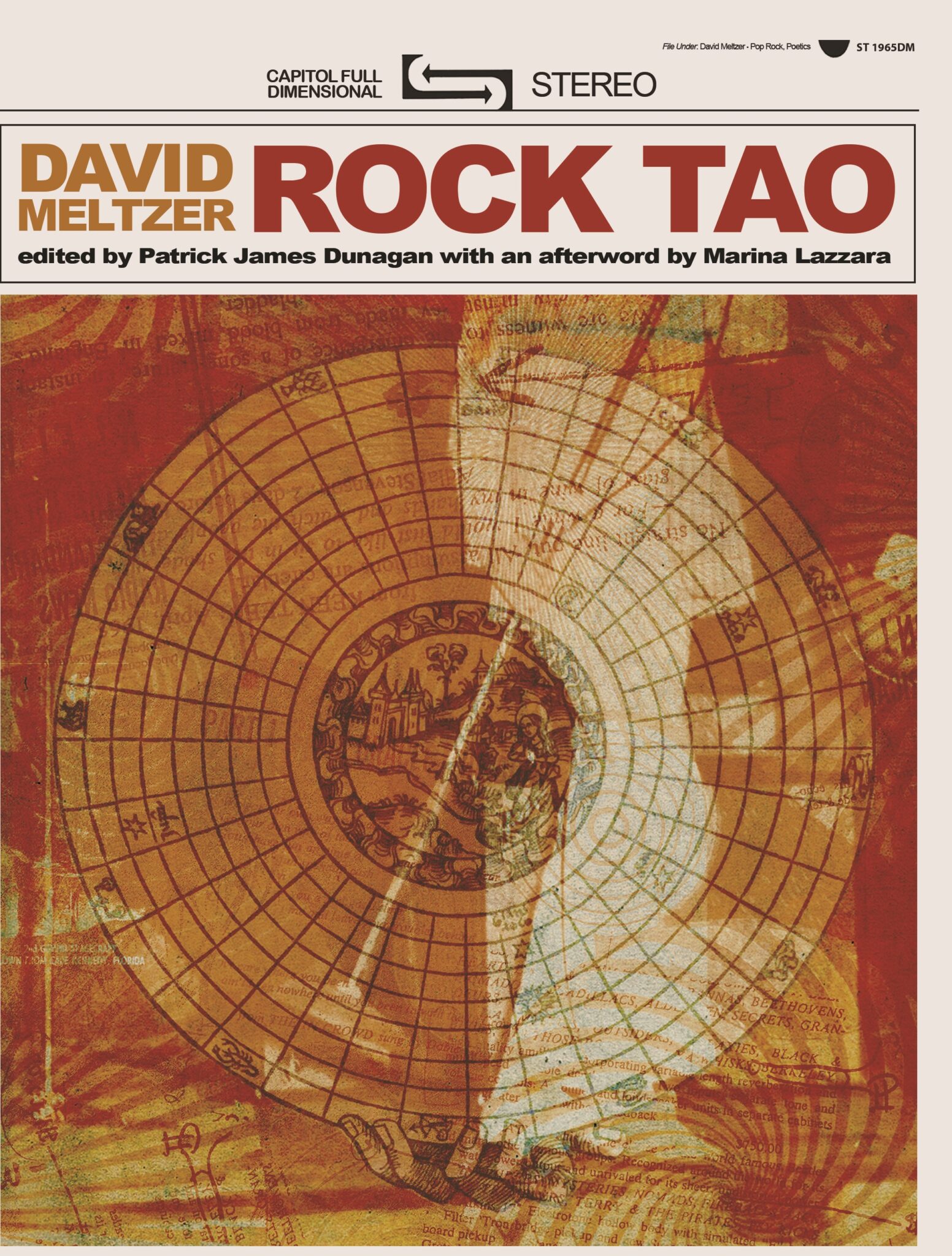
“If the Tao is a way of doing something in concert with its essential nature, David Meltzer’s ‘Rock Tao,’ a relic from the 1960s published for the first time this year by Lithic Press, is an aptly named guide. It’s a book as mysterious, ageless and full of contradiction as rock music itself.
Presented on the page as a textual collage in six parts, Meltzer alternates quotations from the I Ching with Greek philosophy and lyrics by the Supremes. He expounds on the teen appeal of the Beatles and the Rolling Stones, and touches on the artistry of Sam Cooke and showmanship of James Brown, among others. Weaving in and out of the music with scene-changing headlines, Meltzer chronicles, annotates, observes and critiques his times in “Rock Tao,” providing a portal into the mind of an insider.” Read the full story, my latest for Datebook in the San Francisco Chronicle
“My poems are a product of a complete life of resistance,” said Tongo Eisen-Martin when I interviewed him for the San Francisco Examiner in 2018. On Friday, the San Francisco-born movement worker, educator and poet was named the city’s Eighth Poet Laureate.
With the civic appointment and as author of (the award-winning) “Heaven Is All Goodbyes,” No. 61 in the prestigious City Lights Books “Pocket Poets Series” — which includes “Howl and Other Poems” by Allen Ginsberg and “Lunch Poems” by Frank O’Hara — Eisen-Martin is receiving the kind of recognition it often takes poets a lifetime to achieve. Yet, he is exceedingly humble, his head in his work as a social and racial justice teacher, and his eyes on the prize.
“The best reality for me is the reality that’s better for everybody,” he said, his extra-tall self contained in what looks to be a chair too tiny for him in the back of a Mission District bookstore. “If not that, I’m deluding myself and not living the ideas I’m championing in my poems.
This week, and what a week it was, I’m pleased to introduce you to several writers living and working in San Francisco, all of them striving
Poet and activist Thea Matthews in the Mission District on Wednesday, June 3, 2020. (Kevin N. Hume/S.F. Examiner)
toward a more just and equitable society in their own unique ways. First, poet and activist Thea Matthews is a San Francisco born and raised writer, celebrating the publication of her first poetry collection for a local press. She’s also deeply involved and on the frontlines of the Movement 4 Black Lives. Read more about where she’s been and where she’s going in this week’s San Francisco Examiner column, SFLives.
Also publishing today, a story I was reporting on and off for about five months on the Writers Grotto, a community of authors who found they needed to recreate their organization so that it would be more inviting to writers of color. You can read the full story in today’s San Francisco Chronicle Datebook (and one day, I promise to a write story about the process of reporting it).
I love my work, seeking out the stories on the lives of the people and places that show San Francisco at its best. What a privilege it is to be trusted to tell these stories and deliver them to you, especially in these times. As ever, I thank you for taking the time to read and I bid the best to you and your families as the pandemic runs its course. May the moral arc of the universe continue its bend toward justice.








 “My poems are a product of a complete life of resistance,” said Tongo Eisen-Martin when I interviewed him for the San Francisco Examiner in 2018. On Friday, the San Francisco-born movement worker, educator and poet was named the city’s Eighth Poet Laureate.
With the civic appointment and as author of (the award-winning) “Heaven Is All Goodbyes,” No. 61 in the prestigious City Lights Books “Pocket Poets Series” — which includes “Howl and Other Poems” by Allen Ginsberg and “Lunch Poems” by Frank O’Hara — Eisen-Martin is receiving the kind of recognition it often takes poets a lifetime to achieve. Yet, he is exceedingly humble, his head in his work as a social and racial justice teacher, and his eyes on the prize.
“The best reality for me is the reality that’s better for everybody,” he said, his extra-tall self contained in what looks to be a chair too tiny for him in the back of a Mission District bookstore. “If not that, I’m deluding myself and not living the ideas I’m championing in my poems.
“My poems are a product of a complete life of resistance,” said Tongo Eisen-Martin when I interviewed him for the San Francisco Examiner in 2018. On Friday, the San Francisco-born movement worker, educator and poet was named the city’s Eighth Poet Laureate.
With the civic appointment and as author of (the award-winning) “Heaven Is All Goodbyes,” No. 61 in the prestigious City Lights Books “Pocket Poets Series” — which includes “Howl and Other Poems” by Allen Ginsberg and “Lunch Poems” by Frank O’Hara — Eisen-Martin is receiving the kind of recognition it often takes poets a lifetime to achieve. Yet, he is exceedingly humble, his head in his work as a social and racial justice teacher, and his eyes on the prize.
“The best reality for me is the reality that’s better for everybody,” he said, his extra-tall self contained in what looks to be a chair too tiny for him in the back of a Mission District bookstore. “If not that, I’m deluding myself and not living the ideas I’m championing in my poems.

 Denise Sullivan