Denise Sullivan

Author, Arts & Cultural Reporter and Worker

Lives and loves: Patti Smith and Robert Mapplethorpe

“He wrote me a note to say we would make art together, and we would make it with or without the rest of the world,” writes Patti Smith of Robert Mapplethorpe in Just Kids, her memoir of their lives and great love. Concerning their time as young artists discovering New York City and themselves in the late ‘60s and early ‘70s, not only would both of them make art together, they would eventually become nothing short of internationally recognized, particularly among artists, freethinkers, and members of their blank generation. But while Mapplethorpe’s life was cut short by AIDS in 1989, Smith lived on to keep the fire of rock’s poetic origins alight, Mapplethorpe’s influence on her inseparable from the origin of inspiration in her art and life.  Without his prodding—his love—it’s quite possible that an entirely different Patti Smith than the one we know would have emerged. In Just Kids, Smith reveals Mapplethorpe’s commitment to art, his companionship, and his collaboration in the years leading up to her debut album Horses was invaluable to its creation: Not only did he capture the image of the poet/rock star-to-be on its cover, but it was he who first encouraged her to sing.

Produced (reportedly with some difficulty) by John Cale and performed by the Patti Smith Group (with songs written mostly by Smith and co-writers Tom Verlaine, Allen Lanier, and members of her group, specifically Lenny Kaye), Horses launched at least a hundred punk bands, if not a generation of kids with punk attitude, and it remains fully alive today. Infused with the spirit of Smith’s dead poet/rock ‘n’ roll heroes—particularly Arthur Rimbaud, the libertine poet whose spirit she’s kept moving through rock ‘n’ roll—the first word of the first song is “Jesus,” as Smith cleverly fuses her own invocation to Van Morrison, proclaiming rock ‘n’ roll “Gloria: In Excelsis Deo.” Whether intertwined with the Catholicism of Mapplethorpe’s youth or with Rimbaud’s travels to Ethiopia and his relationship to Rastafari, Smith made bold statements, particularly for a young woman who claimed to be shy by nature; she summoned the spirits of two men named James (Hendrix and Morrison) with three Bobs (Marley, Dylan, and Neuwirth) or four if you count Mapplethorpe, and her own strong desire to merge poetry with performing rock ‘n’ roll.

“I felt, watching Jim Morrison, that I could do that. I can’t say why I thought this… yet, I harbored that conceit,” she writes in Just Kids. Her connection with Hendrix was slightly more intimate: She was invited to the opening of his recording studio, Electric Lady. “I was excited to go. I put on my straw hat and walked downtown, but when I got there, I couldn’t bring myself to go in,” she writes. “By chance, Jimi Hendrix came up the stairs and found me sitting there like some hick wallflower and grinned.” He talked to Patti, revealing that he didn’t like parties either. “He spent a little time with me on the stairs and told me his vision of what he wanted to do with the studio. He dreamed of amassing musicians from all over the world in Woodstock and they would sit in a field in a circle and play and play… Eventually, they would record this abstract universal language of music in his new studio. ‘The language of peace. You dig?’ I did.” And then he was off, to catch a plane to England, from which he never returned. Smith read the news of his death about a month later while on a trip to Paris—on one of her rare respites from her gigs as a bookstore clerk/rough living artist/caretaker of Robert.

In New York, she happened to meet singer-songwriter and painter Bob Neuwirth in a coffee shop (she recognized him from the Dylan documentary, Don’t Look Back), and becomes just a little more inspired to try her hand at turning her poems into songs. “Next time I see you I want a song out of you,’ he said as we exited the bar,” she writes. But when she reports to Mapplethorpe of meeting Neuwirth, the photographer snaps back, “Maybe he’ll be the one to get you to sing, but always remember who wanted you to sing first.” Mapplethorpe doesn’t approve of Smith’s Marley-inspired pot smoking either, but the pair go on to spark up some sacred herb together, in the name of enhancing creativity.

Trying on her voice, reading her poetry aloud, Smith dove into performance mostly without Robert’s help, as he was moving deeper into the world of street hustling (this time it’s Patti who is disapproving). She reads for unappreciative fans of the New York Dolls and gets heckled by drunks before finding her sea legs and accompanists—first guitarist Lenny Kaye, and then Richard Sohl on piano. But when it’s time to record a single, it’s Robert who pays for the studio time at Electric Lady. For the recording, they choose “Hey Joe”, a song made famous by Hendrix. While Jimi closed his set at Woodstock with it, Smith and co. use it to usher in the era of the punk rock seven-inch. Recording at Jimi’s place, “I felt a real sense of duty,” she told the Observer in 2005. “I was very conscious that I was getting to do something that he didn’t.” Though Horses’ de facto title track “Land” was famously inspired by William Burroughs’ The Wild Boys, the lesser-acknowledged last third—“La Mer (de)”—makes reference to Jimi (“In the sheets there was a man”), as well as Rimbaud. “Elegie”, the final song on Horses, is also for Hendrix: It was recorded on September 18th, the anniversary of his death. “I think it’s sad, just too bad, that all our friends can’t be with us today,” she wrote, the words closely echoing those from Jimi’s “Well, it’s too bad that our friends can’t be with us today,” from  “1983… (A Merman I Should Turn to Be)” from Electric Ladyland. As for fellow inspirer and rock star ghost Jim Morrison, “Break It Up” was based on a dream Smith had about him covered in plaster—like a statue.
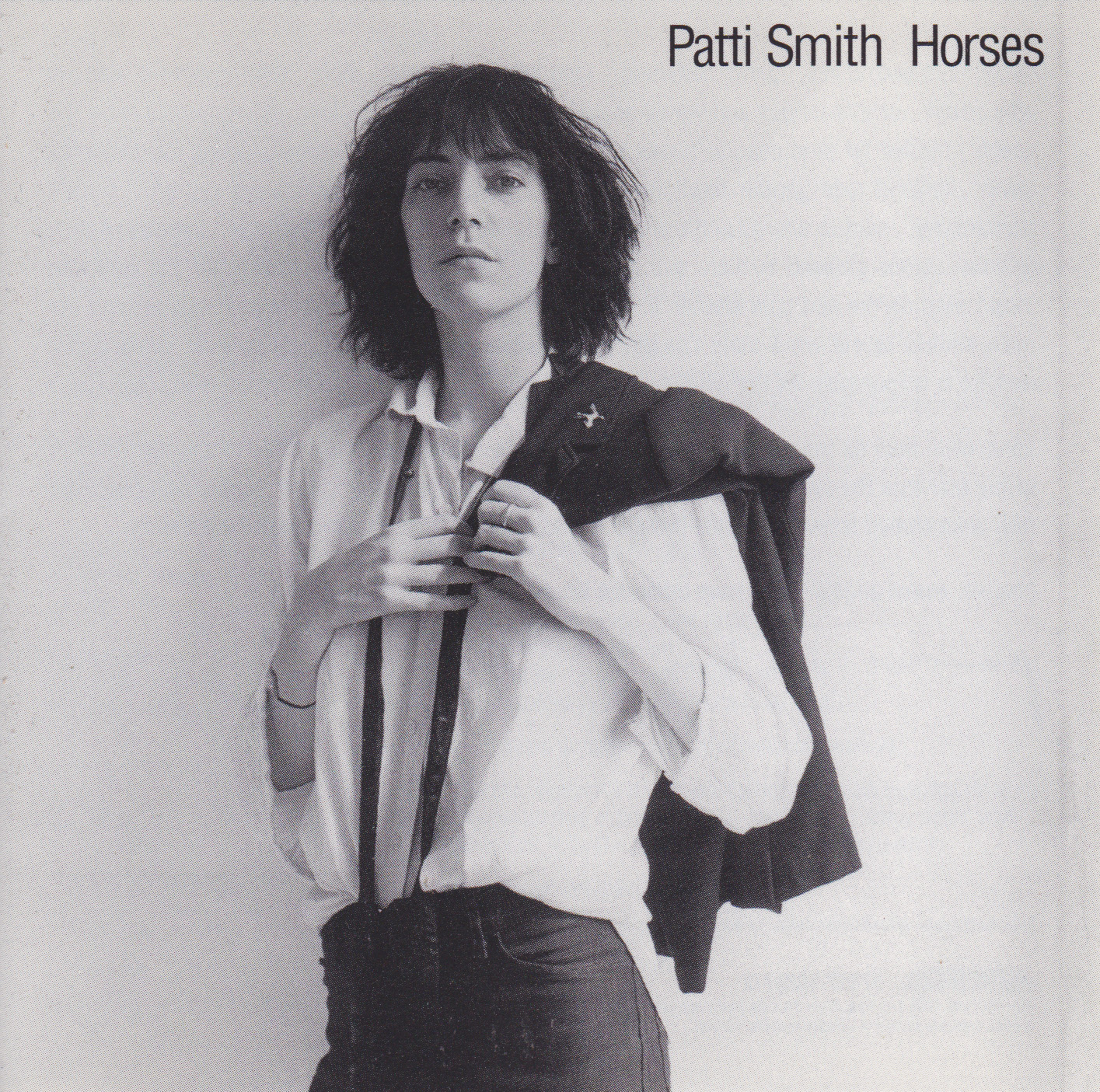
Patti Smith - HorsesThe making of Smith’s own image as a rock star poet was yet another Mapplethorpe collaboration. “You should take your own photographs,” she once told him, and eventually he turned his attention away from jewelry, objects, and installations and towards photography. For the Horses cover Mapplethorpe knew exactly what he wanted, and so did Smith: “I flung the jacket over my shoulder, Frank Sinatra style; I was full of references,” she writes. Though still developing as a photographer, Mapplethorpe was clear that he would work only in shades of black and white. Illuminated only by natural light, he got the image of Patti in 12 shots.

“Patti, you got famous before me,” said Mapplethrope in 1978 as he and Smith walked the streets of Greenwich Village. “Because the Night”, the song Smith wrote with Bruce Springsteen, blared from a series of storefront radios, “fulfilling Robert’s dream that I would one day have a hit record,” Smith writes. The song rose to lucky 13 on the pop charts, but Smith was burning out on the biz before she’d barely gotten stared in it. Following the recording of the album Wave, produced by her friend Todd Rundgren and again cover photographed by Mapplethorpe, she retreated from New York and rock to live as a wife and mother in Detroit, where her husband, Fred “Sonic” Smith of the MC5, hailed. But the hiatus didn’t really take, and by 1986, she was ready to make a comeback. With the encouragement of her husband, she called her old friend Robert to see if he would shoot a portrait for the album, Dream of Life; Mapplethorpe, who had become a major art star in the interim, took the photo of Patti as a 40th birthday gift. But the reunion between artists was fated to be brief, and the sessions that took place yielded some of his final photos.

Mapplethorpe’s patron and partner Sam Wagstaff succumbed to AIDS during the making of the album (Smith and Smith recorded “Paths That Cross” in Wagstaff’s memory). She had sung “The Jackson Song” (for the Smiths’ son) in which Mapplethorpe is also referenced (“little blue star that offers light”) to Wagstaff as a lullaby in his final days. Recording for Dream of Life continued, and she wrote “Wild Leaves” for Robert on the occasion of his 41st birthday. Somewhere in this mix, Smith and Smith also penned an enduring protest anthem, “People Have the Power”—the kind of song people sing when they need to raise a little spirit to keep on keeping on. Dream of Life was finally released in June of 1988, 10 years after the success of “Because the Night.” Mapplethorpe died in March of 1989, and Smith wrote “Memorial Tribute” (“little emerald soul, little emerald eye”) for him (it appears on the 1993 No Alternative AIDS awareness compilation).

In 1994, Fred “Sonic” Smith died, followed by the death of Patti Smith’s brother Todd and her bandmate Richard Sohl. Soon to turn 50, she returned to Electric Lady for the recording of the 1996 album Gone Again, a tribute to her dead friends and loved ones. Kurt Cobain was mourned (“About a Boy”) and soon to be gone Jeff Buckley sang on “Beneath the Southern Cross”, a song that survives as part of the Patti Smith Group’s concert repertoire. Following an eight year gap after Dream of LifeGone Again, recorded in Fred’s memory, proved to be Smith’s real comeback. Now without Fred or Robert, she was supported as ever by guitarist Lenny Kaye and by new friend Oliver Ray, a young poet and guitarist who joined her band and photographed her. Michael Stipe (who had been inspired to become an artist himself upon hearing Horses) was also on board as a road friend when Bob Dylan invited her to tour with him. Back on the swing shift as a musician, there was no time to write the book she promised Robert on the day before he died that she would one day write.

In 2010, 35 years after its debut,  Horses was added to the National Recording Registry of the Library of Congress, archived for posterity alongside sonic artifacts by Little Richard, Willie Nelson, and Ethel Merman. That same year, Just Kids won the National Book Award. Moved to tears as she accepted the honor, Smith recalled what it was like to work as a bookstore clerk, dreaming of what it might feel like to author a book with the award-winning seal one day. “Thanks for letting me know,” she said by way of acceptance. For the reader, Just Kids is the kind of book that serves not only as a history of a bygone age or a how-to as an artist, but as inspirational literature. It is a reminder that we are all members of the human family and artists of the everyday. If we are lucky, we have friends, relatives, and inspirers, our own set of losses, and our own unique memories, as well as a collective conscience from which we draw. There are dreams to be accessed and visions to fulfill, all day, everyday, whether through words, music, pictures, or the creation of an artful life. As Allen Ginsberg told Patti upon the occasion of the death of Fred “Sonic” Smith:  “Let go of the spirit of the departed and continue your life’s celebration.”

While Mapplethorpe depicted dark against light—and vice versa, his increasingly sexually explicit images landed him in much hot water. But there is something innocent in his early photograph of Smith that portends more about the new wave of rocker than words could have ever described at the time: Smith is an original and reverent, androgynous yet vulnerable, regular but inscrutable. Mapplethorpe’s true image of her on Horses ripples through the contemporary persona who conducted the interviews for Just Kids: Patti Smith in black and white has her humble and “bravada” sides; the disheveled waif converges with the mensch in designer clothes. Open but reserved, she is a wizened poet who’s still girlish, gangly, and awkward—and still very much in love with art and life.

http://www.youtube.com/watch?v=c3coSfks4rQ


Filed under: Bob Dylan, Bob Marley, Origin of Song, Poetry, Punk, Reggae, , , , , , ,

Keep on Pushing (Again)

Everybody’s humming “Keep On Pushing” again, thanks to it being the soundtrack to a new ad, but there are a few details that even LeBron’s smart phone doesn’t know about the wonderful song that also stands in for the title of my book concerning political movement and music.

http://www.youtube.com/watch?v=Ie0mAnjz1Oc

Among the  young songwriters who knew the power of an anthem and made the Freedom Movement swing was Curtis Mayfield of Chicago. Just 17 and straight out of the Cabrini-Green housing projects when he hit it big with “Your Precious Love,” recorded by his vocal group the Impressions, Mayfield was a highly conscious, conscientious, and musicially gifted individual. By the early ‘60s he had already sustained the departure of his childhood gospel choir buddy, Jerry Butler, from the group and was leading Samual Goodens and Fred Cash on his own as he became a formidable writer of inspirational R&B hits.

The Impressions captured the ephermeral spirit of gospel’s lift and married it to Mayfield’s layered melodies with a message. In 1964 Mayfield came up with the black-powered “Keep on Pushing,” its sentiment and language  borrowed from a gospel groove and easily adapted to the civil rights cause:  “Hallelujah, hallelujah, keep on pushing.”  “Keep on Pushing” was in perfect synch with Dr. King and the march forward; it has been characterized as one of the movement’s unofficial anthems.  “Move up a little higher,” “I’ve got my strength,” “keep on pushing,” all phrases from the song, also borrowed from gospel’s language and its inspirational intent.  These were elements that never strayed far from Mayfield’s consciousness, and combined with the melodious strains to which he set his words, he could disguise the tougher sentiments by weaving them into the complex harmonies, while never losing the threads.  As time went on, Mayfield became more direct lyrically, but these early works were foundational to setting soul music in its new direction while they also passed in the mainstream.

The Impressions album Keep on Pushing was a Top 10 hit, making its impression on the masses as well as on two major 20th Century songwriters:  images-1Bob Marley had begun performing with his vocal group the Wailers in Kingston Jamaica, as if they were their country’s answer to the Impressions.  “Amen” and “I Made a Mistake” from Keep on Pushing were an important part of their early repertoire.  In 1965, Bob Dylan featured a picture of Keep on Pushing on the cover of his own album, Bringing It All Back Home.  That same year, the Impressions hit again with “People Get Ready,” a song Mayfield was first inspired to get busy on following the March on Washington; it ultimately became the song for which he would be best known.  “When humans from all walks of life can experience a piece of music and feel the same way—that’s soul,”  he once said.  Fifty years later, “People Get Ready” and “Keep on Pushing” are still turning heads and inspiring people to singalong, though sadly Mayfield is gone.  Following a distinguished career as a groundbreaking solo recording artist and performer, Mayfield became paralyzed as a consequence of an in-concert accident (a lighting rig fell on him). He still wrote, but didn’t perform; he died the day after Christmas in 1999 of complications from diabetes.

You can read more on Curtis Mayfield and “Keep on Pushing” in Keep on Pushing. And next time you see that LeBron spot, I hope you enjoy the Curtis song just a little bit more.

Amoeblog: There’s a lot of “Keep On Pushing” titled songs. Which one were you thinking of when you titled your book?

Denise Sullivan: I was thinking of the original song by the Impressions, written by Curtis Mayfield and the way “keep on pushing,” and “move up a little higher” reoccur in his other songs, like “We’re a Winner” and “Move on Up.” Mayfield isn’t talking about the ladder of success and financial status. He’s talking about raising consciousness and about transcendence–about moving above and beyond circumstances. Combine those themes that are of deep interest to me with the genius of his composition and you get a title that I hope conveys the potential for extreme unity, between message, music and people.

http://www.youtube.com/watch?v=VrqJphU-1cI

Filed under: Bob Dylan, Bob Marley, Civil Rights, Curtis Mayfield, Keep On Pushing, , ,

Hail to the Yeah: Obama Prevails

November 5, final campaign stop, Columbus, OH.

“Don’t believe the media. I think it’s going to be a landslide,” said Bob Dylan from the stage on election eve in Madison, WI.

The President and the Boss also put in a Madison appearance earlier in the day.


Filed under: Bob Dylan, Concerts, , , , , ,

When Record Store Day Meets Earth Day, it’s time for The Esso Trinidad Steel Band

In honor of this weekend’s most auspicious collision of Record Store Day and Earth Day,  Saturday and Sunday respectively, I decided to reprise a story about where environmentalism meets record collecting, which as it happens is also the most-read article here at denisesullivan.com.  The Day Van Dyke Parks Went Calypso, originally appeared in the pages of Crawdaddy! in 2009, 40 years after the Santa Barbara oil spill and the birth of the environmental movement, and upon the occasion of the  re-reissue of Parks’ long out-of-print productions for calypso artists, the Esso Trinidad Steel Band, and the Mighty Sparrow. Parks had a goal and an idea ahead of its time: To forge environmental healing through music made by instruments made of cast-off oil drums. The story further explains one man’s adventures in art and activism and begins after the clip below: Taken from a documentary on the Esso Trinidad Steel Band,you won’t find the rest of the film on youtube, though you will find it with the reissued Esso, available at your local record store.

When 80,000 barrels of oil spilled into the waters of the Santa Barbara Channel in January of 1969, the crude-splattered water, beaches, and birds along the California coast in its aftermath became the symbols of modern eco-disaster. While the ensuing public outcry helped hasten the formalization of the environmental movement as we now know it, for musician Van Dyke Parks, the spill and “the revelation of ecology,” as he calls it, was a very personal, life-altering occasion. “It changed my M.O. and changed my very reason for being,” he says. The Union Oil rig rupture in Santa Barbara made Parks go calypso.

“When I saw the Esso Trinidad Steel band, I saw myself in a Trojan Horse,” he says. “We were going to expose the oil industry. That’s what my agenda was. I felt it was absolutely essential.” From 1970 to 1975, Parks waged awareness of environmental and race matters through the music and culture of the West Indies, though in the end, “You don’t know whether to laugh or cry. That’s what makes Van Gogh go,” he says, “That’s what great art does.” Though Parks is referring directly to Esso Trinidad’s happy/sad steel drum sounds, he could just as easily be talking about his own experience during his Calypso Years.

Over a five-year period, Parks produced albums by the Esso Trinidad Steel band (1971) and Bob Dylan favorite, the Mighty Sparrow (Hot and Sweet, 1974); he also recorded his own calypso-inspired works, Discover America (1972) and Clang of the Yankee Reaper (1976). Born from his passion for popular song and launched at a time when grassroots protest was at an all-time high, Parks had every reason to believe calypso consciousness would prevail. But he hadn’t factored in the complications of taking on big oil, nor of touring the US with a 28-man steel drum corps from the Caribbean. He was unable to predict that the sessions with Mighty Sparrow would be fraught with rage, and that his efforts would earn him the enmity of Bob Marley, whose production requests he ignored in favor of calypso. And yet, you get the feeling he’d agree in one hot minute to do it all over again the exact same way if given a chance to revisit this section of his checkered recording history.  Read the rest of this entry »

Filed under: Bob Dylan, Bob Marley, Calypso, cross cultural musical experimentation, Harry Belafonte, Interview, , ,

The Ballad of Trayvon Martin

The story of 15-year-old Emmett Till of Chicago, murdered while on summer vacation in Money, Mississippi, was among the events in the mid-‘50s that mobilized the Civil Rights Movement; the tragedy was chronicled by Bob Dylan in one of his earliest songs. This clip contains a bit of background as well as the audio of the song which tells the story.

Oddly, I had long been holding tickets to attend a staged reading this week of Ifa Bayeza’s play, The Ballad of Emmett Till, in which the scene above with Mose Wright is recreated, as is mother Mamie Till’s testimony. The script was beautifully written and the acting superb, especially by Lorenz Arnell who played Till.  But I had a difficult time sitting through the show, in light of the recent events in the Sunshine State, and the information that continues to surface following the death of 17-year-old Trayvon Martin.

Today, as people gather in Union Square in New York City to protest the racially motivated killing of the young man in Sanford, Florida on February 26, his assailant has not yet been arrested or charged.  The rally is intended not only to shine a light on injustice—Martin’s murder was clearly a hate crime and needs to be treated with the kind of seriousness that an offense like that demands—but a plea to end the practice of racial profiling.

It’s been fifty years since Dylan sang his song about Emmett Till and it is unthinkable that it should have to be reprised as a mourning song anymore, except to be used as a history lesson. I encourage people unfamiliar with the Trayvon Martin case to read up on it and to listen to Dylan’s song. I hope that all of us will think of Martin and his family, and think of Emmett Till and his kin, and of all the Trayvon Martins and would-be Emmett Tills out there. And if there’s a freedom singer in the town square, maybe he or she will sing these verses loud, so everyone can hear them, all over this land, once and for all.

If you can’t speak out against this kind of thing, a crime that’s so unjust

Your eyes are filled with dead men’s dirt, your mind is filled with dust…

…But if all us folks that thinks alike, if we gave all we could give

We could make this great land of ours a greater place to live.

Read more on “The Death of Emmett Till” in Keep on Pushing 


Filed under: Bob Dylan, Folk, Hip Hop, , , , , ,

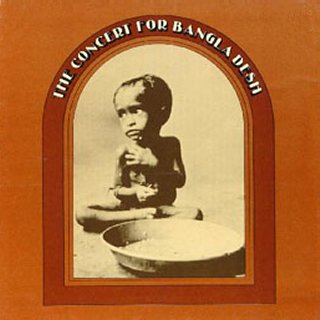
The Concert For Bangladesh

Forty years ago this August, George Harrison and his musical mentor Ravi Shankar organized the mother of all benefits with an all-star line-up: The Concert for Bangladesh at Madison Square Garden. Reeling from one of the world’s worst cyclones on record, refugees from East Pakistan (Bangladesh)—engaged in a liberation struggle from West Pakistan—flooded Shankar’s native Bengal region in India, a land still compromised from the great migration during Partition in 1947. Harrison heard his friend’s plea,and though he had no previous organizational experience he called on friends Bob Dylan, Eric Clapton, Leon Russell and Ringo Starr. Dylan, making his first public appearance in two years, chipped in “A Hard Rain’s A-Gonna Fall” and “Blowin’ in the Wind.” Harrison offered up “Here Comes the Sun” along with “Bangla Desh,” composed for the cause. Bangladesh set a precedent for immediate, organized concert charity in the name of tragedy and political strife, gathering the biggest names in music in the effort to preserve humanity.

The concert is streaming for free this weekend on  iTunes in honor of the 40th anniversary, while musicians have united with UNICEF in their Month of Giving to  bring relief to the children in the Horn of Africa, currently impacted by drought and famine.

Read more on the Concert for Bangladesh and the history of charitable music concerts in Keep on Pushing.

Filed under: Bob Dylan, Concerts, , ,

“George Jackson” and “Hurricane”

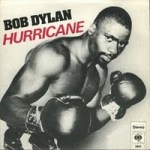
Bob Dylan’s relationship to the political world and the matters he chooses to champion or protest have been the subject of much debate, discussion, and inspiration for 50 years now. His arrival in Greenwich Village in 1961, to a scene that was informed equally by poetry and politics as it was jazz and folk, marked the beginning of his journey with topical song, to be followed by his famous retreat from it, as well as from those looking to pin a generational voice or spokesman tag on him. And yet, as the ‘70s began, Dylan was back on topic, returning to his roots as a social justice singer with “George Jackson”, a memorial for the radicalized convict and Black Panther who died in a San Quentin prison shoot-out in 1971. Dylan spoke to power again in 1975 with “Hurricane”, concerning the flawed judicial process that sent away middleweight boxer Rubin “Hurricane” Carter for an unjust term. Certainly the names George Jackson and Rubin Carter would be remembered in the halls of political history and activism (and in Carter’s case, boxing as well), even if their stories hadn’t been the subject of Dylan songs. But it’s also safe to say that in both cases, Dylan’s songs contributed toward increasing awareness among rock fans of the shortcomings of a criminal justice system in need of reform, as well as toward an understanding that all human life is of equal value, no matter the person’s race or class. In the case of Carter, a song even affected the outcome, though for Jackson it was too late: Like Dylan, he would’ve turned 70 this year—though as the song goes, “Lord, Lord, they cut George Jackson down” in 1971.

“George Jackson”

Against a backdrop of escalating war in Vietnam and social and political mayhem to accompany it at home, by the late ’60s and early ’70s, the climate was hot for topical rock and soul songs which documented the times. John Lennon put forth “Imagine”, the follow-up to his and Yoko Ono’s initial bursts of song devoted to giving peace a chance. Marvin Gaye voiced his concerns in “Inner City Blues (Makes Me Wanna Holler)”, “What’s Going On?”, and “Mercy, Mercy Me (The Ecology)”, while Cat Stevens boarded the “Peace Train” that would ultimately take him to study the Qur’an and inspire a conversion to Islam. It was also more or less expected that in these times of trouble, serious artists would weigh in on the events with a song. From the chart-busting Motown artists who began to draw from a repertoire that was blacker and stronger, to the rush-released recording by Crosby, Stills, Nash and Young of “Ohio” concerning the shooting tragedy at Kent State, the appetite for topical songs in the US was evidenced by their chart successes. And it was in part thanks to Bob Dylan’s early ‘60s pro-civil rights and anti-war songs that rock music with a message thrived throughout the decade. Although, from 1966 through much of 1971 Dylan remained in self-imposed exile from touring, leaning more towards poetical and philosophical flavors, rather than those polemical or topical for his songs—that is, until his unexpected return.

Performing in public for the first time since his Isle of Wight concert in 1969, Dylan appeared at Madison Square Garden on August 1st at the Concert for Bangladesh, the model for contemporary all-star rock charity events. Organized by George Harrison and Ravi Shankar, the rally for Bangladesh raised awareness and funds for the residents of East Pakistan and Bengal India, regions beset by complications of war and a cyclone and the flooding and famine that went with it. An already troubled region was now devastated, and as Shankar outlined the situation for concert-goers, Dylan helped to draw them, performing “A Hard Rain’s A-Gonna Fall”, as well as a handful of more apolitical songs.

It was later that month at San Quentin during the summer of 1971 that George Jackson was shot to death during an alleged escape attempt following a prison riot in which inmates and a guard were killed. Less than a month after the Jackson incident in California, a historic event at Attica Correctional Facility wherein prisoners took control of the prison to protest its poor conditions resulted in more fatalities and became an unmistakable call for prison reform. Perhaps it was that call that Dylan was responding to when in November, he cut and released “George Jackson”, a 45-rpm record that reached the Top 40 in January of 1972. Opening with the blues trope, “I woke up this morning,” Dylan’s “George Jackson” is not a typical blues song, though it surely addresses the larger topic of racial and socio-economic oppression from which a certain strain of blues was born.

Jackson had made it to California from the streets of Chicago; a 70-dollar robbery landed him in prison, his sentence indeterminate. Jackson found trouble inside the prison walls too, and as his sentences were extended—chiefly behind events occurring at Soledad State Prison in which three black inmates and a white guard were killed—he used the time in solitary to educate himself.  He studied psychologist Franz Fanon (The Wretched of the Earth), Marx, and Mao, and came to understand the incarceration of poor blacks for petty crimes in a political context. A leader in moving prisoners to radicalize, Jackson joined the Black Panthers while on the inside, and went on to become one of the group’s most celebrated members. However by 1969, J. Edgar Hoover—declaring the Black Panthers to be public enemy number one—had set out to decimate them, and other groups like them, with a counterintelligence program, and was largely successful at it. Nevertheless, Soledad Brother: The Prison Letters of George Jackson was published in 1971 and was greeted by a positive reception by intellectuals and political progressives. That Jackson had been framed in the Soledad incident, for conspiring to kill a guard, was a widely held belief; subsequently, a vocal celebrity chorus came to Jackson’s defense. But a few days before his trial for the murder was to begin, a riot broke out in San Quentin in which inmates and guards were again slain; Jackson was shot while running across the yard in an alleged escape attempt. The details of the case are still being debated by scholars, historians, and survivors, many of them with a personal attachment to the events of that day.

“The power of George Jackson’s personal story remains painfully relevant to our nation today, with its persistent racism, its hellish prisons, its unjust judicial system, and the poles of wealth and poverty that are at the root of all that,” wrote historian Howard Zinn in an updated version of Jackson’s Soledad Brother. Wresting larger truths from the events of 1971, Dylan delivered his summation in these often quoted lines from “George Jackson”:

“Sometimes I think this whole world
Is one big prison yard
Some of us are prisoners
The rest of us are guards”

“Hurricane”

While Dylan’s late ’60s and early ’70s performances were scarce and scarcely political, hisalbumsSelf Portrait and New Morning were the personal reflections of a more inwardly directed songwriter. Though he stepped out with the Band for Planet Waves and a tour in a new era of big-time rock ‘n’ roll concert business, he retreated again, against the backdrop of a marital disintegration that famously produced Blood on the Tracks in 1975. But by summer of that year, he came out swinging.

“Here comes the story of the Hurricane
The man the authorities came to blame
For something that he’d never done
Put him in a prison cell but one time
He coulda been the champion of the world”

Dylan once again spoke to criminal injustice when he took on the plight of boxer Rubin “Hurricane” Carter, who was serving time on a triple murder conviction in a New Jersey state prison. Impressed with Carter’s book, The Sixteenth Round, in which Carter explains his history as a vocal supporter of black rights and his experience of being framed by New Jersey law enforcement, Dylan was moved to visit him in prison. As the story goes, following a five- or six-hour talk with Carter, Dylan set about writing the tribute with Jacques Levy, his collaborator at the time. “Look, there’s an injustice that’s been done and Rubin’s gonna get out, there’s no doubt about it,” Dylan told author Larry Sloman. “But the fact is, it can happen to anybody.”

“Hurricane” transcends simple topical protest song. Broadcasting as clearly as the pistol shots that rang out in that New Jersey night, Dylan sets the scene and creates a detailed picture of a world unfamiliar to the majority of his listenership—many of them now younger, and largely unacquainted with the combustible state of race relations in Patterson, New Jersey, circa 1966. The song stirs feelings of empathy and compassion; it becomes a companion for believers in the cause to free Rubin Carter, as well as for others wrongly imprisoned behind false testimonies and racial bias. Following the release of the song as a single in 1975 and the formation of a grassroots movement for Carter’s freedom based on the false evidence used to convict him, the boxer was released on bail and granted a new trial the following year. His conviction was finally overturned in 1988.

During his 1975-’66 Rolling Thunder Revue, Dylan and friends performed “Hurricane” onstage every night. The entourage, including Allen Ginsberg, Joan Baez, Joni Mitchell, T Bone Burnett, Bob Neuwirth, and Ramblin’ Jack Elliott, rolled into Madison Square Garden in December of 1975. They were joined that evening by singer Roberta Flack and boxer Muhammad Ali for a benefit billed as “The Night of the Hurricane.” Ali addressed the crowd playfully, in characteristic rhyme.  “I’m so glad to see you all with the cause because you have the connection with the complexion to get the protection,” he said from the stage.

Carter also spoke that night, his words delivered through the house PA via telephone. “Muhammad… on a serious note, my brother Bob Dylan once wrote, ‘Walk upside down inside handcuffs, throw up my legs and kick them off. Say all right, I’ve had enough. Now what else can you show me?’” Carter said, quoting from “It’s Alright Ma (I’m Only Bleeding).” “Speaking from deep down in the bowels of the state prison of New Jersey, the fact that I’m speaking to you and the other brothers and sisters in the audience, that’s revolutionary indeed.” Praising the love of his wife and daughter, Carter said his hope was alive. “I knew that if I remained alive, that if I kept myself well… I knew they were going to come to my rescue, and tonight, here you are.” And though eventually all charges against Carter were dropped and he was exonerated, controversy still surrounds his case.

Richie Havens, a frequent interpreter of Dylan’s songs who opens all his shows with “All Along the Watchtower” (to name just one of Dylan’s pointed “post-protest” era tunes), says that “Hurricane” remains his favorite among all of Dylan’s songs. “That was an incredible job of going in there and winning, getting him out of there. Unbelievable,” Havens said in 2008.

If I had to pick just one, I would have to say that “Hurricane” is my favorite song by Dylan too. From the first time I heard it in 1975, it spoke to matters that as a young person I had little experience with, and yet I felt the truth in the lines, especially the one about the criminals in their coats and ties and how they put the wrong man behind bars. Everyday, I couldn’t wait for the song to come on the radio so I could stop whatever I was doing, and for an entire eight minutes and some odd seconds, be transported, away from whatever real or imagined injustice was happening in my immediate sphere. This was not my parents’ Dylan (not that they listened to him), the vast catalog of songs from the ’60s that at the time meant so much to so many yet very little to me; this was the new ’70s Dylan. His exciting return to protest, and of course rebellion, was something that  I as a member of a new generation of listeners could totally get with.

Perhaps the goodwill of however many Dylan fans, young and old, diehard or just discovering him, rushing toward the Carter case and the folks who feverishly worked on it gave the cause a boost. Without a doubt, it was a song that set a direction for me—toward further discovery of folk and story songs, topical singing and freedom movement, liberation, cultural celebration, and message songs; the kind that contain secret, hidden histories of ourselves and of our country; the kinds of stories that aren’t often told in school but rather handed down in oral tradition, read in books like Carter’s and Jackson’s and, of course, heard in Bob Dylan’s songs.–

published on May 24, 2011 in Crawdaddy!

Filed under: Bob Dylan, ,

Archives

Recent Posts

Browse by subject or theme