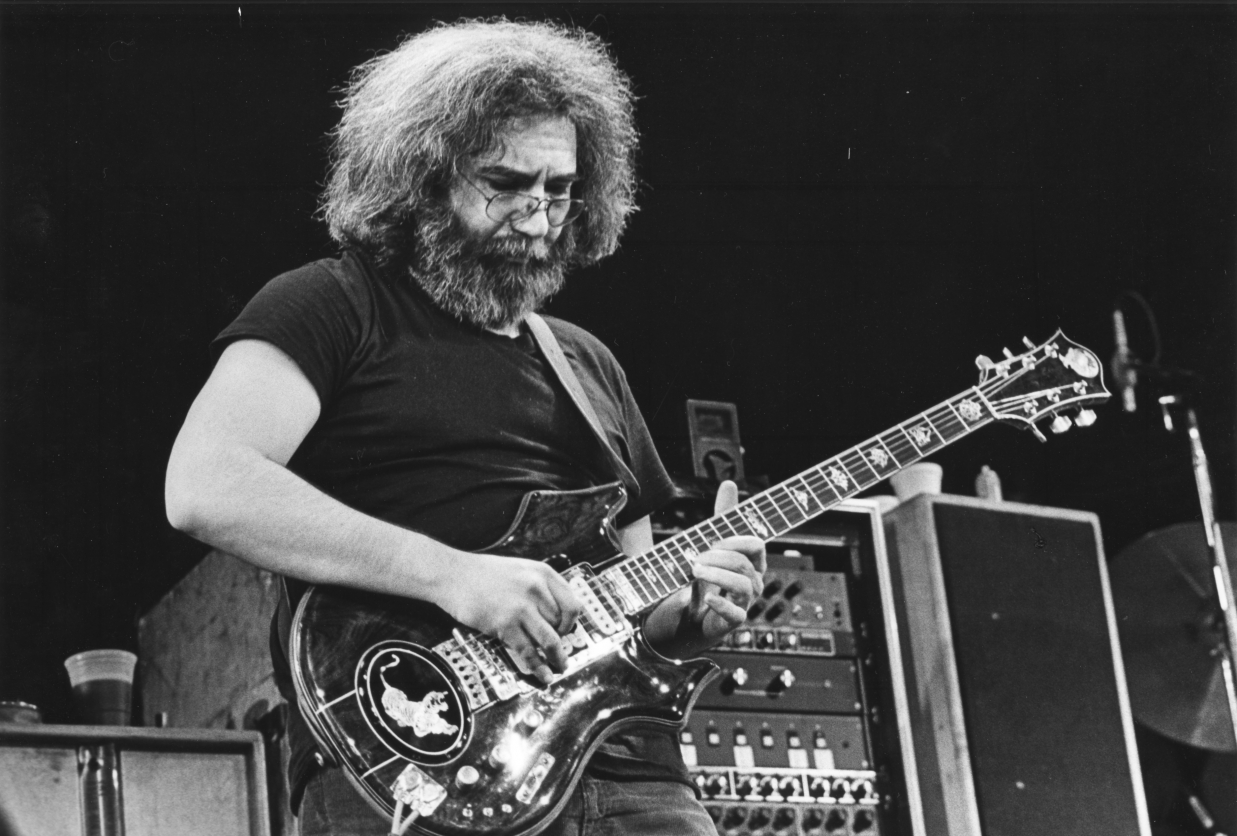
Back in the Paleolithic era, I worked as front desk receptionist for concert promoter Bill Graham and had several encounters with members of the Grateful Dead family. Not that I knew who they were at the time: it was a big part of my identity as a modern music lover to not know, though I’ve come around to their sound and specifically to Jerry Garcia.
For the sake of a prequel and partial sequel to the business at hand, I accidentally experienced the Dead at a Day on the Green concert in 1976 when they co-headlined with The Who. At the time I didn’t know or care that the big events staged at Oakland’s stadium would became a kind of testing ground for the full scale festival tours we know today. It didn’t help I didn’t know “Scarlett Begonias” from “China Cat Sunflower” or to that to my unformed mind, experiencing the Dead was just a three hour endurance test before the Who hit the stage. I was not transformed, my consciousness was not altered by their music, as some members of the band and the people who love them claim, though today, I quite like most all of Garcia’s and lyricist Robert Hunter’s material. I like to think I have grown into it.
But even back when, I knew Jerry was Jerry, and later in my role as receptionist, I certainly knew enough about receiving office visitors that I was not to waylay people of his renown at the entrance with formalities like announcing their arrival. In the flash it took me to recognize a musician, he could walk past me, nod, and in Jerry’s case, with his cherubic smile, head bowed and hands jammed in his pockets, proceed without pause, into the open main office, then in the direction of Bill’s corner sanctum. Same went for Carlos. Santana. He and Jerry were of course legends by then, their reputations enshrined thanks to their inimitable, celestial guitar styles. I was less generous about their music then, but showed respect anyway: These were people born in the same decade as my parents. Then again, I can’t claim to have displayed anything resembling even courtesy the day an even older man dressed in a fur loin cloth and carrying a walking stick announced his arrival.
“Bear for Bill.” “Excuse me?” I couldn’t hide my contempt, buzzing over the line to Bill’s assistant. “Someone named Bear is here for Bill?” “Send him in.” The shock registered on my face compelled a co-worker witnessing the scene to whisper my way. “Bear is Owsley.” “And?” “He invented acid.” I get it now.
On another day, Mountain Girl announced herself. My lack of exposure to hippie culture was pitiable and the name drew a complete blank. I said something like, “Say what now?” I feel sorry for being just one more person to judge Carolyn Garcia based on her chosen name and hope she can forgive me. Perhaps we might even agree that Jerry would be “rolling in his grave” in connection with some of events of the last few weeks celebrating the 60th anniversary of the formation of the Grateful Dead.
Thirty years ago, on August 9, 1995, Jerry Garcia died. His diabetes raged, his heart gave out and his body failed him while detoxing from a lifetime of drug dependence. A few days later, his life was celebrated with a public memorial concert in Golden Gate Park. By that time, the Dead had been doing big business for some time, thanks to constant touring and their first top 40 hit, “A Touch of Gray.” Never mind then that Garcia’s health was down and his addictions were up: The show must go on as the Dead’s touring, merch and ticket sales were doing the kind of big boring business the music industry represents today.
The bands formed in Jerry’s wake include The Other Ones, The Dead, Further, Ratdog, Phil Lesh & Friends and the Rhythm Devils (there are more). But the extreme monetization of all things rock ’n’ roll, psychedelic and Dead had been well under way for several decades. The Grateful Dead as corporation was just another aspect of its long strangely quirky and contradictory trip.
Beginning in 2015, Dead members Bob Weir and Mickey Hart began billing themselves Dead & Company; by 2023, they played to bid goodbye to touring with their Fare Thee Well shows. Those dates, according to published accounts in music industry trade magazines and other media outlets, grossed $114.7 million over 28 shows, though they were hardly the end. In 2024, Weir, Hart and an amalgamation of musicians played a 30 show stand at the Sphere in Las Vegas and earned $130 million that year as Dead & Company. This year’s Dead & Company returned from the dead, again, for 18 shows at the Sphere and three in Golden Gate Park to mark the 60th anniversary of the formation of the Grateful Dead and 30 years since Jerry’s passing. The tour receipts for this year have not yet been published, though some fiscal facts are known.
Tickets for the Golden Gate Park weekend ranged from $600 for three days and went up to $7k for the VIP Package. The concerts brought $150 million to the city’s economy, $7 million into the Parks and Recreation Dept. according to local media, and some untold sum for promoter, Another Planet Entertainment, not to mention the band, its agents, managers and other profiteers. I don’t know much about the Grateful Dead but I’ve read the books and can tell you that profit was not a big motivator when the band was founded. Money and possessions were seemingly of little interest to Garcia.
To say it another way, Dead & Company do not embody the spirit of the Dead and its commitment to alternatives to commercialism and mainstream culture. That is if there is such a thing as a spirit of a band: In the Dead’s case, that bird has definitely flown. I can say more, much more, but won’t now except: In 1996 I spent six weeks on the road with the Further festival. It was unpleasant to say the least and I survived it by immersing myself in nightly sets by Los Lobos, a band I am certain has a spirit because I can feel it.
And yet, there are still some traces of Jerry’s spirit around if you are looking for it in the city that raised him. Whether its the makeshift shrines in the Haight, stenciled Jerry bears on sidewalks around town, or the annual Jerry Day free concert at McLaren Park, I could swear some days, especially in August which marks his birth and death, he hovers.
Jerry Day was established in 2003 to celebrate the Excelsior District’s most famous son; this year a street there was named for him. But the future of Jerry Day is imperiled due to “lack of funding” and city support. How could this be in a city of 80 billionaires? How could this be in a city whose mayor is worth millions made from the profits of Levi Strauss, the jeans favored by hippies and punks and everyone else, you may ask and I will answer: We are a city that creates and then commodifies everything: From rock ’n’ roll, psychedelics, and cannabis, to the Grateful Dead, to mention but a fraction of what comes from Northern California. We even have a Counterculture Museum to keep the idea of an underground in place.
No, I don’t blame the latest generation who want to partake in their own rituals or a virtual tribal love rock musical: It’s the cost to play the game I can’t relate to. There’s also the carbon in/carbon out trucking and busing of staging and sound equipment on public park grounds, our much-needed oasis in a largely concrete residential neighborhood that’s hard to get your head around.
Jerry loved Golden Gate Park. It’s east to west world map of flora and fauna literally inspired his guitar playing. But following the three dates of Dead & Company there, the three-day Outside Lands festival and last week’s straight vanilla “alt-country” event, the concerts have trampled the landscape and turned the largely working class, Democratic voting blocks of the outer Richmond and outer Sunset neighborhoods into a parking lot. And we did nothing to prevent it. Oh sure, we voted to make the Great Highway a park, but we got very little in return for that either.
The highway, its nearby grid of avenues, and the park itself, were built on sand dunes. They were not designed with an in and out flow of 60,000 non-residents a day in mind. These neighborhoods of families, people with disabilities, seniors and people of all ages who speak more languages than in any other area of the city are boxed in. Many of us are in the work force and use the roads to travel to and from our jobs. There are hospitals and other services that bookend the park and people need access. And then there is the wildlife that has been displaced for a month by top volumes, distracting spotlights, and cyclone fencing not to mention the human footprints marring their paths home.
Jerry used the park himself to find peace and quiet: That’s where he was found one morning in his car in 1985 with a shit ton of drugs on him and in him (in 2025, concert goers in the park enjoy the brain freezing drug of nitrous oxide). Communing with nature takes many forms but the combination of numbing out in these times seems less like a tribute and more like a cop-out.
Granted, my distress is not about the disruption outside my window but is intertwined with the upheavals worldwide. If you’re reading this, you wake up screaming in some form or another, whether about detainment, displacement, about the genocides, dictatorships, rolled back rights and the current incompetence at most levels of leadership [release the files]. And yet these cries are signs of our human connection, our consciousness, the kind once encouraged by the Dead or psychedelics or a combination of the two.
Even though now it seems like no one is listening, those of us who are awake and alive are the miracles we are seeking. The shakedown, whether in the park, at the Dead & Company HQ or on the national stage is just another version of life in all its stages: good, bad, ugly and beautiful. So I keep doing what I do. Live my life accordingly. Sometimes I ask myself, what would Jerry do? And while I choose not to check out, I can’t deny we’re living in a blast furnace. Yet I see no choice but to play it through, and just keep truckin’ on.
This is your Earth Day long read: The story of how musician, composer and arranger Van Dyke Parks came to produce the 16-man steel pan band, Esso Trinidad, following the Santa Barbara oil spill of 1969. I interviewed Parks in 2009 for Crawdaddy! and since that time, this story has become the most-read on this site, receiving the top number of views daily from around the world. Thanks for your continued readership and for your stewardship of the earth today (Parks suggests planting milkweed, to save the Monarch butterflies).
When 80,000 barrels of oil spilled into the waters of the Santa Barbara Channel in January of 1969, the crude-splattered water, beaches, and birds along the California coast in its aftermath became the symbols of modern eco-disaster. While the ensuing public outcry helped hasten the formalization of the environmental movement as we now know it, for musician Van Dyke Parks, the spill and “the revelation of ecology,” as he calls it, was a very personal, life-altering occasion. “It changed my M.O. and changed my very reason for being,” he says. The Union Oil rig rupture in Santa Barbara made Parks go calypso.
“When I saw the Esso Trinidad Steel band, I saw myself in a Trojan Horse,” he says. “We were going to expose the oil industry. That’s what my agenda was. I felt it was absolutely essential.” From 1970 to 1975, Parks waged awareness of environmental and race matters through the music and culture of the West Indies, though in the end, “You don’t know whether to laugh or cry. That’s what makes Van Gogh go,” he says, “That’s what great art does.” Though Parks is referring directly to Esso Trinidad’s happy/sad steel drum sounds, he could just as easily be talking about his own experience during what we’ll dub the Calypso Years.
Over a five-year period, Parks produced albums by the Esso Trinidad Steel band (1971) and Bob Dylan favorite, the Mighty Sparrow (Hot and Sweet, 1974); he also recorded his own calypso-inspired works, Discover America (1972) and Clang of the Yankee Reaper (1976). Born from his passion for popular song and launched at a time when grassroots protest was at an all-time high, Parks had every reason to believe calypso consciousness would prevail. But he hadn’t factored in the complications of taking on big oil, nor of touring the US with a 28-man steel drum corps from the Caribbean. He was unable to predict that the sessions with Mighty Sparrow would be fraught with rage, and that his efforts would earn him the enmity of Bob Marley, whose production requests he ignored in favor of calypso. And yet, you get the feeling he’d agree in one hot minute to do it all over again the exact same way if given a chance to revisit this section of his checkered recording history.
Parks is generally a well-mannered and affable Southern-born gent with a mildly mischievous streak. A one-time child prodigy on clarinet, he’s often mentioned in tandem with his Southern California work with Beach Boy Brian Wilson, who was reportedly too tripped-out to continue their Smile-era collaborations. A formidable freethinker and raconteur of psychedelic dimensions himself, you can hear the Parks imprint, curly-cuing through “Heroes and Villains” and “Sail On, Sailor”; songs that made a lasting impression on the Beach Boys sound. Rarely at a loss for bookings as a composer, arranger, musician, and producer (Parks would go on to work with artists from Harry Nilsson and Ringo Starr to Joanna Newsom and Rufus Wainwright), his song “High Coin” traded freely on the hippie covers market while he juggled sessions by psychedelic bands as well as singer-songwriters Randy Newman and Phil Ochs. It was following the critical success of his first solo work, Song Cycle, in 1968 and the oil spill in ’69, that Parks began in earnest his pursuit of the music of the West Indies—specifically calypso and steel drum (also known as steel pan). Initially played on instruments made from clankity household odds and ends, by the ’40s, steel drums were made from a surplus of oil barrels, washed ashore the islands of Trinidad and Tobago from the coast of Venezuela. “America pollutes its environment with oil: Little Trinidad makes beautiful music from the drums that you throwaway,” says pan player Godfrey Clarke in the Esso liner notes.
Serving as the accompaniment to Carnival (for which Trinidad is world-famous), calypso is also often accompanied by lyrically potent verses that alternately use breezy and nasty humor to signify its weighty concerns: Imperial oppression and the extreme poverty of the islands. Ideally, the counterculture audience could’ve dug this political/party music with its motives to create equality and earthly harmony. Surely younger folks could identify with the calypsonian struggle, more than say, Liberace’s audience in Las Vegas, which is where Parks found the Esso Trinidad Tripoli Steel band working in the late ’60s. “I saw them as enslaved in their relationship to Liberace; I thought it was a vulgarity. I wanted to save them from their trivialization.” What had begun as Parks’ desire to popularize calypso at that point became his crusade.
The Land of the Hummingbird
“I just love that performance of ‘Aquarium,’” Parks says of Esso’s album finale. “You see, it represents that eco-consciousness that the album should project. I’m just telling you why I did it: I devoted the album to Prince Bernhard, who was the head of the World Wildlife association. Everything was directed to making it a proper, political, green album.” Nearly 40 years later, the Bananastan label has issued newly-minted versions of the Parks-produced Esso and Sparrow’s Hot and Sweet. Not only are the calypsos strangely contemporary, I find I’m deeply moved by Esso’s environmentally-tuned music from the island officially nicknamed the Land of the Hummingbird. When Parks suggests we meet beside the Santa Monica Bay, I agree: There is no better place than under the sun for a talk about his rarely-discussed calypso intermezzo. “This has been a well-kept secret,” he begins with a whisper. “The promotion men were successful at that.”
Parks’ devotion to calypso puts him in the unique position of serving as the music’s chief 21st century stateside ambassador; as it is, his relationship to calypso predates his own childhood and runs in the family. According to Parks, his mother’s uncle was the founder of the University of Miami and a calypso devotee. “Of course, they were touched by calypso down there. He had been to Trinidad at the same time as FDR,” explains Parks. President Franklin Delano Roosevelt’s 1936 trip to Trinidad, documented in the song “FDR in Trinidad”, is among the first calypso standards. By the 1940s, “Rum and Coca-Cola”, as sung by the Andrews Sisters, had brought calypso music to the American masses. “Of course, everyone was aware of ‘Rum and Coca-Cola’, which was incidentally my mother’s favorite drink,” says Parks. Though, everyone was not necessarily aware that the jolly little song was also a critique of American military presence in Trinidad (nor would it be a truly great calypso without the double edge). But the Andrews Sisters’ vocal stylings would soon be outdone by authentic calypsonian Harry Belafonte’s ’50s success with the Jamaican folk song “Day-O (The Banana Boat Song)”, calypso’s most enduring hit. In the early ’60s, Parks recalls he and his brother were “left in the dirt” on a bill they shared with calypso’s Andrew “Pan” de la Bastide. But it is in the music’s details rather than its broad overview where Parks gleans inspiration: The origins of the intensity of the music, the unparalleled musicianship of the pan players, the wordplay of the singers and their emotional extremes—from treachery to triumph—are the elements of interest to Parks.
“I was serious about serious music from an early age. Hardwired to a lot of music of dead white guys—very serious discipline—I had three brothers who played. We had this musical oleo in the house, from Bill Haley and the Comets to Les Paul and Mary Ford, Fats Waller, George Shearing, Paul Whiteman, the usual popular American diet, from 78s on. To me, calypso music was everything that the Memphis blues was, everything that Schubert and his sort were of the 19th century Romantic songwriters. Melody: Fantastic, like studying a novel with many subplots, seeing all of them resolved by the conclusion of the work. Lyrics: The scansion, the absolute art of phrasing, it had absorbed everything proper from the British Empire, so you find this incredible intelligence of mind. These are the scions of African nobility, the protectors of the musical and oral tradition. That’s what I think of calypso—the greatest pop music.”
The music of the West Indies was begotten from a 19th century slave history. “Barbados, adjacent to Trinidad, is direct in line of the slave trade that unfortunately plagues us all,” says Parks. But while European settlers imposed customs and traditions on the islands’ people, the indigenous population and those whose origins were African engaged in their own forms of expression. It’s that combination of sound, from two hemispheres and at least three continents, that make up the basics of calypso. Working with the large ensemble steel band, “I took it as an incredible opportunity… from a standpoint of my very American identity,” says Parks. “This group presented such a great opportunity in testing my ethics.” Though were the ethical challenge not combined with the band’s esthetic of extreme musicianship, individually and as a collective, Parks probably wouldn’t have traveled the distance he did with Esso.
“It was really a profound experience to me, to hear the small fish that run by quickly in the ear during Saint-Saëns’ ‘Aquarium’ from The Carnival of the Animals. Those fast notes that shimmer through the piece, they are 32nd/10th notes, there are 10 in a figure, and these guys memorized this thing in a matter of two days and they did an incredible job.” The band was led, as it were, by Hugh Borde. “He was their captain, there was no leader,” explains Parks, though for those two days in the studio he passed his captain’s hat to Parks and pan man Kenrick Headley, who led the group through versions of songs like “Apeman” by the Kinks, “I Want You Back” by the Jackson Five, and Simon and Garfunkel’s “Cecilia.” The Rev. Fr. John Sewell, an Episcopalian missionary who served transcribing the ultimately jaw-dropping versions of the playful classical and orchestral pieces in Esso’s repertoire, also assisted the group. “They were the first to do it,” says Parks of Esso’s classical works on pan, “and it became a requirement for all steel bands to have a classical test piece. So they might do ‘Waltz of the Flowers’ by Tchaikovsky or ‘Unto Us a Child Is Born’ from Handel’s Messiah.” For the recording, they chose the aforementioned Saint-Saëns and the frantic “Sabre Dance.” The steel band also cut a Parks favorite, “Erasmus B. Black”, a wordplay tune penned by the Mighty Sparrow in which an innocently christened baby ends up with an unfortunate double entendre of a name. “I thought there was a great deal of theater and comedy in the group. I’ve never enjoyed myself so much, almost understanding what was going on!”
Keep Your Eye on the Mighty Sparrow
Steel band players gain entry into the prestigious ensembles through a highly competitive audition process. The spirit of musical competition and excellence is rooted in poverty, though it’s a celebratory event, staged each year at Carnival, the annual pre-Lenten festival that finds pan players and wordsmithing calypsonians performing for cash and crowns. The annual Carnival Road March is a calypso competition at its fiercest and reigning supreme eight times was the Mighty Sparrow—his wins rivaled only by contemporary calypso’s Super Blue and Sparrow’s friend and competitor, Lord Kitchener. While Sparrow had traveled to the US seeking help from Belafonte at the height of calypso’s popularity, Kitchener was making a name for himself in England. Upon their respective returns to the islands, Kitchener and Sparrow spent the rest of the decade and into the early ’70s duking out the Road March and Calypso Monarch crowns.
“I wanted very much to do Lord Kitchener,” admits Parks. “Lord Kitchener, to me, is the greatest of all the calypso singers, but Sparrow was absolutely rhapsodic.” In his liner notes to Biograph,Bob Dylan wrote of the Sparrow: “… as far as concept and intelligence and warring with words, Mighty Sparrow was and probably still is the king.” “I thought he would be more difficult to sell than Kitchener,” says Parks. “Sparrow would show up with a cape; Kitchener would’ve shown up in a fedora.” Perhaps Sparrow could sense Parks’ preference for Kitchener upon his arrival at Miami’s famed Criteria Studios. Or maybe it was a hurricane, just about to make its way to land, that turned the session into a perfect storm. “We got to Miami. Phil Ochs appears,” begins Parks, referring to his friend and fellow traditional music enthusiast, famous for folk-singing and a notorious unraveling that had already begun. “Phil is somewhat deranged. The rain starts to whip against the wall absolutely horizontally. We are near the eye of the hurricane. It’s a big one. The studio owner Mack Emerman wondered if we should airboat the whole thing to Barbados.” In a world without Pro Tools, the crew obtained remote power from their own generator and hunkered down as the hurricane passed. “What you hear, we did in two days. Sparrow would step up to the piano and go pht pht—pht pht. You notice that’s irregular,” explains Parks, pounding on the picnic table before us for emphasis. “It’s not pht, pht, pht, pht. You know, it’s said that irregular beat is something that started in Curaçao as the natives imitated the Dutch governor, Peter Stuyvesant… he had a lame leg and so he would pht pht—pht pht. That’s what I heard… it’s the rhythm that Sparrow played for two bars before the piece begins. And then the band came in. This didn’t take a producer. This didn’t take an efficiency expert. This was incredible.”
Rather than arriving at the studio with a finished set of lyrics, Sparrow came with phrases. “Sparrow knows exactly where he’s going… he knows how to get the cat out of the tree, get the cat down; he’s got the chorus solved. He’s very able. There is nothing false about his incredible musical skill. That he can ideate phraseology with such powers of deception is a very good quality of his work. It’s the very same power of deception that I see in Schubert, that also likes to take you out somewhere, then puts you somewhere subtly that is surprising and refreshing.” Of the songs he compiled for Hot and Sweet, Parks cites two standouts: “More Cock” (“I asked for it. I know, it’s my fault”) and “Maria.” “My favorite. As Ted Turner said… ‘it only looks easy.’ To me, it’s as good as anything I’ve heard out of Allen Toussaint. It’s tight.”
Co-produced with Andy Wickham, the session with Sparrow was not without incident. Parks describes British Wickham as “right wing” and in thrall to “Country and western and super-America, Buck Owens and Merle Haggard.” Parks says, “I remember he was ecstatic with ‘Okie from Muskogee,’” Haggard’s toast to redneckism. And yet, like Parks, Wickham loved calypso. “He came to realize how much the butt [of the jokes] the British were.” Wickham could also appreciate the melodies (“He loved Wagner, secretly,” says Parks) and the lyrics (“Very good turn of phrase,” he’d say). But it was sport that bound Wickham to the calypsonians. “He knew all the West Indian super heroes of cricket,” says Parks; however, that did not make him the boss of Mighty Sparrow.
Sparrow was not one to take studio direction. “Which is a big mistake. Every bullet counts on a record,” says Parks. “It was hard. It was a bumpy ride. It was occasionally filled with rage and great hostility. And blackberry brandy; I think the record was a four quarts of blackberry brandy record.” The necessary lubricant relieved some of the tension courtesy of the elephant in the room: The British Empire. “Well, the British were leading the decolonized African freeman, and I was right in the middle of all that. The Sparrow is filled with bravado and severe opinions that aren’t always convenient… There were moments that you hoped the guy in the cape wasn’t going to show up at dinnertime to protest his individuality to everyone.”
By the time Parks was finishing with Sparrow, calypso’s rhythmic energy was in the process of being subsumed by disco, while the war on poverty was being fought by reggae, the Caribbean’s other music. “Calypso was feeling very disco-ed, which is funny because they wanted to feel disco-ed, and yet, they were bothered by the fact that disco was calypso. It was a dead ringer,” Parks says, once again sounding out beats at the picnic table. “They were mad as hell about that. And then reggae hit the fan—in a big way—and I was delighted.” This is when Parks received his call from Bob Marley.
Clang of the Yankee Reaper
“‘Let’s face it, Mr. Parks, the white man is finished in the Caribbean,’” said Marley to Parks. “I thought that was a rather harsh thing to say. He was so pissed at me, because I didn’t have time to work for him because I was so trying to get 28 toothbrushes… I was just too busy and he took it as a slight.” Though, what may’ve been a missed opportunity with Marley, Parks made up for it by recording with his contemporary, Jimmy Cliff. “Jimmy Cliff was a big deal to me,” he says. Believing Cliff’s melodies often prevailed over Marley’s “rhythm machine,” Parks helped the singer secure his publishing and played keyboards on Cliff’s 1976 album, Follow My Mind. “I honestly think that the Jamaicans showed a greater power of adaptability against ‘guns, germs, and steel’ than calypso. Trinidad is more removed—it’s a different world…”
Following the Sparrow production gig and Parks’ own Clang of the Yankee Reaper (a good half of its material bearing the earmarks of calypso), by the end of the ’70s, Parks was back in the bosom of the California singer-songwriter scene, working with Lowell George, Nicolette Larson, and again with Harry Nilsson. So what then of calypso, his first Caribbean love?
“Calypsonians were an uncapturable lot, really, and I’ll tell you why… They never had any regard in an engagement in copyright. Maybe it’s an uncommon modesty of sorts.” Matters of contractual arrangement were a formality that, according to Parks, was of no interest to calypsonians. “It finally dawned on me there is an undeniably vulgar aspect to contract agreements because they’re built to check coercion and that’s a sad way to approach any mutual trust. These songs are for a moment’s discovery, born of such a highly extemporaneous, unanticipated purpose. A solution to a problem is what it’s all about.”
Artistically, he was satisfied by the calypso interlude. “Those two recordings were made at the apex of analog. Such a phenomenon of sound and so nuanced… small notes that all make up the way it feels in the bones,” he said.
Environmentally, the idea to link calypso or any music to the earth’s wellness was visionary on Parks’ behalf; the frontiers of such thought combined with activism are yet to be fully explored. Although at one time he’d hoped to deliver his message directly to consumers at the pump as a “premium gift” with fill-up (the idea was a sound sheet of the Esso Trinidad Steel Band singing “White Christmas” with Bing Crosby), his dream of harmony, enlightenment, and environmental healing through steel band music was too far-reaching. Idealistically, Park could not fulfill his full vision with Esso.
“I was in the crosshairs of the racial divide with these gentlemen who had no idea about such things,” explained Parks. “A guy shot at us—a farmer up on a hill with a shotgun—when the bus broke down on the road in the South. The culture collision was probably among the top five benchmark psychological events of my life, for so many reasons.” Esso’s US tour ground to a halt for good when their aforementioned bus crashed. Several men were hospitalized and one was laid up at the Parks household for four months. “I came up as quickly as I could with another record about calypso to keep the focus on the medium. I put a Greyhound bus and a Continental Trailways bus on the front cover, just to get these men out of bed.” The Parks album Discover America contains interpretations of “FDR in Trinidad”, “The Four Mills Brothers”, and “Bing Crosby”, among others from the calypso canon. Parks’ time with the steel band was drawing to a close, though not before one last act in which he finessed a potentially sticky situation with Standard Oil of New Jersey that ultimately okayed the Trinidad Steel Band to retain the use of Esso in its name, without an injunction.
He still stands by a statement he made of Esso, those years ago: “The greatest group I’ve ever had the privilege to produce.” Like his calypso brethren, Parks may’ve been bloodied, but his confidence in the art of calypso is unyielding. “All of the bravado of such poverty—poor people speaking plainly, representing the disenfranchised—is what calypso is all about,” he states. “It’s not only topical songs that are optimally crafted, both lyrically and melody—it’s that they do things: They move mountains. It’s a life force.”
April 18 marked the beginning of Beat poet Bob Kaufman’s centennial year, and San Francisco celebrated with three days of poetry, film and talks about the often overlooked but finally fully recognized artist. From about 1958-1986, he wrote poetry and made his home in the North Beach and Mission districts of San Francisco. He was a forceful presence on the scene, even as he had taken a vow of silence against the Vietnam War.
“He’s the quintessential representation of a San Francisco poet,” said San Francisco poet, Josiah Luis Alderete. In France, he was dubbed “The Black Rimbaud.”
For some time, it was hard to come by Kaufman’s slim volumes of poetry, but in 2019, City Lights Books published his first-ever collected works, with a forward by devorah major and edited by Neeli Cherkovski, Raymond Foye, and Tate Swindell. I wrote a long piece about him and his influence on modern day poets for the San Francisco Chronicle with more detail on his background and his surrealist’s eye.
A hundred years since he came into this world and nearly 40 since he left it, Kaufman’s poems against racism, injustice and war are as powerful now as they were then. San Francisco poet Kim Shuck said, “Bob Kaufman was so far and away the best…”
Karen Finley is no stranger to the culture wars: A 1990 Supreme Court case – National Endowment for the Arts v. Finley – ruled that she and her fellow performance artists, the NEA Four, could have their grant money withheld from the federally funded arts program, though the artists’ freedom of expression could not be overturned or legislated.
Once again, the arts in the United States are under attack: The far right has infected all three branches of government and its ostensible separation of powers that relies on a system of checks and balances to function. The current dysfunction, the dangerous clowning around, the trolling on life and death issues and false accusations of “wasteful spending” while wastefully spending are not just a sideshow, they are the main event. As the world burns and the economy is in trouble, the mad obsession to dismantle the resources and guardrails related to not only all life but the arts, diversity, equity and inclusion impacts us all, no matter if you enjoy conceptual art or whether you care to take a stand on federally-funded projects and institutional grants.
“It’s a horrible time,” Finley told me when we spoke about her new book, Covid Vortex Anxiety Opera Kitty Kaleidoscope Disco,” a meditative/healing rant on pandemics past and present.
“I’m very concerned and the concern is that the arts are related to so many different aspects of funding. It connects to books and libraries, healthcare and education.” Indeed, our library systems are under attack. The healthcare system is itself in perilous health and universities and the public education system are in process of becoming shadows of themselves — institutions of white lies and systemic oppression instead of enlightenment. These are but some of the ways attacks on arts and culture show up in our day to day, while the song, and the cost of eggs, remains the same.
“Not like I would ever be at the Kennedy Center,” said Finley, “But it was great to have, it was a symbol.”
When the the existing board of the Kennedy Center, historically a non-partisan institution, was sent into disarray by executive order and the selection committee dispersed, among the big ideas of the new self-appointed chairman was to honor baseballer Babe Ruth (sports achievements are not in the purview of the center’s awards), Elvis, and the musical, Cats. No way around it: The Spectacle is gonna spectacle.
When Chris Pierce performs his somber take on “Southern Man” on Heart of Gold: The Songs of Neil Young, he brings personal experience to the line about crosses burning fast. Pierce was five-years-old when locals burned a cross on the front lawn of his family home in Pasadena, California. His parents, a mixed race couple, stayed in their residence, despite the hate crime and stood up to racism.
It was in that same spirit Pierce held his date at the Kennedy Center on March 12, in the face of the President installing himself as the cultural institution’s new chairman (he met with the board on Monday to see how he could wield influence over its annual lifetime achievement honors). Read more on Pierce’s remarks about the performance last week and watch the entire set in today’s edition of Down With Tyranny.
It takes an extraordinary effort to write a book and see it through to completion. That might seem like an obvious and plain thing to say, but it’s true: Though many folks like to think they can do it or try to, fewer actually do. Perhaps that is why publication day and month is most always a big deal for writers: Congratulations cards, flowers and gifts are in order! Short of those things, I’ve got a couple of articles I wrote about two very different writers with two very different books celebrating mutual publication dates to share with you.
“Sexy Life, Hello!” is the first book for Michelle Kircherer. Her debut novella is also the premiere release of her independent publishing venture, Banana Pitch Press. Kicherer is an ambitious performer, writing coach and instructor and has a big vision for her multimedia venture, without any of the yuckiness associated with the big three publishing houses. She will be reading from her book and discussing it at Green Apple on the Park in San Francisco on March 6 and at Clio’s in Oakland on March 8. You can read more about Michelle in my profile of her for the San Francisco Chronicle.
“The Mansion” (Gnashing Teeth Publishing) is the tenth collection of poems by Dee Allen. A performance poet, Dee has been writing and performing his work in San Francisco, Oakland and beyond for over 20 years. I had the good fortune to first hear him read in 2012, or maybe it was 2013 — at any rate, that was several books ago for Dee. I try never to miss his publications and readings, but they are coming so fast and furious, I accidentally skipped 2024’s collection “Discovery.” It’s time to catch up and that’s exactly what we’ll be doing during a live-streamed conversation from Bird and Beckett Books and Records on Sunday March 9 at 10 a.m. A sneak preview of what’s likely to come up is in this profile forBay City News, published today.
Congratulations to Michelle and Dee on their respective new publications. Though writing is its own reward, sometimes it helps to know there are those of us reading and appreciating the work, respecting what goes into the process and identifying with it. Thanks to this pair of authors for making our Bay Area literary community particularly unique, for making my job reporting on them easy, and for helping to keep the spirit of independent publishing alive in these unreal times.
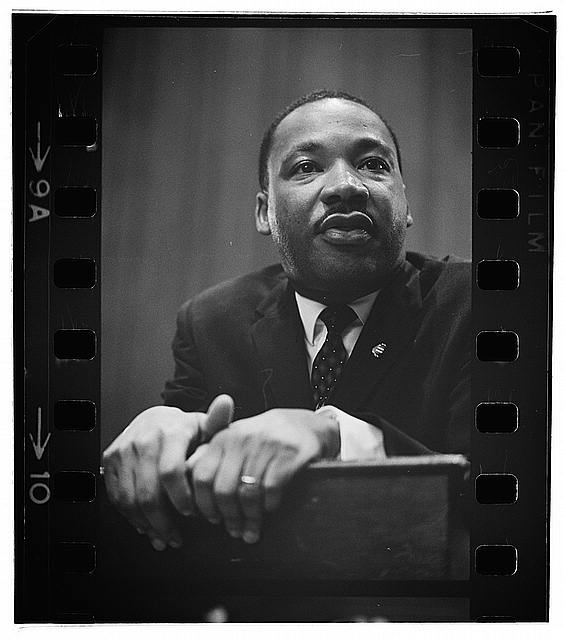
January 15 would have been the 96th birthday of Dr. Martin Luther King, Jr. born in 1929 in Atlanta, Georgia. It was a long road to the third Monday of the month when all 50 states observe the federal holiday named in his honor. Largely owed for making the dream of MLK Day a reality is Stevie Wonder: Back in 1980, he wrote the pointed song, “Happy Birthday,” then launched a 41-city U.S. tour (and invited Gil Scott-Heron along) to promote the idea which was first mooted by Rep. John Conyers in 1968. The musical efforts were ultimately the key in collecting the millions of citizen signatures that had a direct impact on Congress passing the law signed by President Ronald Reagan in 1983, declaring a day for MLK.
Observed for the first time in 1986, some states were late to participate, however, by the turn of the 21st Century, all were united in some form of remembrance of the civil rights giant. “Happy Birthday,” which served as Wonder’s King holiday campaign theme (and is now the “official” King holiday tune) is the last track on Hotter Than July. The album also features “Master Blaster,” Wonder’s tribute to Bob Marley (Marley had been scheduled for the tour until he fell too ill which was how Scott-Heron came to participate). In his memoir The Last Holiday, Scott-Heron details his own journey with music and activism, as he retraces the long and winding road Wonder took to bring home the last US federal holiday, with the help of a song.
The Hotter Than July tour brought Scott-Heron and Wonder to Oakland, where they played in the name of King, along with Rodney Franklin and Carlos Santana. In a weird turn of events, the concert on December 8, 1980, coincided with the night John Lennon was killed. The musicians and crew learned of the tragedy from a backstage television, and the job fell to Wonder, with Scott-Heron and the other musicians at his side, to deliver the shocking news to an arena of music fans.
“For the next five minutes he spoke spontaneously about his friendship with John Lennon: how they’d met, when and where, what they had enjoyed together, and what kind of man he’d felt Lennon was,” wrote Scott-Heron. “That last one was key, because it drew a line between what had happened in New York that day and what had happened on that motel balcony in Memphis, Tennessee, a dozen years before. And it drew a circle around the kind of men who stood up for both peace and change.” Scott-Heron devotes the final pages of The Last Holiday to a remembrance of how the murder of Lennon fueled the final drive to push for a federal observance of the official MLK Day.
The politics of right and wrong make everything complicated
To a generation who’s never had a leader assassinated
But suddenly it feels like ’68 and as far back as it seems
One man says “Imagine” and the other says “I have a dream” -Gil Scott-Heron
Scott-Heron was a lifelong campaigner and champion for human rights himself, beginning on his 1970 live album Small Talk at 125th and Lenox. There is no doubt he would have much to say of the unfortunate confluence of this year’s King holiday with the inauguration and the project known as 2025. The parenthetical title refrain from his song, “Alien (Hold On To Your Dreams)” (see clip below following his topical poem, “Whitey on the Moon/(Mars)”) has been spinning around in my head, alongside the words of Dr. King collected from one of his sermons from the early ’60s. Whatever confronts us today, whatever dangers real or perceived that touch our friends, families and fellow humans in these perilous times, in these words and songs may you find comfort and be inspired to act in love.
Returning hate for hate multiplies hate, adding deeper darkness to a night already devoid of stars. Darkness cannot drive out darkness; only light can do that. Hate cannot drive out hate; only love can do that. Hate multiplies hate, violence multiplies violence, and toughness multiplies toughness in a descending spiral of destruction. – MLK, Jr.
Martin Luther King Jr., Joan Baez and Harry Belafonte
Joan Baez was a junior at Palo Alto High School when she first heard Martin Luther King, Jr. speak at a conference for young Quakers. She would go on to sing for the non-violent movements for civil rights, social, economic and racial justice and against the war in Vietnam.
“King was giving voice to my passionate and ill-articulated beliefs,” wrote Baez in her memoir. Her “exhilarating sense of ‘going somewhere’ with my pacifism” in the aftermath of that speech would lead her to join King on marches in the Jim Crow south and at the historic March on Washington.
If you don’t already know about Baez’s history as a lifelong activist, you certainly would not get it from a viewing of the ahistorical Bob Dylan biopic, A Complete Unknown, released in US theaters this Christmas.
Loosely based on Dylan’s arrival in New York City in 1961, the film covers the songwriter’s introduction to the Greenwich Village scene, his meetings with Woody Guthrie and Pete Seeger, and his intimate relationships with Baez and the fictional Sylvie Russo, a stand-in for his real life steady, Suze Rotolo.
“During the height of the civil rights era Bob wrote, among other songs, ‘The Lonesome Death of Hattie Carroll,’ ‘The Death of Emmett Till,’ [‘Only A Pawn In Their Game’] and of course, ‘Blowing in the Wind,’ which became a kind of anthem,” Rotolo wrote in her own memoir of the Village in the ‘60s. In the film, “Blowing in the Wind” is framed in his repertoire to be more like an annoyance or an albatross.
There’s a scene recreating Dylan and Rotolo’s meeting at a 1961 folk-a-thon at the Riverside Church, the historic hub of progressive gathering in New York City. And there is a brief moment when the Russo character explains to a befuddled Dylan that she works at the Congress for Racial Equality (CORE), organizing the Freedom Rides from North to South — in fact one of Rotolo’s jobs in the era.
Facts are also, that in 1963, Dylan walked off the all-important nationally broadcast The Ed Sullivan Show when he was asked not to play his song, “Talkin’ John Birch Society Blues.” For those unacquainted, the John Birch Society is a radical far right group and the song is a satire.
That not much is made of the realities of the causes and concerns that moved both Baez and Rotolo to become immersed in movement work and the folk scene is perhaps understandable: A Complete Unknown is after all, a version of a story of Dylan becoming Dylan. But the gaps in the story of Dylan’s own connections to civil rights and the songs he wrote in their favor are woefully understated in the film, as are his friendships with the people in his circle (where, for example, were the nods to Ramblin’ Jack Elliott? Phil Ochs? Odetta? Lead Belly, at least, appears in an 8×10 photograph). There are also no poets, comedians or jazz musicians in the film’s version of the Village, though they are among those who also contributed to it being America’s bohemian center of its time.
Nor are there any three dimensional Black artists or musicians depicted in the film. The one scene in which a Black musician has a speaking role was made out of whole cloth and is particularly egregious: The fictional bluesman, Jesse Moffette (portrayed by Big Bill Morganfield whose father in real life was blues legend Muddy Waters) is played as a drunken mess when he appears with Dylan on Seeger’s public television show, Rainbow Quest. That Rainbow Quest really existed and featured musicians Rev. Gary Davis, Mississippi John Hurt and Sonny Terry and Brownie McGee is undeniable. The inclusion of any one of those artists would’ve made an interesting, albeit fictional meeting between Black and white, established and next generation musicians. But the creation of a fictionalized and stereotypical bluesman is not only in poor taste, it was a missed opportunity to introduce new listeners to the musicians who influenced Dylan and generations of future folk, blues and rock musicians.
One full episode of Rainbow Quest was devoted to Dylan’s friend and contemporary, Len Chandler, another figure on the Village scene who was eliminated from the story told in A Complete Unknown. It was Chandler who drove Dylan on the back of his motorbike to deliver his first album to Guthrie in the hospital.
“We took out our guitars and played Woody songs,” said Chandler.
Len Chandler and Bob Dylan at Newport Folk Festival, 1964, photo by Jim Marshall
Chandler and Dylan hung out, traded songs, learned their trade and celebrated their song publications in folk journals, Broadside and Sing Out! And while Chandler spent considerably more time in the South fighting for the rights of Black Americans (like Baez, it was his calling), it’s significant that Dylan appeared shoulder to shoulder with both of them at the March on Washington (though the film makes a bungle of computer generated imagery to recreate his appearance there).
Considering what could’ve been is a fool’s game but I’ll play it anyway: Dylan’s first recording session was as a harmonica player on another one of his heroes records: Harry Belafonte’s “Midnight Special.” The often told story of Dylan throwing his harps in the trashcan afterward would’ve made a great cinematic moment. The inclusion of a civil rights giant would’ve again been a nice prompt for a young viewer to dig deeper into Belafonte’s role in American civil rights, music and Dylan’s own history.
Oh but there’s more: Dylan famously had a crush of the wanting to marry her kind on Mavis Staples. Here again, was another missed opportunity to demonstrate how the singer’s dreams listening to and playing music with his inspirers became his reality. Instead, there is a Black woman of intrigue in the film who Dylan dumps in short order after her appearance. We have no idea who she is or is supposed to be standing in for, but a little like the nameless “mistress” played by Angela Bassett in Masked in Anonymous, she is there to let us know the main dude is an equal opportunity romancer.
The studio players on Dylan’s recordings, Paul Griffin, Sam Lay, Bruce Langhorne, as well as his producer Tom Wilson, could all have been elevated to characters with even one or two-line speaking roles, if only to let the audience know these cats were not just extras to add color to the cast: These were seasoned professionals hand-picked for the records that transitioned Dylan from solo folky to serious, original artist.
And then there is the short shrift given to Dr. King, whose “I Have A Dream” speech Dylan and Chandler listened to in real time, on the day it was delivered.
“That’s what I remember from the speech, being behind another monument with Dylan and silencing ourselves, and sitting in amazement as we heard that wonderful speech unfold,” Chandler remembered. But the take on historic Black preaching in A Complete Unknown, comes in the form of a man in a fedora and trench coast on a soap box. Listed in the credits as “civil rights speaker,” the character is but a token symbol for the movement that reached its very apex during the era depicted in the film. The scenes at the Newport Folk Festival would take me another viewing to de/reconstruct but they suffer from similar missed opportunities to display Black excellence and inspiration (Lightnin’ Hopkins, Willie Dixon, Fannie Lou Hamer, for God’s sake).
What could’ve been a simple and effective portrait of young Dylan and the ways folk musicians, women, and Black Americans intersected with the Civil Rights Movement and helped to shape the counterculture and ideals that came to define the ’60s, is in the end, just another piece of product, a part of the Dylan Industrial Complex: The books for days, the several documentaries, a museum and archive, a brand of liquor, a Christmas album, ornaments, and a line of bobbleheads…these are but a fraction of the branded, approved, licensed and unlicensed materials on offer in his name. Why should I have wished that a biopic be anything more than a distraction, an entertainment?
In the end, the contributions to the Civil Rights Movement made by women and Black Americans are the real hidden figures and unknowns obscured in the Hollywood retelling of Dylan’s own early ‘60s story. As impenetrable as the “real Dylan” may be or seem to be, I left the film not thinking about him, but wanting to ask the folks living and passed over, how does it feel?
Now that it’s September and the clouds here in San Francisco have cleared, I have some news to share: A new publication – the slim volume pictured above is on a new press – and it was made not only in memory of a movement hero, but in support of voting rights for all.
The story of Len Chandler is one of a path taken by chance. Among the countless singers, students and teachers from coast to coast who sat in, stood up and rode freedom’s highway for the voting rights of their fellow Americans in the Jim Crow South, Chandler had an extraordinary knack for topical songwriting and an unwavering dedication to racial justice. From his home in Akron, to the heart of the Greenwich Village folk scene, Chandler was introduced in short order to humorist Hugh Romney aka Wavy Gravy, poets Bob Kaufman and Langston Hughes, and folksingers Dave Van Ronk and Bob Dylan. Swiftly recruited by Pete Seeger to join the singing organizers with the Student Nonviolent Coordinating Committee, he was sent to Arkansas to register voters.
“You have to take the lead from somewhere and there were only a few performers around who wrote songs, and of them, my favorite was Len Chandler,” said Dylan. Compiled from rare interviews with Chandler by the author, Denise Sullivan’s concise tribute, Shadow Dream Chaser of Rainbows, pays homage to an unsung folk hero and provides instruction and inspiration for artists and activists pushing for change in perilous times.
This project has been long in the making: It started nearly 20 years ago when I embarked on the research for Keep on Pushing. It was resurrected when I was invited by the Bob Dylan Center to contribute an essay to a proposed catalog, and it was completed with the creation of a small press, Lyon Editions. Your purchase of Len Chandler: Shadow Dream Chaser of Rainbows will not only support its makers, it will contribute toward supporting voting rights and poll watching organizers, specifically in Georgia.
Rest assured Chandler is missed this election season, but let’s vote in his memory and in the memory of Medgar Evers, Viola Liuzzo, James Chaney, Andrew Goodman, Michael Schwerner, Martin Luther King, Jr. and others who lost their lives in the name of civil rights. A vote for Kamala Harris will see to it that the John R. Lewis Voting Rights Advancement Act is passed, ending voter suppression in all its forms, once and for all.
Thank you to our friends at Bird and Beckett Books and Records for the proper launch on August 28 as we commemorated 61 years since the March on Washington for Jobs and Freedom, and one year to the day of the passing of Chandler. Full book talk and discussion here. Purchase books here. Thank you.









 Denise Sullivan