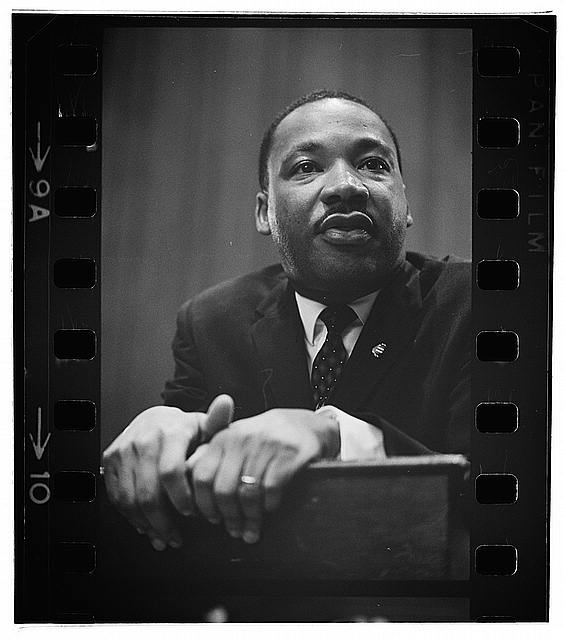
“In the end we will remember not the words of our enemies but the silence of our friends.” –Martin Luther King, Jr.
This weekend I joined hands with Down With Tyranny!to present a series of guest blogs. Following a bit of background on the creation of the King holiday by a musician, I write a little about the music in the extraordinary film, Selma, and direct listeners to the old songs that still sing out strong during the current justice movement afoot in the US.
Yesterday’s post concerns the State of San Francisco following last week’s mayoral address. Tuesday will feature an everyday story of gentrification and how it is impacting the lives of two working people here in town.
Wishing you peace and enjoyment of this day of service.
There’s a new version of the labor standard, “Which Side Are You On?” going around: Sung at the Black Lives Matter and Blackout Coalition actions, it’s also been used as the intro and outro marching song at some of the Black Brunch protests.
Malcolm X was a freedom fighter And he taught us how to fight We go’n’ fight all day and night Until we get it right Which side are you on, my people? Which side are you on?
In the early ’30s when the United Mine Workers of America began to organize around Eastern Kentucky (in an effort to end practices like payment in scrip and pay docking toward rent in substandard housing) it was Florence Reece, a Kentucky miner’s daughter and wife who wrote the original lyrics to “Which Side Are You On?”. It remains a labor movement standard.
They say in Harlan County There are no neutrals there You’ll either be a union man Or a thug for J.H. Blair
Blair was the sheriff who rousted Reece’s family during the strike among Harlan County mine workers, just one of the struggles which contributed toward the region earning its nickname “Bloody Harlan County.” In the ‘70s, workers struck again and Reece reprised the song for striking miners (preserved in this clip from Barbara Kopple’s Academy Award-winning documentary, Harlan County U.S.A.).
The song’s melody is said to be based on a hymn, “Lay the Lily Low.” Some researchers believe it is the same song that forms the basis for the traditional “Jack-a-Roe,” (also known as “Jack Munro”), its best-known version performed by the Grateful Dead. But I think that somewhere in the Kentucky mountains, singers have been intoning this strange melody for hundreds of years, its deep minor tones more reminiscent of the mystic drone of a Gregorian chant than anything known to folk or gospel. Whatever its melody’s true origins, “Which Side Are You On?” was first repurposed during the Civil Rights Movement by topical singer-songwriter Len Chandler (you can hear his recorded version on the album, WNEW’S Story of Selma).
Come all you Northern liberals, Take a Klansman out to lunch But when you dine instead of whine You should serve nonviolent punch Which side are you on? Which side are you on?
Chandler told me his story, of how he came to be a topical singer in Greenwich Village, then moved on to marching with Dr. King from, Selma to Montgomery (he appears in archival footage in the new film, Selma). “I’d write a song like that and then I’d be singing it in a mass meeting that night. People would be playing and singing for forty five minutes, until you were just worn out,” he said. Fifty years later, he remains in pursuit of social justice through action and song (Chandler’s full story appears in Keep on Pushing). I learned from listening to Chandler’s songs and to his songtalk, and by studying the work of freedom singers like Odetta, Bernice Johnson and voting rights activist Fannie Lou Hamer, that group singing among activists gives people who may start the night as strangers a chance to bond. Communing over songs, we become more bound to purpose. Singing together is energizing, nourishing, and feeds the spirit; it provides strength to move forward, together as one. But group singing for justice serves a further purpose beyond what some mock as a moment to join hands and sing “Kumbaya”: In the fight for non-violence, singing has the ability to disarm.
Hamer practiced the power of song when she sang alongside Chandler and other SNCC volunteers at the mass meetings and marches, through her representation of the Mississippi Freedom Democratic Party at the 1964 Democratic Convention and on to the passage of the Voting Rights Act of 1965. Women at the forefront of workers organizing, who’ve pushed for voting and employment rights, and led the fights to end war, poverty, and racism across the planet all know well the power of song: Whether Hamer, Reece, or Ani DiFranco (who updated the song in 2012 then titled her collection of socially conscious songs, ¿Which Side Are You On?) or the Black Lives Matter and Blackout Coalition organizers, women are allied in a long and storied legacy of traditional and gospel song. With songs we have contributed to toppling apartheid in South Africa, had voting rights granted in the US, fought warlords in Liberia and begun to make corrections to the broken justice system in the USA. With songs that have traveled the road from blues to hip hop, we will continue toward freedom for all people. It’s good to hear the timeless soundtrack to justice making a comeback. Now, which side are you on?
On November 20, 1969, All Tribes of the Native Nations occupied the island of Alcatraz in the San Francisco Bay. The taking of the former state penitentiary (the one that once held down gangster Al Capone and the notorious “Birdman,” famous for escaping it) was a major awareness-raising event, illuminating the treatment and near-extinction of Native people in the US. Issues like land theft and other deceptions served to Americans were in process of being clarified for all of us by members of the Native Nations: the Indians had longer-term plans to establish a culture center on the Rock, but federal authorities ultimately ended the peaceful occupation—with force—after a 19-month stand. Today, the former prison operates as a museum; it is presently hosting an art installation of work by renowned Chinese artist Ai Weiwei, with reference to the island’s Native American protest past)
Among those who heard the call to gather in 1969 was John Trudell (Santee Sioux) who served as a broadcaster, the Voice of Alcatraz. Radio Free Alcatraz reached the airwaves daily via KPFA in Berkeley and KPFK in Los Angeles (the Pacifica radio network). “He is extremely eloquent, therefore extremely dangerous,” says the note in Trudell’s FBI file. In 1979, Trudell lost his wife, his three children and his mother-in-law in a mysterious house fire. The event was a turning point toward his life as a poet, musician and actor; miraculously his spirit remains outspoken and free.
Deborah Iyall (Cowlitz) was just a teenager at the time of the occupation: She ran away from her childhood home (with her mother’s blessing) to join the protestors on Alcatraz. “I remember a song this woman Oona taught me at the powwow… I felt like I had these little nuggets and culture to hang on to.” Iyall remained on the Rock for a few foggy and cold nights before returning home, but her introduction to a creative Native person helped shape her own identity as a professional visual artist, poet and musician (Iyall recorded and toured as the frontwoman of Romeo Void and remains a solo artist. Read more on the lives of Debora Iyall, the work of John Trudell, Buffy Sainte-Marie and other artists inspired by the American Indian Movement in Keep on Pushing).
The anniversary of the Alcatraz occupation, the annual sunrise Thanksgiving Day ceremony there, the team sports protests and the ongoing violation of Indian lands made it an Indian news-filled week here in Nor Cal, but then, here in the US, everyday is an opportunity to remember what the Indian people sacrificed for US and to say thank you for their land which the rest of us occupy.
Thanks to Mary Jean Robertson—host of Voices of the Native Nation, broadcasting every second, third, and fourth Wednesday of the month on KPOO—for bringing the news to Natives and their allies. Last night she played the above clip by Redbone, released in 1970 at the height of the occupation, with footage collected from more recent sunrise ceremonies.
Today’s first-ever Howard Zinn Bookfair convenes at San Francisco’s historic Mission High School with a list of right-on authors as long as your arm so you’re going to have to check the program to believe your eyes. Organized by author James Tracy who also founded the San Francisco Community Land Trust, the day is jam–packed with discussion and presentations concerning the people’s history—past, present and future—and is free to the public. I’ll be leading the discussion titled Supporting Our Bookstores in a Time of Gentrification from 1:30-2:30 PM in the James Baldwin Room, and will be joined by Karen and Gregory Johnson of Marcus Books San Francisco and Kate Rosenberger of the Mission District’s Dog Eared and Alley Cat Books. We hope to see the room filled with bookstore workers and supporters as we imagine ways in which our City’s bookstores can work cooperatively and reach out to each other more in what was a record-breaking year of small business closures in San Francisco.
As the day-long celebration of our stories transitions into the evening, there will be an arts and awards ceremony: I’m pleased to say, Marcus Books will be making an announcement about the store’s future and will be receiving a lifetime achievement award for their service to the people of San Francisco and beyond it. Read my coverage on the current state of San Francisco’s bookstores at 48 Hills, and I’ll see you at the people’s bookfair.
Bob Neuwirth is one of those characters from the secret history of rock ‘n’ roll; if you know, you know. In 2011, on the occasion of a retrospective of his paintings showing in LA, I seized a rare opportunity to interview him for Crawdaddy! and got a few words on the state of 21st Century music and art.
Update: Neuwirth died on May 18, 2022. With deepest condolences to his partner, his family and many friends, I’m reposting this brief in his memory.
“I think it was Matisse who said artists should have their tongues cut out,” says Bob Neuwirth. As a visual artist and songwriter, his large abstract canvases are rarely shown, but enjoyed by collectors privately, while his solo singer-songwriter albums Back to the Front and 99 Monkeys are appreciated by connoisseurs of the form.
A great teller of tales, as opposed to a tale-teller, Neuwirth has remained largely in the shadows since his ’60s and ’70s associations at the epicenter of music and culture, but through the years, he’s played a unique role in the lives of his fellows: He’s served as an ear and inspirer to friends in the arts for five decades. Often the a catalyst to epic songs, he lived the moments we read about in history books.
“Art is everywhere,” explains Neuwirth. “Though it takes a different set of eyes to recognize it. If it’s music, it’s a different set of ears…Just because something is reproduced in multiples doesn’t make it good,” he says. “Turn on the radio. What you hear on the radio is for people who aren’t really listening.”
Sometimes what Neuwirth is rapping sounds as cryptic as a zen koan, though he’s earned a right to wax on as one who actually pulled-off the great American hat trick of living a rich artist’s life while remaining under the radar of mass success. An original hipster—back when it was still cool to be cool—his tales of beatnik glory took him from Boston’s Back Bay, hanging out with folk guitarist Sandy Bull, to checking into art school (“but not for long,” as he sings in his semi-autobiographical song, “Akron,” the rubber city from which he ran). From Boston it was on to busking in Paris with Ramblin’ Jack Elliott; from there, to Berkeley where he developed his abstract-expressionist painting and tried winging it as a folksinger who “couldn’t sing and couldn’t play,” he says.
In his time, he was insulted by Lenny Bruce, kissed on the mouth by Miles Davis, and invited to meet the Beatles while on tour with Bob Dylan in England, a trip he took in exchange for art supplies.
“He said I’ll give you a leather jacket and all the canvas you can paint on,” remembers Neuwirth of the deal with Dylan. The resulting tour was documented in D.A. Pennebaker’s milestone rock documentaries, Don’t Look Back and the follow-up, Eat the Document, which Neuwirth also had a hand in technically assisting. He remained a confidante of Dylan’s (he was there when they switched on the electricity at Newport, and was also invited on board the Rolling Thunder Revue). He’s been a compadre to Kris Kristofferson, a friend to Janis Joplin (he co-wrote “Mercedes Benz”), a companion to Jim Morrison and a filmmaker for the Doors.
In the ’70s Neuwirth moved on to pre-punk New York and the Max’s Kansas City scene, a legendary hanging place for visual artists. He brought in songwriters like Willie Nelson and Waylon Jennings (who weren’t as well-appreciated in that period as they are now), and contributed to the club’s culture while making music and gathering more fuel for his great untold stories of rock’n’roll.
“Then the New York Dolls showed up, and that was pretty much it,” he says of the temporary displacement of folk-inspired, singer-songwriters from Manhattan. And yet, Neuwirth had a direct hand in the changing of the guard when he advised one of the club’s regulars, Patti Smith, to turn her poems into songs: “Next time I see you I want a song out of you,” is how Smith remembered his encouragement in her autobiography, Just Kids.
Going on to collaborate with John Cale on The Last Day on Earth, a prescient musical theater piece concerning the apocalypse, and working on projects that took him from Cuba (Havana Midnight) to Appalachia (Down From the Mountain), Neuwirth remained in the orbit of collaboration with musicians and artists of all stripes. There are plenty more stories where these came from, though between his brushes with greatness, Neuwirth stayed devoted to his own art, attempting to collage and paint his masterpiece. Bumping around from studio to studio, he lived in a loft (“rat-infested,” by his description) formerly occupied by jazzman Eric Dolphy. By then, New York and the art scene had changed. The roads for struggling artists to take had gradually began to close down and the art and music inspired by the ideas that emerged in the ‘60s and ‘70s were subsumed into a new age of mass consumerism. Could Neuwirth imagine the culture returning to a time when artists and musicians held as much influence as 15 minutes of Internet fame do today?
“In the 21st Century, everyone thinks they’re an artist,” he says, “But trying to do anything good is harder than it looks. There’s lots of good around but that doesn’t make it excellent and it doesn’t make it art. Someone actually just said to me that they thought banking was an art,” he says.
So where does one find art in the culture today?
“If people want art, they have to look for art,” he says. “There are plenty of musicians with things to say. There’s plenty of jazz…classical….there are really good paintings around—maybe not for sale. ”
“There’s something to be said for beauty being in the eye of the beholder,” he says, staking his claim. “Bad art is better than good bombs.”
“I and I vibration is positive (got to have a good vibe),” sang Bob Marley. Nesta Marley was born on February 6, 1946 in the Nine Mile village of St. Ann’s Parish, to a black mother and a white father. Shuttling between two worlds, two homes, Marley translated a fractured urban/rural experience into a music with an alarmingly positive vibration that also sent a message. Born from an expression of outrage at injustice and frustration at western societal values, Marley’s sound was as unique as it was soulful and universal; today, his image serves as an international symbol of peace and liberation. There were of course detractors—people who found fault with Marley’s brand of “Rastaman vibration”, his strength and his convictions. “Government sometimes maybe don’t like what we have to say,” he once said. “Because what we have to say too plain”, while non-believers had little patience for what they heard as platitudinous refrains, along the lines of “Every little thing gonna be alright ” from the song, “Three Little Birds.”
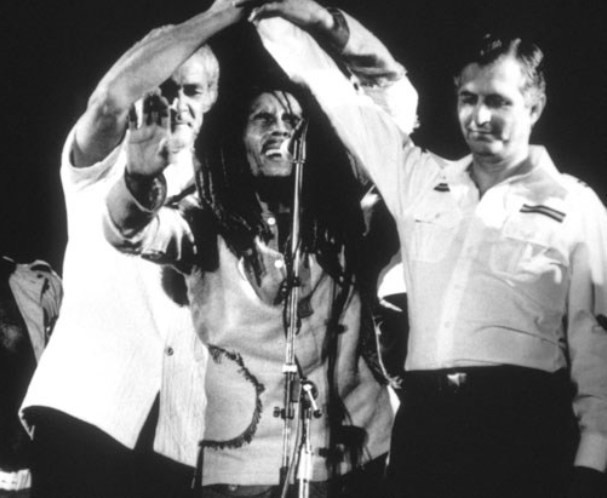
Doom-saying, despair, negativity and futility were not in Marley’s repertoire: “Why not help one another on the way? Make things much easier,” he sang. He also backed up the message in the music with action, as in 1978, when he was called out of exile by Jamaican authorities and asked to return home to Kingston, to join the effort to help quell escalating violence there. At the One Love Peace concert, Marley called opposing party leaders Michael Manley and Edward Seaga to the stage and raised their hands in a show of unity.
Taking his cues from the messaging in the records of Curtis Mayfield and the Impressions, the teachings of Black Nationalist Marcus Garvey (a Rastafari prophet), and with devotion to Ethiopian emperor Haile Selassie whom he believed to be the incarnation of Jah or God, Marley, alongside Bunny Livingston and Peter Tosh, brought reggae music to the world as the Wailers. Their songs provided not only temporary relief from fear, loneliness, isolation and other human conditions, they were also stepping stones toward solutions to world war, poverty, famine, and all forms of human rights violations. A short life with maximum impact, Bob Marley died of cancer in 1981 at the age of 36; his eulogy was delivered by Prime Minster Seaga.
The folksinger, activist, songcatcher, banjo-picker, environmentalist, family man and non-violent resistor Pete Seeger was inspiration and forbear to any man or woman who uses their songs for economic and social justice—and doesn’t ever stop. Persecuted for his beliefs by federal law enforcement, the House Un-American Activities Committee and the public, he pressed on to become the greatest singing activist of our time. “These days my purpose is in trying to get people to realize that there may be no human race by the end of the century unless we find ways to talk to people we deeply disagree with,” Seeger told his biographer Alec Wilkinson, author of The Protest Singer. “Whether we cooperate from love or tolerance, it doesn’t much matter, but we must treat each other nonviolently.” Seeger will be an irreplaceable force on the protest scene, not only for his songs and actions, but for his pure belief in the promise that we shall overcome someday.
In one of those weird, under-reported facts, the origin of the third Monday in January when all 50 states are set to observe the birth of Dr. Martin Luther King, Jr. (January 15, 1929) is not widely acknowledged, but it is in fact a musician we may largely thank for the creation of a federal holiday in the name of MLK. Back in 1980, Stevie Wonder wrote his pointed song “Happy Birthday,” then launched a 41-city U.S. tour (and invited Gil Scott- Heron along) to promote an idea first mooted by Rep. John Conyers in 1968. The city to city tour was ultimately the key in collecting the millions of citizen signatures which had a direct impact on Congress passing the law signed by President Ronald Reagan in 1983, declaring the day for MLK. Of course it took some more years, more activist effort, more songs, and more applied pressure for the idea to catch on and the day to become a reality.
“Happy Birthday,” which served as the Wonder-campaign theme (and is now the “official” King holiday tune) is the last track on Wonder’s Hotter Than July album which also features “Master Blaster,” his tribute to Bob Marley. The reggae giant was also scheduled for the tour until he fell too ill to participate. Stepping into the breach was Scott-Heron whose 2011, post-humously published memoir, The Last Holiday, details his own journey with music and activism; he retraces the long and winding road Wonder took to bring home a US federal holiday with the help of a song. In a a strictly horrific twist of fate, the tour brought Gil and Stevie to Oakland, California, where they were playing in the name of King (as did Rodney Franklin and Carlos Santana) on the night John Lennon was assassinated. The story of the evening is better read in Scott-Heron’s book, though here’s a clip of Wonder delivering the news to the assembled crowd, back in the time before we carried our own tracking devices.
Observed for the first time in 1986, some states were late to the party, however, by the turn of the 21st Century, all were united in some form of remembrance. On Monday January 20, cities all across the country will attempt to honor Dr. King’s dream the best they can, given our nation’s state of economic and moral poverty. In King’s birthplace of Atlanta, Georgia, the King Center, has a full weekend schedule of events culminating on Monday (the King Center’s events are dedicated to discussing and teaching non-violence). In San Francisco on January 20, there is an all-day celebration of King’s life, its theme Now is the Time, at Yerba Buena Center for the Arts from 11 a.m. — 5 p.m. Among the events scheduled are author readings sponsored by Marcus Books, America’s oldest black-owned bookstore engaged in a final push to preserve culture and community in the City’s historic Fillmore District. San Francisco is generally struggling with displacement of its African American population, as well as other issues related to the City’s techsploitation of housing and services. City of Santa Monica hosts Southern California’s largest King Day event; this year’s theme is Unity in the Community. I am permanently dumfounded by the American shame that is Skid Row LA: Just spitting distance from the unfathomable displays of wealth that define Beverly Hills, Hollywood and the Westside, human life and dignity are compromised there everyday.
Much like Dr. King’s vision, justice and equality in our democracy remain very much a dream. But wherever we go, whatever we do that day, let us not only continue to dream of love and peace, but to take an action toward eradicating poverty, eliminating racial injustice, and loving our fellows, in the name of MLK.
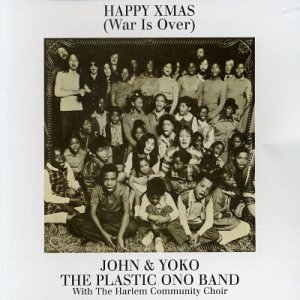
Sometime in New York City, 1971, John Lennon and Yoko Ono came up with a Christmas song for the ages, its subject peace on earth during wartime, its melody extraordinarily similar to “Stewball,” a hoary folk song about a racehorse. Behind its veil of bluegrass, “Stewball” has deep roots plus class and race resonances (if you’ve got the time to delve into these matters, there’s more where this came from, including clips and further linkage), but only a tangential connection to the “Happy Xmas” song.
In his final major interview, Lennon explained, “‘Happy Christmas’ Yoko and I wrote together. It says, ‘War is over if you want it.’ It was still that same message—the idea that we’re just as responsible as the man who pushes the button. As long as people imagine that, somebody’s doing it to them and they have no control, then they have no control.” Lennon and Ono had used the slogan “War Is Over! (If You Want It)” in their 1969 billboard campaign that sold peace to the people just as aggressively as consumer goods and war were promoted in the public sphere.
Recorded in October at the Record Plant and assisted by producer Phil Spector, the Plastic Ono Band (who for this session included Jim Keltner, Nicky Hopkins, and Hugh McCracken) were joined by the children of the Harlem Community Choir (they sing, “War is over if you want it”). The single was released in the US on December 6th and held until the following November of 1972 for release in the UK.
Spector’s influence is clearly a presence on the track—you can hear his signature claustrophobic effects, similar to those on the Paris Sisters’ “I Love How You Love Me” and the Teddy Bears’ “To Know Him Is to Love Him.” But there is another ghost of rock and roll past in the room: The song borrows the feeling and the melody of “Pledging My Love” by Johnny Ace, a well- known Lennon favorite.
As for the slogan War is Over, the Doors had previously used it in their 1968 anti-war song, “Unknown Solider” as had W.S. Merwin in his anti-Vietnam poem, “When the War Is Over,” published in 1967. “Happy Xmas” bears traces of all the aforementioned melodies and influences, in addition to their somber moods, along with the note-for-note cadence of “Stewball.” Opening with a whisper to their children from whom they were estranged at the time (“Happy Christmas Kyoko, Happy Christmas Julian”), the lyrics open with a rather pointed question (“And so this is Christmas, and what have you done?”) and wishes for a better world to follow. All is forgiven by the final uplift.
As most readers know, Spector is currently serving time in a California state prison for using a firearm to murder Lana Clarkson. Legend has it Johnny Ace shot himself by accident, and the persecution of peacenik Lennon as well as his end have been well-documented. Ono continues to work for peace and against gun violence. The song “Happy Xmas (War Is Over)” itself has inspired many covers, none of them worth mentioning, and at least one (Billy Bob Thornton) worth calling out as being unmentionable. The only version worth a bleep I’ve ever heard is the original: It just might be the best rock’n’roll song to capture the spirit of Christmas. Though if, by now you are seeking something a bit cheerier to spin, I wouldn’t blame you, so I’ve included a clip of “Run Rudolph Run” by Chuck Berry—original rock’n’roller and another Lennon-inspirer. Merry Christmas Everybody, and God Bless Us, Everyone.

 “In the end we will remember not the words of our enemies but the silence of our friends.” –Martin Luther King, Jr.




 Denise Sullivan