Sixty two years ago today, when Bob Dylan, Joan Baez and Len Chandler gathered onstage to sing “Keep Your Eyes on the Prize,” at the March on Washington for Jobs and Freedom, conditions world and nationwide were less than ideal and in many cases grim. And yet, the mass gathering of people of all ages, ethnicities, and beliefs, the speech by Dr. King, and all that singing of freedom songs, delivered a sense of hope that the world could mend and change.
Baez has continued to sing for liberation causes. Though she’s announced her retirement, she shows up to Bay Area protests and events to lend her voice, from the stage and from the crowd. Dylan isn’t so much a protest singer anymore as something more: A Nobel laureate. Chandler died an activist and freedom singer, on this day in 2023. He used his voice to raise money for progressive candidates and causes until the end.
In today’s top news in protest music, last night, Neil Young performed a new song, “Big Crime,” live for the first time with his band, the Chrome Hearts. Young has been very much on the front line of street protest this time around and uses his voice as a performer to fight fascism. He has particularly waged a fight against his music being used for commercial ventures and especially preventing it from being co-opted by the right.
Fifty five years ago, following the massacre of four unarmed students by Ohio’s National Guard at Kent State University on May 4, Young famously wrote “Ohio,” recorded by Crosby, Stills, Nash & Young. Young has of course made some missteps in his political action though for the most part, he has been on the people’s side, in favor of environmental wellness, human rights and against wars.
On the heels of the life-changing events at Kent State, Devo — first a concept, then a band — formed. With a point of view, something to say, Devo attempted not to lose sight of what it meant to remind us: that humankind has been heading in the wrong direction for some time and the devolution we were warned about is upon us (A new documentary on the group tells that story very well). That members of Devo were also present on that day at Kent State and collaborators with Young was no coincidence: They are artists interested in bringing the news.
That both styles of music, the old guard and the new, reached me at the right time of life, as a young person seeking answers through songs, makes me a lucky listener. I’m always listening for messages in songs, as well as appreciating music for the sheer joy and beauty it brings into the mixed bag of life. Throughout the ’80s, ‘90s and ’00s, there was plenty to protest and music from which to choose, from Dylan, Young, Devo and countless others: Punk resisted right-wingism and racism and so did hip hop. Public Enemy’s Chuck D rightly nailed it when he noted rap and hip hop were broadcasting the news from Black America. The long history of resistance music spans the globe and will not be silenced. It’s just that sometimes, the noise of the news is so loud, it’s harder to hear the music. Once in awhile, a song or video cuts through (insert your favorite here).
From 2007-2011 I worked on a book about the different strands of resistance music and how the form was faring at the turn of the 21st Century. It seemed to me to be a latent period for American protest movement and music. But then, the revival: Occupy Wall Street and Black Lives Matter put organizing and the music that goes with it, back into the public consciousness. You might even say the movements were a wake-up call after a long slumber that included the invasion of Iraq, the bail out of the banks and an increased awareness of police brutality because of phones and social media broadcasting the horrors. That’s a pretty offhand, incomplete characterization of those years, but if you’re reading this, you have a general idea of what I’m talking about, even if I don’t…
Yet this is to say: This is why we don’t stop. This is what is meant by keeping one’s eyes on the prize. This is why I am writing this today, on the anniversary of the March and on the day after Young debuted a new protest song. We are no longer on the precipice…we are immersed. The need for protest and the music that goes with it in this country has never gone away. There have been and always will be artists like Tom Morello and M.I.A. and Chris Pierce and Jesse Wells and Carsie Blanton, out there getting the job done. When a new song drops in the heat of a moment, by an artist old or young or in the middle, I’m always pleased to hear it, as a fan of music with a desire for change. It’s a chance to pause and say thanks to everyone who is unafraid to take a stand. Today, it’s thanks to Neil, for staying in the game. As a song, “Big Crime” is unlikely to change the world or become an anthem, but then, again, we don’t know what will. We simply have to believe in a more hopeful future and be willing to work toward it.
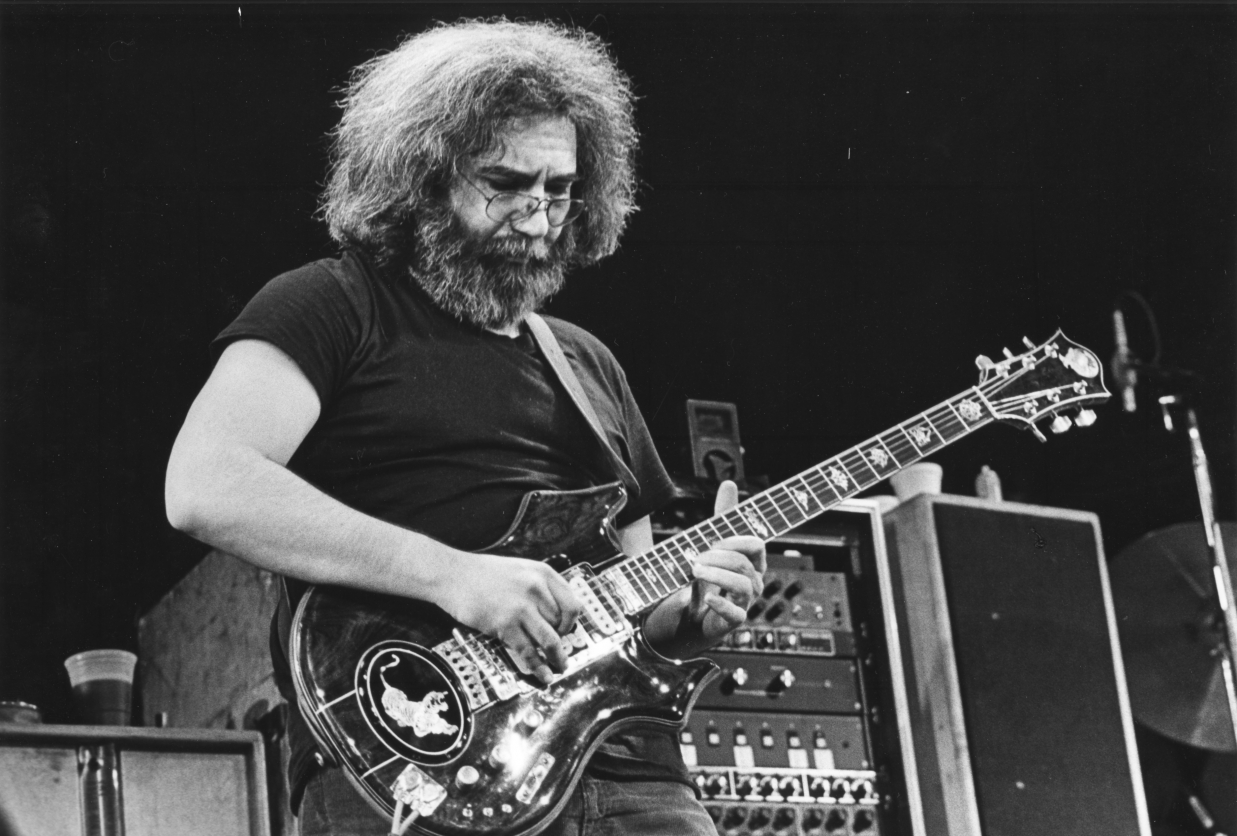
Back in the Paleolithic era, I worked as front desk receptionist for concert promoter Bill Graham and had several encounters with members of the Grateful Dead family. Not that I knew who they were at the time: it was a big part of my identity as a modern music lover to not know, though I’ve come around to their sound and specifically to Jerry Garcia.
For the sake of a prequel and partial sequel to the business at hand, I accidentally experienced the Dead at a Day on the Green concert in 1976 when they co-headlined with The Who. At the time I didn’t know or care that the big events staged at Oakland’s stadium would became a kind of testing ground for the full scale festival tours we know today. It didn’t help I didn’t know “Scarlett Begonias” from “China Cat Sunflower” or to that to my unformed mind, experiencing the Dead was just a three hour endurance test before the Who hit the stage. I was not transformed, my consciousness was not altered by their music, as some members of the band and the people who love them claim, though today, I quite like most all of Garcia’s and lyricist Robert Hunter’s material. I like to think I have grown into it.
But even back when, I knew Jerry was Jerry, and later in my role as receptionist, I certainly knew enough about receiving office visitors that I was not to waylay people of his renown at the entrance with formalities like announcing their arrival. In the flash it took me to recognize a musician, he could walk past me, nod, and in Jerry’s case, with his cherubic smile, head bowed and hands jammed in his pockets, proceed without pause, into the open main office, then in the direction of Bill’s corner sanctum. Same went for Carlos. Santana. He and Jerry were of course legends by then, their reputations enshrined thanks to their inimitable, celestial guitar styles. I was less generous about their music then, but showed respect anyway: These were people born in the same decade as my parents. Then again, I can’t claim to have displayed anything resembling even courtesy the day an even older man dressed in a fur loin cloth and carrying a walking stick announced his arrival.
“Bear for Bill.” “Excuse me?” I couldn’t hide my contempt, buzzing over the line to Bill’s assistant. “Someone named Bear is here for Bill?” “Send him in.” The shock registered on my face compelled a co-worker witnessing the scene to whisper my way. “Bear is Owsley.” “And?” “He invented acid.” I get it now.
On another day, Mountain Girl announced herself. My lack of exposure to hippie culture was pitiable and the name drew a complete blank. I said something like, “Say what now?” I feel sorry for being just one more person to judge Carolyn Garcia based on her chosen name and hope she can forgive me. Perhaps we might even agree that Jerry would be “rolling in his grave” in connection with some of events of the last few weeks celebrating the 60th anniversary of the formation of the Grateful Dead.
Thirty years ago, on August 9, 1995, Jerry Garcia died. His diabetes raged, his heart gave out and his body failed him while detoxing from a lifetime of drug dependence. A few days later, his life was celebrated with a public memorial concert in Golden Gate Park. By that time, the Dead had been doing big business for some time, thanks to constant touring and their first top 40 hit, “A Touch of Gray.” Never mind then that Garcia’s health was down and his addictions were up: The show must go on as the Dead’s touring, merch and ticket sales were doing the kind of big boring business the music industry represents today.
The bands formed in Jerry’s wake include The Other Ones, The Dead, Further, Ratdog, Phil Lesh & Friends and the Rhythm Devils (there are more). But the extreme monetization of all things rock ’n’ roll, psychedelic and Dead had been well under way for several decades. The Grateful Dead as corporation was just another aspect of its long strangely quirky and contradictory trip.
Beginning in 2015, Dead members Bob Weir and Mickey Hart began billing themselves Dead & Company; by 2023, they played to bid goodbye to touring with their Fare Thee Well shows. Those dates, according to published accounts in music industry trade magazines and other media outlets, grossed $114.7 million over 28 shows, though they were hardly the end. In 2024, Weir, Hart and an amalgamation of musicians played a 30 show stand at the Sphere in Las Vegas and earned $130 million that year as Dead & Company. This year’s Dead & Company returned from the dead, again, for 18 shows at the Sphere and three in Golden Gate Park to mark the 60th anniversary of the formation of the Grateful Dead and 30 years since Jerry’s passing. The tour receipts for this year have not yet been published, though some fiscal facts are known.
Tickets for the Golden Gate Park weekend ranged from $600 for three days and went up to $7k for the VIP Package. The concerts brought $150 million to the city’s economy, $7 million into the Parks and Recreation Dept. according to local media, and some untold sum for promoter, Another Planet Entertainment, not to mention the band, its agents, managers and other profiteers. I don’t know much about the Grateful Dead but I’ve read the books and can tell you that profit was not a big motivator when the band was founded. Money and possessions were seemingly of little interest to Garcia.
To say it another way, Dead & Company do not embody the spirit of the Dead and its commitment to alternatives to commercialism and mainstream culture. That is if there is such a thing as a spirit of a band: In the Dead’s case, that bird has definitely flown. I can say more, much more, but won’t now except: In 1996 I spent six weeks on the road with the Further festival. It was unpleasant to say the least and I survived it by immersing myself in nightly sets by Los Lobos, a band I am certain has a spirit because I can feel it.
And yet, there are still some traces of Jerry’s spirit around if you are looking for it in the city that raised him. Whether its the makeshift shrines in the Haight, stenciled Jerry bears on sidewalks around town, or the annual Jerry Day free concert at McLaren Park, I could swear some days, especially in August which marks his birth and death, he hovers.
Jerry Day was established in 2003 to celebrate the Excelsior District’s most famous son; this year a street there was named for him. But the future of Jerry Day is imperiled due to “lack of funding” and city support. How could this be in a city of 80 billionaires? How could this be in a city whose mayor is worth millions made from the profits of Levi Strauss, the jeans favored by hippies and punks and everyone else, you may ask and I will answer: We are a city that creates and then commodifies everything: From rock ’n’ roll, psychedelics, and cannabis, to the Grateful Dead, to mention but a fraction of what comes from Northern California. We even have a Counterculture Museum to keep the idea of an underground in place.
No, I don’t blame the latest generation who want to partake in their own rituals or a virtual tribal love rock musical: It’s the cost to play the game I can’t relate to. There’s also the carbon in/carbon out trucking and busing of staging and sound equipment on public park grounds, our much-needed oasis in a largely concrete residential neighborhood that’s hard to get your head around.
Jerry loved Golden Gate Park. It’s east to west world map of flora and fauna literally inspired his guitar playing. But following the three dates of Dead & Company there, the three-day Outside Lands festival and last week’s straight vanilla “alt-country” event, the concerts have trampled the landscape and turned the largely working class, Democratic voting blocks of the outer Richmond and outer Sunset neighborhoods into a parking lot. And we did nothing to prevent it. Oh sure, we voted to make the Great Highway a park, but we got very little in return for that either.
The highway, its nearby grid of avenues, and the park itself, were built on sand dunes. They were not designed with an in and out flow of 60,000 non-residents a day in mind. These neighborhoods of families, people with disabilities, seniors and people of all ages who speak more languages than in any other area of the city are boxed in. Many of us are in the work force and use the roads to travel to and from our jobs. There are hospitals and other services that bookend the park and people need access. And then there is the wildlife that has been displaced for a month by top volumes, distracting spotlights, and cyclone fencing not to mention the human footprints marring their paths home.
Jerry used the park himself to find peace and quiet: That’s where he was found one morning in his car in 1985 with a shit ton of drugs on him and in him (in 2025, concert goers in the park enjoy the brain freezing drug of nitrous oxide). Communing with nature takes many forms but the combination of numbing out in these times seems less like a tribute and more like a cop-out.
Granted, my distress is not about the disruption outside my window but is intertwined with the upheavals worldwide. If you’re reading this, you wake up screaming in some form or another, whether about detainment, displacement, about the genocides, dictatorships, rolled back rights and the current incompetence at most levels of leadership [release the files]. And yet these cries are signs of our human connection, our consciousness, the kind once encouraged by the Dead or psychedelics or a combination of the two.
Even though now it seems like no one is listening, those of us who are awake and alive are the miracles we are seeking. The shakedown, whether in the park, at the Dead & Company HQ or on the national stage is just another version of life in all its stages: good, bad, ugly and beautiful. So I keep doing what I do. Live my life accordingly. Sometimes I ask myself, what would Jerry do? And while I choose not to check out, I can’t deny we’re living in a blast furnace. Yet I see no choice but to play it through, and just keep truckin’ on.
“I will never forget the image nor the smell of death,” are the words of Jack Dairiki, survivor of the attack on Hiroshima on August 6, 1945. In my long career as a reporter, I will never forget the opportunity I had to speak to Dairiki at the San Francisco home he shares with his wife Jun. There, he told me his life story as an American, detained in Japan when war broke out. He spoke of his eventual return to the Bay Area, of his attendance at Cal and his enrollment in a free drawing class. “This is what came out,” he said, holding his depiction of a mushroom cloud. In 2024, Nihon Hidankyo, the Japanese confederation of organizations recognizing A and H-Bomb sufferers, also known as the, hibakusha/survivors, was awarded the Nobel Peace Prize. Since the bombings, Dairiki has worked for peace in our time. It is with great appreciation and thanks to Karen Kai and the Dairikis that I once again offer this remembrance of all who perished from the blasts and live with the trauma of being forced into US concentration camps The full interview with atomic bomb survivor Jack Dairiki is available at this link. Thanks for remembering.
(photo by Kevin Hume)
Jack Dairiki, a Japanese-American who survived the atomic bombing of Hiroshima at age 14, holds a framed drawing of his memory of the explosive atomic mushroom cloud that he made in 1950 at his senior living apartment on the edge of Japantown on Monday, Jan. 28, 2019. (Kevin N. Hume/S.F. Examiner)
Allen Ginsberg claimed he wept when he heard it for the first time.
Folksinger Len Chandler started to play it when the words and music were first published in Sing Out!, the folk song magazine, at the end of 1962. Patti Smith performed the song when Bob Dylan received the Nobel Prize in Literature in 2016.
Among the timeless songs he wrote in his early period, Dylan characterizes “A Hard Rain’s A-Gonna Fall” and others as “all one long funeral song.”
And while it was not specifically written to confront nuclear winter, Kronos Quartet and the Hard Rain Collective released two versions of “Hard Rain” last week, to commemorate 80 years since the first atomic bomb was detonated as a test on July 16 in Alamogordo, New Mexico.
A second drop, “Hard Rain (Drone)” — as in the style of music — is a spoken word version. The collective recordings include voicings by Laurie Anderson, Ocean Vuong, Charlotte Gainsbourg, Satomi Matsuzaki, Willie Nelson, Iggy Pop, Asha Boshle and many more. Terry Riley’s raga, “Komal Reshab Asavari” is central to the theme (read more about the project and other songs devoted to world health and the biosphere at Redhot).
“You know, it’s remarkable that a 21-year-old singer-songwriter wrote this song in 1962 and how — when you observe and know the words of this song very clearly, how important it is to our time right now,” Kronos founder David Harrington told Democracy Now.
Harrington was joined on the program by physicist Daniel Holz, chair of the Science and Security Board of the Bulletin of the Atomic Scientists and one of the organizers of the assembly which gathered Nobel laureates and nuclear experts to raise awareness of the growing (yes, growing) risk of nuclear war, particularly against a backdrop of climate change.
“…The likelihood that we’ll sort of stumble into a nuclear war and the end of civilization … has gone way up… We’re bringing together Nobel laureates and nuclear experts and trying to find a way forward, a way to reduce the risk, get the messages out to the public and also to leaders that here are steps that can be taken to reduce this. We need to get the awareness back, and we need to do everything we can to prevent the sort of nuclear annihilation that would impact literally everyone on the planet,” said Holz.
It’s understandable if you missed the 80 year commemoration of the Trinity test, given the week that was. But there is still time to prepare for a suitable remembrance of August 6 and 9: It’s been 80 years since bombs were dropped on Hiroshima and Nagasaki. There are very few survivors, or hibakusha, as they are known, left to speak about the horrors of the A-bomb. In 2019, I spoke to one — an American citizen detained at age 14 in Japan while visiting relatives when World War II broke out.
Today, the planet – not just the region impacted – but the entire planet will simply not survive a nuclear explosion. The sun will not sun. Famine will ensue. The past is our future. War is still unhealthy for children and other living things. Please contact your representatives and support candidates accordingly.
April 18 marked the beginning of Beat poet Bob Kaufman’s centennial year, and San Francisco celebrated with three days of poetry, film and talks about the often overlooked but finally fully recognized artist. From about 1958-1986, he wrote poetry and made his home in the North Beach and Mission districts of San Francisco. He was a forceful presence on the scene, even as he had taken a vow of silence against the Vietnam War.
“He’s the quintessential representation of a San Francisco poet,” said San Francisco poet, Josiah Luis Alderete. In France, he was dubbed “The Black Rimbaud.”
For some time, it was hard to come by Kaufman’s slim volumes of poetry, but in 2019, City Lights Books published his first-ever collected works, with a forward by devorah major and edited by Neeli Cherkovski, Raymond Foye, and Tate Swindell. I wrote a long piece about him and his influence on modern day poets for the San Francisco Chronicle with more detail on his background and his surrealist’s eye.
A hundred years since he came into this world and nearly 40 since he left it, Kaufman’s poems against racism, injustice and war are as powerful now as they were then. San Francisco poet Kim Shuck said, “Bob Kaufman was so far and away the best…”
When Chris Pierce performs his somber take on “Southern Man” on Heart of Gold: The Songs of Neil Young, he brings personal experience to the line about crosses burning fast. Pierce was five-years-old when locals burned a cross on the front lawn of his family home in Pasadena, California. His parents, a mixed race couple, stayed in their residence, despite the hate crime and stood up to racism.
It was in that same spirit Pierce held his date at the Kennedy Center on March 12, in the face of the President installing himself as the cultural institution’s new chairman (he met with the board on Monday to see how he could wield influence over its annual lifetime achievement honors). Read more on Pierce’s remarks about the performance last week and watch the entire set in today’s edition of Down With Tyranny.
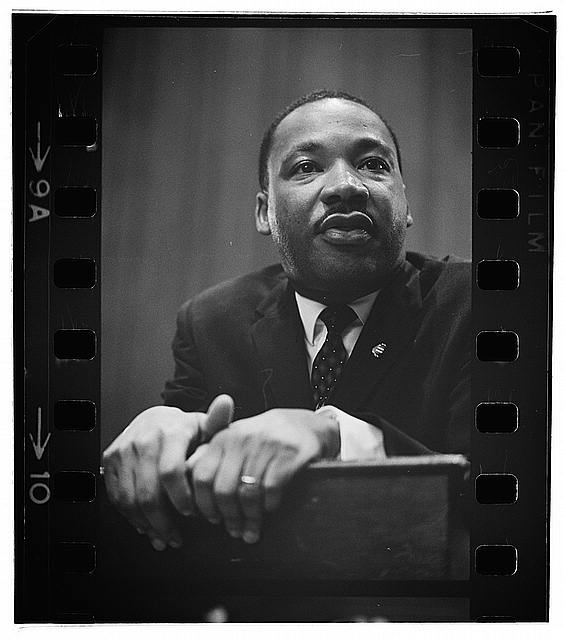
January 15 would have been the 96th birthday of Dr. Martin Luther King, Jr. born in 1929 in Atlanta, Georgia. It was a long road to the third Monday of the month when all 50 states observe the federal holiday named in his honor. Largely owed for making the dream of MLK Day a reality is Stevie Wonder: Back in 1980, he wrote the pointed song, “Happy Birthday,” then launched a 41-city U.S. tour (and invited Gil Scott-Heron along) to promote the idea which was first mooted by Rep. John Conyers in 1968. The musical efforts were ultimately the key in collecting the millions of citizen signatures that had a direct impact on Congress passing the law signed by President Ronald Reagan in 1983, declaring a day for MLK.
Observed for the first time in 1986, some states were late to participate, however, by the turn of the 21st Century, all were united in some form of remembrance of the civil rights giant. “Happy Birthday,” which served as Wonder’s King holiday campaign theme (and is now the “official” King holiday tune) is the last track on Hotter Than July. The album also features “Master Blaster,” Wonder’s tribute to Bob Marley (Marley had been scheduled for the tour until he fell too ill which was how Scott-Heron came to participate). In his memoir The Last Holiday, Scott-Heron details his own journey with music and activism, as he retraces the long and winding road Wonder took to bring home the last US federal holiday, with the help of a song.
The Hotter Than July tour brought Scott-Heron and Wonder to Oakland, where they played in the name of King, along with Rodney Franklin and Carlos Santana. In a weird turn of events, the concert on December 8, 1980, coincided with the night John Lennon was killed. The musicians and crew learned of the tragedy from a backstage television, and the job fell to Wonder, with Scott-Heron and the other musicians at his side, to deliver the shocking news to an arena of music fans.
“For the next five minutes he spoke spontaneously about his friendship with John Lennon: how they’d met, when and where, what they had enjoyed together, and what kind of man he’d felt Lennon was,” wrote Scott-Heron. “That last one was key, because it drew a line between what had happened in New York that day and what had happened on that motel balcony in Memphis, Tennessee, a dozen years before. And it drew a circle around the kind of men who stood up for both peace and change.” Scott-Heron devotes the final pages of The Last Holiday to a remembrance of how the murder of Lennon fueled the final drive to push for a federal observance of the official MLK Day.
The politics of right and wrong make everything complicated
To a generation who’s never had a leader assassinated
But suddenly it feels like ’68 and as far back as it seems
One man says “Imagine” and the other says “I have a dream” -Gil Scott-Heron
Scott-Heron was a lifelong campaigner and champion for human rights himself, beginning on his 1970 live album Small Talk at 125th and Lenox. There is no doubt he would have much to say of the unfortunate confluence of this year’s King holiday with the inauguration and the project known as 2025. The parenthetical title refrain from his song, “Alien (Hold On To Your Dreams)” (see clip below following his topical poem, “Whitey on the Moon/(Mars)”) has been spinning around in my head, alongside the words of Dr. King collected from one of his sermons from the early ’60s. Whatever confronts us today, whatever dangers real or perceived that touch our friends, families and fellow humans in these perilous times, in these words and songs may you find comfort and be inspired to act in love.
Returning hate for hate multiplies hate, adding deeper darkness to a night already devoid of stars. Darkness cannot drive out darkness; only light can do that. Hate cannot drive out hate; only love can do that. Hate multiplies hate, violence multiplies violence, and toughness multiplies toughness in a descending spiral of destruction. – MLK, Jr.
Now that it’s September and the clouds here in San Francisco have cleared, I have some news to share: A new publication – the slim volume pictured above is on a new press – and it was made not only in memory of a movement hero, but in support of voting rights for all.
The story of Len Chandler is one of a path taken by chance. Among the countless singers, students and teachers from coast to coast who sat in, stood up and rode freedom’s highway for the voting rights of their fellow Americans in the Jim Crow South, Chandler had an extraordinary knack for topical songwriting and an unwavering dedication to racial justice. From his home in Akron, to the heart of the Greenwich Village folk scene, Chandler was introduced in short order to humorist Hugh Romney aka Wavy Gravy, poets Bob Kaufman and Langston Hughes, and folksingers Dave Van Ronk and Bob Dylan. Swiftly recruited by Pete Seeger to join the singing organizers with the Student Nonviolent Coordinating Committee, he was sent to Arkansas to register voters.
“You have to take the lead from somewhere and there were only a few performers around who wrote songs, and of them, my favorite was Len Chandler,” said Dylan. Compiled from rare interviews with Chandler by the author, Denise Sullivan’s concise tribute, Shadow Dream Chaser of Rainbows, pays homage to an unsung folk hero and provides instruction and inspiration for artists and activists pushing for change in perilous times.
This project has been long in the making: It started nearly 20 years ago when I embarked on the research for Keep on Pushing. It was resurrected when I was invited by the Bob Dylan Center to contribute an essay to a proposed catalog, and it was completed with the creation of a small press, Lyon Editions. Your purchase of Len Chandler: Shadow Dream Chaser of Rainbows will not only support its makers, it will contribute toward supporting voting rights and poll watching organizers, specifically in Georgia.
Rest assured Chandler is missed this election season, but let’s vote in his memory and in the memory of Medgar Evers, Viola Liuzzo, James Chaney, Andrew Goodman, Michael Schwerner, Martin Luther King, Jr. and others who lost their lives in the name of civil rights. A vote for Kamala Harris will see to it that the John R. Lewis Voting Rights Advancement Act is passed, ending voter suppression in all its forms, once and for all.
Thank you to our friends at Bird and Beckett Books and Records for the proper launch on August 28 as we commemorated 61 years since the March on Washington for Jobs and Freedom, and one year to the day of the passing of Chandler. Full book talk and discussion here. Purchase books here. Thank you.
Back when I wrote for the music press part time and worked at a small record label where it was also my job to answer the phone, I received a call from San Quentin. Immediately a recording played, stating the call was coming from a California correctional facility, though I was surprised to learn the call was for me. Though I did not know the person, he was seeking a member of the press to write about the sudden cessation of the prison’s writing program. He said it was imperative to get the word out so that some action could be taken to preserve the incarcerated population’s right to read. I listened to the plea, said I would do what little I could, and called a reporter, a friend of mine’s sister, who worked at the San Francisco Chronicle. I think the calls came a couple of more times, but there wasn’t much I could do. To my knowledge there was never a news story about conditions at the prison or its literacy programs. At the time, I didn’t realize there wasn’t any meaningful oversight of the state prison system and that “privileges” like food, exercise and activities were withheld at random, say, if a guard took a dislike to an incarcerated individual.
During the ’80s, the Reagan administration’s War on Drugs created the conditions that led to the over-incarceration we see today, particularly of Black and Latinx individuals. Scholars, like Michelle Alexander and Angela Davis among others, contend incarceration is a racist system of control that extends outside prison walls. There is plenty documented on the subject and I invite you to read more
Today there are over 2 million people living inside America’s prisons. According to the Sentencing Project, at the time I received the call from San Quentin, there were about 40,000 people in prison at the cost of approximately 6 billion dollars annually. Today the state spends over 60 billion on incarcerating its citizens. Two new books on the subject, mostly in the words of people who have done their time, suggest that prisons are a modern day form of slavery and that we abolish the prison nation.
When I received that phone call from San Quentin some years ago, I did not know that the prison population would increase by 500 percent over the next 40 years. Surely by now, most every American knows someone whose life or family has been impacted by the carceral system.
Writing and educational programs have been restored on and off in the California system, though mostly, they are off.
Over the years, I thought about that phone call, the lack of coverage of the prison system in the media, and lack of oversight behind prison walls. I became aware of the prison industrial complex — the relationship between businesses and institutions — as well as the basic human rights violations of incarcerated individuals, and corresponding mobilization efforts, inside and out, to raise awareness of the injustices and correct the abuses.
I am still learning about how we talk about the injustices of incarceration. Hearing stories from people who have lived the horror of America’s prisons seems to offer the most hope toward solutions. I recently viewed the documentary, The Strike, and learned more about the historic California State Prison hunger strike; I listen to Prison Radio, which broadcasts the voices of incarcerated, and look forward to the compact commentaries, often prophecies from Mumia Abu-Jamal. I read the San Francisco Bay View, one of the few publications that delivers firsthand coverage from incarcerated reporters; and I have spoken to San Franciscans who do what they can, using their time and talent to care for incarcerated loved ones and strangers.
Please take a moment today to consider the over 2 million Americans incarcerated. If interested, one action you can easily take is to support the Prison Literature Project: They send books to incarcerated individuals which is not as easy as it sounds — it’s a process and they are specialists. Thanks for reading today. Songs also contain information. Thanks for listening.
Earlier this year in San Francisco, there was a live, all-star tribute to 92-year-old folksinger, Ramblin’ Jack Elliott. Making his way around the world in the ‘50s, and a friend of Woody Guthrie’s during the pivotal modern era of American folk music, the contemporary celebration of Elliott was also a benefit for Sweet Relief, the 30-year-old organization founded by Victoria Williams to assist musicians in need. Oddly, the show was mostly void of political content save for a few remarks by musical director Joe Henry, 64, and Jackson Browne, 75, nodding to Guthrie and the roots of American folk and topical song.
Showing up in Elliott’s honor were Joan Baez and Bob Weir, both 83, and Steve Earle and Rickie Lee Jones aged 69. Of course there were younger performers on the bill, but my eyes and ears weren’t trained on them as much as they were on the older adults onstage and in the house: I gleefully whispered to my husband that unusually, I was among the youngest in the room.





 Denise Sullivan